July 11, 2026
The Supercycle That Never Came: Understanding Why Capital Is Staying on the Sidelines
Energy markets have a long history of dramatic capital cycles. The post-2000 commodity boom triggered one of the most aggressive upstream spending waves in history, culminating in the 2014 to 2015 period when global oil and gas capital expenditure reached its peak. What followed was a brutal correction, with prices collapsing and investment slashed by hundreds of billions of dollars. Many in the industry assumed that once prices recovered, the spending cycle would restart. In 2026, with Brent crude trading well above $90 per barrel, that assumption has been proven wrong.
The oil and gas investment decline despite higher prices is not a temporary anomaly. It reflects a fundamental rewiring of how energy producers think about risk, returns, and the long-term durability of demand. Understanding this shift requires moving beyond price charts and into the structural mechanics of capital allocation in an era defined by uncertainty, shareholder activism, and competing energy narratives.
When big ASX news breaks, our subscribers know first
How Much Is Actually Being Spent in 2026?
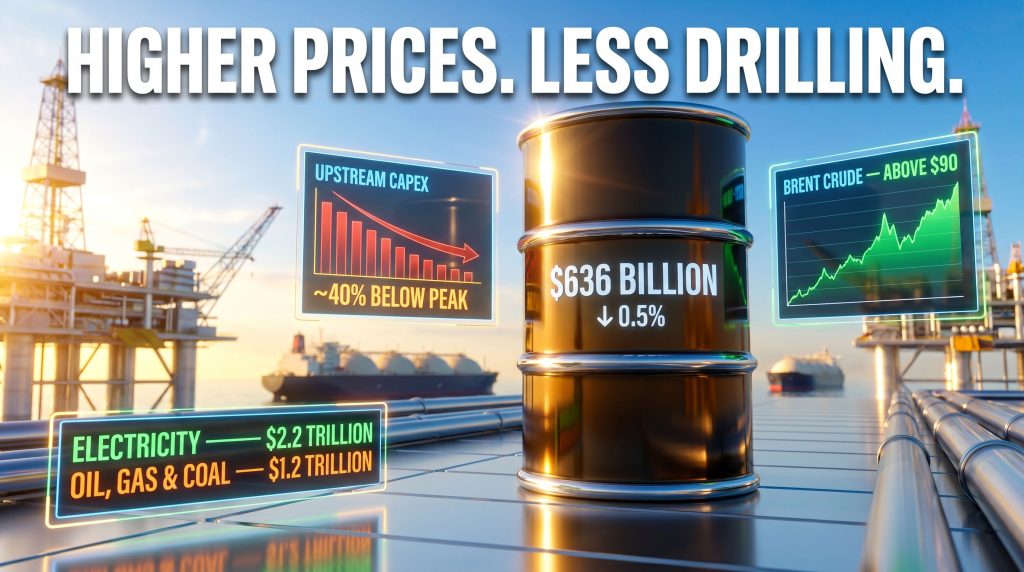
The numbers tell a clear story. According to BMI, a Fitch Solutions company, total global oil and gas capital expenditure in 2026 is forecast at approximately $636 billion, representing a decline of roughly 0.5% from 2025 levels. That modest dip may not sound dramatic, but the context makes it striking: Brent crude was averaging around $69 per barrel in 2025, and prices have moved substantially higher since. Historically, that kind of price improvement would have triggered a meaningful increase in upstream commitments. Furthermore, the oil price rally seen in recent months has done little to shift producer behaviour.
The International Energy Agency paints an even more nuanced picture when separating crude oil from natural gas investment:
| Metric | 2026 Forecast | Key Context |
|---|---|---|
| Total global oil & gas capex (BMI) | ~$636 billion | Down ~0.5% from 2025 |
| Crude oil investment alone (IEA) | Below $500 billion | Third consecutive annual decline |
| Natural gas investment (IEA) | ~$330 billion | Highest level in a decade |
| Total global energy investment (IEA) | ~$3.4 trillion | Electricity accounts for $2.2 trillion |
| Upstream spend vs. 2014-2015 peak | ~40% below peak | Sustained post-crash discipline |
| Share of upstream spend on field maintenance | ~90% | Offsetting natural production decline |
What these figures collectively reveal is an industry running at maintenance speed. Approximately 90% of upstream investment is estimated to be directed at offsetting natural decline rates at existing producing fields, leaving an extremely thin margin for net new supply growth. The IEA's field decline rates report highlights just how significant this challenge has become. The industry is, in practical terms, spending enormous sums simply to hold output steady.
Why Gas Is Attracting More Capital Than Oil Right Now
While crude oil investment records its third consecutive annual decline, natural gas is moving in the opposite direction. The IEA's forecast of approximately $330 billion in gas investment for 2026 represents the highest level in a decade, and the divergence is not accidental.
The LNG supply outlook for 2026 and beyond is a key driver of this trend. LNG infrastructure projects offer something that short-cycle oil drilling cannot: long-term demand visibility backed by multi-decade offtake contracts, particularly from Asian importers seeking supply security. Countries across Northeast and Southeast Asia are signing long-term LNG deals at a pace that gives gas project developers confidence in future revenue streams extending well beyond a typical investment horizon. That structural demand certainty makes LNG a comparatively attractive destination for capital allocators who would otherwise hesitate to commit to multi-billion dollar projects in a volatile price environment.
The Capital Discipline Era and Why It Is Not Reversing
The transformation in producer behaviour dates back to the 2014 to 2015 price crash, when the industry underwent a painful but consequential restructuring. Companies that had grown accustomed to deploying capital aggressively during the commodity boom were forced to relearn the basics of financial discipline. Leverage was reduced, portfolio quality improved, and shareholder return frameworks were rebuilt around dividend sustainability rather than production growth targets.
What makes the current environment different from every previous price recovery cycle is that producers have internalised these lessons at an institutional level. Boards and management teams now benchmark success against free cash flow generation and return on capital employed, not barrels added. The result is that even with prices well above $90 per barrel, the reinvestment rate — which measures the proportion of operating cash flow directed back into new upstream development — remains structurally lower than in previous cycles.
When producers believe elevated prices are temporary rather than structural, committing billions to multi-year upstream projects becomes a strategic liability rather than an opportunity. Long project lead times mean today's investment decision must be justified by price assumptions five to ten years forward, not today's spot price.
Dividends and share buybacks are now direct competitors to drilling budgets. Major integrated producers returned record sums to shareholders throughout 2022 and 2023 following the post-COVID price surge, and investor appetite for that capital return model has not diminished. Any management team that redirects cash from buybacks into speculative exploration faces immediate scrutiny from institutional shareholders who have grown accustomed to direct returns.
Rising financing costs compound the picture. Higher interest rates since 2022 have expanded the cost of capital for new oil and gas developments, reducing the net present value of long-dated projects and raising the price hurdle that new upstream investments must clear to achieve acceptable returns.
Five Forces Suppressing Capital Commitment in 2026
The investment hesitation is not driven by a single factor. Five distinct structural forces are operating simultaneously to keep capital on the sidelines:
-
Price signal volatility: Commodity prices are increasingly influenced by geopolitical headlines, social media commentary from political figures, and algorithmic trading sentiment rather than the physical balance between oil supply and demand. When prices can swing several dollars per barrel on a single statement or market rumour, producers cannot use today's price as a reliable proxy for the economics of a project that will produce for twenty years.
-
Geopolitical conflict exposure: Ongoing hostilities in the Middle East are causing project delays and increasing the risk premium attached to regional assets. Infrastructure exposure to conflict zones introduces non-commercial risks that standard investment models struggle to price accurately.
-
Climate policy ambiguity: Regulatory frameworks governing carbon emissions, fuel standards, and energy transitions vary enormously across major economies and continue to shift. The uncertainty this creates over long-term hydrocarbon demand introduces a terminal value risk into upstream project economics that was largely absent in previous investment cycles.
-
Supply chain and equipment constraints: Offshore rig availability and specialised equipment supply have not fully recovered to pre-2020 levels in all regions. Even where capital exists and willingness to invest is present, physical constraints limit the pace at which new development can be initiated.
-
Cost of capital divergence: The financing gap between high-carbon and low-carbon projects has widened materially. Many institutional lenders and asset managers now apply stricter lending criteria or higher risk premiums to oil and gas developments, making project-level financing more expensive and structurally harder to arrange at scale.
How Geopolitical Noise Has Displaced Fundamentals as the Price Driver
One of the more underappreciated dynamics shaping investment caution is the degree to which oil price discovery has migrated away from physical market fundamentals. Traditionally, prices reflected the interplay of production volumes, inventory levels, refinery throughput, and consumption data. That relationship has been increasingly disrupted by market volatility driven by geopolitical developments and short-term trader positioning.
For project planners working with twenty-year discounted cash flow models, this kind of short-term noise is essentially impossible to incorporate constructively. The rational response is to apply wider price scenario ranges and higher discount rates, which reduces the number of projects that clear internal investment hurdles even when spot prices appear attractive. In addition, the trade war impact on oil markets has introduced yet another layer of pricing uncertainty that producers must navigate.
Regional Divergence: Who Is Investing and Who Is Pulling Back
Investment behaviour in 2026 varies significantly by geography, reflecting different strategic priorities and financing environments across regions:
| Region | Investment Posture | Key Driver |
|---|---|---|
| North America (U.S. shale) | Active but disciplined | Shareholder return maximisation over volume growth |
| Europe (integrated majors) | Refocusing on core hydrocarbons | Low-carbon venture underperformance |
| Asia | Stable and long-term oriented | Energy security imperative |
| Sub-Saharan Africa | Constrained despite government ambitions | Investor caution and financing pressure |
Europe's Supermajors: The Transition Retreat
One of the most consequential regional shifts involves Europe's largest integrated oil and gas companies, several of which made aggressive commitments to low-carbon energy businesses over the preceding five years. Those commitments were driven by a combination of political pressure, ESG investor mandates, and optimistic projections about the financial returns available from renewable energy ventures.
The financial reality has not matched those expectations. Several European majors are now scaling back their low-carbon ventures and redirecting capital toward their core hydrocarbon operations, according to BMI's investment analysis. Importantly, this does not mean abandoning emissions reduction commitments entirely. The shift is toward reducing the carbon intensity of existing oil and gas operations rather than building parallel low-carbon businesses that have failed to generate competitive returns. Industry observers at Carbon Tracker have characterised this as a quiet but deliberate retreat from earlier transition ambitions.
Sub-Saharan Africa: Ambition Constrained by Multilateral Pressure
Sub-Saharan Africa presents a particularly complex investment picture. Several governments across the region have clearly expressed their intention to develop domestic hydrocarbon resources, viewing oil and gas revenues as essential to economic development and poverty reduction. However, multilateral financing institutions continue to limit their exposure to fossil fuel projects in the region, applying pressure on developing nations to adopt renewable energy pathways instead.
This creates a structural financing gap that has little to do with the commercial viability of the resources themselves and much to do with the external pressures shaping the available pool of development capital. Private investors, already cautious about price uncertainty, face an additional layer of complexity when multilateral support is absent.
The IEA's Shifting Narrative on Hydrocarbon Longevity
No analysis of current oil and gas investment trends would be complete without examining the evolution of the IEA's own forecasting position. Several years ago, the agency made a widely publicised projection that global oil and gas demand would peak within roughly four years, a forecast that shaped significant capital allocation decisions across the industry and financial community. That projection has since been substantially revised.
The IEA's 2026 energy investment outlook, which projects total global energy investment reaching $3.4 trillion, implicitly acknowledges the continued relevance of hydrocarbons by directing $1.2 trillion of that total toward oil, gas, and coal. The revised long-term demand view — which now acknowledges that hydrocarbons will continue to power the global economy for decades rather than peaking imminently — has material implications for how project economics are modelled and how investors assess terminal value risk.
| Energy Category | 2026 Investment Forecast | Share of Total |
|---|---|---|
| Electricity (grids, storage, nuclear, wind, solar, efficiency) | $2.2 trillion | ~65% |
| Oil, gas, and coal combined | $1.2 trillion | ~35% |
| Crude oil alone | Below $500 billion | ~15% |
| Natural gas | ~$330 billion | ~10% |
The next major ASX story will hit our subscribers first
Three Scenarios for Oil Supply Through 2030
The persistence of maintenance-level upstream spending carries long-term supply implications that markets have not fully priced. If the current investment posture continues, the thin margin between production growth and field decline rates could narrow further:
| Scenario | Investment Trajectory | Supply Outcome | Price Implication |
|---|---|---|---|
| Base Case | Flat to modest decline | Production growth stalls; decline offset maintained | Elevated prices with persistent volatility |
| Tightening Case | Further capex reduction | Net supply contraction by late decade | Structural upward price pressure |
| Recovery Case | Price certainty returns; capex rebounds | Moderate supply growth resumes | Price stabilisation in mid-cycle range |
The tightening scenario deserves particular attention from investors and analysts. Natural field decline rates for conventional oil assets average somewhere between 5% and 7% per year, meaning that without continuous reinvestment, global production would fall by several million barrels per day annually. The current skew of upstream spending toward field maintenance rather than greenfield development means the industry's buffer against unexpected demand growth is structurally thinner than at any point since the pre-2000 era.
What Energy Security Means for Capital Allocation Through the Rest of the Decade
The most consequential shift in strategic framing across the global energy industry over the past two years has been the replacement of emissions reduction as the primary investment lens with energy security. Consequently, the focus on energy security has elevated supply certainty to a position of overriding strategic importance for governments and corporations alike. This is not to say that climate considerations have been abandoned, but that geopolitical fragmentation and supply chain vulnerabilities have fundamentally reordered priorities.
For capital allocation, this means that projects offering long-term supply certainty from stable jurisdictions are commanding a premium. High-certainty returns from existing, well-understood asset bases are preferred over speculative frontier exploration, regardless of the potential upside. The industry's posture is best described as a deliberate narrowing of risk tolerance in exchange for greater visibility over future cash flows.
This approach is likely to define upstream spending strategy through the remainder of the decade, with meaningful implications for supply concentration, price volatility, and the geopolitical leverage of the world's most prolific producing regions. The oil and gas investment decline despite higher prices will, however, ultimately be tested by whether demand growth begins to outpace the industry's maintenance-level supply response.
Frequently Asked Questions: Oil and Gas Investment Decline Despite Higher Prices
Why is oil and gas investment falling when prices are high?
Higher commodity prices no longer automatically trigger increased capital expenditure. Producers now prioritise financial discipline, shareholder returns, and long-term price certainty. When the durability of elevated prices cannot be confidently projected across the multi-year lifespan of a major upstream project, the risk-adjusted case for committing capital weakens substantially regardless of the current spot price.
What is the total global oil and gas investment forecast for 2026?
BMI forecasts total global oil and gas capital expenditure at approximately $636 billion in 2026, a decline of around 0.5% from 2025. The IEA places crude oil investment alone at below $500 billion, marking the third consecutive annual decrease.
Why is natural gas investment rising while oil investment falls?
Natural gas investment is being driven by LNG infrastructure projects that carry longer-term demand visibility, particularly from Asian importers securing supply. The structural demand case for LNG is perceived as more durable than short-cycle oil price movements, making gas projects comparatively more attractive to risk-conscious capital allocators.
What percentage of upstream oil investment goes to maintaining existing production?
Approximately 90% of upstream investment is estimated to be directed toward offsetting natural production decline at existing fields, leaving minimal capital available for meaningful net supply growth. This dynamic is central to understanding the oil and gas investment decline despite higher prices that continues to define the current cycle.
How far below the 2014-2015 peak is current upstream investment?
Current upstream investment remains approximately 40% below the 2014-2015 peak, reflecting the sustained capital discipline that has defined the industry since that era's price collapse.
Disclaimer: This article is intended for informational and educational purposes only. Nothing contained herein should be construed as financial, investment, or legal advice. Forward-looking statements, forecasts, and scenario analyses involve assumptions that may not materialise. All investment decisions should be made with reference to individual circumstances and in consultation with qualified financial advisers. Past price cycles are not necessarily indicative of future outcomes.
Want to Capitalise on the Next Major Resource Discovery Before the Broader Market?
While oil and gas producers maintain capital discipline in the face of price uncertainty, significant mineral discoveries on the ASX continue to generate transformative returns — and Discovery Alert's proprietary Discovery IQ model ensures subscribers receive real-time alerts the moment those discoveries are announced, turning complex data across more than 30 commodities into clear, actionable opportunities. Explore historic examples of major discovery returns on Discovery Alert's dedicated discoveries page, or start your 14-day free trial today to position yourself ahead of the market.