
June 22, 2026
Understanding Oil Marketing Company Business Models in Volatile Markets
The petroleum industry operates through complex value chains where refining and distribution companies face unique structural challenges during periods of commodity price volatility. Oil marketing companies function as intermediaries between crude oil procurement markets and regulated retail fuel distribution networks, creating inherent exposure to margin compression when input costs rise faster than output pricing mechanisms can adjust. The impact of rising oil prices on oil marketing companies becomes particularly evident during periods of sustained price escalation.
These companies generate revenue through multiple streams that include gross refining margins from crude-to-product conversion, retail marketing spreads on fuel sales, petrochemical product margins, and ancillary storage and distribution services. Each revenue component responds differently to crude oil price movements, creating a complex web of profitability dynamics that requires careful analysis to understand fully.
The business model vulnerability stems from the fundamental mismatch between market-driven input costs and policy-constrained output pricing. While crude oil purchases occur at international spot prices that fluctuate continuously, retail fuel prices often follow government-regulated formulas with built-in adjustment delays, creating periods of severe margin compression during rapid crude price escalations. Moreover, companies must implement comprehensive market volatility hedging strategies to protect their operations.
When big ASX news breaks, our subscribers know first
Gross Refining Margins as Core Profitability Indicators
Gross refining margins represent the essential measurement of oil marketing company financial health, calculated as the differential between refined product revenues and crude oil input costs. This metric serves as an early warning system for quarterly earnings performance and cash flow sustainability during volatile market conditions.
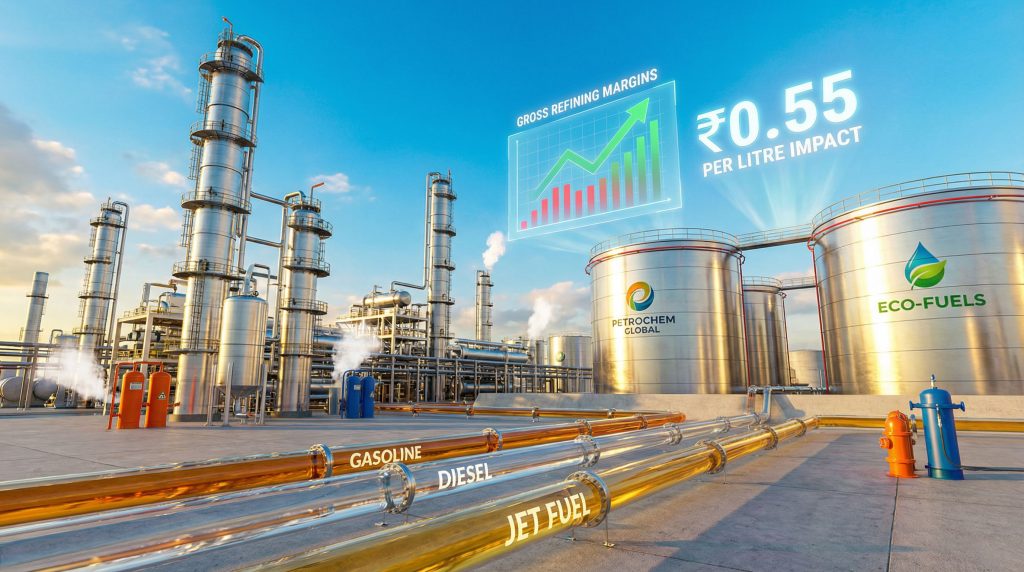
Research from JM Financial Institutional Securities demonstrates that every $1 per barrel increase in crude oil prices typically reduces auto-fuel gross marketing margins by ₹0.55 per litre, assuming stable retail prices and excise duty structures. This sensitivity translates to consolidated EBITDA contractions of 7-9% for each dollar of crude price appreciation.
Under normal market conditions with Brent crude trading around $70 per barrel, oil marketing companies typically maintain gross marketing margins of ₹3.5-4.0 per litre on petrol and diesel sales. However, the recent oil price rally from approximately $71 per barrel in January 2026 to $82.3 per barrel by March 2026 represents a 16% increase that has compressed these baseline margins significantly.
The mathematical relationship between crude prices and margin compression creates predictable earnings volatility patterns. At the current crude price environment, estimated margin compression reaches approximately ₹6.21 per litre based on the $11.30 per barrel increase, effectively eliminating baseline profitability margins entirely.
Margin Sensitivity Analysis
| Crude Price Scenario | Margin Impact (₹/litre) | EBITDA Effect | Profitability Status |
|---|---|---|---|
| $70/barrel baseline | ₹3.5-4.0 | 100% | Normal operations |
| +$5/barrel | ₹2.75-3.25 | -35% to -45% | Moderate pressure |
| +$10/barrel | ₹2.0-2.5 | -70% to -90% | Severe compression |
| +$15/barrel | ₹1.25-1.75 | -105% to -135% | Threatened viability |
Inventory Dynamics Creating Secondary Volatility Layers
Beyond operational margin compression, oil marketing companies face additional earnings volatility through inventory revaluation effects during periods of rising crude oil prices. These dynamics create a secondary layer of financial impact that amplifies the primary margin compression effects.
The inventory vulnerability emerges from processing time lags between crude oil procurement and refined product sales. Companies purchase crude oil at current market prices, process it over several days, and sell refined products at retail prices that reflect replacement cost economics rather than historical acquisition costs.
Working capital requirements intensify dramatically during rising price environments as the absolute rupee value of inventory holdings increases. For companies maintaining typical 20-day inventory levels, a crude price increase from $70 to $82.3 per barrel represents an additional $2.46 million per day in working capital requirements for every 200,000 barrels of average inventory.
Inventory Risk Calculation Example
Consider an oil marketing company with 5 million barrels of average inventory during the March 2026 price environment:
- Price increase: $11.3 per barrel (January to March 2026)
- Inventory revaluation loss: $56.5 million per quarter
- Equity impact: 10-15% of quarterly market value (assuming 2.5x leverage ratio)
This calculation demonstrates how inventory dynamics can create substantial earnings volatility independent of operational performance. Furthermore, according to the International Energy Agency, these effects are particularly pronounced when companies maintain higher inventory turnover requirements or limited hedging coverage.
Product Category Vulnerability Hierarchy
Different petroleum product categories exhibit varying degrees of sensitivity to crude oil price movements, with government-subsidised products showing the most severe margin compression during price escalation periods.
LPG Under-Recovery Crisis
Liquefied Petroleum Gas represents the most vulnerable product category due to government-mandated pricing structures that prevent cost pass-through to consumers. Analysis from Nomura Financial Advisory and Securities reveals that LPG under-recoveries have more than doubled from ₹33 per cylinder in the previous quarter to ₹69 per cylinder in the March 2026 quarter.
| Time Period | Crude Environment | Under-Recovery (₹/cylinder) | Change |
|---|---|---|---|
| Q3 FY2025-26 | Stable pricing | ₹33 | Baseline |
| Q4 FY2025-26 Current | Rising crude | ₹69 | +109% |
| Q4 FY2025-26 Projected | Sustained elevation | ₹75-85 | +127% to +158% |
The under-recovery mechanism forces oil marketing companies to sell LPG at government-fixed prices while absorbing the full impact of rising crude costs in their production expenses. This creates direct profit erosion that companies must finance through other business segments or external funding sources.
Auto Fuel Margin Compression Mechanics
Transportation fuels experience significant but more manageable margin pressure compared to LPG, as pricing adjustment mechanisms exist despite implementation delays. The regulatory formula-based pricing system allows for periodic adjustments to retail prices, creating temporary compression periods followed by margin recovery phases.
Current market conditions suggest auto fuel margins have compressed from the ₹3.5-4.0 baseline to severely negative spreads, requiring companies to operate these product lines at losses until pricing adjustments occur. Additionally, oil price movements continue to create uncertainty in pricing strategies.
Regional Market Structure Variations
Geographic market characteristics significantly influence how oil marketing companies experience crude price volatility, with regulatory frameworks, import dependency ratios, and competitive structures creating distinct regional patterns.
Indian Market Dynamics
The Indian petroleum market demonstrates unique characteristics that amplify the impact of rising oil prices on oil marketing companies through several structural factors:
- Import dependency: India imports approximately 85% of crude oil requirements, creating direct exposure to international price volatility
- Regulatory pricing mechanisms: Government-controlled pricing formulas create adjustment delays during rapid price movements
- Extensive subsidy systems: LPG and kerosene subsidies force companies to absorb cost increases directly
- Strategic reserve policies: Government petroleum reserve management affects supply-demand dynamics
Major Indian oil marketing companies including IOCL, HPCL, and BPCL face integrated margin declines of $3-4 per barrel at current crude price levels compared to previous quarters, according to Nomura Financial Advisory and Securities analysis.
Competitive Positioning Factors
Market positioning within regional competitive landscapes determines relative performance during volatile periods:
- State-owned vs. private operators: Different regulatory treatment and subsidy compensation mechanisms
- Integrated vs. standalone refiners: Vertical integration provides natural hedging against margin compression
- Retail network density: Larger distribution networks offer economy of scale advantages
- Petrochemical integration levels: Diversified product portfolios reduce petroleum dependency
Upstream Sector Benefits from Price Appreciation
While oil marketing companies face margin compression, exploration and production companies experience direct revenue enhancement from higher crude oil prices, creating divergent performance patterns within the energy value chain.
Companies like ONGC and Oil India benefit directly from rising crude prices, with every $1 per barrel increase boosting earnings by 1.5-2% according to JM Financial Institutional Securities research. The optimal profitability threshold typically occurs around $70 per barrel Brent crude, with current prices of $82.3 per barrel creating substantial earnings enhancement opportunities.
However, government windfall taxation policies may moderate these gains through special levy structures designed to capture exceptional profits during high price environments. The extent of upstream benefits ultimately depends on policy decisions regarding taxation and subsidy allocation mechanisms.
Upstream Performance Metrics
- Revenue elasticity: 1.5-2% earnings increase per $1/barrel crude appreciation
- Optimal price range: $70-80/barrel for maximum profitability
- Current environment benefit: Approximately 18-25% earnings enhancement at $82.3/barrel
- Policy risk factors: Windfall taxation and subsidy obligation adjustments
The next major ASX story will hit our subscribers first
Natural Gas Utility Parallel Pressures
Gas distribution companies face analogous challenges to oil marketing companies when liquefied natural gas prices experience volatility, creating broader energy sector margin compression beyond petroleum products.
Recent market developments have seen spot LNG prices more than double to $25 per million British thermal units following supply disruptions, affecting companies such as GAIL, Petronet LNG, Gujarat Gas, and city gas distributors. These price movements create simultaneous volume and margin pressure as industrial and commercial customers reduce consumption in response to higher costs.
The parallel between oil and gas utility challenges demonstrates broader structural vulnerabilities in energy distribution business models during commodity price volatility periods. Consequently, many companies now experience oil price stagnation as a welcome respite from sustained pressure.
Financial Market Valuation Impacts
Equity markets typically discount oil marketing company valuations during periods of rising crude prices, reflecting anticipated margin compression and earnings volatility in investment decision-making processes.
Valuation Methodology Adjustments
Financial analysts employ several analytical frameworks during volatile crude price environments:
- Price-to-earnings multiple contraction: P/E ratios compress as earnings become more volatile
- Debt-to-EBITDA deterioration: Leverage metrics worsen with margin compression
- Working capital impact assessment: Increased inventory financing requirements
- Dividend sustainability analysis: Cash flow pressure affecting distribution policies
Market Performance Characteristics
Oil marketing companies exhibit predictable market behaviour patterns:
- Defensive positioning: Investors reduce exposure during crude price uptrends
- Relative performance cycles: Outperformance during crude price decline periods
- Sector correlation dynamics: Movement patterns within broader energy sector indices
- Currency exposure effects: Import cost implications through rupee-dollar exchange rates
Strategic Adaptation Mechanisms
Oil marketing companies implement various operational and financial strategies to mitigate crude oil price volatility impacts on their business performance.
Operational Optimisation Strategies
- Refinery configuration adjustments: Maximising high-value product output ratios
- Inventory management protocols: Optimising storage levels during volatile periods
- Supply chain efficiency programmes: Reducing operational costs to offset margin pressure
- Petrochemical integration expansion: Diversifying revenue streams beyond traditional fuels
Financial Risk Management Approaches
- Commodity price hedging: Using derivatives to manage crude oil exposure
- Working capital optimisation: Managing cash flow requirements during price cycles
- Capital expenditure timing: Adjusting investment schedules based on market conditions
- Debt refinancing strategies: Optimising financing costs during favourable periods
Furthermore, companies must navigate complex relationships between tariffs and inflation as outlined by Trading View research, which indicates that rising oil prices significantly impact various business sectors.
Government Policy Influence Dynamics
Regulatory frameworks create significant complexity in how oil marketing companies navigate crude price volatility, with subsidy policies, taxation structures, and strategic reserve decisions affecting company performance substantially.
Policy Intervention Mechanisms
Government responses to crude price volatility typically include:
- Subsidy compensation timing: Delays in LPG under-recovery reimbursements affect cash flow
- Windfall taxation implementation: Special levies on upstream companies during high price periods
- Strategic petroleum reserve operations: Government buying/selling affecting market dynamics
- Import duty modifications: Tariff adjustments on crude oil and refined product imports
These policy tools create additional uncertainty layers beyond fundamental market dynamics, requiring companies to model multiple scenario outcomes in their strategic planning processes.
Future Outlook and Investment Implications
Long-term prospects for oil marketing companies depend on structural changes in global energy markets, regulatory framework evolution, and technological advancement in refining and distribution operations.
Emerging Market Trends
Several transformative factors will influence future performance patterns:
- Energy transition acceleration: Renewable fuel mandates and electric vehicle adoption affecting refined product demand
- Carbon pricing mechanisms: Environmental regulations creating additional operational costs
- Digital transformation initiatives: Technology investments in retail operations and customer engagement
- Regulatory framework modernisation: Government policy evolution toward market-based pricing mechanisms
Investment Strategy Considerations
Investors evaluating oil marketing company opportunities should consider:
- Capital allocation priorities: Management focus during volatile crude environments
- Consolidation opportunities: Merger and acquisition potential in challenging markets
- Technology investment benefits: Operational efficiency improvements through digital transformation
- Sustainability positioning: Environmental compliance and renewable fuel integration capabilities
The impact of rising oil prices on oil marketing companies creates both challenges and opportunities for strategic positioning within evolving energy market structures. Companies demonstrating operational flexibility, financial resilience, and strategic adaptation capabilities are most likely to navigate volatile market conditions successfully while positioning for long-term growth in transitioning energy markets.
This analysis is based on publicly available market research and financial data. Investment decisions should be made after consulting with qualified financial advisors and conducting thorough due diligence on specific companies and market conditions.
Ready to Capitalise on Energy Sector Opportunities?
Discovery Alert's proprietary Discovery IQ model delivers real-time alerts on significant ASX mineral discoveries, including energy and critical mineral opportunities that could benefit from oil price volatility trends. Begin your 14-day free trial today to position yourself ahead of the market and discover why major mineral finds can generate substantial returns for informed investors.