July 27, 2026
The Hidden Architecture of Oil Price Shocks: Why Chokepoints Define Energy Security
Global energy markets are not simply responsive to supply and demand fundamentals. They are deeply sensitive to the physical geography of oil transport, and the world's crude supply network is built around a surprisingly small number of maritime passages. When those passages come under threat, price signals amplify rapidly, often disproportionate to the actual volume of supply lost. Understanding this architecture is essential to interpreting why oil prices rise on Red Sea shipping attacks and Kazakhstan output cuts with such speed and magnitude.
The events that unfolded in the most recent trading week illustrate this dynamic with unusual clarity. Two independent disruption events, separated by geography but connected by their impact on global supply confidence, collided within the same trading period. The result was one of the most significant weekly crude price rallies seen outside of a formal geopolitical crisis declaration.
When big ASX news breaks, our subscribers know first
Benchmark Performance: A Week of Compounding Pressure
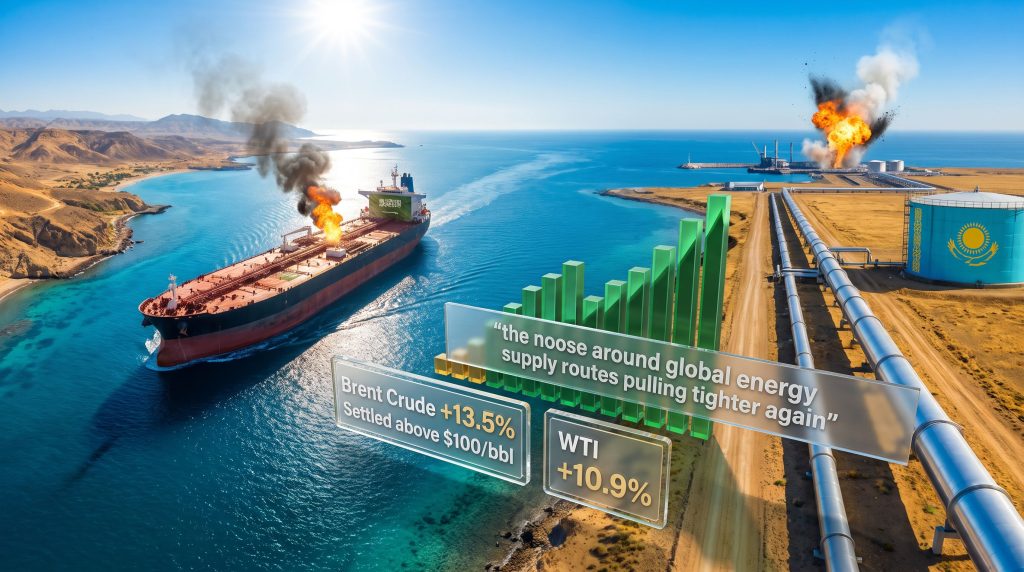
The scale of the weekly move across crude benchmarks captured the attention of energy traders and macro investors alike. Brent futures settled above the psychologically significant $100 per barrel level for the first time since May, while WTI approached $91.49 per barrel intraday.
| Benchmark | Weekly Gain | Notable Level |
|---|---|---|
| Brent Crude | +13.5% | Settled above $100/bbl (first time since May) |
| WTI Crude | +10.9% | Approached $91.49/bbl intraday |
| Brent (Thursday settlement) | +7.0% | Crossed $100 threshold |
| WTI (Thursday settlement) | +6.2% | Strongest single-day gain in months |
By Friday, Brent had eased slightly to $99.97 per barrel as early positioning gave way to profit-taking, though the weekly trajectory remained firmly higher. Double-digit weekly gains in crude are historically rare outside of genuine supply crisis conditions, which is precisely what made this episode significant. Furthermore, the oil price volatility trends observed during this period were consistent with historical chokepoint disruption events.
"A 13.5% weekly gain in Brent does not occur in orderly markets with adequate supply buffers. It reflects a market that perceives structural vulnerability, not just temporary disruption."
The Red Sea Crisis: Geography as a Strategic Weapon
Why the Bab el-Mandeb Strait Is So Critical
To understand the scale of market concern, it helps to appreciate what the Bab el-Mandeb actually controls. This narrow waterway, roughly 30 kilometres wide at its most constrained point, connects the Red Sea to the Gulf of Aden and the Indian Ocean. Every barrel of crude or refined product shipped from the Persian Gulf to European and North American markets via the Suez Canal must transit this passage.
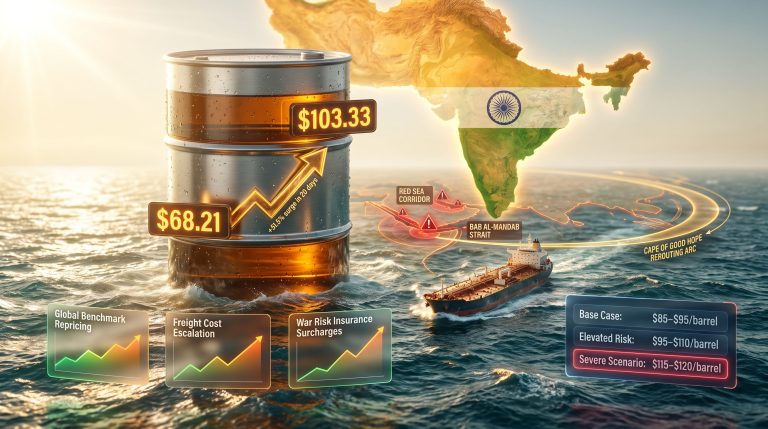
It ranks as the second most strategically important oil shipping chokepoint on the planet, behind only the Strait of Hormuz. On a daily basis, millions of barrels of crude and refined products move through this corridor. A closure, even a partial one driven by risk aversion rather than physical blockade, would force a substantial portion of global tanker traffic onto the far longer Cape of Good Hope routing, adding 10 to 14 days to voyage times and meaningfully increasing delivered costs for Asian importers.
From Declared Blockade to Confirmed Strike
The sequence of events that triggered the latest price spike began earlier in the week when Iran-aligned Houthi forces declared a naval blockade against Saudi Arabia. This was not initially treated as a credible operational threat by all market participants. That calculus shifted when Houthi forces confirmed strikes on two Saudi oil tankers operating within the Red Sea corridor.
The strategic logic behind the targeting is worth examining. Saudi Arabia had been rerouting its crude exports via overland pipeline specifically to bypass the Strait of Hormuz, which Iran had moved to close. By targeting tankers at the Bab el-Mandeb, the Houthis effectively created a secondary chokepoint threat that neutralised Saudi Arabia's routing workaround.
This is what analysts have begun calling the chokepoint substitution problem: closing one major artery forces dependence on an alternative, which then itself becomes a target. Indeed, the crude oil geopolitical tensions driving these developments have been escalating across multiple theatres simultaneously.
Reports indicated that Iran had been pressing Houthi forces to threaten the Bab el-Mandeb gateway specifically in response to continued U.S. strikes on Iranian power infrastructure, following the collapse of an interim U.S.-Iran truce approximately two weeks prior. U.S. President Donald Trump publicly stated that Iran would be held accountable for any further escalation linked to Houthi naval operations.
Risk Premium Mechanics: Why Prices Move Before Physical Supply Is Lost
A critical and often misunderstood dynamic in energy markets is the distinction between actual supply disruption and risk premium pricing. When a major shipping chokepoint is threatened, freight insurance costs surge immediately. War risk insurance premiums for vessels transiting the Red Sea can increase by multiples of their baseline rates within hours of a confirmed tanker strike.
This insurance cost escalation feeds directly into tanker spot rates, which in turn affects delivered crude prices for importers. The physical barrels may still be moving, but the cost of moving them rises, effectively tightening market conditions even before a single barrel is lost. Historical precedents from Red Sea attacks, including the 2019 Gulf of Oman tanker attacks and periods of elevated Red Sea tension during prior regional conflicts, demonstrate that markets consistently price this uncertainty before disruption is confirmed.
As IG market analyst Tony Sycamore noted in a research communication, "the progressive tightening of threats around global energy supply routes creates a self-reinforcing risk environment that markets struggle to price with precision."
Kazakhstan's Output Cut: A Separate Supply Shock on a Different Continent
The Caspian Pipeline Consortium's Outsized Importance
While the Red Sea situation was already moving crude benchmarks higher, a physically distinct and operationally separate supply disruption was unfolding in Central Asia. Kazakhstan's primary crude export artery, the Caspian Pipeline Consortium pipeline, was forced to halt operations following reported Ukrainian drone strikes targeting tankers at the country's main Black Sea export terminal.
The CPC route is not a marginal export channel. It handles approximately 2% of global daily crude supply, a volume that carries outsized pricing significance in a market already operating with limited spare capacity. When the CPC suspended loadings, Kazakhstan's energy ministry confirmed that oil companies had implemented temporary production reductions in response.
One industry source indicated that output at Kazakhstan's largest producing field fell by more than half on a daily basis during the suspension period. Kazakhstan's ministry did not specify the precise scale of the aggregate reduction, but the field-level data point suggests the impact was operationally material, not marginal.
The Landlocked Producer's Fundamental Vulnerability
What makes Kazakhstan's situation structurally different from most major producers is its complete absence of direct maritime access. Unlike Saudi Arabia, which has multiple port options and overland pipeline alternatives, Kazakhstan is entirely dependent on pipeline export infrastructure to move its crude to global markets.
This geographic constraint means that any disruption to the CPC pipeline, the country's primary export route, translates almost immediately into upstream production decisions. Operators cannot store unlimited volumes of crude indefinitely, and without the ability to move barrels, they must reduce wellhead output. Consequently, export route security is not a logistics concern for Kazakhstan: it is a direct production constraint.
This dynamic is poorly understood by investors accustomed to evaluating producers with diversified port access and flexible routing options.
"Landlocked energy exporters face a fundamentally different risk profile than coastal producers. Infrastructure disruption does not merely increase delivery costs; it stops production at the source."
How Two Independent Events Compound Into a Single Price Signal
The Mathematics of Simultaneous Disruption
Energy markets, particularly the algorithmic systems that now dominate short-term price discovery, are calibrated to respond to individual risk events with a defined probability-weighted price adjustment. When two independent disruption events occur within the same trading week, those models do not simply add the two risk premiums together.
They assign a higher conditional probability to further escalation, because the co-occurrence of two disruptions signals a deteriorating geopolitical environment rather than isolated incidents. This dynamic helps explain why oil prices rise on Red Sea shipping attacks and Kazakhstan output cuts beyond what a linear analysis of either event in isolation would have predicted.
The OPEC+ Backdrop That Made This Worse
Neither of these disruptions occurred in a market with abundant spare capacity. The OPEC influence on oil pricing had been a meaningful factor in the preceding period, as the group maintained production discipline and limited the cushion of readily deployable additional barrels that could absorb unexpected outages.
U.S. shale production, while structurally responsive over a 6-to-12-month horizon, does not respond to price signals within days or weeks in a way that offsets acute supply interruptions. The combination of pre-existing supply tightness and simultaneous multi-geography disruption created conditions where even a relatively modest physical supply loss generated outsized price movement.
Scenario Analysis: Pathways Forward
| Scenario | Probability Assessment | Estimated Price Impact |
|---|---|---|
| Partial shipping rerouting via Cape of Good Hope | Moderate-High | +$5-$10/bbl freight premium |
| Sustained tanker attacks, no formal closure | Moderate | Risk premium maintained at $8-$15/bbl |
| Full Bab el-Mandeb closure | Low-Moderate | Potential $20-$30+/bbl spike |
| Kazakhstan output restored within days | High | Partial price reversal, $5-$8/bbl pullback |
| Dual escalation across both chokepoints simultaneously | Low | Extreme volatility, potential Brent above $130/bbl |
Disclaimer: Scenario probability assessments and price impact ranges represent analytical frameworks for illustrative purposes only and should not be construed as investment advice or price forecasts.
Downstream Consequences: Who Bears the Cost
Asian Importers Face the Steepest Exposure
The economies most exposed to Red Sea shipping disruption are concentrated in Asia. China, India, Japan, South Korea, and Southeast Asian refining economies collectively depend on Middle Eastern crude routed through the Indian Ocean and the Bab el-Mandeb corridor. Rerouting via the Cape of Good Hope does not prevent oil from reaching these markets; it delays it and makes it more expensive.
The freight cost increase from extended voyage routing, combined with elevated war risk insurance premiums, adds meaningful delivered cost to every barrel. For refinery operators already managing thin margin environments, this cost increase compresses profitability before the crude even enters a processing unit. In addition, the US-China oil price risks stemming from broader trade tensions compound the pressure on Asian importers already managing difficult margin environments.
Refined Product Prices and Inflationary Transmission
Crude price spikes do not remain contained within wholesale energy markets. They transmit into gasoline, diesel, and jet fuel prices at the retail level, typically with a lag of two to six weeks depending on regional refinery inventory levels and government pricing policy. For economies already managing elevated energy cost burdens, a sustained period of triple-digit Brent represents a meaningful inflationary input.
Shipping and Insurance Market Spillovers
The impact extends beyond energy cargo. When war risk insurance premiums escalate for vessels operating in the Red Sea and Black Sea simultaneously, shipping companies respond by rerouting all cargo categories, not only tankers. Container shipping rates rise as available vessel capacity is reduced through route avoidance and speed adjustments. This creates secondary inflationary pressure across global supply chains that extends well beyond energy markets.
The next major ASX story will hit our subscribers first
Key Indicators for Monitoring Ongoing Developments
For market participants tracking the evolution of these supply pressures, the following indicators carry the most informational value:
- Houthi operational tempo: Frequency and scale of further tanker targeting in the Red Sea corridor
- CPC terminal restoration: Kazakhstan's Black Sea export terminal restart timeline and production recovery rate at the Tengiz and Kashagan fields
- U.S.-Iran diplomatic signals: Any indication of renewed negotiations or ceasefire arrangements that would reduce Houthi operational pressure
- OPEC+ emergency posture: Whether the group convenes an unscheduled meeting or signals production adjustment if Brent sustains above $100 per barrel
- Asian strategic petroleum reserve drawdowns: Whether major importers begin releasing emergency reserves to buffer against supply tightness
- Freight and insurance market rates: Real-time signal of how the shipping industry is pricing ongoing corridor risk
The Structural Problem That Outlasts This Episode
Chokepoint Concentration as a Systemic Risk
The events of this trading week are a reminder that the architecture of global oil logistics has not fundamentally changed despite decades of investment in energy diversification. The world's crude supply remains concentrated through a small number of maritime passages, each of which represents a single point of failure for large volumes of global supply.
Geopolitical actors who understand this architecture can exploit it with asymmetric effectiveness. The cost of mounting a drone or naval strike on a tanker is a fraction of the market value destruction created by the risk premium spike that follows. This asymmetry means that maritime chokepoint threats are likely to remain a recurrent feature of energy market volatility, not episodic exceptions.
Geopolitical Risk Premium as a Structural Oil Price Component
Perhaps the most important longer-term implication of this week's events is the reinforcement of a thesis that energy analysts have been advancing with increasing conviction: geopolitical risk premium is no longer a temporary overlay on crude pricing; it is becoming a structural baseline component.
Furthermore, the oil price trade war impact on market dynamics adds another layer of complexity for long-term energy planners and portfolio managers navigating this environment. The era of relatively stable, logistics-secure global oil transport may be giving way to a period of persistent route uncertainty and elevated freight cost volatility.
Oil prices rise on Red Sea shipping attacks and Kazakhstan output cuts in ways that reveal deep structural vulnerabilities in the global energy system. Investors and analysts seeking deeper ongoing coverage of these dynamics can follow commodity market developments from specialist energy reporting platforms that provide continuous analysis of Middle Eastern and Central Asian supply developments as they evolve.
Want to Capitalise on the Next Major Commodity Discovery Before the Market Moves?
The same geopolitical forces reshaping global oil supply chains are creating significant volatility across mineral commodity markets — and Discovery Alert's proprietary Discovery IQ model scans ASX announcements in real time, delivering instant alerts on significant mineral discoveries so subscribers can act ahead of the broader market. Explore how historic mineral discoveries have generated substantial returns and begin a 14-day free trial to position yourself at the forefront of the next major find.