July 26, 2026
When Chokepoints Become Crisis Points: Understanding India's Crude Oil Vulnerability
Every barrel of crude oil that reaches an Indian refinery travels a path shaped by geography, geopolitics, and maritime risk. For most of the past decade, that path has been taken for granted. But when shipping lanes running through the Red Sea and the Strait of Hormuz come under simultaneous pressure, India's deep structural dependence on imported energy transforms what might otherwise be a regional conflict into a nationwide economic event. The Indian crude oil price surge due to Red Sea disruptions in July 2026 is precisely that kind of event, and understanding why it happened, how it transmits through the economy, and what it signals for the future requires looking well beyond the headline numbers.
When big ASX news breaks, our subscribers know first
India's Import Dependency: The Structural Foundation of Price Vulnerability
India is one of the world's largest consumers of crude oil and, critically, one of the most import-dependent major economies on the planet. The country sources approximately 85 to 90 percent of its crude oil requirements from international markets, meaning virtually every domestic price movement in petroleum products traces its origins back to global shipping lanes, benchmark pricing mechanisms, and geopolitical events occurring thousands of kilometres away.
This level of exposure is not simply a function of resource scarcity. It reflects decades of industrial growth outpacing domestic production capacity, a refining sector built to process a diverse mix of imported crude grades, and an energy consumption trajectory that continues to climb with economic expansion. Furthermore, the crude market dynamics at play mean that maritime chokepoints, which most countries treat as distant geopolitical concerns, function for India as direct transmission belts connecting foreign conflicts to domestic pump prices.
The July 2026 Price Shock: Numbers That Demand Explanation
The scale of the price movement recorded across July 2026 is striking even by the volatile standards of global oil markets. The Indian crude basket, which represents a weighted average of the specific crude grades India actually purchases rather than a single theoretical benchmark, recorded the following trajectory:
| Date | Indian Crude Basket Price | Movement |
|---|---|---|
| July 3, 2026 | $68.21 per barrel | Baseline |
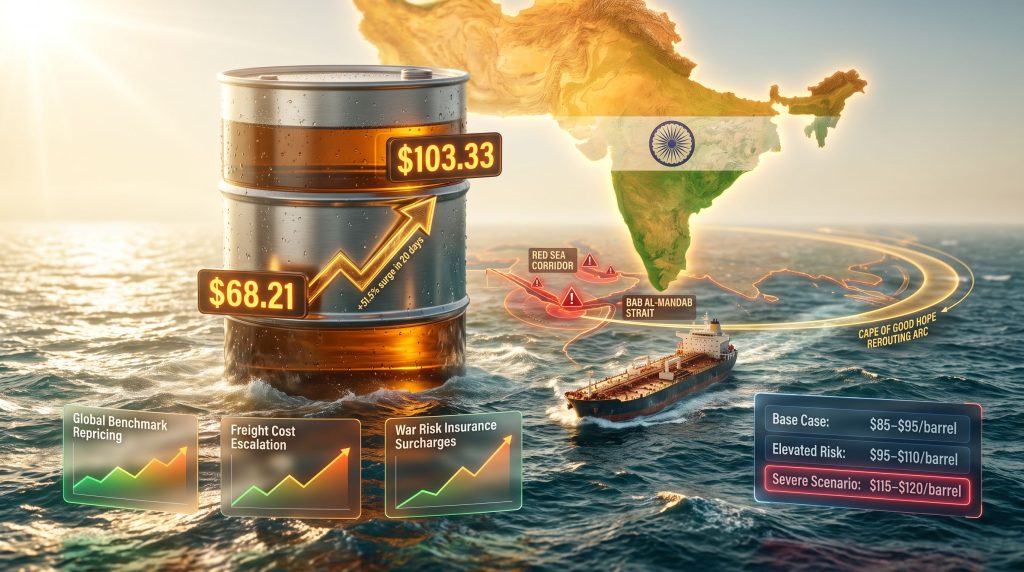
| July 23, 2026 | $103.33 per barrel | +51.5% over 20 days |
| Brent Crude (peak) | Above $100 per barrel | Two-month high |
| Brent Crude (eased) | $97.08 per barrel | As of July 25 evening |
A 51.5 percent increase in twenty days is an extraordinary compression of price movement. For context, major crude price shocks in prior cycles, including the 2022 Ukraine war-driven spike, typically unfolded over weeks to months before reaching comparable percentage gains. The velocity of this move reflects the simultaneous activation of multiple risk factors rather than a single supply disruption.
It is important to note that the Indian crude basket consistently trades at a discount or premium relative to Brent depending on the composition of grades India sources in any given period. When India has been able to access discounted Russian crude since 2022, this has partially decoupled the basket from Brent movements. However, during episodes of acute maritime stress, freight costs and insurance surcharges narrow or eliminate that advantage, making the basket more sensitive to global benchmark moves than in calmer periods.
The Anatomy of the Red Sea and Hormuz Disruption
The Bab al-Mandab Strait: Geography as Destiny
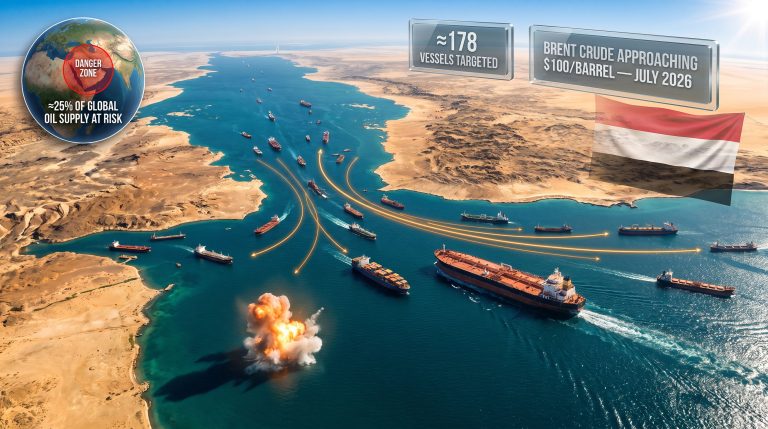
The Red Sea corridor connects the Indian Ocean to the Mediterranean via the Suez Canal, with the Bab al-Mandab Strait serving as its southern gateway. At its narrowest point, this passage is approximately 29 kilometres wide, a geographic bottleneck through which a significant share of global energy trade has historically flowed. Houthi militia attacks on shipping in and around this corridor, targeting tankers and cargo vessels with drones, missiles, and maritime mines, have created sustained disruption.
The strategic logic behind these attacks is to impose economic friction on global trade as a form of geopolitical leverage. The practical outcome for energy markets is a sustained elevation of risk premiums embedded into every vessel transiting the region.
The Strait of Hormuz: A Compounding Risk Factor
Simultaneously, the Strait of Hormuz, through which approximately 20 percent of global oil supply transits, has faced its own disruption pressures. Unlike the Red Sea, which handles a meaningful but not dominant share of global oil trade, the Hormuz passage is genuinely irreplaceable for Persian Gulf producers. There is no practical alternative route for the volume of crude that moves through it.
Energy market analysts have noted that simultaneous stress across both the Red Sea corridor and the Strait of Hormuz could push crude prices toward the $115 to $120 per barrel range in a severe disruption scenario, a level that would materially accelerate India's import bill and create significant inflationary pressure across the economy.
When both chokepoints face elevated risk simultaneously, the market does not simply add the two risk premiums together. The psychological and logistical feedback loops amplify the combined effect, as insurers, shipowners, and commodity traders all reprice risk across the entire Middle East supply chain. Consequently, understanding the geopolitical oil price analysis becomes essential for interpreting how these events feed into benchmark pricing.
The Cape of Good Hope Detour: Hidden Costs in the Data
One of the least visible but most economically significant consequences of Red Sea disruption is the rerouting of vessels around the Cape of Good Hope at Africa's southern tip. This detour adds approximately 10 to 14 additional sailing days per round voyage, with cascading effects:
- Fuel consumption per cargo delivery increases substantially, raising the effective landed cost per barrel
- Vessel utilisation rates tighten as ships spend more time at sea per delivery cycle, reducing available fleet capacity
- Port scheduling becomes less predictable, adding demurrage and logistics costs
- The effective supply of tanker capacity available to India at any given time decreases even if no physical supply reduction has occurred
These cost layers are invisible in headline Brent price data but are fully present in the actual cost India's refiners pay for delivered crude. Indeed, oil price movements driven by rerouting and insurance costs can be just as consequential as those driven by benchmark shifts alone.
How Disruption Travels From Shipping Lanes to Petrol Stations
The Three-Channel Transmission Mechanism
The pathway from maritime disruption to domestic fuel prices operates through three distinct but interconnected channels:
-
Global benchmark repricing: Brent crude and WTI incorporate geopolitical risk premiums as soon as sustained supply insecurity is perceived. Even if no physical barrel is actually lost, the market prices in the probability of future supply constraint.
-
Freight cost escalation: Vessels rerouting around the Cape of Good Hope face materially higher operating costs per voyage. These costs are passed through to cargo buyers via higher freight rates, directly inflating the landed cost of crude at Indian refineries.
-
War risk insurance surcharges: Underwriters have repriced coverage for vessels transiting conflict-adjacent maritime zones. These surcharges represent a per-barrel cost that does not appear in benchmark price quotes but is paid by every refiner importing through affected routes.
India absorbs these costs with particular intensity because its refining infrastructure is geographically concentrated on its western coastline, with supply chains optimised for Middle Eastern and African crude deliveries via the Red Sea corridor. Diversifying to Atlantic Basin suppliers on short notice is possible but costly, and the process of renegotiating long-term supply agreements to achieve geographic diversification cannot happen quickly enough to offset an acute price shock.
MCX Crude Futures as a Real-Time Barometer
India's domestic Multi Commodity Exchange crude futures contract provides a real-time signal of how the market is pricing supply risk for Indian consumers. During periods of elevated maritime stress, the MCX contract tends to trade at widening premiums relative to its historical relationship with Brent, reflecting the additional freight and insurance components specific to India's supply chain. Traders and analysts monitoring the spread between MCX crude and Brent can therefore extract a rough implied estimate of how much of India's price pain is benchmark-driven versus logistics-driven.
Downstream Consequences: Under-Recovery and Inflation Risk
The Under-Recovery Problem
India's retail petrol and diesel prices operate through a mechanism linked to international FOB (free-on-board) product prices. When global refined product prices surge but the government or oil marketing companies hold domestic pump prices unchanged for political or social reasons, the difference between the cost of supplying fuel and the price recovered from consumers creates what the industry terms under-recovery.
Under-recovery is not simply a corporate accounting problem. Sustained under-recovery at state-owned oil marketing companies eventually requires either retail price increases, government fiscal transfers to compensate the companies, or some combination of both. Historically, Indian governments have faced difficult political choices during sustained crude price spikes, and the July 2026 event brings that pressure back into focus.
Inflation Passthrough: Beyond the Pump
The inflationary consequences of a crude price shock extend well beyond petrol and diesel retail prices. Higher transport fuel costs raise the operating expenses of:
- Road freight operators, increasing the delivered cost of virtually every physical good
- Agricultural supply chains, where diesel powers irrigation, harvesting, and cold storage equipment
- Aviation and logistics sectors, where fuel typically represents 25 to 35 percent of operating costs
- Small manufacturing enterprises with limited capacity to absorb sudden input cost increases
The cumulative effect is a broad-based cost-push inflationary impulse that feeds through consumer price indices over a period of weeks to months after the initial crude price spike.
The next major ASX story will hit our subscribers first
Separating Risk Premium From Structural Supply Deficit
Not all market analysts interpret the July 2026 price surge as signalling a fundamental shift in global supply balances. Research published by CRISIL has argued that Red Sea disruption is unlikely to permanently reshape global crude pricing, noting that approximately 10 percent of global oil trade transits the Red Sea corridor. Under this view, current elevated prices reflect a risk premium that markets are pricing into the forward curve, rather than an actual reduction in the physical barrels available to buyers.
This distinction matters enormously for policy and investment decisions. A risk premium can deflate rapidly when geopolitical conditions shift. A structural supply deficit, however, requires years to resolve. The three scenarios below illustrate the range of outcomes India faces depending on how the disruption evolves:
| Scenario | Brent Price Range | Key Driver | India Basket Implication |
|---|---|---|---|
| Base Case (disruption contained) | $85 to $95 per barrel | Houthi activity stabilises | Moderate import bill pressure |
| Elevated Risk (prolonged disruption) | $95 to $110 per barrel | Sustained rerouting and insurance costs | Significant under-recovery risk |
| Severe Scenario (dual chokepoint) | $115 to $120 per barrel | Red Sea and Hormuz simultaneous stress | Major fiscal and inflation shock |
The severe scenario threshold of $115 to $120 per barrel is only achievable under conditions where both major chokepoints face sustained simultaneous stress, a scenario that energy market analysts flag as low-probability but non-trivial given current geopolitical dynamics. Furthermore, the trade war impact on oil adds another layer of complexity to how these price scenarios may ultimately unfold.
Russia's Discounted Crude: A Partial Buffer With Limits
One factor that has partially insulated India from crude price spikes since 2022 is access to discounted Russian crude, which India has sourced in increasing volumes following the Western sanctions regime that reduced other buyers' willingness to purchase Russian barrels. At its peak, Russian crude accounted for a substantial share of India's import mix, providing a meaningful discount to prevailing international benchmarks.
However, this buffer has structural limits. Russian crude is delivered primarily via routes that bypass the Red Sea entirely, but the freight costs for those routes have their own dynamics. More importantly, the discount available on Russian crude has narrowed over time as more buyers have adapted to the new supply landscape. When global benchmarks surge as sharply as they did in July 2026, even a discounted feedstock source cannot fully absorb the magnitude of the price movement. India's crude imports face additional disruption risks when Houthi threats specifically target Saudi oil shipping lanes, further complicating the import mix.
Strategic Implications: What India's Policymakers Face
Strategic Petroleum Reserve Deployment
India maintains strategic petroleum reserves capable of providing short-term supply cover during acute disruption events. The Indian crude oil price surge due to Red Sea disruptions illustrates precisely the scenario these reserves are designed to buffer, though their utility is primarily in preventing physical supply shortages rather than dampening price effects driven by global market dynamics.
The Long-Term Energy Security Argument
Each successive crude price shock strengthens the economic case for accelerating India's transition toward domestically produced renewable energy. Solar and wind power cannot displace crude oil in transport and petrochemical applications in the near term, but each percentage point of electricity generation shifted to renewables reduces the economy's overall oil intensity, gradually decreasing the severity of future maritime shocks. Considering oil's global economic importance, the July 2026 episode is therefore not just a near-term fiscal challenge but a recurring reminder of the strategic value embedded in India's ongoing renewable energy expansion.
Frequently Asked Questions: India's Crude Surge and Red Sea Disruptions
Why did the Indian crude oil price surge 51.5% in just three weeks?
The Indian crude basket climbed from $68.21 per barrel on July 3 to $103.33 per barrel by July 23, 2026. The move reflected a combination of Houthi militia attacks on commercial shipping in the Red Sea, Brent crude crossing $100 per barrel for the first time in two months, and the compounding effect of elevated freight rates and war risk insurance premiums driven by vessel rerouting around the Cape of Good Hope.
What makes the Strait of Hormuz particularly dangerous for India's energy security?
The Strait of Hormuz is the only viable export route for crude oil from major Persian Gulf producers including Saudi Arabia, the UAE, Iraq, and Kuwait. These nations collectively supply a large portion of India's crude imports. Any sustained disruption at the Hormuz passage directly constrains the physical availability of the grades India's refineries are configured to process.
How does under-recovery affect Indian consumers?
When international product prices rise faster than domestic pump prices can be adjusted, oil marketing companies absorb the difference. This creates financial pressure that historically resolves through eventual retail price increases, fiscal transfers, or both. Consumers who do not see immediate pump price changes are therefore not insulated from the shock; they are simply experiencing it on a delayed timeline.
Is the current price surge driven by a real supply shortage?
Analyst assessments suggest that the July 2026 spike is primarily a risk premium rather than a reflection of actual barrels being removed from the global supply pool. Approximately 10 percent of global oil trade transits the Red Sea, which is significant but insufficient to cause a structural global deficit on its own. The key variable is duration: if disruptions persist for months, risk premiums can become self-reinforcing through longer-term supply contract repricing and infrastructure investment delays.
What crude price level would constitute a genuinely severe economic shock for India?
The $115 to $120 per barrel range represents a threshold at which India's import bill, inflation trajectory, and fiscal position would face material simultaneous stress. Reaching that level would require sustained concurrent disruption across both the Red Sea corridor and the Strait of Hormuz, a scenario that remains a tail risk rather than a base case for the Indian crude oil price surge due to Red Sea disruptions.
Readers seeking further context on India's energy import dynamics and global oil market developments may find ongoing analysis and reporting at ET EnergyWorld, which covers developments across India's oil and gas sector. This article contains forward-looking scenario analysis and should not be construed as financial advice. Crude oil price forecasts involve significant uncertainty and actual outcomes may differ materially from scenarios described.
Want to Stay Ahead of the Next Major Commodity Price Shock?
Discovery Alert's proprietary Discovery IQ model scans ASX announcements in real time, instantly identifying significant mineral discoveries across more than 30 commodities — including those directly exposed to global energy and resource price movements — and delivering actionable insights before the broader market reacts. Explore how historic mineral discoveries have generated exceptional returns and begin your 14-day free trial today to position yourself ahead of the market.