July 26, 2026
The World's Most Dangerous Stretch of Water Is Getting More Dangerous
Global energy markets operate on a set of assumptions so deeply embedded that they rarely get examined until something breaks them. One of those assumptions is that the waterways connecting oil producers to consumers will remain functionally open, even during periods of regional conflict. The events unfolding across the southern Red Sea and the Strait of Hormuz through 2025 and into 2026 have shattered that assumption with a precision that no geopolitical risk model fully anticipated.
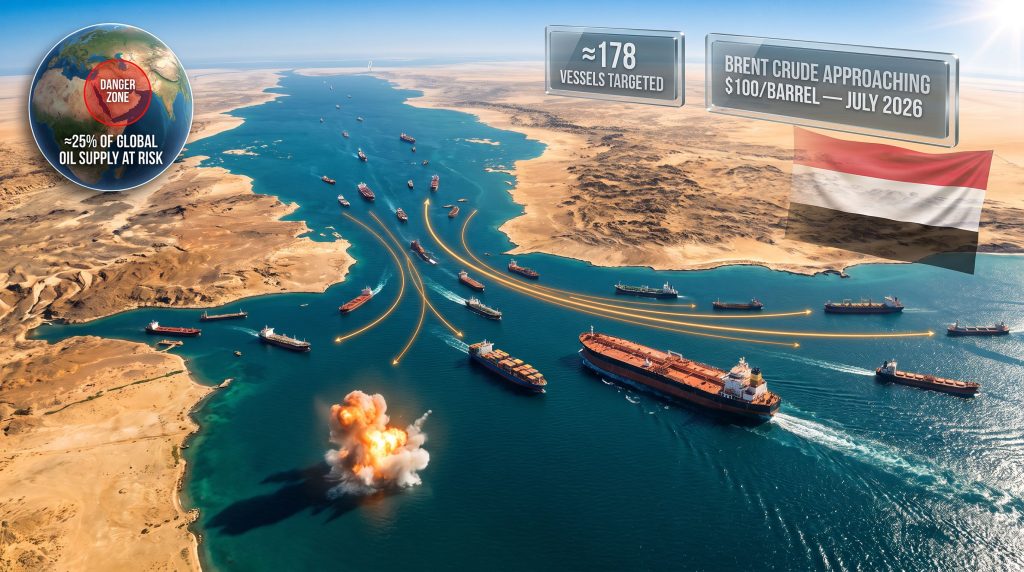
What makes the current crisis structurally different from prior maritime disruptions is not the scale of any single attack, but the simultaneous compression of two major chokepoints that together carry an estimated 25% of global oil supply. When one corridor closes, the other serves as a pressure valve. When both are compromised at the same time, the system has no release mechanism.
When big ASX news breaks, our subscribers know first
The Strategic Anatomy of Two Failing Corridors
The Bab el-Mandeb Strait, a 29-kilometre-wide passage separating Yemen from Djibouti at the southern entrance to the Red Sea, is one of the most consequential pieces of geography on the planet. On any given day in normal conditions, this narrow channel processes somewhere between 12% and 15% of global seaborne trade, acting as the southern gateway to the Suez Canal and the most direct maritime link between Asian manufacturing hubs and European consumer markets.
The Suez Canal itself cannot function as a global trade artery without the Bab el-Mandeb feeding it. Vessels transiting from the Indian Ocean to the Mediterranean have no other efficient option. The Cape of Good Hope alternative adds approximately 14 to 18 additional sailing days to a standard Asia-Europe voyage, a cost penalty that cascades through freight rates, fuel consumption, and delivery schedules across dozens of industries simultaneously.
At the northern end of the Arabian Peninsula, the Strait of Hormuz presents a parallel vulnerability. This corridor previously carried roughly one-fifth of global oil supply, primarily from Saudi Arabia, the UAE, Kuwait, Iraq, and Iran. The U.S.-Iran conflict, now extending into its fifth month as of July 2026, has severely curtailed transit through Hormuz, transforming what was historically treated as a theoretical risk into an active operational disruption.
The compounding effect is significant. Analysts monitoring both corridors simultaneously now estimate that roughly a quarter of global oil supply faces active exposure, a figure that has no modern peacetime precedent. Understanding the broader crude oil market dynamics helps contextualise just how unprecedented this dual-corridor pressure truly is.
How Red Sea Shipping Attacks by Houthi Rebels Became a Structural Market Event
The Houthi maritime campaign did not emerge fully formed. It evolved from a land-based insurgency operating in one of the world's poorest countries into a sophisticated naval threat capable of striking commercial vessels hundreds of kilometres from Yemen's coastline.
The campaign's formal opening came on 19 November 2023, when Houthi forces launched their first maritime strike against a commercial vessel, framing the action as solidarity with Gaza amid the outbreak of the broader regional conflict. What followed became the most sustained maritime disruption campaign since the Second World War. The Red Sea crisis has since drawn international attention as one of the most consequential maritime security events in recent history.
Campaign Metrics: Two Years of Escalating Pressure
| Metric | Data Point |
|---|---|
| Campaign Start Date | 19 November 2023 |
| Total Vessels Targeted (cumulative) | approximately 178 vessels |
| Primary Attack Zone | Southern Red Sea, Bab el-Mandeb, Gulf of Aden |
| Weapons Deployed | Missiles, drone swarms, cruise missiles, small boat tactics |
| Confirmed Sailor Fatalities | 4 to 9 (varying by reporting period) |
| Ships Sunk or Severely Damaged | Multiple confirmed losses |
| Brent Crude Price Response (July 2026) | Approaching $100 per barrel |
The weapons architecture behind these strikes deserves attention because it explains why conventional naval deterrence has proven so difficult to apply. The Houthi arsenal includes anti-ship ballistic missiles, drone swarms, sea-skimming cruise missiles, and small boat assault tactics. Each weapon category exploits a different vulnerability in commercial vessel defences and naval escort protocols. Iran is widely assessed as the primary external supplier of advanced systems, technical guidance, and operational intelligence enabling this capability.
Crucially, the selection of commercial vessels rather than military assets as primary targets is not incidental. It reflects a deliberate strategic calculation: attacking merchant shipping maximises economic coercion at a fraction of the cost and risk involved in engaging naval warships. A single successful strike on a crude oil tanker can move global benchmark prices, disrupt insurance markets, and trigger route alterations across dozens of operators simultaneously.
The July 2025 Resumption and the Illusion of Normalcy
A ceasefire-adjacent pause in Houthi maritime operations created a brief window in which some operators began treating the Red Sea as conditionally navigable again. That assumption proved costly. Attacks resumed in July 2025, with strikes on multiple vessels including the Magic Seas and Eternity C, resulting in the deaths of four crew members and renewed condemnation from maritime safety organisations.
The resumption demonstrated something analytically important: the Houthis retain independent operational decision-making capacity and are not simply reactive to broader diplomatic developments. The group's ability to pause and restart a maritime campaign on its own timeline makes the threat environment fundamentally harder to price into risk models. Furthermore, this kind of oil market disruption compounds existing pressures that traders and analysts are already grappling with.
The Saudi Arabia Rerouting Problem
Perhaps the most underappreciated dimension of the current crisis is the strategic trap now facing Saudi Arabia's crude oil export infrastructure.
In response to Hormuz disruptions, Saudi Arabia activated its East-West Pipeline, a major overland route designed specifically to bypass the Strait of Hormuz by connecting Persian Gulf production fields to the Red Sea coast. The pipeline moves millions of barrels of crude daily, and its existence was long regarded as a meaningful hedge against Hormuz closure scenarios.
The flaw in that hedge is now visible in real time. The pipeline's Red Sea terminal sits at the northern end of a corridor whose southern exit point is the Bab el-Mandeb Strait, which is directly adjacent to Houthi-controlled territory. Saudi Arabia's Hormuz bypass infrastructure feeds directly into a Houthi threat environment.
Saudi Arabia's contingency infrastructure, built over decades specifically to provide an alternative to Hormuz dependency, now terminates at the entrance of a second active threat corridor. The rerouting strategy that was designed to solve one chokepoint problem has created direct exposure to another.
Following the Houthis' announcement of intent to target Saudi-linked shipping, Kpler tracking data showed nearly a dozen vessels either turning back or avoiding the strait entirely in the immediate aftermath. A Saudi-linked vessel was subsequently struck in the Red Sea, sustaining minor damage with zero casualties before continuing its transit route. The incident confirmed both the reality of the threat and the willingness of some operators to accept residual risk rather than absorb the cost of full diversion.
Interestingly, the same Kpler data showed 43 vessels crossing the Bab el-Mandeb on a single Thursday in late July 2026, up from 35 the previous day. This divergence between vessel behaviour and threat signals reflects the core tension in maritime risk decision-making: the cost of rerouting is immediate and certain, while the probability of being targeted on any individual transit remains below 100%.
Vessel Economics and the War-Risk Calculus
How Operators Actually Make Routing Decisions
Maritime routing decisions under active threat conditions involve a three-tier framework that rarely gets explained in mainstream coverage:
- Continue transit and absorb elevated war-risk insurance premiums as an operating cost
- Reroute via the Cape of Good Hope and absorb additional fuel, time, and charter day costs
- Suspend operations entirely pending clearer intelligence or improved security conditions
The economics of each option depend on vessel type, cargo value, contract structure, and the specific war-risk premium applied by underwriters. For crude oil tankers carrying high-value cargo on spot market contracts, the calculus often favours continued transit with premium absorption. For container vessels operating on thin margin structures, rerouting becomes more financially defensible once premiums cross a certain threshold.
Why the Suez Canal Cannot Simply Absorb Redirected Traffic
A common misconception in coverage of Red Sea disruptions is that the Suez Canal represents a straightforward alternative for vessels avoiding the Bab el-Mandeb. The reality is more constrained.
| Factor | Red Sea Route | Cape of Good Hope Reroute |
|---|---|---|
| Transit Time (Asia-Europe) | approximately 11-12 days | approximately 25-30 days |
| Cost Premium | Baseline | 40-60% higher fuel and time costs |
| VLCC Compatibility | Full access | Suez Canal excludes fully laden supertankers |
| Logistical Complexity | Direct | Requires lightering or pipeline transfer |
| Market Capacity Impact | Normal | Tightens effective tanker supply significantly |
The exclusion of fully laden Very Large Crude Carriers (VLCCs) from the Suez Canal is a structural constraint that most general coverage overlooks. A VLCC carrying a full cargo of approximately 2 million barrels of crude cannot pass through the canal at full load. Operators must either partially discharge cargo into smaller vessels through lightering operations at sea anchorages, or accept the Cape route entirely.
Lightering adds cost, time, and its own operational risks, including weather dependency, crew exposure, and additional port fees. More significantly, the cumulative effect of forcing the global tanker fleet onto longer routes reduces effective capacity even without any change in the physical number of vessels. Ships spending more days at sea to complete each voyage have fewer days available for additional voyages, which functions as a supply squeeze on the tanker market with direct implications for freight rates and ultimately crude oil delivery costs.
Oil Price Transmission Mechanisms
From Maritime Risk to Brent Crude Benchmarks
Brent crude approaching $100 per barrel in July 2026, its highest level in approximately two months, reflects a specific transmission chain that connects maritime threat signals to spot and futures pricing.
The mechanism works as follows:
- Attacks or credible threat announcements trigger immediate war-risk premium increases from marine underwriters
- Operators adjust routing decisions, with some vessels diverting to longer routes
- Effective tanker supply tightens as fleet utilisation rises on longer voyages
- Freight rates increase, adding to delivered crude costs at destination refineries
- Refinery feedstock cost increases translate into product price movements
- Futures markets anticipate supply uncertainty and bid up forward prices
- Spot Brent adjusts upward as physical market tightness becomes apparent
What distinguishes the July 2026 episode from prior Red Sea disruption cycles is the simultaneous Hormuz dimension. In 2024, the Strait of Hormuz remained fully operational, providing a theoretical upper limit on how far the Red Sea disruption could tighten the global market. That buffer no longer exists.
The next major ASX story will hit our subscribers first
Geopolitical Architecture: Iran, the Houthis, and Proxy Maritime Warfare
The Strategic Logic of Targeting Commercial Shipping
Understanding why the Houthi campaign has persisted requires stepping back from the tactical level and examining the strategic framework within which it operates. The broader geopolitical risk landscape across the region adds further complexity to any resolution pathway.
The targeting of commercial vessels, rather than military assets, is consistent with a broader doctrine of asymmetric economic coercion. By imposing unpredictable costs on global shipping, the Houthis achieve several objectives simultaneously:
- They generate international economic pressure on states they frame as adversaries
- They demonstrate operational capability that elevates their domestic and regional political standing
- They impose costs on the international economy that are disproportionate to the resources consumed in each attack
- They complicate the diplomatic calculus for states that might otherwise apply more forceful deterrence
Iran's role in enabling this capability extends beyond weapons supply. Technical training, intelligence sharing, and financial support have all been attributed to Iranian involvement by multiple independent assessments. The Houthi maritime campaign fits within Iran's broader strategic posture of projecting influence through proxy networks across the region.
Evidence That Threat Perimeter Has Widened
Early in the campaign, the Houthis maintained at least a nominal distinction between vessels linked to Israel and those operating independently. That distinction has eroded considerably. Multiple vessels with no documented Israeli commercial connection have been targeted, which has had the effect of transforming the threat from a targeted political action into a generalised maritime hazard across the entire southern Red Sea corridor.
This widening of the threat perimeter is strategically significant because it means that route risk assessment can no longer be managed through cargo origin verification or flag-state selection. Any vessel transiting the Bab el-Mandeb now operates in an environment where the attack probability is driven more by Houthi operational tempo than by vessel-specific characteristics. Consequently, geopolitical oil tensions have become a permanent pricing variable rather than an intermittent risk factor.
Long-Term Structural Implications
What Sustained Disruption Rewrites
Extended maritime disruption at the scale now being observed does not simply increase costs. It restructures the economic geography of global trade in ways that persist beyond any eventual stabilisation.
Shipping contract structures are being rewritten to incorporate Red Sea risk clauses. Insurance frameworks are undergoing revision as underwriters reassess their exposure to war-risk concentrations in the region. Fleet deployment strategies are shifting, with operators considering long-term repositioning of tanker capacity toward routes that avoid the Red Sea corridor entirely.
For oil-importing nations, the implications vary significantly by geography. Asian economies with heavy dependence on Middle Eastern crude face compounded exposure, given that both their primary supply source and their primary transit route are under simultaneous pressure. India, as both a major Middle Eastern crude importer and a significant user of Red Sea shipping lanes, faces a dual vulnerability that domestic strategic petroleum reserves can only partially offset.
European refinery operators are managing feedstock timing disruptions as crude deliveries arrive later than contracted, requiring either reserve drawdowns or spot market purchases at elevated prices.
What Stabilisation Would Require
Diplomatic resolution of the Yemen conflict remains the only durable path to normalising the Red Sea corridor, but the political conditions required for that outcome remain distant. Naval coalition operations in the region have demonstrated the limits of conventional deterrence against asymmetric maritime threats. However, OPEC's market influence may prove to be one of the few stabilising levers available should supply disruptions escalate further.
International maritime law provides a framework for classifying the attacks, as Houthi attacks continue to pressure international trade beyond the immediate region, but no effective enforcement mechanism exists at the operational level.
The more immediate question for markets is not whether the corridor will eventually stabilise, but how much structural adjustment the global shipping industry will complete before it does, and whether those adjustments prove more or less permanent once the threat environment eventually recedes. Red Sea shipping attacks by Houthi rebels have, in this respect, already achieved a lasting effect on how maritime risk is priced and managed globally.
This article contains forward-looking analysis, scenario projections, and market assessments that involve inherent uncertainty. Oil price trajectories, shipping route economics, and geopolitical outcomes discussed here are based on conditions as reported through July 2026 and are subject to material change. Nothing in this article constitutes financial or investment advice. Readers should conduct independent research before making decisions based on geopolitical risk assessments.
Want to Stay Ahead of the Next Major Resource Discovery Amid Global Supply Disruptions?
As geopolitical instability reshapes energy supply chains and compresses global commodity markets, Discovery Alert's proprietary Discovery IQ model scans ASX announcements in real time, delivering instant alerts on significant mineral discoveries so subscribers can identify actionable opportunities before the broader market reacts — explore historic discovery returns or begin a 14-day free trial today.