August 25, 2026
The Indo-Pacific Energy Order Is Being Redrawn From the Ground Up
Scan the trajectory of global energy geopolitics over the past five years and a clear pattern emerges: the nations that will hold structural power in the coming decades are not necessarily those sitting atop the largest hydrocarbon reserves, but those who control the minerals, processing facilities, and trusted supply networks that underpin the clean energy economy. This shift is reshaping bilateral relationships across the Indo-Pacific at a pace that traditional diplomatic frameworks were never designed to accommodate.
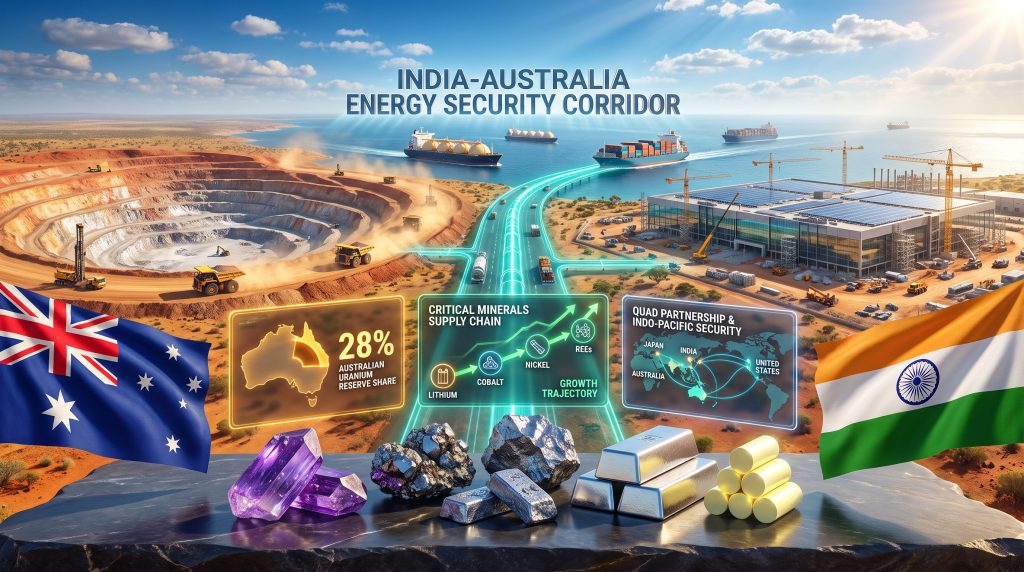
Nowhere is this reconfiguration more consequential than between India and Australia. What began as a relatively conventional resource-trade relationship has evolved into the architecture of something far more ambitious: the India-Australia Energy Security Corridor, a multi-layered strategic framework spanning critical minerals, civil nuclear cooperation, green hydrogen, battery manufacturing, and maritime logistics resilience across the Indo-Pacific.
The corridor concept was the subject of a dedicated policy dialogue convened by CUTS International in association with the Rajasthan International Centre in Jaipur, bringing together policymakers, researchers, and strategic affairs specialists to examine how both nations can operationalise this partnership against an increasingly volatile geopolitical backdrop.
When big ASX news breaks, our subscribers know first
Why Energy Security Now Means More Than Fuel Supply
The traditional definition of energy security centred almost entirely on the availability and affordability of oil, gas, and coal. That framework is now strategically obsolete. Lisa Singh, Chief Executive Officer of the Australia India Institute in Melbourne, articulated this evolution clearly during the policy dialogue, observing that the energy security transition now begins with access to critical minerals and extends outward across mining, refining, manufacturing, logistics, and trusted bilateral supply chains.
This is not merely rhetorical expansion. It reflects a hard structural reality: the clean energy transition has created an entirely new category of supply chain vulnerability. Solar panels require polysilicon and silver. Wind turbines depend on rare earth elements for permanent magnets. Electric vehicle batteries consume lithium, cobalt, nickel, and manganese at industrial scale. Every megawatt of renewable capacity installed anywhere in the world draws on a mineral supply chain that, today, remains alarmingly concentrated.
Geopolitical disruptions have already demonstrated the fragility of this system. Conflicts in West Asia, maritime chokepoint pressures, and pandemic-era logistics collapses have shown how localised shocks transmit rapidly into region-wide economic instability. For the Indo-Pacific, which accounts for a disproportionate share of global energy demand growth, this fragility carries exceptional strategic risk.
Furthermore, critical minerals demand continues to intensify across clean energy sectors, compounding the urgency of building resilient supply chains across trusted allied-nation networks.
The clean energy transition paradoxically risks replicating the supply concentration vulnerabilities of the fossil fuel era, but in critical minerals rather than hydrocarbons. Nations that fail to diversify mineral and processing supply chains now face the prospect of strategic dependency in a decarbonised economy.
The Five Pillars of the India-Australia Energy Security Corridor
The corridor is not a single agreement or commodity deal. It is a proposed strategic architecture organised around five interconnected dimensions:
- Critical minerals supply and joint processing covering lithium, cobalt, nickel, and rare earth elements
- Civil nuclear cooperation, including uranium exports from Australia to India under international safeguards frameworks
- Low-carbon and clean fuel development, encompassing green hydrogen, green steel, and electrification pathways
- Energy trade continuity, including LNG flows from Australia and refined liquid fuels from India
- Maritime logistics and supply chain resilience across Indo-Pacific shipping corridors
Each pillar reinforces the others. Uranium supply strengthens baseload energy security while critical minerals underpin the renewables buildout. Green hydrogen creates export pathways for both nations while battery manufacturing absorbs critical mineral output further up the value chain.
Complementary Strengths: Why This Bilateral Partnership Has Structural Logic
The India-Australia Energy Security Corridor works because both nations possess what the other needs. This is not diplomatic convenience but genuine economic complementarity.
Australia's Critical Mineral Endowment
Australia's resource base positions it as one of the few nations capable of supplying the full input spectrum required for both the clean energy transition and advanced manufacturing. The scale of this endowment is significant:
| Critical Mineral | Australia's Global Standing | Strategic Relevance |
|---|---|---|
| Lithium | World's largest producer | EV batteries, grid-scale storage |
| Cobalt | Top-tier reserves | Battery cathodes, aerospace applications |
| Nickel | Major global supplier | Battery anodes, stainless steel |
| Rare Earth Elements | Significant deposits | Wind turbines, electronics, defence systems |
| Uranium | Holds approximately 28% of world's known reserves | Civil nuclear power generation |
Despite this endowment, Australia's domestic processing capacity remains materially underdeveloped relative to the size of its reserves. A substantial portion of Australia's critical mineral output is exported in raw or semi-processed form, capturing limited value and leaving the supply chain exposed to processing chokepoints elsewhere. Australia's green metals leadership agenda is, however, increasingly focused on addressing this gap through targeted industrial policy and bilateral investment frameworks.
India's Manufacturing Ambition and Demand-Side Scale
India brings a different but equally powerful set of assets. Its manufacturing sector is among the world's fastest-expanding, with government-backed Production-Linked Incentive schemes targeting advanced chemistry cell batteries, electronics, and clean energy equipment. India's renewable energy targets are among the most ambitious globally, creating long-term structural demand for the exact minerals Australia holds in abundance.
Bipul Chattopadhyay, Executive Director of CUTS International, framed the strategic shift with clarity during the dialogue, noting that India's lithium strategy is no longer oriented exclusively toward Western suppliers. Australia has consequently emerged as a key strategic energy partner in India's eastward pivot, with the bilateral relationship now carrying weight that extends well beyond conventional commodity trade.
Where Australia has world-class mineral resources but limited processing scale, India has manufacturing ambition and demand depth but constrained mineral access. The corridor is designed to convert this asymmetry into a mutually reinforcing industrial partnership.
Critical Minerals: The Corridor's Industrial Foundation
Moving Beyond the Buyer-Seller Model
The most strategically significant dimension of the corridor is its explicit ambition to move beyond transactional commodity trade. Historically, resource-rich nations export raw or semi-processed materials to manufacturing economies, capturing minimal value while remaining exposed to price volatility. The corridor framework targets a fundamentally different model:
- Joint critical mineral processing facilities co-invested by Indian and Australian entities
- Battery technology development and manufacturing scale-up leveraging Australian minerals and Indian industrial capacity
- Green steel production combining Australian iron ore with Indian manufacturing expertise
- Collaborative research institutions focused on processing innovation and clean energy technology
- Skills development and workforce exchange programmes spanning mining, processing, and advanced manufacturing
The Processing Concentration Problem
Understanding why joint processing investment matters requires grasping the depth of the current concentration problem. Global critical mineral processing, particularly for rare earth elements and battery-grade lithium and cobalt, is overwhelmingly concentrated in a single dominant geography. This creates systemic supply chain risk for every nation dependent on clean energy technologies, regardless of their own mineral reserves.
Pradeep S. Mehta, Secretary General of CUTS International, highlighted at the policy dialogue that India's accelerating transition toward renewable and nuclear energy makes reducing this processing dependency a national strategic priority. The corridor provides a vehicle for both India and Australia to build processing capacity within a trusted allied-nation framework, reducing collective exposure to third-party chokepoints.
Diversifying processing geography across Quad-aligned partners including India and Australia is now viewed as a strategic imperative by multilateral energy bodies and G7 economies alike. The Australia India Institute's analysis of Indo-Pacific resilience further reinforces the case for embedding this bilateral corridor within a broader multilateral framework.
Civil Nuclear Cooperation: Uranium as a Strategic Energy Asset
The Landmark Uranium Supply Commitment
Australia holds approximately 28% of the world's known uranium reserves, making it one of the most consequential potential suppliers for nations expanding civil nuclear programmes. India's nuclear energy capacity is projected to grow substantially over the coming decades as part of its long-term baseload strategy, complementing intermittent renewable generation during the transition period.
A pivotal development underpinning the corridor's nuclear dimension was the outcome of the annual India-Australia Leaders' Summit between Prime Minister Narendra Modi and Australian Prime Minister Anthony Albanese. Australia formally committed to serving as a reliable uranium supplier to India under international safeguards, a development that qualitatively shifted the bilateral energy relationship into strategic territory previously inaccessible. In addition, uranium market dynamics suggest that long-term supply agreements of this nature carry significant commercial as well as strategic value.
Nuclear Liability Reform as an Enabling Condition
For years, India's nuclear liability legislation created meaningful barriers to international reactor technology investment and fuel supply agreements, creating commercial and legal uncertainty that deterred foreign engagement with India's civil nuclear programme. Reforms to this framework have materially improved the operating environment for international civil nuclear cooperation, opening new avenues for the kind of long-duration supply relationships that underpin genuine energy security.
This reform trajectory, combined with the uranium supply commitment, positions nuclear energy as a durable long-term pillar of the corridor rather than a peripheral or aspirational element.
The next major ASX story will hit our subscribers first
Green Hydrogen and Battery Technologies: Building Tomorrow's Value Chains
Green Hydrogen as a Shared Strategic Priority
Both India and Australia have identified green hydrogen as a priority pathway for industrial decarbonisation and potential export revenue. Australia's exceptional renewable energy resource base combined with available land area positions it as a credible large-scale green hydrogen producer for Asian markets. India's industrial hydrogen demand, particularly in fertilisers, steel production, and petroleum refining, creates a natural long-term import market even as India's own national hydrogen mission targets domestic production growth.
The corridor framework envisions bilateral cooperation spanning electrolyser manufacturing, technology development, and export logistics infrastructure, creating a green hydrogen supply chain anchored in allied-nation capacity.
Battery Manufacturing: The Central Industrial Battleground
The global battery supply chain, from mineral extraction through cell manufacturing to pack assembly, represents the critical industrial competition of the clean energy era. India's PLI schemes targeting advanced chemistry cell manufacturing align directly with Australia's strategic interest in capturing more value from its lithium and cobalt reserves rather than exporting them as raw feedstock.
Bilateral cooperation in battery technology offers a pathway to building an integrated supply chain that reduces dependence on any single external supplier, creates industrial employment in both countries, and generates shared intellectual property in next-generation battery chemistries and processing technologies.
The Quad Dimension: Multilateral Architecture for a Bilateral Corridor
The India-Australia Energy Security Corridor does not exist in isolation. The Quadrilateral Security Dialogue, comprising Australia, India, Japan, and the United States, provides an existing multilateral architecture within which the bilateral corridor can be embedded and amplified.
Singh identified Japan and Singapore as natural complementary partners during the policy dialogue, noting that both nations can contribute technology investment, logistics infrastructure, and financing capacity to the broader Indo-Pacific supply chain resilience agenda. Japan's advanced manufacturing capabilities and Singapore's role as a regional financial and logistics hub create specific points of integration that would strengthen the corridor's operational depth.
The Quad's Critical Minerals Working Group and related institutional mechanisms provide channels for multilateralising what begins as a bilateral framework, distributing both the investment burden and the strategic benefits across a wider allied-nation architecture. The joint statement on energy security released following the Leaders' Summit further cements the diplomatic foundation upon which this multilateral expansion can be built.
Challenges: From Diplomatic Declaration to Industrial Reality
The Implementation Gap
Significant bilateral frameworks have been established through summit diplomacy, policy dialogues, and joint statements. The challenge that now confronts both governments is translating these declaratory commitments into operational industrial partnerships with measurable milestones. Singh acknowledged directly at the policy dialogue that while meaningful progress has been achieved through initiatives such as the Australia-India Renewable Energy Partnership and joint skills programmes, the next phase must be defined by implementation rather than further framework-building.
Structural and Financing Barriers
Several concrete obstacles must be navigated:
- Differences in regulatory environments and environmental approval timelines between India and Australia create friction for joint venture structuring
- Workforce capability gaps in mineral processing and advanced manufacturing require coordinated investment before large-scale industrial cooperation can be operationalised
- Infrastructure deficits in port capacity, rail connectivity, and energy supply to processing sites require parallel public investment
- Large-scale critical mineral and battery manufacturing projects carry substantial capital requirements and long payback periods, demanding blended finance mechanisms combining development finance institutions, export credit agencies, and private capital
Three Scenarios for Corridor Development
| Scenario | Timeline | Key Indicators |
|---|---|---|
| Accelerated Integration | 2025-2030 | Joint processing investments financed within 24 months; uranium shipments commenced; bilateral battery R&D operational |
| Incremental Progress | 2025-2032 | LNG and liquid fuels trade deepens as near-term anchor; long-term industrial cooperation develops gradually |
| Structural Stall (Risk Case) | Ongoing risk | Domestic political cycles deprioritise bilateral investment; commodity price volatility reduces commercial incentive |
The Long-Term Strategic Stakes
If successfully implemented, the India-Australia Energy Security Corridor carries significance well beyond the bilateral relationship. It could serve as a replicable model for Indo-Pacific supply chain architecture more broadly, demonstrating that allied-nation industrial partnerships can address the full value chain from mineral extraction through processing, manufacturing, and logistics, rather than isolated commodity trade.
For India, the corridor accelerates the eastward diversification of energy partnerships and reduces exposure to concentrated supply dependencies that would otherwise constrain its clean energy ambition. For Australia, it transforms a world-class mineral endowment from a commodity export base into a strategic industrial asset embedded within allied-nation manufacturing ecosystems.
The participants in the CUTS International policy dialogue reached a shared conclusion that carries weight beyond the event itself: energy security in the 21st century can no longer be evaluated purely through a production lens. The new calculus encompasses mineral access, processing geography, manufacturing capability, logistics resilience, and the political reliability of supply partners. The India-Australia Energy Security Corridor, if it progresses from dialogue to delivery, addresses all of these dimensions simultaneously.
The corridor's success will ultimately be determined not by the ambition of its diplomatic declarations, but by the speed and depth of its industrial implementation, measured in processing facilities commissioned, battery supply chains built, nuclear fuel agreements operationalised, and the workforce capabilities that underpin them all.
Disclaimer: This article is intended for informational purposes only and does not constitute financial or investment advice. Forward-looking statements and scenario projections involve inherent uncertainty and should not be relied upon as predictions of future outcomes.
Want to Track the ASX Mineral Discoveries Powering the Clean Energy Transition?
As the India-Australia Energy Security Corridor reshapes global critical mineral supply chains, Discovery Alert's proprietary Discovery IQ model delivers real-time alerts on significant ASX mineral discoveries — instantly translating complex geological announcements across lithium, uranium, rare earths, and beyond into actionable investment insights. Explore Discovery Alert's dedicated discoveries page to understand how historic mineral discoveries have generated substantial market returns, and begin your 14-day free trial today to position yourself ahead of the next major find.