July 8, 2026
When Presidential Words Move Markets: The Oil Price Surge Explained
Few forces reshape commodity markets as rapidly as geopolitical uncertainty concentrated in a single maritime corridor. The global oil system, despite decades of diversification rhetoric, remains structurally tethered to a narrow strip of water between Iran and Oman. When that corridor becomes contested, the consequences ripple through futures markets, shipping lanes, refinery procurement desks, and consumer fuel prices within hours. Understanding why oil surges as Trump signals more strikes on Iran requires examining not just the immediate military events, but the deeper architecture of global energy vulnerability that makes those events so consequential.
When big ASX news breaks, our subscribers know first
From Ceasefire Optimism to Renewed Crisis: A Timeline
The second quarter of 2026 had generated genuine optimism across energy markets. A June ceasefire agreement between Washington and Tehran reopened the Strait of Hormuz to commercial traffic, eased sanctions pressure on Iranian crude exports through a U.S. Treasury-administered waiver mechanism, and drove Brent crude oil price trends into a sustained decline as supply expectations improved. Traders repositioned toward bearish supply-glut narratives, and the geopolitical risk premium that had inflated prices through much of 2025 began to compress.
That narrative collapsed within weeks. A series of coordinated maritime attacks on commercial vessels transiting the strait, including a Qatari LNG carrier and two large crude tankers, represented the most severe single-day assault on commercial shipping since the ceasefire took effect. Washington attributed the attacks directly to Iranian forces, triggering an immediate policy response. The U.S. conducted strikes against more than 80 targets inside Iran and revoked the sanctions waiver that had allowed Tehran to resume meaningful crude export volumes, effectively placing millions of barrels per month of Iranian oil back under full enforcement restrictions.
Then came the remarks from Ankara. Speaking at the NATO summit in Turkey, President Trump confirmed overnight strikes and indicated further military action was likely. The comments diverged sharply from earlier messaging about lowering global energy costs, and that credibility gap amplified the market reaction considerably.
Markets do not wait for military action to occur. When a sitting U.S. president publicly signals that additional strikes are probable, crude futures reprice forward supply risk within minutes. The statement itself becomes the supply disruption event.
The Price Reaction: What the Numbers Reveal
The oil price response was immediate and substantial, though the intraday dynamics revealed important nuances about how markets were processing multiple simultaneous signals.
| Benchmark | Intraday Movement | Level Reached | Context |
|---|---|---|---|
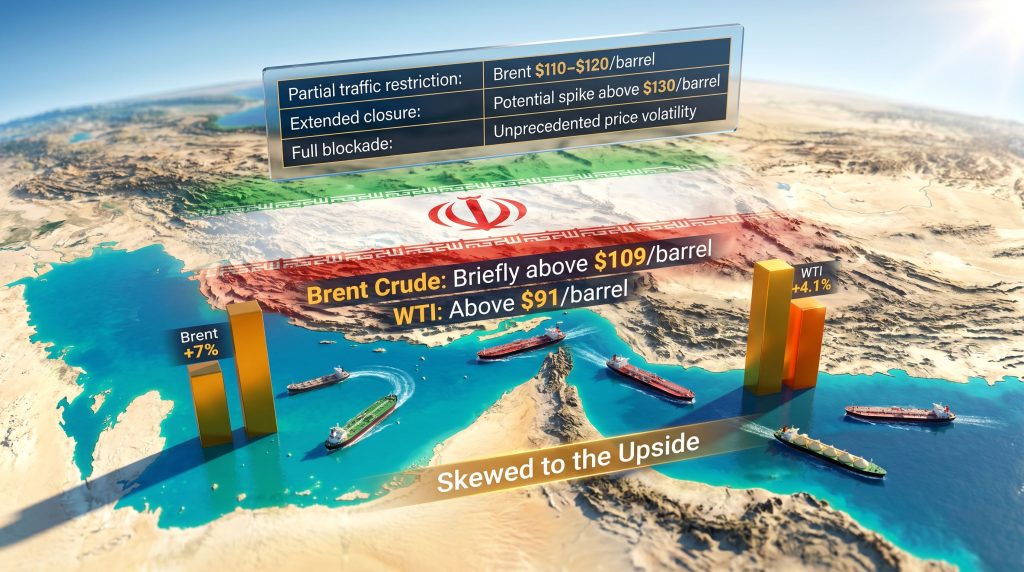
| Brent Crude | +7% intraday | Briefly above $109/barrel | Reversed months of Q2 softening |
| WTI Crude | +4.1% advance | Above $91/barrel | Sharp reversal from earlier session losses |
Both benchmarks trimmed gains after the initial spike, a pattern consistent with markets attempting to simultaneously price in escalation risk and assign non-trivial probability to de-escalation outcomes. This behaviour is technically described as a geopolitical risk premium being partially discounted by uncertainty around the conflict's trajectory.
The equity market response told a parallel story. Asian equities declined as the oil price rally unfolded, illustrating the dual-sided economic pressure that energy supply shocks create. Higher crude prices simultaneously increase input costs for manufacturers, compress consumer discretionary spending through elevated fuel prices, and raise inflation expectations that complicate central bank policy. This equity-oil divergence pattern has historical precedent: similar dynamics played out following the September 2019 drone strikes on Saudi Arabia's Abqaiq and Khurais oil processing facilities, and again during the early weeks of Russia's 2022 invasion of Ukraine.
Critically, market data from this same period demonstrates just how bi-directional oil price sensitivity has become. When separate signals emerged suggesting Iran might halt aggression, Brent crude reportedly fell approximately 3.4%, with prices briefly approaching the mid-$60s per barrel range. That implies a potential price corridor of more than $40 per barrel between full escalation and full diplomatic resolution, a spread that quantifies the extraordinary geopolitical risk premium currently embedded in crude futures.
The Strait of Hormuz: Anatomy of the World's Most Consequential Chokepoint
Why No Alternative Route Exists
The Strait of Hormuz is approximately 33 kilometres wide at its narrowest navigable point. Through this passage flows a disproportionate share of global seaborne crude oil and liquefied natural gas, originating from Saudi Arabia, Iraq, Kuwait, the UAE, Qatar, and Iran itself. The structural problem for global energy security is straightforward: no short-term alternative export corridor exists for Persian Gulf producers to redirect equivalent volumes at comparable cost or speed.
Saudi Arabia operates the East-West Pipeline (Petroline) that can divert some crude to Red Sea terminals, bypassing the strait entirely, but its capacity represents only a fraction of normal Hormuz throughput. For Qatar, which supplies a substantial share of global LNG, no bypass pipeline exists at all. When Hormuz is threatened, Qatar's LNG export capacity is threatened by extension.
Following the maritime attacks, Western naval forces formally elevated the threat level for merchant shipping in the region from substantial to severe, a classification escalation that carries significant practical consequences for insurance underwriters, shipping operators, and cargo owners.
Iran's Maritime Authority Claim and International Law
Iran communicated to the International Maritime Organization that it maintains authority over portions of the strait and that vessel transits require its approval. This position conflicts directly with the United Nations Convention on the Law of the Sea (UNCLOS), which codifies the right of transit passage through international straits used for international navigation. Under UNCLOS, all ships and aircraft enjoy the right of continuous and expeditious transit through such straits, and coastal states cannot suspend or impose prior approval requirements on that passage.
Iran's legal claim is not recognised under the international framework, but the operational reality diverges from the legal position. Reports of tankers turning back mid-transit, even as others continued, created a bifurcated risk environment that shipping operators must navigate in real time, often without clear intelligence on which vessels face interdiction risk.
Scenario Modelling: Three Disruption Levels
| Disruption Scenario | Estimated Supply Impact | Price Implication |
|---|---|---|
| Partial restriction (30-50% throughput) | Moderate supply tightening | Brent $110-$120/barrel range |
| Extended closure (weeks) | Severe supply shock | Potential spike above $130/barrel |
| Full blockade with naval escalation | Structural market crisis | Unprecedented price volatility |
These scenarios are illustrative projections based on historical disruption modelling frameworks and do not represent guaranteed price outcomes. Oil markets involve significant uncertainty and multiple variables beyond supply disruption alone.
Sanctions Mechanics: What the Waiver Revocation Actually Does
Understanding why the sanctions waiver revocation amplifies the supply shock requires understanding how these mechanisms function operationally.
A sanctions waiver, administered by the U.S. Treasury's Office of Foreign Assets Control (OFAC), creates a temporary legal carve-out allowing specified countries or entities to transact with sanctioned parties without incurring U.S. penalties. Following the June 2026 ceasefire, Iran had resumed meaningful crude export volumes under such a waiver, and Asian refiners, particularly in China, India, and South Korea, had quietly reintegrated Iranian crude into their procurement mix. Iranian crude typically trades at a significant discount to Brent, making it commercially attractive for cost-sensitive refiners.
The waiver's revocation does several things simultaneously:
- It removes the legal protection that allowed importing countries to purchase Iranian crude without U.S. penalty exposure
- It forces Asian refiners to seek alternative supply sources rapidly, creating spot market demand pressure that pushes benchmark prices higher
- It signals a return to maximum-pressure sanctions enforcement, which reduces Iran's export revenue and foreign currency earnings
- It compounds the military escalation by creating an economic dimension to the supply shock, meaning fewer Iranian barrels are accessible even if the strait remains physically open
The combination of active military escalation and simultaneous sanctions reimposition creates a compounding supply shock. This is not merely a geopolitical risk premium reflected in futures pricing; it represents an actual and near-immediate reduction in barrels accessible to international buyers.
Analyst Perspectives and Market Psychology
UBS Group commodity analyst Giovanni Staunovo noted that renewed Middle East tensions and concerns about potential reductions in regional oil export volumes were providing direct price support, with the crude outlook carrying risks skewed toward further upside given the trajectory of U.S.-Iran hostilities at the time of the remarks.
This shift from bearish to risk-premium-dominated pricing frameworks happened within days, illustrating a critical dynamic in how energy markets process geopolitical information. Fundamental supply-demand models that had pointed toward improving balances through the second half of 2026 were rapidly displaced by scenario-based geopolitical pricing models that assign probability weights to escalation outcomes. Furthermore, the trade war impact on oil prices from earlier in the year had already conditioned markets to respond swiftly to policy signals.
From a market psychology perspective, the current environment exhibits several distinctive characteristics:
- Reflexivity: Presidential statements become self-fulfilling supply signals because market reactions to the statements can themselves influence subsequent political and military decisions
- Asymmetric sensitivity: Escalation signals produce larger and faster price moves than equivalent de-escalation signals, because supply disruption risk is easier to quantify than diplomatic resolution timelines
- Liquidity dynamics: During acute geopolitical episodes, bid-ask spreads in crude futures widen and market depth decreases, amplifying intraday price swings beyond what fundamental supply changes would justify
The next major ASX story will hit our subscribers first
LNG Markets: The Crisis Dimension Beyond Crude Oil
The attack on a Qatari LNG carrier introduces a dimension of this crisis that receives less attention than crude oil but carries significant implications for European and Asian energy security. In particular, the LNG supply outlook for the region has become markedly more uncertain as a result of the ongoing hostilities.
Qatar is the world's largest LNG exporter. European buyers, who dramatically expanded Qatari LNG procurement after Russian pipeline gas supplies collapsed following the 2022 invasion of Ukraine, now face renewed exposure to Middle East maritime transit risk through the same waterway that threatens crude supply. European LNG import infrastructure, built and expanded at considerable cost since 2022, depends on supply chains that run directly through Hormuz.
Asian LNG buyers face a dual pressure point: higher spot LNG prices driven by supply uncertainty, and reduced procurement flexibility from a region that represents a cornerstone of seaborne LNG trade. Japan, South Korea, and Taiwan, all of which rely heavily on imported LNG for power generation, have limited short-term alternatives if Qatari supply becomes unreliable.
Policy Responses Being Watched Across Energy Markets
Several near-term policy responses will shape how the oil surge develops in the weeks ahead:
- Strategic Petroleum Reserve decisions: Western governments, led by the U.S. and coordinated through the International Energy Agency, may consider coordinated SPR releases to signal supply adequacy and cap price spikes
- Naval escort protocols: NATO member coordination on commercial tanker escort arrangements through contested waters could reduce insurance risk premiums and partially restore shipping confidence
- Alternative supply acceleration: Non-Middle Eastern producers including U.S. shale operators, West African exporters, and Norwegian North Sea producers may face accelerated procurement interest from buyers seeking to reduce Hormuz exposure
- OPEC+ response calculus: OPEC's influence on oil markets creates an internal tension between benefiting from higher prices and the long-term demand destruction risk that sustained high oil prices accelerate
Frequently Asked Questions
Why did oil prices surge when Trump signalled more strikes on Iran?
Iran is a major crude producer and the Strait of Hormuz, which borders Iranian waters, serves as the primary export corridor for Persian Gulf crude and LNG. Any credible military escalation threat prompts traders to immediately price potential supply disruptions into futures contracts, driving benchmark prices sharply higher before any physical supply disruption necessarily occurs.
What is a sanctions waiver and why does its revocation matter?
A sanctions waiver is a temporary legal mechanism that allows designated countries to purchase goods from a sanctioned nation without facing U.S. penalties. When revoked, importing countries lose that legal protection and must rapidly source supply elsewhere, tightening global spot markets and adding upward price pressure beyond whatever geopolitical risk premium is already embedded in futures.
What is the difference between Brent and WTI crude prices?
Brent crude, priced in the North Sea, serves as the primary international benchmark used across Europe, Asia, and Africa. WTI, or West Texas Intermediate, is the U.S. domestic benchmark. During Middle East supply disruptions, Brent typically responds more sharply because it prices seaborne crude most directly exposed to regional transit risk, explaining why Brent's intraday move of up to 7% exceeded WTI's 4.1% advance.
Could prices reverse sharply if diplomacy resumes?
Available market data from this period confirms they can. As global leaders work to ease the oil price surge, Brent fell approximately 3.4% on separate occasions when signals of potential de-escalation or Iranian willingness to negotiate emerged. The current crude market is consequently functioning less as a supply-demand equilibrium mechanism and more as a geopolitical sentiment index with extreme sensitivity in both directions.
Key Takeaways for Energy Market Participants
- The speed of the Q2 2026 narrative reversal, from supply optimism to acute geopolitical risk premium within days, demonstrates the structural fragility of market confidence when it depends on political stability in contested regions
- The Strait of Hormuz remains the single most consequential energy chokepoint globally, and Iran's assertion of transit authority over it represents a persistent systemic risk that no short-term infrastructure investment can eliminate
- Compounding supply shocks, where military escalation and sanctions reimposition occur simultaneously, create fundamentally different market conditions than either factor alone would produce
- LNG market exposure through the same transit corridor adds a European and Asian energy security dimension that extends well beyond crude oil pricing
- Energy diversification away from Middle East supply concentration remains structurally incomplete for the majority of large importing nations, leaving global markets vulnerable to exactly this type of rapid repricing event
Disclaimer: This article contains forward-looking analysis, scenario modelling, and price projections that involve significant uncertainty. Oil markets are influenced by a wide range of variables including geopolitical developments, OPEC+ policy decisions, macroeconomic conditions, and currency movements. Nothing in this article constitutes financial or investment advice. Readers should conduct independent research before making any investment decisions.
Want to Stay Ahead of the Next Major Commodity Discovery?
While geopolitical shocks like the U.S.-Iran escalation dominate energy headlines and compress markets within hours, Discovery Alert's proprietary Discovery IQ model monitors ASX announcements in real time, instantly identifying significant mineral discoveries across more than 30 commodities and translating complex data into clear, actionable opportunities — explore historic discovery returns on Discovery Alert's discoveries page to see what early positioning can mean, and begin your 14-day free trial today to ensure you're never behind the market when the next major find is announced.