June 15, 2026
The Hidden Architecture of Oil's Conflict Premium
Crude oil markets operate on two distinct pricing layers. The first reflects physical supply and demand fundamentals: production volumes, refinery throughput, inventory cycles, and consumption trends. The second layer is less visible but often more powerful in the short term: the risk premium embedded in prices because the world's most critical energy infrastructure sits inside one of its most volatile geopolitical regions.
Understanding how this second layer behaves, and what strips it away, is essential for anyone interpreting why oil prices fall on Iran peace talks with such speed and severity. Furthermore, crude oil price trends over recent years illustrate just how sensitive markets are to diplomatic signals.
When big ASX news breaks, our subscribers know first
What the Strait of Hormuz Risk Premium Actually Represents
The Strait of Hormuz is a 33-kilometre-wide maritime passage between Iran and Oman. Despite its modest physical dimensions, it functions as the circulatory system of global energy supply, with approximately 20% of the world's daily crude oil moving through its waters. Estimates place that flow at roughly 17 to 21 million barrels per day under normal operating conditions.
When conflict threatens that corridor, crude prices do not simply reflect reduced supply. They reflect the probability of reduced supply, multiplied by the severity of what a closure would mean for oil-importing economies with no immediate alternative. This probability-weighted fear is the geopolitical risk premium. The geopolitical oil price drivers at play here are deeply structural and recurring.
Historical benchmarks illustrate how large this premium can grow:
- During the 1990 Gulf War, crude prices spiked by roughly $15 to $25 per barrel above pre-conflict levels before collapsing as military outcomes became clear.
- The 2019 drone strikes on Saudi Arabia's Abqaiq processing facility briefly added an estimated $8 to $12 per barrel in a single trading session.
- Russia's 2022 invasion of Ukraine sustained a risk premium of approximately $10 to $20 per barrel across several months as supply rerouting costs and sanctions uncertainty persisted.
What makes the Hormuz premium unique is the absence of credible alternatives at scale. The Abu Dhabi Crude Oil Pipeline, which bypasses the strait entirely, offers partial relief but cannot absorb the full volume of Hormuz transit flows. This structural bottleneck means that even a partial closure creates outsized price responses relative to the actual barrels affected.
The May 21, 2026 Market Session: A Case Study in Rapid Repricing
How Diplomatic Signals Translated Directly Into Price Action
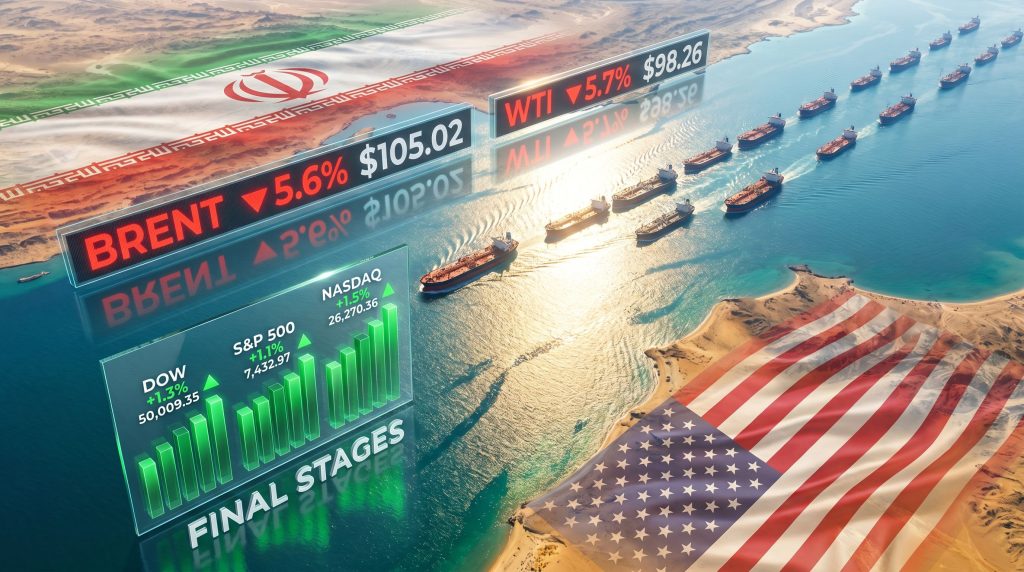
On May 21, 2026, two separate catalysts converged to accelerate crude's decline. The first came early in the trading session when Iran's Revolutionary Guards confirmed they had permitted 26 commercial vessels to transit the Strait of Hormuz across a 24-hour window, including a South Korea-flagged tanker. Traders interpreted this as a confidence-building gesture, signalling that the hard closure of the strait was being selectively relaxed.
The second, more powerful catalyst arrived later in the morning when U.S. President Donald Trump stated publicly that American negotiators were in the advanced stages of reaching an accord with Iran. Trump described the situation as being on the boundary between a completed deal and a return to military action, introducing what traders immediately processed as a binary risk scenario. Consequently, oil markets under trade war conditions had already primed investors to react sharply to any diplomatic breakthrough.
The market response was swift and significant:
- Brent North Sea Crude fell 5.6% to $105.02 per barrel
- West Texas Intermediate (WTI) dropped 5.7% to $98.26 per barrel, breaking below the psychologically significant $100 threshold
The speed of this repricing illustrates a core principle of commodity markets: traders do not wait for formal agreements. They price the probability distribution of outcomes in real time, and when credible signals shift that distribution toward resolution, long positions are unwound before any ink is dry.
Why WTI Falling Below $100 Matters Beyond the Number
Round-number price levels carry disproportionate significance in futures markets. The $100 per barrel threshold for WTI functions as a psychological anchor for both retail participants and systematic trading strategies. When WTI breached that level to the downside, it likely triggered pre-programmed sell orders and momentum signals across algorithmic systems, amplifying the organic selling pressure from geopolitical repricing.
Crucially, WTI remaining well above pre-conflict price levels even after the selloff indicated that markets were not pricing a full resolution. A credibility discount was firmly in place. According to Reuters reporting on this session, crude markets remained cautiously positioned despite the scale of the intraday move.
Global Equity Markets: The Mirror Image of the Oil Selloff
Falling crude prices during geopolitical de-escalation events tend to produce equity market rallies through a well-understood transmission mechanism. Lower oil prices reduce inflationary pressure, which in turn softens inflation expectations embedded in bond markets, which causes yields to decline, which lowers the discount rate applied to future corporate earnings, which raises the present value of equities.
On May 21, that chain reaction played out across Western markets:
| Market Index | Movement | Closing Level |
|---|---|---|
| Dow Jones Industrial Average | +1.3% | 50,009.35 |
| S&P 500 | +1.1% | 7,432.97 |
| Nasdaq Composite | +1.5% | 26,270.36 |
| FTSE 100 (London) | +1.0% | 10,432.34 |
| CAC 40 (Paris) | +1.7% | 8,117.42 |
| DAX 30 (Frankfurt) | +1.4% | 24,737.24 |
| Nikkei 225 (Tokyo) | -1.2% | 59,804.41 |
| Hang Seng (Hong Kong) | -0.6% | 25,651.12 |
| Shanghai Composite | -0.2% | 4,162.18 |
The Time-Zone Asymmetry Explaining Asian Declines
The divergence between Western and Asian market performance is not a contradiction. Asian markets had already closed or were deep into their trading sessions before Trump's statements emerged, meaning their price action reflected the prior session's Wall Street losses rather than the peace-talk catalyst. This time-zone asymmetry in geopolitical price discovery is a structural feature of 24-hour global markets that frequently misleads casual observers into assuming contradictory signals.
The Nasdaq's relative outperformance among U.S. indices was also partly attributable to anticipated earnings from a major semiconductor manufacturer, with the chip sector's results representing a separate, independent catalyst layered on top of the geopolitical repricing. Jack Ablin of Cresset Capital noted that positive results from major big-box retailers provided an additional earnings tailwind alongside the diplomatic optimism, creating a compounding effect on risk sentiment.
The Credibility Discount: Why Investors Remained Cautious
One of the most instructive aspects of the May 21 session was what did not happen. Despite a 5.6% crude decline and broad equity market gains, WTI remained far above pre-conflict levels, and implied volatility in crude options did not collapse. Markets were processing a partial, not complete, removal of the risk premium.
Jack Ablin of Cresset Capital captured the prevailing investor psychology by noting that two months of diplomatic signals from the Trump administration had conditioned market participants to treat presidential statements as directionally informative rather than conclusively actionable. The pattern of repeated near-deal announcements without formal outcomes had introduced a discounting mechanism into how traders weighted White House statements.
Viktoria Kuszak of Sucden Financial characterised oil as the central macro pressure point in the current environment, observing that elevated yields, a firm dollar, and unresolved energy risk were collectively constraining broader risk appetite. She noted that Nvidia's earnings represented the next significant test for equity sentiment beyond the geopolitical narrative.
This credibility discount is a sophisticated behavioural feature of mature financial markets. It reflects the accumulated memory of failed diplomatic cycles encoded into institutional positioning models. However, the crude oil market overview suggests that even partial de-escalation signals can produce meaningful near-term price relief.
Bond Yields, the Fed, and the Three-Way Feedback Loop
Why 30-Year Treasury Yields Matter to Oil Traders
Before the diplomatic signals emerged, yields on the 30-year U.S. Treasury bond had reached a 19-year peak, driven significantly by persistent inflation expectations that elevated energy costs were reinforcing. This created a feedback loop: high oil prices fed inflation expectations, which pushed yields higher, which strengthened the dollar, which increased the cost of dollar-denominated oil imports for emerging markets, which compressed demand while simultaneously sustaining energy-driven price pressure.
The crude price decline on May 21 directly interrupted this loop by softening near-term inflation expectations, allowing the 30-year yield to retreat from its multi-decade high. The yield pullback then provided supplementary support to equity valuations. In addition, oil price movements throughout 2025 had already demonstrated how tightly energy costs and Treasury yields were correlated.
Federal Reserve meeting minutes released around the same period confirmed that a majority of FOMC policymakers considered further interest rate increases necessary if inflation remained persistently above the 2% target. A sustained diplomatic resolution that structurally reduced energy costs could materially alter that calculus, shifting the Fed's forward guidance in ways that would have second-order effects across virtually every asset class.
The next major ASX story will hit our subscribers first
Scenario Modelling: Three Pathways From Here
The following scenario analysis involves forward-looking projections and assumptions. It does not constitute financial advice, and actual outcomes may differ materially from those described.
Scenario 1: Full Peace Accord and Hormuz Reopening
A formally concluded agreement restoring full Hormuz transit would likely push Brent toward the $80 to $90 per barrel range as the conflict premium fully unwinds. The downstream consequences would include meaningful inflationary relief across major importing economies, including India, Japan, South Korea, and the eurozone. OPEC+ would face a strategic recalibration challenge as Iranian supply potentially re-enters global markets at scale.
Scenario 2: Partial De-escalation Without Formal Agreement
Under this pathway, Brent stabilises in the $100 to $110 range as reduced but unresolved conflict risk is priced into futures. Hormuz remains selectively open, introducing ongoing logistical uncertainty for tanker operators and sustaining a partial risk premium. Bond yields remain elevated, limiting equities from fully repricing lower discount rates.
Scenario 3: Talks Collapse and Escalation Resumes
A breakdown in negotiations accompanied by resumed military operations could drive crude toward $120 to $130+ per barrel, particularly if Hormuz closes entirely. Global recession risk would increase materially, confronting central banks with a stagflationary dilemma: rising energy-driven inflation alongside deteriorating growth conditions. The Guardian's analysis of collapsed US-Iran talks outlines in detail how rapidly such an energy shock could materialise.
The asymmetric risk profile across these three scenarios is critical. Escalation produces larger price spikes than de-escalation produces price declines, reflecting the limited spare capacity within OPEC+ and the absence of alternative supply routes capable of absorbing Hormuz volumes at scale.
Currency Markets and the Dollar's Dual Role
Currency movements during the May 21 session reflected reduced safe-haven demand as diplomatic optimism took hold:
- Euro/dollar moved to 1.1629 from 1.1605, as dollar strength moderated
- Pound/dollar strengthened to 1.3442 from 1.3395
- Dollar/yen eased to 158.89 from 159.07, signalling reduced flight-to-safety flows
The dollar's role in oil markets creates a layered dynamic. A weaker dollar makes dollar-denominated crude cheaper for non-U.S. buyers, stimulating demand. However, a weaker dollar also reflects reduced risk aversion, which tends to accompany lower oil prices during de-escalation cycles. These two forces can partially offset each other, which is why currency movements during geopolitical transitions require careful disaggregation from the fundamental price signal.
The Structural Problem That Keeps Recurring
Regardless of how the current diplomatic cycle resolves, the Hormuz concentration risk remains embedded in global energy architecture. Approximately one-fifth of daily crude supply flowing through a single 33-kilometre passage represents a systemic vulnerability that individual diplomatic agreements cannot permanently eliminate.
Efforts to develop bypass infrastructure, such as pipeline systems routed around the strait, have reduced marginal exposure but cannot replace Hormuz capacity at scale. Each recurring conflict cycle strengthens the economic and strategic case for accelerating renewable energy deployment in import-dependent nations, not purely for environmental reasons but as a form of geopolitical risk management.
Nations running high fossil fuel import dependency face compounding exposure during Hormuz disruptions: currency depreciation from surging import bills, domestic inflation, reduced fiscal flexibility, and constrained monetary policy options all materialise simultaneously.
The current conflict period has renewed policy attention toward strategic petroleum reserve management, domestic refining capacity expansion, and long-term supply diversification agreements in economies particularly exposed to Middle East energy supply chains. Furthermore, the recurrence of oil prices fall on Iran peace talks episodes underscores the degree to which resolution — even partial — carries immediate and measurable macroeconomic value.
Key Market Drivers: Summary Table
| Factor | Market Impact | Direction |
|---|---|---|
| Trump advanced-stage deal statements | Immediate crude futures selloff | Bearish for oil |
| Iran permitting 26 Hormuz transits | Supply normalisation signal | Bearish for oil |
| WTI breaking below $100/barrel | Psychological level breach triggers systematic selling | Bearish for oil |
| 30-year Treasury at 19-year yield peak | Elevated inflation expectations prior to retreat | Bullish for oil (pre-session) |
| FOMC rate hike signals | Dollar strength, demand compression concern | Bearish for oil |
| Western equity market rally | Risk-on rotation away from safe-haven commodities | Bearish for oil |
| Investor credibility discount on statements | Partial, not full, risk premium removal | Neutral to mildly bearish |
Frequently Asked Questions
Why do oil prices fall when Iran peace talks progress?
Diplomatic progress reduces the perceived probability of Hormuz supply disruptions, prompting traders to unwind the geopolitical risk premium embedded in crude futures. Markets price these signals before any formal agreement is signed, meaning the price move often precedes the actual outcome.
How much did oil prices fall on the May 21, 2026 peace talk news?
Brent crude declined 5.6% to $105.02 per barrel while WTI fell 5.7% to $98.26 per barrel, breaking below the $100 psychological threshold following Trump's statements and Iran's confirmation of 26 Hormuz transits.
What is the Strait of Hormuz and why does it drive oil prices?
The Strait of Hormuz carries approximately 20% of global daily crude oil through a navigable channel just 33 kilometres wide. Any restriction to shipping immediately tightens global supply, and the absence of credible alternative routes at comparable scale amplifies price responses to even partial disruptions.
Will oil prices continue falling if a formal peace deal is signed?
A completed agreement would likely push Brent toward the $80 to $90 range as the conflict premium fully unwinds. However, the pace and magnitude of any decline would depend heavily on the specific terms of any agreement, OPEC+ production decisions, and the speed of Hormuz transit volume normalisation.
What happens to stock markets when oil prices fall on peace signals?
Lower crude prices reduce inflationary pressure, soften bond yields, lower equity discount rates, and improve corporate earnings outlooks for energy-intensive industries. This sequence explains why equity markets across the U.S. and Europe rallied simultaneously with the crude price decline on May 21.
What if Iran peace talks fail entirely?
A collapse in negotiations combined with resumed military escalation could push crude toward $120 to $130+ per barrel under full Hormuz closure scenarios, materially increasing global recession risk and confronting central banks with a stagflationary policy dilemma.
Disclaimer: This article contains forward-looking scenario analysis and market commentary for informational purposes only. It does not constitute financial or investment advice. Commodity price forecasts and geopolitical outcome projections involve significant uncertainty, and actual outcomes may differ materially from those described. Readers should conduct their own research and consult qualified financial advisers before making investment decisions.
Want To Stay Ahead of Market-Moving Resource Discoveries on the ASX?
While geopolitical risk premiums dominate oil markets, significant mineral discoveries on the ASX can generate their own extraordinary returns — and timing is everything. Discovery Alert's proprietary Discovery IQ model delivers real-time alerts the moment significant ASX mineral discoveries are announced, transforming complex data across 30+ commodities into actionable insights for traders and investors alike; explore historic discovery returns to understand the opportunity, then begin your 14-day free trial at Discovery Alert to ensure you're never late to the next major find.