June 4, 2026
When Diplomacy Moves Faster Than Supply: Understanding the Oil Price Paradox
Global oil markets have long operated under a peculiar psychological framework: the anticipation of disruption inflates prices far more rapidly than the prospect of resolution deflates them. This asymmetry sits at the heart of one of energy trading's most persistent behavioural patterns. Fear is a more powerful short-term price driver than hope, and nowhere is this dynamic more visible than in crude oil futures during active geopolitical crises.
The current situation unfolding around the Strait of Hormuz and the broader US-Iran conflict framework is a textbook illustration of this mechanic in real time. Oil slips after Trump says talks with Iran are ongoing has become the defining headline of June 2, 2026, capturing a market caught between the residual trauma of a prolonged chokepoint disruption and the tentative optimism of diplomatic possibility. For broader context, our crude oil market overview helps frame just how unusual these conditions are relative to recent history.
When big ASX news breaks, our subscribers know first
A Market Caught Between Fear and Fragile Hope
Understanding why crude benchmarks would fall in the middle of an active war zone requires grasping how geopolitical risk premiums are constructed and dismantled. Oil futures pricing is never purely a function of physical supply and demand at any given moment. Embedded within every barrel's spot price is a probabilistic assessment of future supply security, adjusted continuously by new information.
When Iran effectively halted nearly all non-Iranian commercial shipping through the Gulf following the outbreak of conflict, markets responded by pricing in a sustained disruption scenario. The result was an oil price rally exceeding 50% from pre-conflict levels, a move driven not by actual barrels disappearing from the market overnight, but by the collective market judgement that they might disappear soon, and in large quantities.
The reversal dynamic works differently. Diplomatic signals, even unverified ones, introduce the possibility of the risk premium unwinding. Markets begin discounting a future in which the disruption ends before pricing in the certainty that it will. This creates a structural downward pressure on prices the moment credible peace signals emerge, even when physical shipping conditions have not yet changed. Understanding the impact on oil markets from concurrent geopolitical pressures helps explain why this dynamic is particularly pronounced right now.
Benchmark Prices on June 2, 2026: Reading the Numbers
The specific price movements on June 2 tell a story of extreme short-term volatility compressed into a single trading session.
| Benchmark | Price (June 2, 2026) | Daily Change | % Change |
|---|---|---|---|
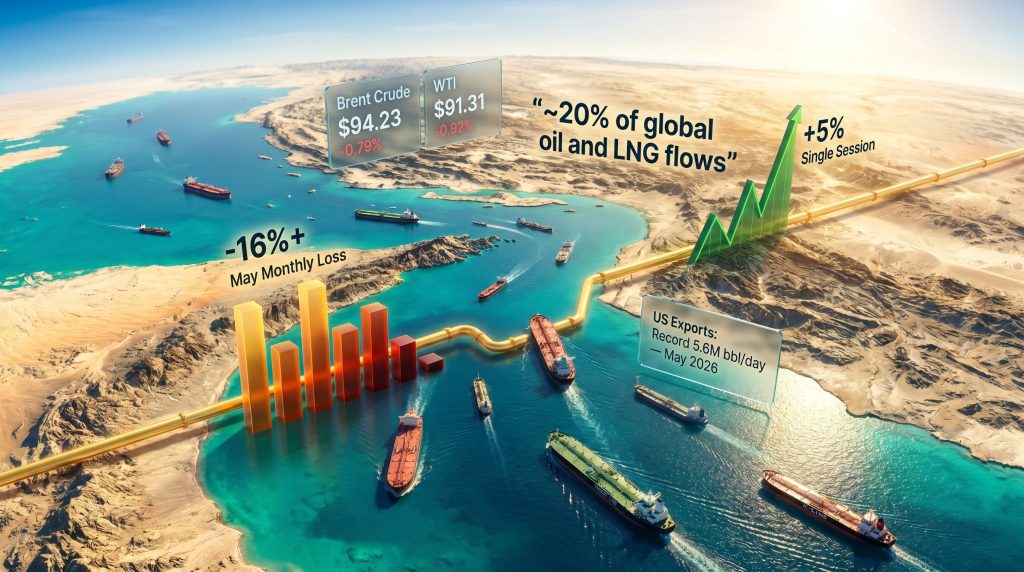
| Brent Crude Futures | $94.23/barrel | -$0.75 | -0.79% |
| WTI (West Texas Intermediate) | $91.31/barrel | -$0.85 | -0.92% |
| Prior Session Move | Both benchmarks | +5%+ | Upward surge |
| May Monthly Performance | Both benchmarks | -16%+ | Monthly loss |
The juxtaposition of a 16% monthly decline in May followed by a 5%+ single-session surge, which then partially reversed on diplomatic commentary, encapsulates the whipsaw behaviour that has defined this market throughout the conflict period. Traders are not reacting to fundamentals alone. They are reacting to the shifting probability distribution of a geopolitical outcome.
Priyanka Sachdeva, senior market analyst at Phillip Nova, noted that while markets had been positioned for potential resolution, conditions as of the morning of June 2 showed no tangible change in the underlying oil supply situation, leaving prices in a state of cautious retreat rather than directional conviction.
The Dual Messaging Problem: How Contradictory Signals Create Volatility
One of the more unusual dynamics in this particular episode has been the role of conflicting official communications in amplifying price swings. On June 1, US President Donald Trump initially expressed ambivalence about the negotiations during a television interview, a posture that Iranian state media outlet Tasnim interpreted as confirmation that indirect US-Iran talks had been suspended. This triggered the 5% oil price surge in that session, as markets rapidly repriced for a prolonged disruption scenario.
Within hours, Trump reversed course via a social media post and confirmed to ABC News that he anticipated a deal to extend the ceasefire and reopen the Strait of Hormuz within approximately one week. The reversal was immediate and the resulting price decline on June 2 reflects markets attempting to triangulate between these contradictory signals. Energy Now's coverage of these events provides useful additional detail on how the messaging sequence unfolded throughout the trading day.
This type of messaging volatility is particularly destabilising for energy futures because:
- Oil futures markets operate across multiple time zones, meaning statements made in one jurisdiction propagate globally before any official clarification can occur
- Algorithmic trading systems respond to keyword signals in real time, amplifying initial moves before human analysts can contextualise the nuance
- Iranian state media and US executive communications operate with fundamentally different objectives, creating an inherent gap between what each side says publicly and what may be occurring in back-channel technical discussions
- The options market, where volatility expectations are priced, tends to widen implied volatility bands during this type of messaging uncertainty, further increasing the cost of hedging for physical commodity traders
Tim Waterer, chief market analyst at KCM Trade, identified the three focal points dominating trader attention as the concrete substance of US-Iran negotiation progress, the tone of Iranian statements specifically regarding Hormuz threats, and real-world tanker movement data through the strait as a ground-truth signal that cuts through political rhetoric.
The Strait of Hormuz: Why This Waterway Controls Global Energy Pricing
Geography, Volume, and Systemic Vulnerability
The Strait of Hormuz is a narrow maritime passage approximately 33 kilometres wide at its narrowest navigable point, positioned between the southern coast of Iran and the Musandam peninsula of Oman. Under normal conditions, it serves as the transit corridor for roughly one-fifth of all global oil and liquefied natural gas flows, making it the single most consequential energy chokepoint on earth.
No equivalent alternative shipping route exists at comparable cost or operational scale. Rerouting tankers around the Arabian Peninsula via the Cape of Good Hope adds weeks to voyage times and significantly increases fuel and insurance costs, making it economically unviable as a long-term substitute for the volume of traffic that normally transits Hormuz. Furthermore, our oil geopolitics analysis outlines why chokepoint vulnerability has become an increasingly central concern for global energy planners.
What Iran's Shipping Restrictions Actually Mean in Practice
The term blockade carries specific legal connotations under international maritime law, and Iran's posture has been carefully calibrated to avoid that formal classification while achieving similar operational effects. Rather than a declared blockade, Iran's wartime posture involves the credible threat of interdiction against non-Iranian commercial vessels, which has been sufficient to deter most commercial shipping operators from transiting the strait without military escort guarantees.
The practical consequences of this operational deterrence include:
- War risk insurance premiums for Gulf-bound voyages have risen to levels that make many commercial charters economically unviable
- Major tanker operators have voluntarily suspended Hormuz transits pending clearer security assurances
- Shipping executives convening in Athens confirmed that any workable peace agreement would need to establish enforceable rules governing commercial vessel access, not merely a political ceasefire declaration
- Physical tanker tracking data, which traders monitor in real time, has become one of the most closely watched indicators of whether diplomatic progress is translating into actual operational normalisation
Approximately 20% of global oil and liquefied natural gas flows pass through the Strait of Hormuz under normal conditions. Since Iran's effective restriction of non-Iranian commercial shipping began, this disruption has contributed to oil price increases of 50% or more from pre-conflict baseline levels.
Three Negotiation Scenarios and What Each Means for Oil Prices
Markets are inherently forward-looking, which means current pricing already embeds some probability weighting across multiple resolution scenarios. Understanding those scenarios and their respective price implications is essential for interpreting current volatility.
| Scenario | Description | Estimated Oil Price Impact |
|---|---|---|
| Full Deal Signed | Ceasefire extended, Hormuz reopened, sanctions partially lifted | Brent could retreat toward $75-$80/barrel range |
| Partial Agreement | Hormuz reopened but nuclear talks stall | Moderate premium reduction; Brent stabilises $85-$90 |
| Talks Collapse | Negotiations break down, blockade intensifies | Risk premium expansion; Brent could retest $100+ |
The gap between the full deal and talks collapse scenarios represents approximately $20-$25 per barrel of embedded optionality in current pricing. This is an unusually wide range for a geopolitical risk premium, reflecting the binary and unpredictable nature of the negotiation dynamics. In addition, the oil volatility trends observed over recent months suggest this level of spread is historically exceptional.
The Nuclear Sticking Points That Could Derail Any Agreement
Beyond the immediate question of Hormuz access, a durable agreement faces several structurally difficult obstacles:
- Enriched uranium stockpile disposition – Iran has accumulated enriched uranium well beyond the limits set under the original 2015 Joint Comprehensive Plan of Action. Any new agreement would need to address the volume, enrichment level, and verifiable disposal or transfer of this material.
- Sanctions sequencing – Tehran's consistent negotiating position has been that economic relief must be guaranteed and partially implemented before Iran commits to verifiable compliance steps, while Washington typically demands verification first.
- Inspection mechanisms – The gap between US requirements for intrusive monitoring and Iran's sovereignty-based objections to certain inspection protocols has historically been one of the hardest issues to bridge.
- Hormuz reopening timing – Whether commercial shipping normalisation is treated as a precondition for signing any deal or as a consequence of signing creates significantly different negotiating incentives for both parties.
The next major ASX story will hit our subscribers first
US Crude Exports: The Structural Beneficiary of Gulf Disruption
One of the less-discussed dimensions of the Hormuz crisis is the extent to which it has accelerated a structural shift in global crude trade flows that was already underway before the conflict began.
US crude exports reached a record 5.6 million barrels per day in May 2026, according to ship tracking estimates. This figure represents a significant uplift driven by Asian and European refinery operators pivoting away from Gulf-origin crude and toward US supply as an accessible, politically lower-risk alternative.
The inventory picture reinforces this demand signal. A preliminary Reuters poll from June 1 pointed to a US crude stockpile drawdown of approximately 3.6 million barrels for the week ending May 29, extending a prior weekly draw. Distillate and gasoline inventories were also expected to have declined, painting a picture of tight supply conditions that would be supportive of elevated prices even in the absence of the geopolitical overlay.
Even if the Hormuz situation were to resolve overnight, the combination of record US export volumes and sequential domestic inventory draws suggests that underlying demand fundamentals would maintain significant upward pressure on crude prices. The geopolitical premium and the fundamental premium are operating simultaneously, making a sharp price collapse unlikely even under the full deal scenario.
The Lebanon Ceasefire: Peripheral Signal or Meaningful Indicator?
Lebanon's announcement of a partial ceasefire between Hezbollah and Israel on June 1 introduced a further variable into an already complex market narrative. On a standalone basis, a Lebanon-specific de-escalation does not directly resolve the Hormuz shipping disruption, which is the primary mechanism through which the Iran conflict is affecting oil supply.
However, markets tend to treat regional de-escalation signals as indicative of a broader diplomatic momentum shift. The reasoning is that Hezbollah's operational posture is closely linked to Iranian strategic direction, meaning a ceasefire in Lebanon that holds could signal a broader Iranian interest in reducing conflict intensity across multiple theatres simultaneously.
This interconnected conflict architecture means traders are watching the Lebanon situation not for its direct supply implications, which are limited, but as a sentiment indicator for the probability of the larger US-Iran framework progressing toward resolution. The Star's reporting on the oil market's response to these overlapping signals offers useful regional perspective on how Asian markets in particular are interpreting the diplomatic signals.
The Longer Arc: What Structural Elevation of Oil Prices Means for Energy Markets
If the Hormuz disruption persists or resolves only partially, the medium-term consequences extend well beyond day-to-day futures pricing. Furthermore, the role of OPEC's market influence in shaping the broader supply response during this period warrants careful attention from anyone tracking the structural trajectory of crude prices.
- Energy security diversification among major importing nations is accelerating, with governments and refinery operators alike seeking to reduce dependence on any single transit corridor
- Alternative infrastructure investment in pipeline capacity, floating storage, and alternative export terminals is receiving heightened attention from both sovereign wealth funds and private infrastructure investors
- OPEC's market influence is operating in an environment where geopolitical supply disruption has effectively done the work that deliberate output cuts would otherwise need to accomplish, creating complex internal dynamics within the producer group
- Demand destruction risk at sustained $90+ price levels is becoming a meaningful consideration in major consuming economies, particularly where energy-intensive industries are already facing margin compression
- US export infrastructure is being stress-tested at record throughput levels, raising questions about whether pipeline, storage, and terminal capacity can sustain the export volumes that global markets are increasingly relying upon
The current moment is not simply a geopolitical episode that will resolve and return markets to prior equilibrium. The routing decisions, insurance market reconfigurations, and refinery sourcing shifts occurring right now are creating structural precedents that will shape global oil trade architecture for years beyond the immediate conflict timeline. Oil slips after Trump says talks with Iran are ongoing may read as a single day's headline, but it represents a much longer and more consequential story about how energy markets adapt to profound geopolitical uncertainty.
Disclaimer: This article contains forward-looking scenario analysis and market commentary that reflects conditions as of June 2, 2026. Oil price projections and geopolitical outcome scenarios are speculative and subject to rapid change. Nothing in this article constitutes financial or investment advice. Readers should conduct independent research before making any investment decisions related to energy markets or commodities.
For ongoing coverage of the intersection between Middle East geopolitics and global energy markets, Arab News Energy provides regularly updated reporting and analysis.
Want To Stay Ahead of Commodity Market Shifts Driven by Geopolitical Events?
Discovery Alert's proprietary Discovery IQ model delivers real-time alerts on significant ASX mineral discoveries, instantly translating complex market conditions into actionable investment insights — explore historic discovery returns to understand the scale of opportunity, then begin your 14-day free trial at Discovery Alert to position yourself ahead of the broader market.