July 15, 2026
The Industrial Decarbonisation Gamble Canada Cannot Afford to Lose
Carbon capture and storage technology has existed in various forms for decades, yet scaling it to match the emissions footprint of an entire industrial sector remains one of the most technically and financially complex challenges in modern energy policy. Most operational CCS projects worldwide capture roughly one million tonnes of CO₂ per year. The Oil Sands Alliance Pathways Project CCS initiative is designed to eventually capture sixteen times that amount annually, making it an experiment in industrial-scale climate engineering unlike anything Canada has attempted before.
Understanding what this project actually is, how it works, and what it could realistically achieve requires moving past the headlines and examining the underlying architecture, the financial mechanics, the regulatory incentives, and the very real risks that could derail it. Furthermore, it must be understood within the broader context of Canada's energy transition challenges and the economic pressures shaping national climate policy.
When big ASX news breaks, our subscribers know first
What Is the Oil Sands Alliance Pathways Project?
The Consortium Behind Canada's Largest Proposed CCS Network
The Oil Sands Alliance is an industry consortium comprising five of Canada's most significant oil producers: Canadian Natural Resources, Cenovus Energy, ConocoPhillips Canada, Imperial Oil, and Suncor Energy. Together, these companies account for approximately 95% of Alberta's oil sands output, making this group effectively the operational heartbeat of Canada's upstream oil industry.
The organisation itself underwent a rebranding in 2024, shifting from its former identity as the Pathways Alliance to its current name, the Oil Sands Alliance. Importantly, the flagship infrastructure initiative retained its original designation as the Pathways Project, which refers specifically to the carbon capture and storage network the consortium is developing.
The decision to build this infrastructure through a shared consortium model rather than through separate company programmes reflects both the scale of the capital required and the efficiency of shared pipeline and storage assets. Building five independent CO₂ transport systems would be economically prohibitive. A single shared trunk line serving multiple facilities is the only configuration that makes the unit economics workable.
What the Pathways Project Actually Builds
A common misconception about the Pathways Project is that it encompasses all aspects of carbon capture across oil sands operations. In practice, the project has a defined and more limited scope.
Critical Distinction: The Pathways Project covers only the transportation and storage infrastructure. Each individual oil sands operator is solely responsible for designing, financing, and constructing their own carbon capture equipment at the facility level. Once CO₂ is captured on-site, it enters the shared network.
The physical infrastructure involves:
- A CO₂ transmission pipeline corridor spanning 400 to 650 kilometres across northeastern Alberta, connecting multiple oil sands processing facilities
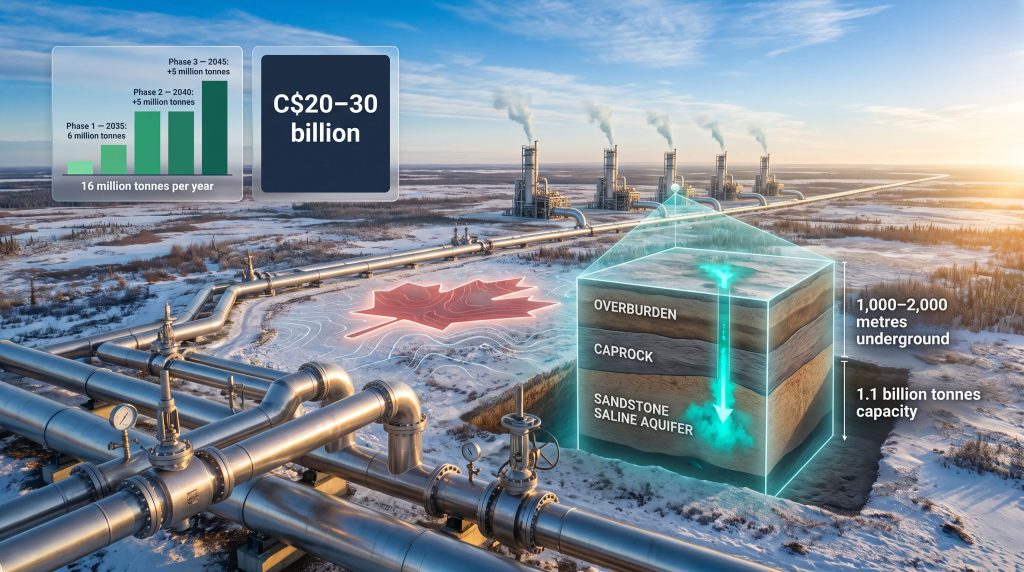
- A geological storage hub near Cold Lake, where compressed CO₂ is injected 1,000 to 2,000 metres underground into a capped sandstone saline aquifer
- A storage formation assessed as capable of holding more than 1.1 billion tonnes of CO₂ in total, far exceeding the project's operational requirements for decades
This scope distinction carries significant implications for cost allocation, subsidy eligibility, and regulatory responsibility, since federal and provincial tax incentives apply differently to capture equipment versus transportation and storage infrastructure.
Project Scale, Cost Trajectory, and Construction Timeline
A Budget That Has Already Grown Substantially
The Pathways Project has not been immune to the cost pressures affecting large infrastructure development globally. The original cost estimate has expanded considerably since the project's early planning phases.
| Cost Estimate Period | Projected Cost | Primary Driver |
|---|---|---|
| Original baseline estimate | C$16.5 billion | Initial infrastructure scope |
| Revised estimate (2026) | C$20 to C$30 billion | Construction inflation and scope expansion |
| Total OSA investment by 2030 | C$24.1 billion | Includes additional emissions-reduction programmes |
This cost escalation is not unusual for mega-infrastructure projects, but it does raise the stakes considerably for both the consortium members and the governments providing incentive support. A project at the higher end of the C$30 billion range would represent one of the most capital-intensive industrial climate initiatives ever undertaken in Canada.
Key Construction and Operational Milestones
| Milestone | Target Date |
|---|---|
| Tripartite MOU signed | July 2, 2026 |
| Binding agreements with each OSA member | November 15, 2026 |
| Construction commencement | January 1, 2032 |
| Phase 1 operations target | January 1, 2035 |
One aspect of the timeline that warrants careful attention is the gap between the MOU signing in mid-2026 and the expected construction start in 2032. That six-year window encompasses regulatory approvals, detailed engineering, financing arrangements, Indigenous consultation processes, and binding commercial agreements among five major corporations with differing capital priorities.
The Phased Emissions Reduction Targets Under the July 2026 MOU
Breaking Down the 16 Million Tonne Goal
The tripartite Memorandum of Understanding signed on July 2, 2026 between the federal government, the Alberta government, and the Oil Sands Alliance establishes a structured, phased approach to emissions reduction across the oil sands sector.
| Phase | Target Year | Annual CO₂ Reduction |
|---|---|---|
| Phase 1 | 2035 | 6 million tonnes via Pathways CCS |
| Phase 2 | 2040 | Additional 5 million tonnes |
| Phase 3 | 2045 | Additional 5 million tonnes |
| Combined Total | 2045 | 16 million tonnes per year |
How 16 Million Tonnes Compares to the Sector's Full Footprint
Context is essential when evaluating these numbers. According to Canada's National Inventory Report (2026), oil sands and thermal heavy oil operations emitted approximately 92 million tonnes of CO₂ equivalent (MtCO₂e) in 2024.
- Phase 1 capture of 6 million tonnes represents roughly 6 to 7% of current sector emissions
- The full 16 million tonne target represents approximately 17% of today's sector-wide emissions baseline
- Oil and gas production as a whole accounts for roughly one quarter of Canada's total national greenhouse gas emissions
The arithmetic reveals an uncomfortable reality: even at full operational capacity, the Pathways Project would leave more than 80% of oil sands emissions unaddressed. Whether CCS functions as a primary decarbonisation mechanism or a supplementary one remains a genuinely open policy question, not a settled debate.
Future phases beyond the initial 6 million tonne target may draw on expanded pipeline capacity or entirely new capture technologies not yet deployed at commercial scale, adding another layer of uncertainty to the long-term projections. In this respect, the decarbonisation economic benefits observed in adjacent industries offer useful comparative lessons for understanding what realistic outcomes might look like.
Government Financial Support: Tax Credits, Incentive Extensions, and Provincial Commitments
Federal Tax Credit Structure
The federal government's financial contribution to making the Pathways Project viable takes the form of extended and expanded investment tax credits rather than direct capital grants.
-
The 50% Investment Tax Credit (ITC) for eligible carbon capture equipment extended to 2035, five years beyond the original scheduled end date
-
A 37.5% ITC for CO₂ transportation, storage, and utilisation equipment also extended through 2035
-
New incentives introduced specifically for enhanced oil recovery (EOR) operations:
- 25% credit for carbon capture equipment deployed in EOR contexts
- 18.75% credit for associated transportation and storage infrastructure in EOR applications
These tax credits are designed to reduce the effective capital cost for operators, improving project economics at a time when construction inflation has pushed total costs significantly higher than original estimates.
Alberta's Provincial Commitments
Alberta's contributions extend across financial incentives, regulatory streamlining, and institutional coordination:
- Extension of the provincial Carbon Capture Incentive Programme through 2035
- Additional financial support linked to expanding oil production capacity for future export markets
- A 120-day regulatory approval timeline for qualifying projects, intended to reduce permitting delays that have historically added costs and uncertainty to large infrastructure developments
- Establishment of a dedicated working group tasked with identifying and removing regulatory barriers affecting oil sands investment
How Alberta's TIER Carbon Pricing System Creates Direct Investment Incentives
The Mechanics of Benchmark-Based Compliance
Alberta's Technology Innovation and Emissions Reduction (TIER) programme operates as the province's primary compliance mechanism for large industrial emitters. The system sets annual emissions intensity benchmarks for covered facilities. Operators who exceed their benchmark are required to purchase emissions credits from the provincial system or contribute financially to the TIER Fund.
Critically, benchmark thresholds tighten automatically each year, meaning the compliance cost burden for non-investing operators escalates over time whether or not energy prices are favourable.
The Reward Structure Embedded in the MOU
The July 2026 agreement introduces a specific incentive mechanism tied to the Pathways Project's phased targets:
- Alliance members achieving the Phase 1 target of 6 million tonnes will see their annual TIER benchmark tightening rate reduced from the standard 2% to 1%
- Companies demonstrating continued progress toward Phase 2 and Phase 3 milestones can maintain the reduced tightening rate through 2045
- Operators that fall short of agreed milestones face accelerated benchmark tightening and the corresponding increase in compliance costs
This dual structure functions as both carrot and stick simultaneously. It rewards early movers with meaningful regulatory relief while systematically increasing the financial pressure on operators who delay or underinvest in emissions reduction infrastructure. Over a multi-decade horizon, the cumulative cost differential between a 1% and 2% annual tightening rate becomes substantial.
The next major ASX story will hit our subscribers first
The West Coast Oil Pipeline Connection: Production Growth and Export Diversification
Why the MOU Explicitly Links CCS to Pipeline Expansion
One of the more strategically significant and contested elements of the July 2026 agreement is the explicit connection it draws between the Pathways Project's progress and federal and provincial support for a proposed West Coast Oil Pipeline (WCOP).
The underlying policy logic is straightforward: expanded oil sands production requires expanded export infrastructure to reach markets beyond North America. Simultaneously, expanded production without emissions management would be politically and legally difficult to advance. The CCS framework provides the emissions management layer that makes production growth arguments more defensible within Canada's broader climate policy architecture.
Key elements of this dual-mandate approach include:
- Linking CCS milestone achievement to advocacy for WCOP advancement
- Export market diversification goals targeting Asian and other international buyers
- Commitments to engage Indigenous communities along both the pipeline corridor and CCS infrastructure route to create meaningful economic participation opportunities
- Preference provisions encouraging operators to source Canadian steel, aluminium, construction materials, and technology where viable
Global Benchmarking: How the Pathways Project Compares to Operational CCS Networks
Placing Phase 1 Capacity in International Context
To appreciate the true scale ambition of the Oil Sands Alliance Pathways Project CCS initiative, it helps to compare it against the operational CCS landscape that exists today. Notably, renewable energy in mining and heavy industry is also progressing rapidly, providing a broader context for understanding where CCS fits within the overall decarbonisation toolkit.
| Project | Location | Annual CO₂ Storage | Status |
|---|---|---|---|
| Pathways Project Phase 1 | Alberta, Canada | 6 million tonnes | Pre-construction (2026) |
| Quest CCS (Suncor/Shell) | Alberta, Canada | ~1 million tonnes | Operational |
| Sleipner CO₂ Storage | North Sea, Norway | ~1 million tonnes | Operational since 1996 |
| Boundary Dam CCS | Saskatchewan, Canada | ~1 million tonnes (design) | Operational but underperforming |
| Northern Lights (Longship) | Norway | 1.5 million tonnes Phase 1 | Operational |
If Phase 1 reaches its stated capacity, the Pathways Project would represent a four to six times scale increase over any currently operational CCS facility in Canada. That magnitude of scale-up is itself one of the key technical risks the project faces, since engineering assumptions that hold at smaller scales frequently encounter unexpected complications at larger ones.
Notably, the Boundary Dam project in Saskatchewan serves as a cautionary reference point. Designed for approximately one million tonnes of annual capture capacity, it has consistently underperformed its nameplate figures since commissioning, suggesting that CCS performance at scale is not guaranteed even with established technology.
Critical Perspectives: What Critics and Supporters Are Saying
The Arguments Against
Opposition to the Pathways Project spans environmental advocates, some climate economists, and fiscal critics who question the value proposition of the current structure:
- Environmental organisations have raised concerns that linking CCS infrastructure to expanded oil production may result in net emissions increases if production growth outpaces capture capacity, effectively using climate technology as a licence for expanded fossil fuel extraction
- Fiscal critics have characterised years of government subsidy advocacy without ground-breaking as a pattern that warrants scrutiny, particularly given the project's cost escalation from C$16.5 billion to a potential C$30 billion range
- The 17% capture rate at full Phase 3 completion leaves the question of what addresses the remaining 83% of sector emissions fundamentally unanswered
The Arguments For
Proponents point to several factors that distinguish the Pathways Project from past CCS proposals that stalled at the planning stage:
- Alberta's geological evaluation approval for the Cold Lake storage formation provides technical validation that the subsurface geology can support long-term storage at scale
- Active engagement with more than 20 Indigenous communities along the pipeline corridor represents a level of early consultation unusual for projects at this development stage
- The TIER programme's compliance cost structure creates a durable financial incentive for investment that does not depend on carbon credit market prices
- The potential to become one of the largest operational CCS networks globally gives the project significant demonstration value for mining electrification and decarbonisation pathways and wider industrial sectors worldwide
Frequently Asked Questions: Oil Sands Alliance Pathways Project CCS
What does the Pathways Project capture and where does the CO₂ go?
The project captures CO₂ generated during oil sands upgrading and steam-assisted gravity drainage (SAGD) operations at individual facilities. That captured gas is compressed and transported through a shared pipeline corridor before being injected into a capped sandstone saline aquifer between 1,000 and 2,000 metres underground near Cold Lake, Alberta.
Who funds the carbon capture equipment at each facility?
Individual operators bear full responsibility for financing, designing, and constructing capture equipment at their own sites. The Pathways Project's collective financing structure covers only the shared pipeline and storage hub.
What happens to companies that miss their emissions targets?
Under the TIER framework, operators who fail to meet phased milestones return to the standard 2% annual benchmark tightening rate, or potentially face accelerated tightening, increasing their ongoing compliance costs and carbon credit purchasing requirements.
Is the July 2026 MOU a binding legal agreement?
No. The MOU signed on July 2, 2026 is a non-binding framework document. Legally enforceable agreements between the federal government, Alberta, and each of the five Oil Sands Alliance member companies are targeted for completion by November 15, 2026.
What makes the Cold Lake storage geology suitable for long-term CO₂ storage?
The Cold Lake formation consists of a porous sandstone saline aquifer capped by an impermeable geological seal. This combination of porosity (allowing CO₂ injection at scale) and caprock integrity (preventing upward migration) meets the fundamental requirements for permanent geological storage. The formation has been assessed as capable of holding more than 1.1 billion tonnes of CO₂ in total, providing a storage reservoir that far exceeds the project's multi-decade operational requirements. For further technical context, the Global CCS Institute's assessment of the Pathways initiative provides detailed analysis of the project's storage credentials and international standing.
What the Pathways Project Means for Canada's Energy and Climate Future
The Oil Sands Alliance Pathways Project CCS initiative sits at an intersection of industrial economics, climate policy, and geopolitical energy strategy that makes it one of the most consequential infrastructure decisions Canada will make this decade. Its capital footprint, potentially exceeding C$30 billion, its phased emissions architecture targeting 16 million tonnes per year by 2045, and its explicit connection to West Coast export infrastructure collectively position it as something more complex than a simple emissions reduction programme.
Whether it ultimately succeeds will depend on factors that extend well beyond the technical: binding legal agreements must be finalised, financing must be secured across five major corporations with competing capital priorities, regulatory approvals must be obtained within a compressed timeline, and construction must proceed in an environment where infrastructure costs have already demonstrated significant upward pressure. Consequently, mining's clean energy transition experiences offer instructive parallels for understanding the institutional and financial challenges that lie ahead.
The project's trajectory over the next 12 to 24 months, culminating in the November 2026 binding agreement deadline, will signal more clearly than any MOU whether Canada's largest proposed industrial CCS initiative is on course to become a globally significant proof of concept, or another entry in a long list of ambitious energy transition proposals that moved more slowly than the climate required. The Pathways Alliance's own progress reporting indicates continued momentum, though the gap between intent and binding commitment remains the defining challenge for the period ahead.
This article contains forward-looking statements and projections based on publicly available information and official documents. Actual project costs, timelines, and emissions outcomes may differ materially from those described. This content is intended for informational purposes only and does not constitute financial or investment advice.
Want to Identify the Next Major Resource Discovery Before the Market Does?
Discovery Alert's proprietary Discovery IQ model delivers real-time alerts on significant ASX mineral discoveries — instantly translating complex resource data into actionable investment insights for both short-term traders and long-term investors. Explore the historic returns major discoveries have generated and begin your 14-day free trial today to position yourself ahead of the broader market.