July 23, 2026
The Supply Chain Logic Behind Restarting a Dormant Graphite Mine
Battery supply chains rarely fail because of demand. They fail because of concentration. For years, the graphite anode sector has operated with an uncomfortable dependency on a single dominant processing nation, and the downstream consequences of that imbalance are now reshaping how battery manufacturers, governments, and industrial investors think about upstream sourcing. The question is no longer whether diversification is necessary. The question is which projects can actually deliver, and on what timeline.
This is where dormant, fully permitted assets in politically stable jurisdictions become commercially interesting again. The global graphite shortage has not changed the underlying geology of existing deposits, but the geopolitical calculus around supply security has shifted decisively, making previously idle assets suddenly strategically valuable.
When big ASX news breaks, our subscribers know first
What a Care and Maintenance Status Actually Signals to Investors
When a mine is placed on care and maintenance, it occupies a distinct intermediate position between active production and full decommissioning. The operation retains its environmental approvals, land tenure agreements, and processing infrastructure without incurring the full cost burden of active extraction. Minimal staffing levels are maintained, equipment is preserved, and regulatory compliance obligations continue. For investors, this status is a conditional holding pattern rather than an abandonment signal.
The distinction matters enormously when evaluating restart candidates against greenfield alternatives. A fully permitted, previously operational mine has already navigated the regulatory gauntlet that can add 12 to 18 months to a greenfield development timeline. Environmental impact assessments, community consultation processes, water licences, and tailings management approvals are already in place. This structural head start is a genuine capital efficiency advantage, not a marketing narrative.
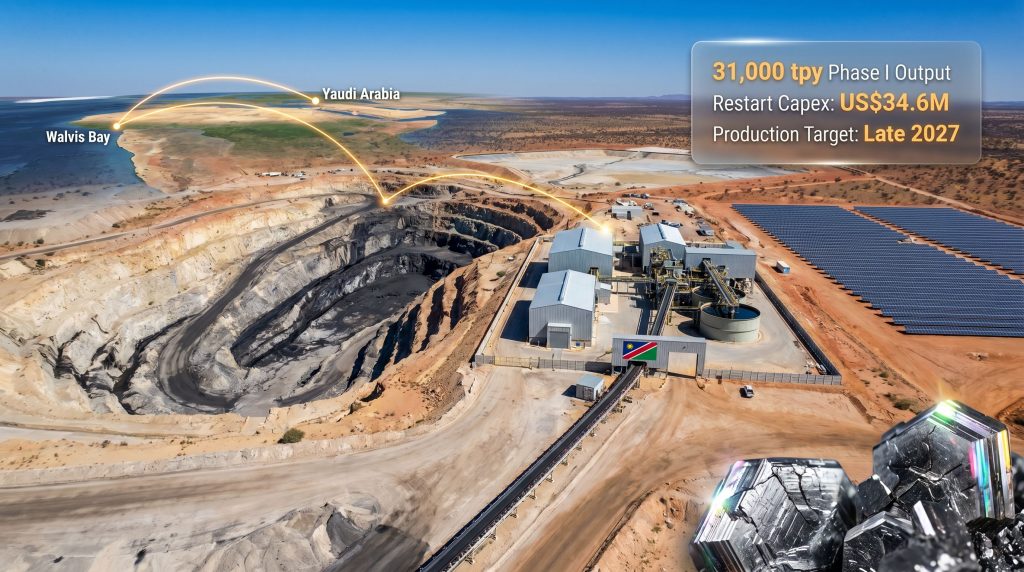
The Okanjande graphite mine, located near Otjiwarongo in central Namibia, exemplifies this risk profile. Currently held in care and maintenance by Northern Graphite, the operation sits on a Measured and Indicated resource of 1.6 million tonnes and carries full permitting credentials. The company has confirmed a restart capital requirement of US$34.6 million for Phase I production targeting 31,000 tonnes per year, with a production restart aimed at late 2027.
For context, that capital intensity compares favourably with the cost of constructing a comparable greenfield graphite operation from scratch, where pre-production expenditure frequently exceeds US$100 million once permitting, infrastructure development, and environmental compliance are factored in.
The Okanjande Resource Profile in Numbers
| Metric | Detail |
|---|---|
| Resource Classification | Measured and Indicated |
| Total Resource Size | 1.6 million tonnes |
| Phase I Target Output | 31,000 tonnes per year |
| Production Restart Target | Late 2027 |
| Restart Capital Estimate | US$34.6 million |
| BAM Facility Integration | Yanbu, Saudi Arabia (targeted 2028) |
From Okorusu to Okanjande: The Engineering Logic of Moving an Entire Processing Plant
One of the less-discussed operational inefficiencies in the previous configuration of Namibia's graphite sector was the geographic separation between the mine deposit and the processing plant. Mineralised material extracted at Okanjande required long-distance haulage to reach the Okorusu processing site, adding transport cost and logistical complexity to the production chain.
Northern Graphite's approach to resolving this is unconventional by typical mining restart standards. Rather than rehabilitating the mill at its original Okorusu location, the company commissioned a 2023 preliminary economic assessment by CREO Engineering Solutions that evaluated whether relocating the entire plant to the mine site would deliver superior economics. The conclusion was unambiguous: relocation was both technically feasible and economically preferable.
The contract to execute this relocation has been awarded to Rotary Engineering Services, a Namibia-based engineering contractor, with a target completion date of end of June 2026. Northern Graphite's plant relocation covers full dismantlement of remaining plant infrastructure at Okorusu, road transport to Okanjande, and mechanical reassembly at the mine site. As of the announcement date in May 2026, this milestone is effectively weeks away.
Why Co-Location Changes the Economic Equation
Moving the processing facility to sit directly at the ore source delivers several compounding operational advantages:
- Elimination of long-haul ore transport between sites, reducing fuel consumption and vehicle maintenance costs
- Simplified logistics management, allowing tighter control over throughput rates and concentrate quality
- Infrastructure consolidation creating a scalable platform for capacity expansion beyond the initial 31,000 tpy target
- Access to existing water and power connections at Okanjande, reducing capital expenditure on utilities installation
The US$34.6 million restart capital estimate benefits directly from this approach. By leveraging a relocatable processing plant rather than constructing new processing infrastructure, the company avoids a significant component of capital expenditure that would otherwise burden the project economics.
It is also worth noting that Northern Graphite disclosed the clearance of approximately US$22 million in secured debt obligations associated with the Namibian operations. Removing this financial encumbrance strengthens the balance sheet position ahead of the construction decision expected in mid-2026. Furthermore, completing a definitive feasibility study at this stage would further de-risk the project for potential financing partners.
Building a Mine-to-Battery Value Chain Across Three Continents
The Okanjande graphite mine restart does not exist in isolation. It is the upstream anchor of a vertical integration strategy that Northern Graphite describes as its mine-to-battery model, spanning multiple continents and targeting multiple points in the battery materials value chain.
Understanding how this architecture fits together is essential for evaluating the Okanjande restart's strategic purpose beyond the immediate production metrics.
Northern Graphite's Multi-Asset Portfolio
| Asset | Location | Status |
|---|---|---|
| Lac des Iles Mine | Quebec, Canada | Currently producing |
| Bissett Creek Project | Ontario, Canada | Development stage |
| Okanjande Mine | Namibia | Care and maintenance, restart planned |
| BAM Facility | Yanbu, Saudi Arabia | Targeted 2028 initial production |
| BAM Facility | Quebec, Canada | Under advancement |
| BAM Facility | France | Under advancement |
Northern Graphite holds the distinction of being the only flake graphite producer currently operating in North America, a market position that provides credibility for its downstream integration ambitions. The Lac des Iles mine in Quebec functions as the operational proof-of-concept, while Bissett Creek and Okanjande represent the medium-term feedstock expansion pipeline.
The Battery Anode Material facilities are where the value chain transforms from raw material supplier to advanced battery component producer. The conversion of natural flake graphite into spheronised, purified battery anode material requires processing that removes impurities to above 99% carbon purity and reshapes flake particles into spheroidal geometries optimised for electrochemical performance in lithium-ion cells. This spheronisation process is technically demanding and capital-intensive, which is why controlling it within the same corporate structure creates margin capture opportunities that a pure mining operation cannot access.
Why Yanbu Was Chosen as the First BAM Hub
Locating the first Battery Anode Material facility in Yanbu, Saudi Arabia reflects a deliberate positioning within the Middle East's industrial transformation ambitions. Saudi Arabia's industrial diversification programme has prioritised advanced manufacturing capacity, and the Kingdom's geographic positioning offers direct sea freight connectivity to both Asian battery assembly hubs and European EV manufacturers.
The Namibia-to-Saudi Arabia graphite supply corridor via Walvis Bay's deep-water port infrastructure creates a logistically coherent export route that circumvents the congested northern European port networks. The three-geography BAM strategy across Saudi Arabia, Quebec, and France also hedges against regional policy disruptions. If offtake demand concentrates in Europe, the French facility provides proximity. If North American battery manufacturing accelerates, Quebec is positioned, and the Saudi facility targets Asian-adjacent and Middle Eastern industrial demand.
Why Namibia Outcompetes Most African Graphite Jurisdictions
The competitive dynamics of African graphite development hinge less on geology and more on what surrounds the ore body. Infrastructure quality, political predictability, regulatory transparency, and export logistics collectively determine whether a technically attractive resource can become a commercially viable supply source.
Namibia's combination of characteristics places it in a structurally superior position relative to the primary competing graphite jurisdictions on the continent. Consequently, the critical minerals demand surge from battery manufacturers is increasingly directing capital towards jurisdictions like Namibia that can demonstrate political and regulatory reliability.
Comparative Jurisdiction Assessment
| Factor | Namibia | Mozambique | Tanzania | Madagascar |
|---|---|---|---|---|
| Political Stability | High | Moderate | Moderate | Moderate |
| Export Port Access | Deep-water (Walvis Bay) | Limited deep-water | Dar es Salaam | Toamasina (capacity constraints) |
| Permitting Environment | Established, track record | Developing | Variable, policy shifts | Variable |
| Infrastructure Maturity | Strong | Moderate | Moderate | Limited |
| Prior Graphite Operations | Yes (Okanjande, Okorusu) | Yes (Balama) | Limited | Yes (limited scale) |
Northern Graphite's CEO, Hugues Jacquemin, characterised the jurisdiction advantage in direct terms, stating that Okanjande's location in one of Africa's most politically stable countries, combined with direct access to deep-water port infrastructure, provides material competitive advantages over most competing African graphite projects.
A point that receives insufficient attention in most graphite sector analysis is the operational precedent argument. Namibia has already hosted both a graphite mine (Okanjande) and a processing facility (Okorusu) through previous operational cycles. This creates an established knowledge base within the national regulatory authorities, a local workforce with sector-relevant experience, and a track record for foreign capital that new jurisdictions simply cannot replicate.
The fully permitted status of Okanjande is not merely an administrative convenience. In jurisdictions where permitting frameworks have evolved or tightened since the mine's original approvals, holding grandfathered approvals represents a regulatory asset with measurable value. Competing projects in jurisdictions with variable permitting environments face the risk of approval delays, condition modifications, or community opposition that can extend pre-production timelines by years.
Green Mining as a Commercial Requirement, Not Just Compliance
Battery supply chain customers have fundamentally changed what they require from upstream suppliers. A decade ago, ESG documentation was largely a reporting exercise. Today, OEM procurement standards for battery-grade graphite increasingly mandate upstream carbon intensity data, water consumption benchmarks, and tailings management certifications as conditions of supply qualification. Failure to meet these criteria can disqualify a producer from the premium-priced battery materials market regardless of the quality of the graphite itself.
Northern Graphite is evaluating two specific sustainability measures for the Okanjande restart that address both the environmental profile of the operation and its long-term commercial positioning:
Solar Power Integration
- A 19 to 20 MW on-site solar installation is being evaluated to reduce the mine's reliance on diesel-generated electricity
- In Namibia's semi-arid climate, solar irradiance levels are among the highest on the continent, making solar generation economically viable at operational scale
- Reduced diesel consumption directly lowers operational carbon intensity, a metric increasingly tracked by battery supply chain auditors
Dry Tailings Technology
- Conventional wet tailings storage is poorly suited to Namibia's water-scarce environment
- Dry tailings processing mechanically extracts moisture from waste material before storage, substantially reducing water consumption per tonne of ore processed
- Beyond water efficiency, dry tailings facilities carry lower long-term closure liability compared to wet storage impoundments, which can remain as environmental obligations for decades
The combination of solar power and dry tailings technology at Okanjande would position the operation at the lower end of the carbon and water intensity spectrum for African graphite producers, a profile that aligns with the supply chain qualification criteria of European and North American EV manufacturers who face regulatory pressure to document the environmental footprint of their upstream materials.
The next major ASX story will hit our subscribers first
The Dual-Market Strategy: Industrial Graphite and Battery Materials
A less-appreciated feature of Okanjande's commercial strategy is its deliberate targeting of two distinct end markets rather than committing exclusively to the battery materials sector.
Industrial Graphite Applications include:
- Refractory products used in steelmaking furnace linings, where graphite's extreme heat resistance is irreplaceable
- Heat management components in high-performance electronics manufacturing
- Friction materials in automotive braking systems, a demand channel that exists independently of EV adoption rates
Battery and Advanced Technology Applications include:
- Natural flake graphite feedstock for purification and spheronisation into lithium-ion battery anode material
- Specialty graphite for defence and national security supply chain applications, an emerging demand category as Western governments seek domestically aligned sources
- Grid-scale energy storage systems, where natural graphite competes with synthetic alternatives on cost curves
This dual-market approach is strategically significant because it provides revenue diversification during the period between mine restart and full BAM facility ramp-up. Industrial graphite markets, while lower-margin than battery-grade applications, offer more immediate offtake pathways with less stringent quality certification requirements. A producer serving both markets can optimise its output allocation based on prevailing pricing conditions. In addition, this flexibility connects directly to the broader battery metals investment landscape that is rapidly evolving as Western supply chain priorities shift.
How Graphite Quality Determines Market Access
Not all graphite is created equal, and understanding the quality differentiation is fundamental to understanding Okanjande's market positioning. Natural flake graphite is characterised by flake size (expressed in mesh classifications such as large flake, medium flake, and fine flake) and carbon content. Battery-grade applications require specific combinations of flake size, purity, and crystalline structure that not all deposits can reliably deliver.
Northern Graphite's assertion that all its projects contain battery quality graphite signals that Okanjande's ore characteristics are compatible with downstream purification and spheronisation into anode-grade material. This is not a universal property of African graphite deposits, and the designation carries commercial weight in offtake negotiations.
Scenario Pathways: From Infrastructure Relocation to First Production
Three broad scenarios frame the risk envelope for the Okanjande graphite mine restart between mid-2026 and late 2027:
Scenario A: On-Track Execution (Base Case)
- Plant relocation completed by end of June 2026 as contracted
- Construction decision reached during mid-2026 following relocation verification
- Commissioning and production ramp-up completed by late 2027
- First graphite feedstock shipments to the Yanbu BAM facility commence in 2028
Scenario B: Moderate Delay (Conservative Case)
- Relocation encounters logistical complications or equipment reassembly issues
- Construction decision pushed to Q4 2026
- Production restart delayed to mid-2028
- BAM facility ramp-up at Yanbu pushed back by six to twelve months
Scenario C: Market Disruption (Stress Case)
- Graphite price weakness from sustained Chinese oversupply reduces project returns below hurdle rates
- Capital market conditions tighten, increasing the cost of restart financing
- Phase I production proceeds at minimum viable scale; modular expansion deferred
- BAM integration timeline extends beyond original planning horizon
Critical Risk Factors Investors Should Monitor
- Graphite pricing dynamics: Natural flake graphite pricing has faced pressure from Chinese production overcapacity, and recovery trajectories remain dependent on EV demand acceleration and potential trade policy interventions
- Relocation execution quality: Plant dismantlement and reassembly introduces mechanical compatibility risks that could affect processing performance post-commissioning
- Financing completion: The US$34.6 million restart capital requires confirmed funding pathways before construction can commence
- Downstream offtake confirmation: The BAM facility's commercial viability depends on customer agreements that have not yet been publicly confirmed in available reporting
- Construction timeline compressibility: The estimated twelve-month construction and commissioning window following the mid-2026 decision is achievable but leaves limited buffer for material delays
Okanjande as a Template for Capital-Efficient Critical Mineral Restarts
The graphite sector's current challenge is not a shortage of resources. It is a shortage of production-ready, politically accessible, and environmentally credible supply sources outside Chinese-controlled processing networks. Greenfield development remains the dominant pathway for most junior miners, but the timeline and capital requirements of building new operations from scratch are increasingly misaligned with the urgency of battery supply chain diversification.
The Okanjande graphite mine restart offers a different template: low restart capital relative to production scale, preserved permitting credentials, a relocatable processing plant that converts a capital liability into a capital efficiency, and a jurisdiction with demonstrated political and regulatory stability. Furthermore, critical minerals and energy security considerations are pushing governments and battery manufacturers to actively seek out exactly these kinds of de-risked, near-production assets.
When combined with integration into a vertically structured battery anode material business spanning three continents, the restart argument moves beyond a single-project narrative into a broader strategic thesis about how African resource assets can capture more of the value chain rather than simply exporting raw commodities. The Okanjande mine's operational details confirm that this approach is already well advanced, with infrastructure works progressing towards the pivotal June 2026 milestone.
Whether Okanjande becomes the proof-of-concept for this model depends on execution quality over the next eighteen months. The June 2026 relocation milestone is the first observable test. Investors and industry observers watching the critical minerals supply chain diversification story unfold would do well to track it closely.
This article contains forward-looking statements and scenario projections based on publicly available information as of May 2026. Mining project timelines, capital estimates, and production targets are subject to change. Nothing in this article constitutes financial advice. Readers should conduct independent due diligence before making investment decisions.
Want to Track the Next Major Critical Mineral Discovery Before the Market Does?
Discovery Alert's proprietary Discovery IQ model scans ASX announcements in real time, transforming complex mineral data into actionable insights across graphite, lithium, and more than 30 other commodities — visit the Discovery Alert discoveries page to explore historic examples of major mineral discoveries and their market returns, then start your 14-day free trial to position yourself ahead of the broader market.