June 3, 2026
The Structural Gap at the Heart of American Aluminium
For nearly five decades, the United States has not built a single new primary aluminium smelter. That extraordinary industrial pause, stretching from 1980 to the present day, reflects a convergence of energy economics, environmental regulation, and globalisation that systematically dismantled domestic smelting capacity in favour of cheaper imports. Today, that structural gap has collided with urgent national security priorities, and the collision point is a proposed USD 4 billion facility at the Tulsa Port of Inola, Oklahoma.
The Oklahoma aluminium smelter project governor race is simultaneously an industrial policy experiment, a fiscal commitment of taxpayer resources, an environmental governance question, and now, unmistakably, the defining fault line of Oklahoma's 2026 governor's race. Understanding why requires looking beyond the project itself and into the deeper dynamics of American manufacturing decline, critical mineral vulnerability, and the politics of industrial revival.
When big ASX news breaks, our subscribers know first
What Makes Primary Aluminium Different From Recycled Metal
A distinction rarely understood outside specialist circles is the fundamental difference between primary aluminium and recycled aluminium. Primary aluminium is smelted directly from alumina, which is refined from bauxite ore through the Bayer process. This electrochemical reduction process, known as the Hall-Heroult process, requires enormous quantities of continuous electrical power, making energy cost the single largest variable in smelter economics.
Recycled, or secondary, aluminium requires only around 5% of the energy needed to produce primary metal. However, it cannot replace primary aluminium in all applications. High-purity primary metal is essential for:
- Aerospace structural components requiring tight metallurgical specifications
- Defence-grade alloys where trace element contamination from scrap is unacceptable
- Advanced semiconductor packaging and electronic substrates
- Certain automotive casting applications demanding controlled microstructures
This distinction matters enormously for the Inola debate. The project is not simply about adding aluminium volume to the US market. It is specifically about rebuilding domestic primary smelting capacity that cannot be substituted by recycling alone, particularly for defence procurement and advanced manufacturing supply chains. Furthermore, the bauxite supply chain that underpins primary aluminium production adds another layer of strategic complexity to this conversation.
The Inola Facility: Scale, Partners, and Precedent
The proposed facility would occupy more than 350 acres at the Tulsa Port of Inola and is being developed through a partnership between Emirates Global Aluminium and Century Aluminum. The combined investment is projected at approximately USD 4 billion, making it one of the largest proposed industrial investments in Oklahoma's history. In addition, the Alcoa strategic partnership model demonstrates how joint ventures between major industry players are increasingly shaping the competitive landscape for new smelting infrastructure.
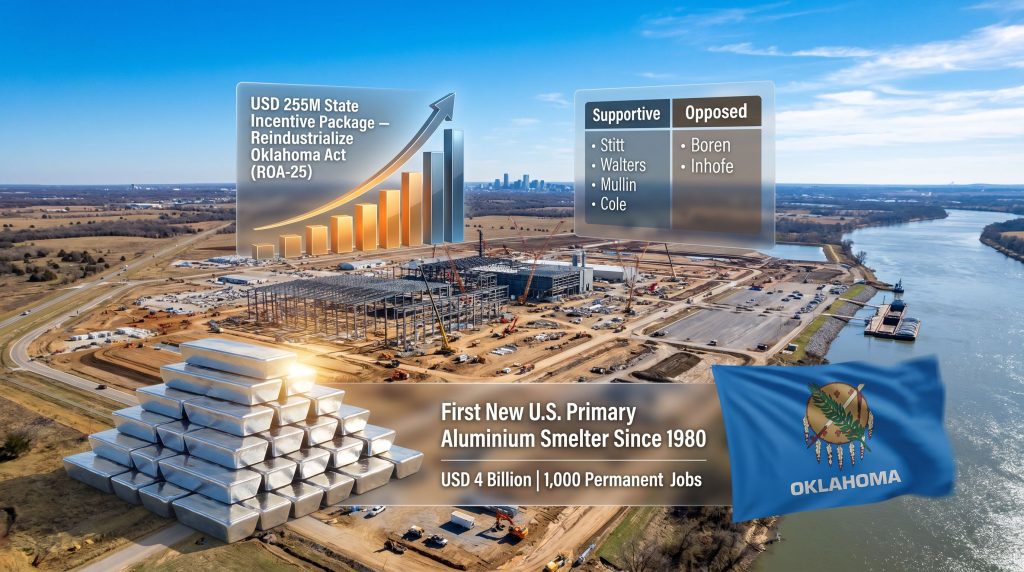
At full operation, the facility is expected to employ approximately 1,000 permanent workers, with substantially larger employment figures anticipated during construction phases and through indirect economic activity in the surrounding region. Oklahoma's commerce department has confirmed the scale of this commitment, highlighting the state's ambitions to anchor a new era of domestic metals production.
If completed, the Inola facility would mark the first new primary aluminium smelter constructed in the United States since 1980, a gap of roughly 46 years that reflects both the economics of the industry and the policy environment that allowed domestic smelting capacity to atrophy.
The strategic significance extends well beyond Oklahoma. The US currently depends heavily on imported primary aluminium from Canada, the Gulf states, and other suppliers. Any disruption to those supply chains, whether from tariff escalation, geopolitical tensions, or trade disputes, creates immediate exposure for defence contractors, aerospace manufacturers, and industrial producers who cannot easily substitute imported primary metal.
Why US Smelting Capacity Collapsed Over Five Decades
The disappearance of American primary aluminium smelting capacity was not a sudden event. It unfolded gradually across decades, driven by several compounding forces:
- Energy cost differentials: Aluminium smelting in the US relies predominantly on grid electricity, which carries significantly higher costs than the hydropower used by Canadian and Norwegian smelters or the subsidised energy available to Gulf state producers.
- Regulatory complexity: Environmental permitting requirements for new greenfield smelters in the US have historically added years and substantial cost to project development timelines.
- Global overcapacity: The dramatic expansion of Chinese primary aluminium production from the 1990s onward flooded global markets with competitively priced metal, further compressing margins for higher-cost US producers.
- Capital allocation priorities: US industrial capital shifted toward less energy-intensive, higher-margin manufacturing sectors, leaving heavy industry to offshore competitors.
The result is that the US today produces a fraction of the primary aluminium it once did domestically, despite being one of the world's largest consumers of the metal. Consequently, global aluminium producers have filled much of that void, reshaping supply chains in ways that now present national security challenges. The Inola project is explicitly designed to begin reversing that trajectory, with the USD 255 million state incentive package serving as the economic bridge between US operating costs and the competitive benchmarks achievable in lower-cost jurisdictions.
The USD 255 Million Incentive Package: Structure and Controversy
Oklahoma lawmakers approved the incentive package through HB 2781, which established the Reindustrialize Oklahoma Act (ROA-25), a dedicated rebate framework designed to support large-scale manufacturers of the type represented by the Inola smelter proposal.
Proponents of the incentive package frame it as a calculated investment in Oklahoma's long-term industrial tax base. The argument is straightforward: 1,000 permanent high-wage manufacturing jobs, combined with billions in capital investment and the downstream economic multiplier effects through supply chain development, logistics, and services, will generate returns that dwarf the initial public commitment over a multi-decade horizon.
Critics, however, raise several legitimate concerns about the package:
- The absence of rigorous independent oversight mechanisms over how incentive funds are deployed
- The risk of setting a precedent where large industrial investors leverage state competition to extract maximum public subsidy
- The question of whether USD 255 million in public resources is appropriately structured given the involvement of a foreign state-linked entity
- The transparency gap between the incentive approval process and the accountability frameworks that follow
Gubernatorial candidate Chip Keating has articulated a middle position: he would not block the project outright but insists on an independent audit of the incentive package to verify that taxpayer funds are being managed responsibly. This position reflects a broader fiscal conservative critique that is distinct from environmental or community opposition to the facility itself.
Candidate Positions: A Fractured Field
The Oklahoma aluminium smelter project governor race has exposed deep divisions within Oklahoma's Republican primary field, where the majority of competitive candidates sit. The table below maps the current positions of the major gubernatorial candidates:
| Candidate | Affiliation | Project Position | Primary Concern |
|---|---|---|---|
| Gentner Drummond | Republican (AG) | Opposed, filed lawsuit | Electricity/water impact, air quality, foreign ownership |
| Mike Mazzei | Republican | Supportive | Job creation, domestic aluminium supply chain |
| Charles McCall | Republican | Opposed in current location | Community opposition from Inola residents |
| Chip Keating | Republican | Conditional support | Audit of USD 255M incentive package |
| Leisa Mitchell Haynes | Republican | Supportive | Economic stimulus and regional employment |
| Cyndi Munson | Democrat | Opposed | Previously voted against enabling legislation |
The split within the Republican field is particularly instructive. It illustrates that industrial development debates in the current political environment no longer map neatly onto traditional party alignments. Pro-business and fiscal-conservative positions are in direct tension, and environmental governance concerns are being raised by Republican as well as Democratic candidates.
The next major ASX story will hit our subscribers first
The Legal Challenge and Its Political Dimensions
Oklahoma Attorney General Gentner Drummond filed formal legal proceedings seeking to halt the Inola project, citing concerns about the facility's demands on shared public infrastructure — specifically electricity and water supply — alongside air quality impacts and the involvement of foreign capital in a strategically significant US manufacturing asset. The US aluminium tariffs backdrop has further complicated this debate, as federal trade policy creates both incentive and urgency for domestic production investment.
The dual role of Drummond as both the state's chief legal officer and a competing gubernatorial candidate creates an inherent tension that observers have noted makes it difficult to separate legitimate legal scrutiny from political positioning. Regardless of intent, the practical effect of the litigation is to introduce material uncertainty into the project's development timeline.
How Might Election Outcomes Shape the Project's Future?
Scenario Analysis: Election Outcomes and Project Futures
- Pro-smelter candidate elected: Legal proceedings likely deprioritised or settled; construction advances toward the targeted 2026 commencement
- Drummond wins: Lawsuit maintained or escalated; project timeline frozen pending judicial resolution
- McCall wins: Project potentially subject to relocation or structural redesign to address community concerns
- Keating wins: Project proceeds under mandatory audit and enhanced fiscal oversight conditions
Active litigation introduces risks beyond the timeline itself. Investors and development partners must model the possibility of injunctions, court-ordered modifications to the project's design or operational parameters, and the regulatory uncertainty that accompanies contested major industrial developments. These variables have direct implications for financing structures and investor confidence.
Foreign Ownership, National Security, and the UAE Dimension
Emirates Global Aluminium is a state-linked entity in the United Arab Emirates, a factor that adds a geopolitical layer to the Inola debate that goes beyond standard foreign direct investment scrutiny. The intersection of foreign state capital, critical material production, and US defence supply chain requirements creates a genuinely complex regulatory environment.
The broader context is important here. The US policy community has spent years attempting to reduce dependence on Chinese dominance in critical mineral and materials supply chains. In doing so, it has actively sought foreign direct investment from allied and partner nations. The UAE sits in an ambiguous position within this framework, maintaining close economic ties with both Western partners and Chinese entities.
This ambiguity does not automatically disqualify UAE-linked investment in US industrial assets. However, it does warrant careful scrutiny through established channels such as the Committee on Foreign Investment in the United States (CFIUS), which has authority to review transactions where foreign control of US businesses could affect national security. Furthermore, the aluminum and steel tariff impact of recent years has already demonstrated how sensitive the domestic metals sector is to geopolitical disruption. Whether the Inola project structure has been or will be subject to CFIUS review is a relevant question that the political debate has only partially addressed.
Community Opposition and the Distribution of Industrial Costs and Benefits
A consistent pattern in large-scale industrial siting decisions is the geographic mismatch between who bears the environmental and infrastructure costs and who captures the economic benefits. The residents of Inola and the surrounding community represent the population most directly exposed to the facility's operational footprint, including potential air quality impacts, increased heavy vehicle traffic, pressure on local water supply, and demands on regional electricity infrastructure.
The economic benefits, by contrast, are distributed far more broadly across the state's tax base, supply chain networks, and workforce. This structural imbalance is not unique to the Inola project. It is a recurring dynamic in industrial siting debates globally, and it explains why localised community opposition frequently emerges even when aggregate economic projections appear strongly positive.
Candidate Charles McCall's opposition specifically centred on community concerns raised by Inola residents, reflecting a recognition that political legitimacy for large industrial projects requires meaningful engagement with the communities that will live alongside them. Local reporting has documented how these community concerns have translated directly into the political and legal challenges now confronting the project.
What the Inola Debate Reveals About Industrial Policy's Next Phase
The Oklahoma aluminium smelter project governor race has exposed several tensions that will define the next generation of US industrial policy debates:
1. The limits of state-level industrial competition: When states compete aggressively through incentive packages to attract capital-intensive manufacturing, the result can be a race to the bottom on fiscal discipline. Oklahoma's USD 255 million commitment raises the question of whether a more structured federal framework for industrial incentives would produce better outcomes than ad hoc state competition.
2. Energy infrastructure as a binding constraint: Primary aluminium smelting at the scale proposed for Inola would place significant new demand on Oklahoma's electricity grid. This demand-side pressure is arriving at a moment when grids across the US are already under strain from data centre growth, electrification of transport, and the integration of intermittent renewable generation. The energy infrastructure question is not merely a local concern — it is a national grid management challenge.
3. The accountability gap in industrial incentives: The Inola debate highlights a widespread problem in US economic development policy: incentive packages are often approved with considerable political momentum but inadequate frameworks for measuring whether the promised economic outcomes actually materialise. Independent audit mechanisms of the kind advocated by Keating represent a more disciplined approach to public accountability in industrial development deals.
4. Rebuilding domestic capacity in contested sectors: The broader imperative to rebuild US primary aluminium production is genuine and well-documented. The challenge is executing that rebuilding in ways that are fiscally responsible, environmentally sound, and community-inclusive, rather than simply moving fast to capture headline investment announcements.
Disclaimer: This article contains forward-looking statements, projections, and scenario analysis relating to industrial investment, political outcomes, and economic development timelines. These represent analytical assessments based on publicly available information and should not be construed as financial, legal, or investment advice. Project timelines, investment figures, and political developments are subject to change. Readers should conduct independent research before making decisions based on information contained herein.
Want to Stay Ahead of the Next Major Resources Discovery on the ASX?
As industrial policy debates reshape critical materials supply chains globally, Discovery Alert's proprietary Discovery IQ model delivers real-time notifications on significant ASX mineral discoveries — including aluminium and other strategic commodities — instantly converting complex data into actionable investment opportunities. Explore how major mineral discoveries have historically generated substantial returns by visiting Discovery Alert's dedicated discoveries page, and begin your 14-day free trial today to position yourself ahead of the broader market.