
June 19, 2026
The Asymmetry of Emergency Crude Buffers: Why Reserve Depth Defines Economic Resilience
When geopolitical shocks ripple through global oil markets, the nations that emerge with the least economic damage are rarely those with the most sophisticated trading desks or the fastest procurement teams. They are, almost invariably, the nations with the deepest strategic crude buffers. The ONGC strategic petroleum reserve in Mangaluru represents India's latest attempt to address this structural vulnerability. Emergency petroleum reserves function as a form of macroeconomic insurance, absorbing the price and supply volatility that would otherwise flow directly into inflation, refinery margin collapse, and currency pressure.
India's position within this framework has long been structurally exposed. The nation consumes approximately 5 million barrels of crude oil per day, imports roughly 85 to 87 percent of its total requirements, and has historically maintained emergency stockpile coverage that falls dramatically short of the International Energy Agency's recommended 90-day benchmark for major consuming nations.
The Iran conflict, which commenced on February 28, brought this vulnerability into sharp focus. While China leveraged its colossal strategic reserve depth to reduce crude imports by approximately one-third in May as prices surged, Indian refiners were compelled to scramble across global spot markets to maintain throughput. Furthermore, the contrast between these two outcomes captures the full strategic weight of reserve adequacy as a policy variable, and you can explore how current crude oil prices have shifted throughout this period.
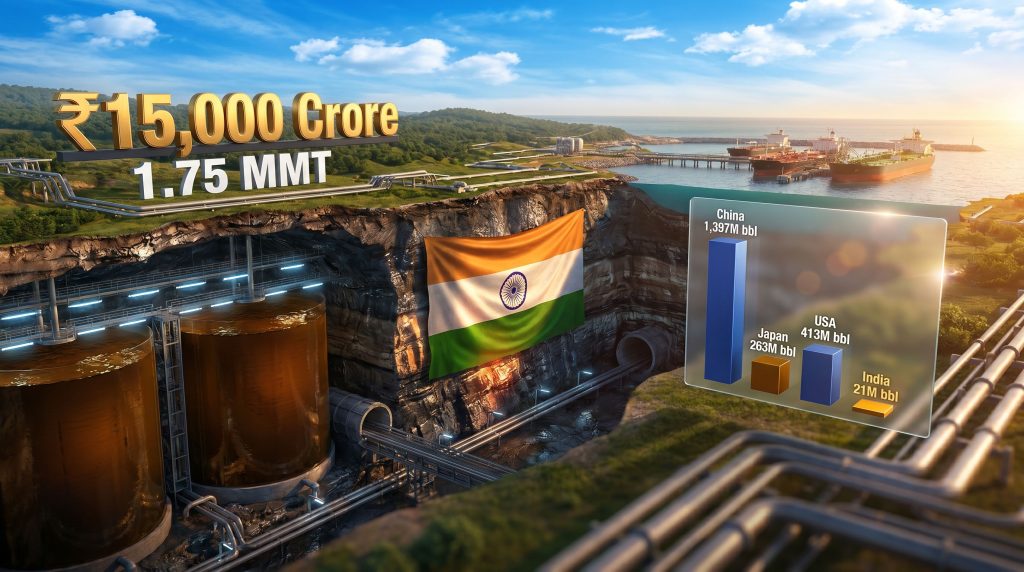
The Indian government's response to this episode has now crystallised into a concrete infrastructure directive: Oil and Natural Gas Corporation (ONGC) has been asked to develop a new strategic petroleum reserve facility at Mangaluru, Karnataka, at a projected total investment of approximately ₹15,000 crore (around $1.6 billion USD). The government's emergency response reflects the urgency felt following the Iran conflict's market impact.
When big ASX news breaks, our subscribers know first
India's Strategic Petroleum Reserve: The Baseline and the Gap
What India's Current SPR Infrastructure Looks Like
India's first-phase strategic petroleum reserve network was developed and is operated by Indian Strategic Petroleum Reserves Limited (ISPRL), a government-owned special purpose vehicle under the Ministry of Petroleum and Natural Gas. The three existing facilities are:
- Visakhapatnam, Andhra Pradesh — 1.33 MMT underground cavern capacity
- Mangaluru, Karnataka — 1.50 MMT underground cavern capacity
- Padur, Karnataka — 2.50 MMT underground cavern capacity
Combined, these facilities provide a total rated capacity of 5.33 million metric tonnes (MMT), equivalent to approximately 39 million barrels. However, utilisation does not always match rated capacity. At the end of 2025, India held just 21 million barrels of strategic crude in storage, a figure that represents roughly four days of consumption cover at current demand levels.
How Does India's Emergency Stockpile Compare Internationally?
The scale of India's deficit relative to peer nations is stark. According to data from the US Energy Information Administration (EIA), the strategic crude stock positions of major consuming nations at end-2025 were as follows:
| Country | Strategic Crude Stocks (End-2025) | Daily Consumption (approx.) | Days of Cover (approx.) |
|---|---|---|---|
| China | 1,397 million barrels | ~16 million bpd | ~87 days |
| United States | 413 million barrels | ~20 million bpd | ~21 days |
| Japan | 263 million barrels | ~3.2 million bpd | ~82 days |
| India | 21 million barrels | ~5 million bpd | ~4 days |
India held just 21 million barrels of strategic crude at end-2025, representing approximately four days of consumption cover. This compares with China's 1,397 million barrels, which enabled Beijing to actively reduce spot market purchases during the Iran war price surge rather than compete for expensive emergency cargoes.
The asymmetry is not merely quantitative. China's reserve depth functioned as an active macroeconomic instrument during the Iran conflict, allowing policymakers to substitute domestic stockpile drawdowns for expensive spot procurement. India had no equivalent lever to pull, consequently forcing its refining complex into reactive, price-exposed purchasing at precisely the worst moment in the market cycle.
The ONGC Strategic Petroleum Reserve in Mangaluru: Project Architecture
Capacity, Cost Structure, and Site Rationale
The proposed ONGC strategic petroleum reserve in Mangaluru would take the form of a 1.75 MMT underground cavern, expanding India's total SPR rated capacity from 5.33 MMT to approximately 7.08 MMT upon completion. This represents a capacity addition of roughly one-third above the current baseline.
The total investment is estimated at ₹15,000 crore, structured across two distinct expenditure categories:
| Investment Component | Estimated Cost |
|---|---|
| Underground cavern construction | ₹5,000 crore |
| Crude oil procurement to fill the facility | ₹10,000 crore |
| Total Project Investment | ₹15,000 crore (~$1.6 billion USD) |
It is important to note that the ₹10,000 crore fill cost is highly sensitive to both global crude prices and the rupee-dollar exchange rate at the time of procurement. A sustained oil price increase or currency depreciation at the time of filling could materially alter the total capital commitment. This price and currency sensitivity makes the timing of the fill decision one of the most consequential operational choices the project will face.
Mangaluru's selection as the project site carries strategic logic beyond simple geography. The city already hosts the ISPRL-operated 1.5 MMT cavern, establishing geological suitability for underground rock cavern storage in the region's sub-surface formation. ONGC already holds land title at the proposed development site, eliminating a significant pre-development hurdle that typically adds years and cost uncertainty to infrastructure projects of this scale. In addition, proximity to Karnataka's coastal refining infrastructure further strengthens the logistical case, as the site offers tanker receipt capability for imported crude.
Underground Rock Cavern Storage: The Technical Mechanism
India's SPR facilities, including all three existing ISPRL sites, use underground lined rock caverns (LRCs) rather than salt dome caverns, which are the dominant storage technology in the United States. This distinction matters for both construction cost and geological suitability.
Salt dome caverns, formed through a solution mining process, are cheaper to develop where the geology permits but require specific subsurface salt formations. Southern and western India's geological profile does not support widespread salt dome development. Lined rock caverns excavated into hard granite or gneissic basement rock offer a viable alternative across a broader range of Indian coastal locations, though at higher construction cost per unit of capacity.
The construction of LRC facilities involves deep excavation, concrete lining, waterproofing systems, and significant civil engineering complexity. The ₹5,000 crore construction estimate for the 1.75 MMT Mangaluru facility reflects this technical intensity. By comparison, the Phase 2 PPP facility at Padur, covering 2.5 MMT, carries a total project cost of ₹5,700 crore, suggesting broadly comparable per-unit construction economics across the two projects. For further context on India's underground storage network, the historical development of this infrastructure is well documented.
A New Institutional Model: Why ONGC's Role Is Structurally Significant
The Institutional Architecture of India's SPR System
All three first-phase SPR facilities were conceived, funded, and are operated exclusively by ISPRL, the dedicated government SPV created for precisely this purpose. ONGC, as India's largest upstream oil and gas producer, has historically had no operational footprint in the strategic reserve system.
The proposed Mangaluru project would represent the first instance of a state-owned oil and gas company being directed to build SPR infrastructure in India. This is a meaningful institutional departure, effectively expanding ONGC's mandate from upstream exploration and production into strategic national infrastructure development. However, geopolitical tensions reshaping trade have accelerated such policy decisions considerably.
The Unresolved Investment Recovery Question
The most consequential unresolved dimension of the project is how ONGC would recover its ₹15,000 crore outlay. Three broad scenarios exist:
- Full government reimbursement — the facility is treated as a national strategic asset, with ONGC compensated by the central government on a cost-recovery basis.
- Commercial leasing or trading rights — ONGC retains operational control and recovers investment through capacity leasing to refiners or commercial crude trading, analogous to the post-2021 ISPRL hybrid model.
- Transfer to ISPRL post-construction — ONGC develops the facility and transfers it to the existing SPR operator, with a negotiated reimbursement structure.
None of these pathways has been publicly defined. For a commercially-oriented state enterprise with active capital commitments across upstream exploration programmes, a ₹15,000 crore directed investment without defined returns has material implications for ONGC's capital allocation priorities and balance sheet profile.
The Evolution of India's SPR Policy: From Pure Strategy to Commercial Hybridity
India's approach to strategic petroleum reserves has evolved significantly since the original first-phase facilities were conceived. The initial design treated reserves as purely strategic national assets, held exclusively for emergency deployment.
In 2021, the government revised this framework substantially, introducing commercial flexibility into the ISPRL operating model. Under the revised policy:
- ISPRL may lease 30% of total capacity to private refiners or commodity traders, generating commercial lease revenue.
- ISPRL may deploy 20% of stored crude for active trading operations, further monetising the reserve infrastructure.
This hybrid framework attempted to make SPR infrastructure financially self-sustaining by generating commercial returns without compromising the core strategic reserve function. The Phase 2 PPP model at Padur and the proposed Chandikhol facility takes this commercialisation logic further still. Furthermore, understanding how OPEC influences global oil markets provides important context for why this commercial flexibility was introduced.
India's Phase 2 SPR Expansion: The Public-Private Partnership Framework
Padur and Chandikhol: How the PPP Model Works
The government-approved Phase 2 expansion programme involves two additional facilities:
- Padur, Karnataka — 2.5 MMT additional capacity under PPP structure
- Chandikhol, Odisha — 4.0 MMT capacity, contract yet to be awarded
Megha Engineering and Infrastructures Ltd secured the Padur mandate through a competitive tender process. The award criterion was the lowest Viability Gap Funding (VGF) bid, with VGF capped at 60% of the ₹5,700 crore project cost. Under the PPP operating model, the private developer recovers its investment through:
- Capacity leasing arrangements with the government and domestic oil companies.
- Full commercial freedom to trade crude held within the facility.
Comparing India's Three SPR Development Models
| Development Model | Facility Examples | Capital Source | Operator | Commercial Rights |
|---|---|---|---|---|
| Fully Government-Funded | Visakhapatnam, Mangaluru (existing), Padur (existing) | Central Government | ISPRL | Limited (post-2021 hybrid) |
| Public-Private Partnership | Padur Phase 2, Chandikhol (pending) | Private Developer + VGF | Private Developer | Full commercial freedom |
| State Company-Directed | Mangaluru (proposed ONGC facility) | ONGC balance sheet | TBD | TBD |
This three-tier architecture reflects an evolving policy philosophy that increasingly treats strategic reserve infrastructure as a platform for commercial value creation alongside national security objectives.
Geopolitical Stress-Testing: What Supply Shock Scenarios Reveal
Three Scenarios and Their Implications for India
Modelling India's position across different supply disruption scenarios illustrates precisely why reserve depth translates into macroeconomic outcomes. The trade war's impact on oil markets has further complicated India's procurement environment, making domestic reserve depth even more critical.
Scenario A: Moderate Disruption (30-day supply shock)
With approximately four days of strategic cover, India's current position provides negligible insulation. Within days of a disruption, domestic refiners face full spot market exposure at elevated prices, with downstream inflation pressure flowing rapidly into fuel costs.
Scenario B: Extended Conflict (90-day supply shock)
A prolonged disruption leaves Indian refiners competing for spot cargoes across multiple pricing cycles at crisis-level premiums. The rupee-dollar dynamic compounds this exposure: crude prices and dollar demand spike simultaneously, amplifying the fiscal cost of each barrel procured.
Scenario C: Post-Expansion Position (7.08 MMT total capacity)
The ONGC strategic petroleum reserve in Mangaluru, once filled, would add approximately five to six additional days of strategic coverage. This is a meaningful improvement in insulation depth but still falls dramatically short of the IEA's 90-day benchmark and leaves India structurally dependent on reactive procurement during any extended disruption.
The Fiscal Mathematics of Import Dependency
India's structural crude import dependency creates a compounding fiscal exposure during geopolitical price events. Each $10 per barrel increase in crude costs India approximately $6 to $7 billion annually in additional import expenditure, before factoring in the currency depreciation that typically accompanies commodity price spikes.
Strategic reserves function as a fiscal hedge instrument in precisely these conditions: the ability to draw down domestic stocks at the onset of a price event reduces spot market purchasing at the most expensive point in the cycle. China's demonstrated behaviour during the Iran war, reducing imports by roughly a third as prices surged, illustrates this hedge function at scale. For further analysis of how geopolitical and logistical factors are shaping crude pricing in 2025, the dynamics are considerable.
Closing the gap to even 30 days of consumption cover would require India to hold storage capacity approaching 150 million barrels. Achieving that level would demand a multi-decade capital programme far beyond any single project currently under development or planning.
The next major ASX story will hit our subscribers first
Key Risks and Unresolved Questions
Financial and Structural Uncertainties
- Investment recovery ambiguity: The mechanism for ONGC to recoup its ₹15,000 crore outlay remains publicly undefined, creating uncertainty about the project's return profile and its impact on ONGC's upstream capital allocation.
- Fill cost sensitivity: The ₹10,000 crore crude procurement estimate is highly exposed to oil price and rupee movements; procurement timing will be a critical value driver.
- Balance sheet pressure: Directing a commercially-oriented upstream operator to fund strategic national infrastructure without clear returns carries governance and capital efficiency implications.
- Operational model ambiguity: Whether ONGC will operate the facility directly, transfer it to ISPRL, or establish a new hybrid arrangement remains undefined.
Regulatory and Operational Considerations
Underground cavern construction in coastal Karnataka requires navigation of complex geological assessment, environmental clearance, and coastal zone regulatory frameworks. Additionally, coordinating development responsibilities between ONGC as the builder and ISPRL as the existing Mangaluru SPR operator will require clear jurisdictional delineation before construction can advance efficiently.
Disclaimer: This article contains forward-looking analysis, scenario modelling, and financial projections based on publicly available data and reported figures. These projections involve inherent uncertainty and should not be interpreted as investment advice. Readers should conduct independent due diligence before making any financial or investment decisions.
Frequently Asked Questions: ONGC Strategic Petroleum Reserve in Mangaluru
What Is the ONGC Strategic Petroleum Reserve Project in Mangaluru?
The Indian government has directed ONGC to develop a new underground crude oil storage cavern at Mangaluru, Karnataka. The proposed facility would have a capacity of 1.75 MMT and require a total investment of approximately ₹15,000 crore, covering construction costs of ₹5,000 crore and crude procurement estimated at ₹10,000 crore at prevailing prices.
Who Currently Operates India's Strategic Petroleum Reserves?
India's three existing first-phase SPR facilities are owned and operated by Indian Strategic Petroleum Reserves Limited (ISPRL), a government-owned special purpose vehicle under the Ministry of Petroleum and Natural Gas. ONGC currently has no operational role in the existing SPR network.
How Much Will the ONGC Mangaluru SPR Expand India's Storage Capacity?
The proposed 1.75 MMT facility would increase India's total SPR rated capacity from 5.33 MMT to approximately 7.08 MMT, an expansion of roughly one-third.
What Makes This Project Institutionally Different From Previous SPR Developments?
This would be the first time a state-owned oil and gas company has been asked to build SPR infrastructure. All three existing sites were centrally funded and are operated by ISPRL. Phase 2 facilities use a PPP model. The ONGC-directed approach represents a third, distinct institutional pathway.
Has the Investment Recovery Mechanism Been Defined?
No. As of the reporting period, no publicly specified mechanism exists for ONGC to recover its approximately ₹15,000 crore investment. Whether the facility will function as a purely strategic national asset, incorporate commercial leasing, or operate under a hybrid model remains an open policy question.
Want to Stay Ahead of the Next Major Resource Discovery?
Discovery Alert's proprietary Discovery IQ model delivers real-time alerts on significant ASX mineral discoveries, transforming complex resource data into actionable investment insights — explore historic discoveries and their exceptional returns to understand the opportunity, then begin your 14-day free trial to position yourself ahead of the broader market.