August 25, 2026
The Infrastructure Equation That Could Define North American Critical Minerals Supply
Remote mineral deposits have existed on every continent since long before the modern mining era. What separates producing districts from permanently stranded assets is rarely geology. It is almost always logistics. The history of resource development, from the Pilbara iron ranges of Western Australia to the Labrador Trough of eastern Canada, demonstrates a consistent pattern: the moment permanent infrastructure arrives, the economics of extraction transform completely. Capital follows access, and access is built on roads and rail.
Nowhere is this dynamic more visible in Canada today than in the James Bay Lowlands of northern Ontario, where one of the most mineralogically diverse critical minerals energy security provinces on the planet has waited nearly two decades for a road connection that most mid-tier mining jurisdictions would have constructed within five years of discovery. The Ontario Ring of Fire road network is now moving from planning toward construction, and the implications for Canada's position in global battery and industrial supply chains are significant.
When big ASX news breaks, our subscribers know first
What Makes the Ring of Fire Geologically Distinct
A Mineral System with Rare Breadth
Most world-class mineral districts are defined by one dominant commodity. The Athabasca Basin in Saskatchewan is a uranium story. The Golden Triangle in British Columbia is a gold and copper story. The Ring of Fire is different in that it combines commodities across multiple supply chains simultaneously.
The region hosts significant chromite mineralisation, which underpins stainless steel and specialty alloy manufacturing. It also contains nickel, copper, cobalt, and platinum group elements, alongside lithium-bearing formations that have attracted growing interest as the global battery supply chain seeks North American-sourced feedstock. This breadth is geologically unusual and commercially important, because it means the district's viability is not entirely dependent on the price cycle of any single metal.
Chromite is the commodity that first drew attention to the Ring of Fire. Canada currently has no domestic chromite production, making it entirely import-dependent for a mineral used extensively in stainless steel manufacturing. The Ring of Fire represents one of the largest chromite discoveries in North American history, with some deposit zones containing high-grade massive chromite horizons that compare favourably with established producing regions in South Africa and Kazakhstan.
What Investors Rarely Understand About Ring of Fire Geology
A less widely appreciated aspect of the Ring of Fire is the structural geology of the chromite deposits themselves. The mineralisation occurs in layered mafic and ultramafic intrusions, a rock type associated globally with the highest-grade chromite and platinum group element concentrations. The Eagle's Nest deposit, operated by Wyloo Metals, exemplifies this with its nickel-copper-platinum group element profile hosted in a similar ultramafic setting.
What this means practically is that the Ring of Fire is not a single deposit but a camp-scale mineral system, where infrastructure investment has the potential to unlock not one mine but a sequence of projects across a shared corridor. This multiplier characteristic is what separates the Ring of Fire from isolated single-mine projects and is central to understanding why road infrastructure investment justifies its cost.
The Ontario Ring of Fire Road Network: Structure and Sequencing
Four Segments, One Strategic Vision
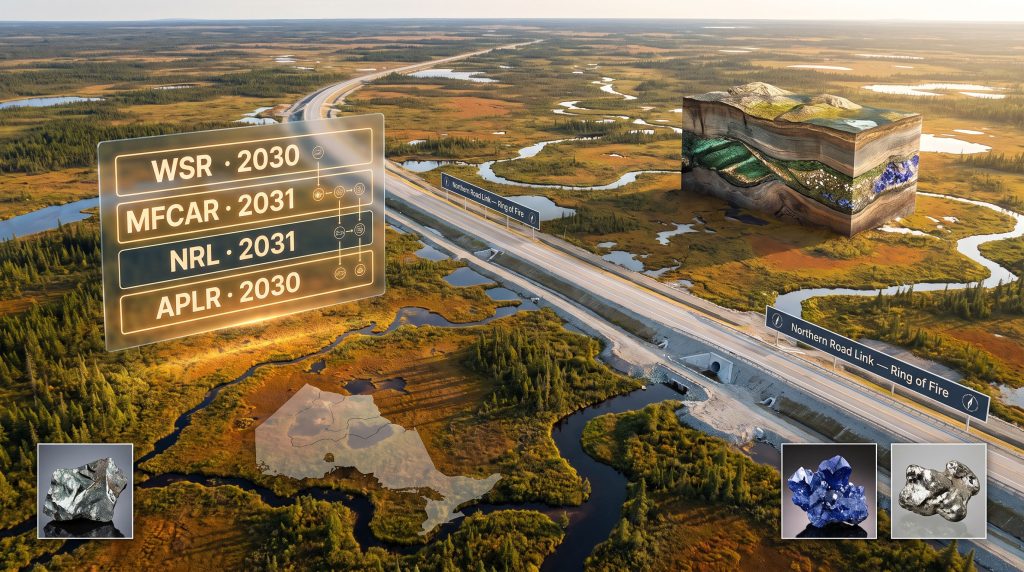
The planned all-season road network that will connect the Ontario Ring of Fire road network to Ontario's provincial highway system is structured across four distinct segments, each with its own environmental assessment status, construction timeline, and functional role within the overall network.
| Road Segment | Abbreviation | Construction Start | Projected Opening |
|---|---|---|---|
| Webequie Supply Road | WSR | June 2026 | November 2030 |
| Marten Falls Community Access Road | MFCAR | August 2026 | November 2031 |
| Northern Road Link | NRL | Spring 2028 | November 2031 |
| Anaconda-Painter Lake Roads Upgrade | APLR | Upgrades underway | November 2030 |
The sequencing of these segments reflects both engineering logic and political negotiation. The WSR and MFCAR segments connect two First Nations communities to the provincial highway network, providing permanent all-season access that transforms healthcare, food security, and education delivery for communities that have historically relied on seasonal ice roads and expensive fly-in supply chains.
The Northern Road Link: The Commercial Linchpin
Of the four segments, the Northern Road Link carries the greatest commercial significance. It is the connector that joins the WSR and MFCAR into a unified network and extends that network into the core mineral deposit zone. Without the NRL, the other three segments create community access infrastructure without enabling bulk mineral transport to processing and export facilities.
The NRL's later start date of spring 2028 reflects its dependency on the completion of upstream segments and the finalisation of remaining environmental approvals. This sequencing means the 2031 target for commercial mining access is the critical date for project proponents and investors, not the 2030 dates for the first two segments.
Engineering in Subarctic Terrain
Building all-season roads through the James Bay Lowlands presents engineering challenges that are fundamentally different from road construction in temperate or even boreal environments further south. The lowlands sit on one of the world's largest intact peatland systems, overlying discontinuous permafrost zones that are particularly sensitive to surface disturbance and temperature change.
The key engineering considerations include:
- Elevated road bed design to minimise thermal disturbance to underlying permafrost
- Culvert engineering to manage seasonal water movement across low-lying terrain
- Peat bridging and geotextile foundations to distribute load across unstable substrates
- Seasonal construction windows that restrict ground-breaking activity to periods when frost provides adequate load-bearing capacity
The term "all-season road" carries a specific meaning in this context. It refers to a certified road capable of carrying heavy commercial vehicles year-round, as opposed to winter-only ice roads or summer trails. This certification is not merely administrative. It is the threshold that lenders and project financiers require before committing capital to mine development, because it determines whether a project can reliably transport bulk ore or concentrate to processing facilities on a schedule that supports debt servicing.
Technical Note: Ice roads, while functional for limited supply purposes, typically operate for only six to twelve weeks per year in the Ring of Fire region. They cannot support the continuous heavy freight volumes required for commercial mining operations. All-season certification changes the entire economics of the district.
Governance Architecture: First Nations as Co-Proponents
From Consultation to Partnership
One of the most structurally significant aspects of the Ring of Fire road development is the formal role of Webequie First Nation and Marten Falls First Nation as co-proponents of the respective road segments connecting to their communities. This is a meaningful distinction from the consultation frameworks that governed earlier generations of Canadian resource infrastructure development.
Partnership agreements formalised in 2025 establish these communities not as stakeholders to be consulted but as active participants in project governance, environmental oversight, and economic participation. The practical implications include:
- Joint decision-making authority on environmental management plans
- Employment and procurement commitments embedded in construction contracts
- Revenue-sharing structures tied to road operations and downstream resource royalties
- Community-controlled monitoring programmes for environmental compliance
This model is partly a response to the Free, Prior and Informed Consent principles that have increasingly shaped Canadian resource law, but it also reflects a pragmatic recognition that projects in northern Ontario cannot advance without sustained community support. The two-decade delay in Ring of Fire development is itself a lesson in what happens when that support is absent or contested.
The Federal-Provincial Co-operation Agreement
Historically, one of the most persistent sources of delay in northern Canadian infrastructure has been the duplication of environmental assessment requirements between provincial and federal regulatory frameworks. A project triggering both processes could spend years navigating sequential or parallel reviews, with federal and provincial authorities sometimes reaching different conclusions on the same evidence.
The 2025 co-operation agreement between the Ontario government and the federal government represents a structural attempt to address this bottleneck by coordinating assessment timelines and reducing regulatory duplication. Furthermore, Ontario's accelerated construction plan to complete roads five years ahead of schedule signals a meaningful shift in political urgency. The practical test of this agreement will be whether the June 2026 construction start for the WSR is achieved as scheduled.
Geopolitical Pressure: The US-Canada Trade Conflict as Accelerant
Critical Minerals in a Tariff Environment
The escalation of trade tensions between the United States and Canada has introduced a geopolitical dimension to Canadian critical mineral development that is reshaping investment priorities across multiple sectors. For the Ring of Fire specifically, the trade conflict has changed the framing of road infrastructure investment from regional development to national economic security.
The minerals hosted in the Ring of Fire, particularly nickel, cobalt, and chromite, are directly relevant to North American battery supply chain localisation. Critical minerals demand growth is intensifying as the Inflation Reduction Act framework in the United States creates strong incentives for sourcing critical minerals from free trade agreement partners, positioning Canadian production as a natural supplier to US battery gigafactories. Trade friction complicates that picture, but it also intensifies the political urgency of developing domestic Canadian supply chains.
Where Ring of Fire Minerals Fit in the Global Supply Chain
| Mineral | Primary Global Sources | Ring of Fire Role | Supply Chain Relevance |
|---|---|---|---|
| Chromite | South Africa, Kazakhstan, India | Potential new North American producer | Stainless steel, specialty alloys |
| Nickel | Indonesia, Philippines, Russia | High-grade sulphide potential | EV batteries, stainless steel |
| Cobalt | Democratic Republic of Congo | Associated with nickel deposits | EV battery cathodes |
| Platinum Group Elements | South Africa, Russia | Hosted in ultramafic intrusions | Catalysts, fuel cells |
| Lithium (formations) | Australia, Chile, Argentina | Exploration-stage potential | EV battery anodes |
The concentration of global chromite supply in South Africa and Kazakhstan, and nickel supply in Indonesia and Russia, represents the kind of geographic concentration that supply chain risk managers find most concerning. Furthermore, the critical minerals trade dynamics emerging across allied nations underscore the strategic importance of developing alternative North American sources. Canadian production from the Ring of Fire would not displace these sources immediately, but it would provide North American industrial consumers with a meaningful alternative.
Three Scenarios for Ring of Fire Road Delivery
Scenario Modelling: What Happens Under Different Outcomes
Infrastructure project scenario analysis is most useful when it moves beyond optimistic base cases and pressure-tests outcomes across a realistic range of delivery pathways.
Scenario 1: On-Schedule Delivery
All four road segments open between November 2030 and November 2031 as planned. The NRL opens on the 2031 target, triggering a wave of feasibility study updates and construction decisions from project proponents who have been staging their timelines against road completion. First commercial mining operations begin transitioning from development to production by 2033–2034. Ontario establishes itself as a credible Tier 1 critical minerals jurisdiction within the North American supply chain.
Scenario 2: Partial Completion with Delays
The WSR and APLR open on their 2030 targets, providing community access and the southern highway connection. The MFCAR and NRL experience delays of twelve to twenty-four months due to engineering complications in the permafrost transition zone north of the Marten Falls corridor, or regulatory review extensions for the NRL. Mining project timelines shift to 2035–2036. Investor confidence is partially maintained by the partial network completion, but project financing windows tighten as commodity cycle uncertainty grows.
Scenario 3: Structural Delay
Permafrost engineering complications prove more severe than anticipated as climate-related ground instability affects construction scheduling. Cost overruns require additional rounds of government budget approval, introducing political risk into the timeline. International capital redirects toward competing jurisdictions with established infrastructure. This scenario is the historical default for this region and represents the path of least resistance if political will or engineering execution falters.
Investor Consideration: The June 2026 construction start for the WSR functions as the first real-world test of project delivery credibility. A successful groundbreaking on schedule would meaningfully shift the probability distribution toward Scenario 1 and could catalyse re-rating of project equities across the Ring of Fire corridor.
The next major ASX story will hit our subscribers first
The Project Pipeline: What Road Access Unlocks
From Exploration to Feasibility: The Economic Threshold
The Ring of Fire mineral camp contains multiple projects at various stages of development, each requiring different infrastructure conditions to advance through the project development cycle. Some projects can move to feasibility-level studies with road access merely confirmed and funded, because the certainty of future access allows project economics to be modelled on all-season operating cost assumptions rather than fly-in premiums.
The economic transformation that road access delivers is substantial. Fly-in operations in remote northern Ontario carry significant cost premiums relative to road-accessible sites. These premiums affect:
- Labour costs, through the expense of fly-in fly-out workforce rotations
- Supply chain costs, through airfreight pricing for consumables and equipment
- Capital costs, through the inability to transport heavy construction equipment economically
- Operating costs, through fuel and reagent delivery at airfreight rather than road freight rates
When these premiums are eliminated by road access, projects that were economically marginal under fly-in operating assumptions become commercially viable. This is the mechanism through which road infrastructure investment generates multiples of its cost in private mining capital deployment.
Chromite Processing: An Unresolved Strategic Question
One aspect of Ring of Fire development that rarely receives sufficient attention is the processing infrastructure question. Chromite ore requires smelting to produce ferrochrome, the intermediate product used in stainless steel manufacturing. No ferrochrome smelting capacity currently exists in Ontario.
The choice between building in-region processing infrastructure versus exporting raw chromite ore has significant implications for the economic value captured in Canada versus shipped abroad. Ferrochrome smelting is energy-intensive, favouring locations with access to reliable and competitively priced power. Northern Ontario's power grid connectivity along the road corridor will need to be developed alongside or following road construction if in-region processing is to be viable. In addition, defence critical materials considerations are increasingly influencing how allied governments approach chromite and ferrochrome supply chain sovereignty.
Benchmarking Against Global Precedents
What History Tells Us About Remote Mining Infrastructure
| Project | Location | Infrastructure Type | Development Period | Outcome |
|---|---|---|---|---|
| Pilbara Road and Rail Network | Western Australia | Road and rail to port | 1960s–1980s | Enabled the world's largest iron ore export industry |
| Labrador Iron Ore Railway | Quebec-Labrador | Rail corridor | 1950s | Unlocked Labrador Trough iron ore district |
| Ring of Fire Road Network | Northern Ontario | All-season road (4 segments) | 2026–2031 (planned) | Pending, critical minerals access |
| Simandou Rail Corridor | Guinea, West Africa | Rail to port | 2020s | In development, world-class iron ore deposit |
The Labrador precedent is particularly instructive for the Ontario Ring of Fire road network. The Iron Ore Company of Canada's railway, constructed through extraordinarily difficult subarctic terrain in the 1950s, unlocked a mineral district that has produced hundreds of millions of tonnes of iron ore over seven decades. The upfront infrastructure investment generated returns that extended across multiple generations of mining activity.
The key distinction between the Ring of Fire and the Labrador model is the absence of a single anchor company with the financial capacity and strategic motivation to build its own dedicated infrastructure. The Ring of Fire road network is a shared-use government infrastructure project rather than a company-specific rail corridor, which changes the financing structure and governance model but ultimately serves the same economic function. Furthermore, North American mining trends indicate growing investor appetite for jurisdictions that demonstrate infrastructure commitment alongside geological potential.
Environmental Realities and Community Dimensions
The Peatland Dimension
The James Bay Lowlands constitute one of the largest intact boreal peatland systems in the world, estimated to store carbon stocks comparable to decades of global industrial emissions. Road construction through peat-dominated terrain carries genuine environmental risks, including carbon release from disturbed peat profiles, hydrological changes affecting wetland ecosystems, and long-term permafrost degradation along the road corridor.
The environmental assessments completed for the WSR and MFCAR include mitigation conditions specifically addressing these risks. These include elevated road bed design to minimise peat compression, culvert systems designed to preserve natural water flow patterns, and monitoring programmes that will track ecological changes over the operational life of the roads.
Permanent Access and Community Transformation
For Webequie First Nation and Marten Falls First Nation, permanent road access represents a qualitative transformation in daily life that extends far beyond mining economics. Communities that currently pay airfreight prices for fresh food, rely on medical evacuation for serious health events, and face educational limitations imposed by geographic isolation will gain year-round land connectivity to provincial services and supply networks.
This community development dimension is not separate from the mining development story. It is central to the political sustainability of the project. Communities that experience genuine improvements in quality of life as a result of road construction have strong reasons to support the continued development of the mineral district, while communities that perceive road development primarily as an extraction mechanism have historical grounds for resistance.
What Investors and Industry Should Watch
Leading Indicators for Timeline Confidence
Investors and industry participants tracking the Ontario Ring of Fire road network should focus on a specific set of milestone indicators rather than top-line announcement dates:
- WSR groundbreaking confirmation in June 2026 as the first credibility test for construction timeline delivery
- NRL environmental approval milestones as leading indicators for the 2028 construction start
- Federal budget allocations for northern infrastructure in successive budget cycles as signals of sustained funding commitment
- First Nations partnership governance reports for indicators of community support stability
- Permafrost engineering reports from the WSR construction season as early warning signals for the technical challenges facing the NRL
The Long-Term Value Creation Thesis
Modelling the downstream economic value of a fully operational Ring of Fire mining district over a thirty-year horizon requires assumptions about commodity prices, production scales, and processing infrastructure development that carry substantial uncertainty. However, the structural case is straightforward: road infrastructure converts geological potential into bankable, financeable projects, and bankable projects attract private capital at multiples of the initial infrastructure investment.
The historical pattern from comparable remote mining districts suggests that every dollar of public road infrastructure investment in a world-class mineral camp generates between five and fifteen dollars of private mining capital over the following decade, depending on commodity market conditions and project development success rates. This multiplier is the core economic justification for public investment in the Ontario Ring of Fire road network, and it is the metric against which the success of this programme should ultimately be judged.
Disclaimer: This article contains forward-looking statements, scenario projections, and financial analysis for informational purposes only. It does not constitute financial advice, investment recommendations, or an offer to buy or sell securities. Readers should conduct their own due diligence before making any investment decisions. Timelines, cost estimates, and project outcomes referenced are based on publicly available information and are subject to change.
Want to Track the Next Major Critical Minerals Discovery Before the Market Does?
Discovery Alert's proprietary Discovery IQ model delivers real-time alerts on significant ASX mineral discoveries — instantly translating complex data across 30+ commodities into clear, actionable insights for investors at every level. Explore historic examples of exceptional discovery returns or start your 14-day free trial today to position yourself ahead of the next major find.