
August 25, 2026
The Invisible Metal Powering the AI Revolution
Solder is not a headline commodity. It does not attract the breathless coverage reserved for lithium, cobalt, or rare earth elements. Yet buried inside every AI accelerator, every high-bandwidth memory stack, and every advanced driver-assistance system controller is a material that no current manufacturing process can replace: tin. As AI hardware demand and tin supply disruption converge, the metals markets underpinning the global infrastructure buildout deserve far closer scrutiny than they typically receive.
Understanding why requires moving beyond the semiconductor narrative and examining what AI hardware actually consists of at the physical level, where tin consumption originates, and why the current supply structure is ill-equipped to absorb a sustained demand acceleration.
When big ASX news breaks, our subscribers know first
Why Tin Belongs in the AI Critical Materials Conversation
Most analyses of AI infrastructure focus on silicon, advanced packaging substrates, and specialty gases. The metals discussion typically centres on copper for power transmission and rare earths for magnetics. Tin rarely appears on these lists, yet its role is structurally embedded in ways that cannot be designed around under current regulatory and technical constraints.
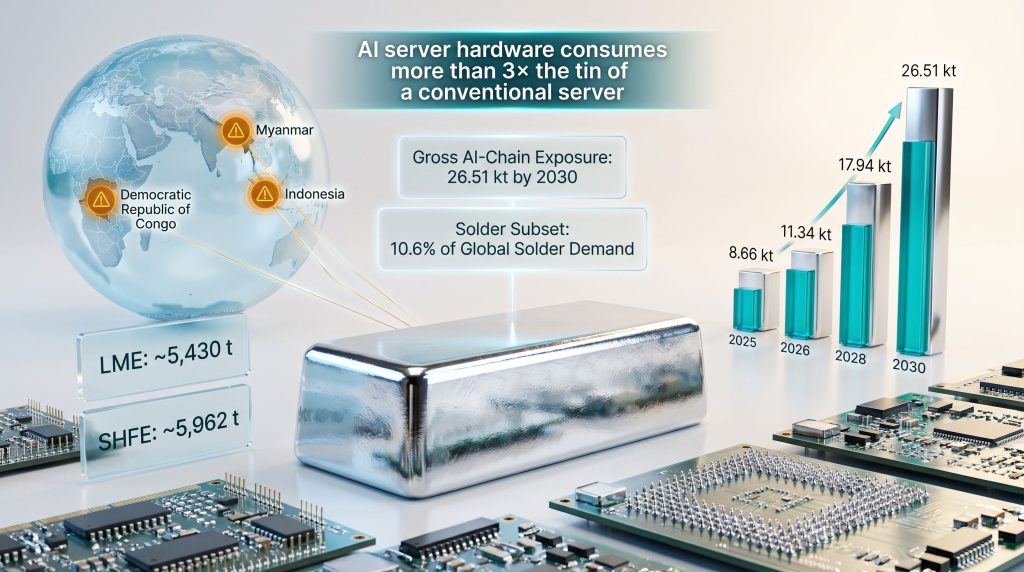
An AI-optimised server consumes more than three times the tin of a conventional server. That differential does not arise primarily from the processor itself but from the density of the printed circuit boards surrounding it, the number of solder joints per unit across power management systems and optical interconnects, and the advanced packaging architectures now standard in high-performance compute.
Flip-chip assembly, wafer-level packaging, and 2.5D and 3D stacking technologies all rely on tin-based solder bumps at the die-attach level. These are not incidental design choices but consequences of the physics of heat management and signal integrity at nanometer geometries. Furthermore, regulatory frameworks reinforce tin's position considerably.
The European Union's RoHS directive, along with WEEE regulations now progressively adopted across Asian manufacturing jurisdictions, mandates lead-free solder in consumer and industrial electronics. Bismuth-based and indium-based alternatives exist but face cost premiums, lower melting point reliability issues, and supply constraints of their own. For high-density AI electronics, tin-based solder is not merely the default choice but the only commercially viable one across the vast majority of applications.
This combination of technical performance requirements and regulatory lock-in makes tin functionally irreplaceable in the near-to-medium term for advanced electronics manufacturing.
Breaking Down Where AI Tin Demand Actually Comes From
A rigorous assessment of AI hardware demand and tin supply disruption risk requires granular, bottom-up analysis rather than top-down extrapolation. Modelling across 26 component lines spanning three principal hardware segments reveals a demand profile that is broader, more durable, and more structurally significant than a server-centric view would suggest. In addition, concerns around critical mineral shortages are increasingly informing how analysts interpret these supply pressures.
The Three Hardware Segments Driving Tin Exposure
Data center compute encompasses server electronics, GPU and AI accelerator boards, high-bandwidth memory modules, optical transceivers, network switches, power supply units, liquid cooling infrastructure, and rack-level components. Each of these categories carries its own tin intensity, and the combined effect of scaling all of them simultaneously is substantial. AI-driven demand signals from the data center sector are already reshaping procurement strategies globally.
Client and edge devices cover AI-enabled laptops and desktops, next-generation smartphones incorporating generative AI inference capabilities, tablets, smart glasses, wearables, edge inference cameras, and industrial AI gateways. This segment is characterised by a higher displacement ratio: many AI-enabled consumer devices replace conventional equivalents rather than represent net new device shipments, which means gross tin exposure overstates the genuinely incremental demand contribution.
Mobility and automation is the segment that most analysts underestimate. Advanced driver-assistance system controllers and their associated sensor arrays, intelligent cockpit electronics, industrial robots, service robots, commercial drone platforms, and the nascent humanoid robot category all carry dense electronics packages with high solder content. By 2030, this segment alone accounts for 14.18 thousand tonnes of gross AI-chain tin exposure, representing 53.5% of the total.
The prominence of mobility and automation is not an artefact of aggressive shipment assumptions. It reflects the fundamental reality that ADAS and robotics platforms integrate dozens of electronic control units, sensor fusion modules, and communication interfaces, each requiring solder at board level and at component attachment points throughout the assembly.
Quantifying the Demand: 2025 to 2030
| Model Measure | 2025 | 2026 | 2028 | 2030 |
|---|---|---|---|---|
| Gross AI-chain exposure (kt) | 8.66 | 11.34 | 17.94 | 26.51 |
| Product-counterfactual increment (kt) | 4.99 | 6.40 | 10.85 | 17.05 |
| Solder-related subset (kt) | 7.73 | 10.16 | 16.04 | 23.64 |
| Increment / global tin demand | 1.24% | 1.56% | 2.58% | 3.98% |
| Solder subset / global solder demand | 3.74% | 4.77% | 7.32% | 10.60% |
Gross procurement exposure grows at approximately 25% compound annual growth rate between 2025 and 2030. Crucially, the product-counterfactual increment, which strips out the tin that would have been consumed in conventional products being displaced, grows faster than gross exposure after 2026. Its share of gross exposure rises from 56.4% in 2026 to 64.3% in 2030, indicating that AI deployment becomes progressively more additive to total tin consumption rather than merely substitutive.
Solder Paste as the Primary Demand Driver
Across all product forms, solder paste dominates the mix. Its contribution rises from 5.14 thousand tonnes in 2026 to 11.62 thousand tonnes in 2030. Solder balls, bar, wire, and preforms collectively account for a further 12.02 thousand tonnes by 2030, while plating and other tin-containing applications reach 2.88 thousand tonnes.
The solder-related subset consistently accounts for roughly 89% of gross AI-chain exposure throughout the forecast window. This concentration matters enormously for market dynamics: tin's AI exposure is overwhelmingly a solder market phenomenon, and solder demand is already the single largest end-use category for refined tin, representing approximately 52% of total global consumption. By 2030, the AI-related solder subset alone is projected to equal 10.6% of total global solder tin demand.
Featured Snippet: By 2030, AI hardware is projected to account for approximately 6.2% of total refined tin demand and 10.6% of global solder tin demand, based on bottom-up modelling across data centers, edge devices, and mobility and automation platforms.
The Methodology That Makes These Numbers Meaningful
Two concepts are essential for interpreting AI-chain tin demand figures correctly, and conflating them produces material analytical errors.
Gross procurement exposure captures the total tin physically embedded in AI-related hardware, inclusive of units that directly displace conventional products. It represents the full purchasing footprint of the AI hardware chain on the tin market, regardless of whether that purchasing is genuinely incremental.
Product-counterfactual increment subtracts the tin that would have been consumed by the conventional equipment being replaced. This produces the closer, though still assumption-dependent, estimate of how much additional tin AI deployment actually adds to global demand.
The net refined factor formula used to translate hardware intensity into refined tin demand deserves particular attention. Calculated as (1 minus scrap rate times recovery rate) divided by (1 minus scrap rate), it avoids the common error of applying a blanket process-loss uplift when solder scrap and dross are recovered and re-enter the production system. Neither measure should be added directly to an existing supply-demand balance without first reconciling the electronics and technology demand already embedded in that underlying forecast. Ongoing tin recovery improvements at a processing level may, however, gradually shift some of these underlying assumptions over time.
Why the Indirect Tin Footprint May Be Larger Than Reported
The direct hardware model does not capture the full tin investment ecosystem surrounding AI deployment. Every data center requires external power infrastructure: grid connection upgrades, substations, uninterruptible power supply systems, and backup generation. Every large-scale compute facility generates waste heat requiring external thermal management. These systems contain tin across connectors, circuit boards, power electronics, and control systems.
Semiconductor fabrication capacity growth, driven partly by AI chip demand, creates additional indirect tin consumption through fab construction, process equipment manufacturing, and power management infrastructure at the facility level. Expanded fibre and wireless communications networks supporting AI-driven data traffic generate further demand. Rather than producing a speculative headline number, monitoring indirect demand through leading indicators provides a more disciplined approach:
- Data center construction permit activity and announced capacity additions
- Grid connection applications and electrical equipment order intake
- Semiconductor fabrication investment announcements and equipment lead times
- Physical solder market conditions including pricing premiums and delivery timelines
A Supply Structure That Cannot Move Quickly
The significance of AI hardware demand and tin supply disruption risk is amplified by the structural fragility of the global supply base. Three jurisdictions dominate refined tin production, and each faces constraints on its ability to respond rapidly to unexpected demand. The Myanmar tin supply disruption has already demonstrated how quickly a single operational setback can reverberate through global prices.
| Jurisdiction | Primary Risk Factor |
|---|---|
| Indonesia | Revised RKAB permitting system limiting supply response pace; export policy uncertainty |
| Myanmar | Ongoing dewatering at Man Maw mine; rainy-season operational windows; restrictions on mining explosives |
| Democratic Republic of Congo | Elevated logistics and operational risk; infrastructure limitations constraining output normalisation |
Refined tin production is forecast to grow approximately 3% in 2026, while demand growth runs at approximately 3.5%, creating a structural production shortfall before AI-specific procurement is separately considered. The supply recovery currently underway is better characterised as delayed normalisation than as confirmed deterioration, but the distinction matters less than the practical consequence: replacement supply cannot mobilise quickly when disruption or accelerated demand arrives simultaneously. The recent tin price surge following DRC operational closures illustrates precisely this dynamic.
Inventory Buffers Offer Limited Protection
Visible exchange inventories provide a useful, if imperfect, measure of the market's immediate physical buffer. As of mid-August 2026, LME tin warehouse stocks stood at approximately 5,430 tonnes, while Shanghai Futures Exchange warehouse stocks registered approximately 5,962 tonnes, for a combined visible total of roughly 11,392 tonnes. LME three-month tin was trading at approximately $56,000 per tonne at that time.
Comparing annual demand increments with point-in-time inventory figures does not measure coverage in a technically precise sense, but the scale relationships are instructive:
- The 2026 product-counterfactual increment of 6.40 kt is equivalent to approximately 56% of combined exchange stocks
- The solder-related subset of 10.16 kt is equivalent to approximately 89% of combined exchange stocks
- Gross AI-chain exposure of 11.34 kt slightly exceeds the combined visible inventory total
These comparisons do not imply AI procurement will physically drain exchange warehouses. However, they illustrate why shifts in AI-related purchasing behaviour could generate disproportionate price responses when supply is simultaneously constrained and participants compete for immediately available units. Bisie mine volatility in the DRC has already underscored how production instability at a single major site can tighten the global market with remarkable speed.
The next major ASX story will hit our subscribers first
How AI Amplifies an Already-Deficit Market
The interaction between AI demand growth and an already-structurally-deficient tin market is where the real analytical tension lies. Refined tin balances are forecast to show deficits of approximately 9 thousand tonnes in 2026 and 8 thousand tonnes in 2027. Consequently, global supply chain pressures are only likely to intensify as these twin forces compound one another.
| Year | Forecast Deficit | Gross AI Exposure | Exposure / Deficit | Product Increment | Increment / Deficit |
|---|---|---|---|---|---|
| 2026 | 9.0 kt | 14.28 kt | 158.7% | 8.33 kt | 92.5% |
| 2027 | 8.0 kt | 17.94 kt | 224.3% | 10.85 kt | 135.6% |
By 2027, the modelled product-counterfactual increment exceeds the entire projected annual deficit in absolute terms. This does not mean AI demand creates the deficit independently, since some electronics consumption growth is likely already captured in the underlying forecast and gross exposure includes tin that conventional products would have consumed regardless. However, it does mean AI-related procurement has become material relative to the market's annual imbalance in a way that cannot be dismissed as a rounding error.
Three distinct mechanisms explain how AI amplifies tin price sensitivity in an existing deficit environment:
- Structural demand floor elevation: AI raises the minimum consumption level the market must satisfy before any surplus accumulation becomes possible, extending the duration of deficit conditions.
- Precautionary restocking acceleration: procurement teams anticipating AI-driven tightness may advance purchasing timelines, compressing spot availability ahead of actual physical delivery requirements and front-loading price pressure.
- Sentiment premium formation: narrative-driven price moves can emerge before AI-associated consumption becomes statistically visible in LME warrant data or SHFE stock levels, creating a gap between price signals and fundamental confirmation.
AI is unlikely to independently create a tin shortage. Its primary market role is to amplify how prices and inventory dynamics respond to an existing deficit, accelerating drawdowns, intensifying competition for spot metal, and extending the duration of price tightness when supply recovery is slow.
Reading the Physical Market Signals That Confirm or Deny the Thesis
Translating the demand model into a price view requires distinguishing between conditions that sustain elevated tin prices and those that allow correction despite robust AI procurement growth.
Conditions supporting sustained price strength:
- Progressive drawdowns in both LME and SHFE warehouse stocks over consecutive reporting periods
- Widening physical delivery premiums in East Asian solder markets, particularly in South Korea, Taiwan, and Japan
- LME cash-to-three-month spread moving into, or deepening within, backwardation
- Deteriorating lead times and allocation pressure from solder paste and solder bar manufacturers
- Sequential upward revision of data center capital expenditure guidance from hyperscale operators
Conditions that would limit AI's price impact despite demand growth:
- Indonesian RKAB approvals accelerating and translating into materially higher refined output within two to three quarters
- Myanmar Man Maw mine returning to full operational capacity following completion of dewatering and dry-season access
- Stock rebuilding that absorbs incremental AI procurement without depleting visible buffers below critical thresholds
- AI-enabled device categories growing primarily through conventional product displacement rather than net new unit additions
The sentiment premium risk cuts in both directions. Markets have historically priced scarcity narratives before physical confirmation arrives, creating genuine upside momentum but also correction vulnerability if supply normalises faster than the narrative anticipates.
Frequently Asked Questions: AI Hardware Demand and Tin Supply
Why does AI hardware consume more tin than conventional electronics?
AI-optimised hardware incorporates significantly denser printed circuit boards, more complex semiconductor packaging architectures, and a substantially higher number of solder joints per assembled unit compared with standard computing equipment. Power management subsystems, high-bandwidth memory stacks, and optical interconnect modules each add further tin-bearing solder content, producing a tin intensity per device that exceeds conventional equivalents by a factor of three or more.
Which segment of the AI hardware chain consumes the most tin?
Mobility and automation platforms, encompassing ADAS systems, industrial robots, service robots, and autonomous vehicle electronics, account for the largest projected share of AI-related tin consumption at approximately 53.5% of gross exposure by 2030. Data center compute is the fastest-growing segment in absolute terms through the forecast period.
Can global tin supply keep pace with AI-driven demand growth?
Current supply growth projections of approximately 3% annually fall short of demand growth estimates of approximately 3.5%, with the gap widening as AI procurement scales. Permitting delays in Indonesia, operational disruptions at Myanmar's Man Maw deposit, and logistics challenges in the DRC all constrain the market's ability to respond quickly to demand acceleration.
Is tin substitution technically feasible in AI hardware?
For the overwhelming majority of AI electronics solder applications, tin substitution is not commercially viable within the near-to-medium term timeframe. RoHS and WEEE regulatory frameworks mandate lead-free formulations, and alternative alloy systems face cost, reliability, and supply constraints that prevent them from displacing tin-based solder at scale in high-density electronics manufacturing.
What price signals indicate AI demand is tightening the tin market?
Key indicators include LME and SHFE warehouse inventory drawdowns across consecutive weeks, widening physical premiums in East Asian solder supply chains, tightening LME cash-to-three-month spreads moving toward backwardation, and deteriorating delivery lead times from solder manufacturers and PCB assembly material distributors.
Strategic Implications for Supply Chain Planners and Market Participants
The convergence of AI hardware demand and tin supply disruption risk creates a set of practical considerations that extend beyond price forecasting into procurement strategy and risk management.
- Electronics manufacturers, PCB fabricators, and semiconductor packaging operations should treat tin as a strategic procurement risk requiring structured forward coverage rather than spot purchasing
- Supply chain planners should monitor the interaction between AI hardware investment cycles and supply disruption events, since simultaneous occurrence of both represents the highest-probability scenario for acute price spikes
- The solder market is the primary transmission mechanism: AI's influence on tin pricing is overwhelmingly a solder story concentrated in paste, balls, and bar rather than a broad refined metal phenomenon
- Market participants should treat AI demand projections as inputs to scenario analysis rather than as standalone price forecasts, given reconciliation requirements with existing balance models
- Indirect demand channels including grid infrastructure, semiconductor fabrication capacity, and communications network expansion represent potential upside to modelled figures that warrant ongoing monitoring through leading indicators
Bottom Line: Tin's growing exposure to AI hardware demand raises its structural consumption floor and increases the market's sensitivity to supply shocks. In a market already running forecast deficits with limited visible inventory buffers and constrained supply elasticity, AI is functioning as both a demand amplifier and a sentiment catalyst. It is not a standalone price driver, but a force multiplier on existing tightness. Physical market confirmation remains the ultimate arbiter of whether elevated prices are sustained or corrected.
Readers seeking additional market intelligence on tin pricing dynamics and base metals supply-demand analysis may find value in exploring commodity research published by Fastmarkets at fastmarkets.com, which covers tin market forecasting and physical price benchmarking across global metals markets.
Want to Position Yourself Before the Next Major ASX Mineral Discovery?
Discovery Alert's proprietary Discovery IQ model scans ASX announcements in real time, instantly identifying high-potential opportunities across tin, base metals, and beyond — turning complex commodity data into clear, actionable insights for traders and investors alike. Explore how historic mineral discoveries have delivered exceptional returns, then begin your 14-day free trial at Discovery Alert to ensure you are positioned ahead of the market.