
August 25, 2026
The Iron Ore Export Chokepoint That Every Steel Market Participant Watches Closely
When commodity traders assess supply risk in the seaborne iron ore market, their attention inevitably gravitates toward one location above all others: Port Hedland on Western Australia's northwest coast. This is not simply because of the volumes it moves, though those are staggering. It is because the port represents a concentration of export capacity with virtually no short-term redundancy. When labour relations at Port Hedland become strained, the reverberations extend far beyond a single employer's balance sheet and into global steel production schedules.
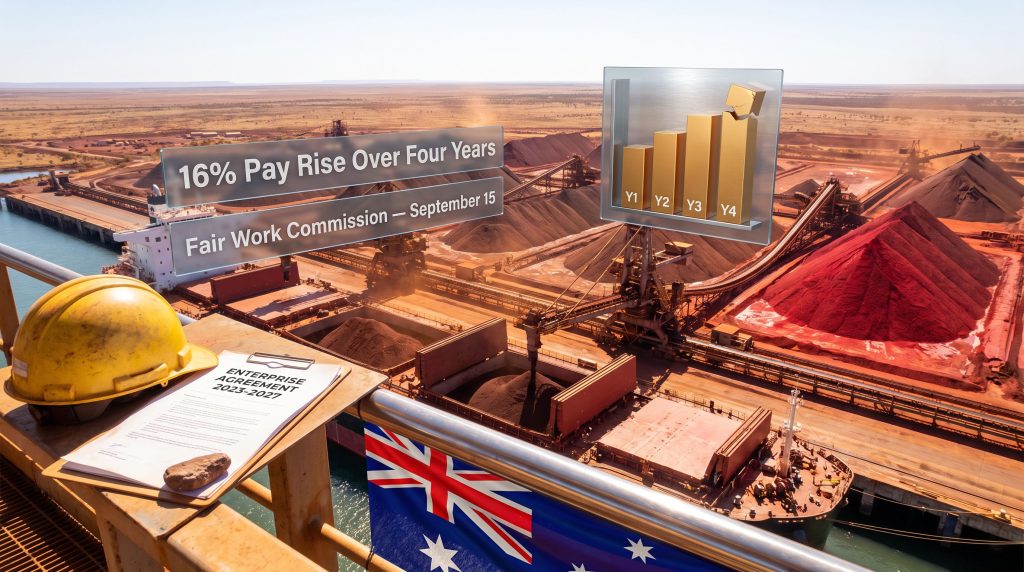
The ongoing BHP Port Hedland wage deal talks have reached a pivotal inflection point, with the Combined BHP Ports Unions formally submitting a counterproposal to BHP following the workforce's rejection of the company's initial offer. With bilateral talks scheduled for September 8 and a Fair Work Commission hearing locked in for September 15, the resolution window is narrowing and the stakes are rising.
When big ASX news breaks, our subscribers know first
What Is Actually Being Contested at the Negotiating Table
Reducing this dispute to a simple numbers argument misses the structural complexity that has made resolution so elusive. BHP's initial proposal put forward a 16% pay increase spread across a four-year agreement for the majority of port employees. On the surface, this appears meaningful. However, when examined through the lens of purchasing power and compounding inflation, the picture changes considerably.
A four-year wage agreement locks workers into a predetermined earnings trajectory. If inflation outpaces the annual increments built into that structure, workers effectively experience a real-terms pay cut despite nominal increases. In regional Western Australia, where cost-of-living pressures have intensified markedly since 2022, this is not a hypothetical concern.
The union's rejection framed the proposal not just as financially inadequate but as structurally harmful, arguing that accepting the offer would have preserved significant pay inequalities between workers rather than resolving them. This distinction matters. The unions are not simply demanding more money across the board. They are challenging the internal architecture of BHP's compensation model, which workers contend creates unjustifiable disparities within the same workforce.
Who Is at the Table and What They Represent
| Stakeholder Group | Role in Negotiations | Coverage |
|---|---|---|
| Combined BHP Ports Unions | Counterproposal authors, workforce advocates | ~450 operators and maintenance workers |
| BHP Iron Ore Division | Employer and original proposal originator | 800+ total Port Hedland employees |
| Fair Work Commission | Independent arbitration and mediation body | Scheduled involvement from September 15 |
The 450 workers covered by the enterprise agreement represent a subset of BHP's broader port workforce, but they occupy operationally critical roles. Operators and maintenance personnel control the physical movement of iron ore through the port's loading and conveyor infrastructure. Consequently, their leverage is disproportionate to their headcount.
The Negotiation Timeline: A Pattern Worth Examining
The chronology of these talks reveals something more significant than a simple breakdown in communication. It shows a recurring cycle of incremental progress followed by stalled agreement, a dynamic that industrial relations specialists associate with entrenched positional bargaining rather than interest-based negotiation. According to Reuters, talks have repeatedly reached the cusp of resolution before stalling on structural issues.
- July 21 onward: Early bargaining rounds show movement but no resolution, with industrial action raised as a possibility
- August 4: Renewed talks signal forward momentum; agreement remains out of reach
- August 18: BHP's formal proposal is presented to the workforce and subsequently rejected by union members
- August 25: The Combined BHP Ports Unions submits a formal counterproposal; negotiations resume
- September 8: Next scheduled bilateral meeting between BHP and union representatives
- September 15: Fair Work Commission hearing scheduled as the formal escalation mechanism
This arc is recognisable to anyone familiar with Australian enterprise bargaining. When negotiations repeatedly cycle through progress and stagnation without resolution, it typically signals that the parties are apart on something more fundamental than headline pay numbers. In this case, that something appears to be the enforceability of conditions and the internal equity of compensation structures.
Why Port Hedland's Labour Dynamics Carry Global Weight
Port Hedland is the world's largest bulk export terminal by annual tonnage, handling the dominant share of Australia's iron ore shipments. Australia's iron ore leadership in the global market means the country supplies a substantial portion of the seaborne iron ore consumed by Asian steel mills, particularly in China, Japan, and South Korea. Any sustained disruption at Port Hedland does not stay contained within Western Australia's borders. It propagates through shipping schedules, spot price indices, and steel production timelines across the Pacific Basin.
BHP's Pilbara iron ore operations represent the company's highest-margin asset class. The port infrastructure connecting those mine sites to export vessels is the final, irreplaceable link in that value chain. Furthermore, unlike a mine-site labour action, which might allow for stockpile drawdown over days or weeks, a port-level disruption creates an immediate export bottleneck with no viable bypass.
Port-side industrial action in bulk commodity export terminals tends to register in spot markets faster than almost any other supply-side event, because the volume concentrations are so extreme that even partial operational slowdowns are visible in shipping data within days.
This asymmetry explains why the 450 workers at the centre of this dispute hold leverage that extends well beyond what their numbers might suggest. Monitoring iron ore price trends through this period will be essential for anyone tracking the downstream impact of these negotiations.
The Human Cost Argument: Heat, Hours, and Hardship
Understanding the union's position requires appreciating the conditions under which Pilbara port workers operate. The demands workers have articulated are grounded in three compounding hardship factors that distinguish their roles from comparable positions in urban environments:
-
Extreme thermal exposure: Port Hedland consistently records some of Australia's highest ambient temperatures, with summer conditions posing genuine occupational health risks that require active management and impose physiological costs on workers operating outdoor and semi-enclosed infrastructure.
-
Extended FIFO rosters: Fly-in, fly-out work arrangements mean prolonged separation from families and community networks. Research into FIFO workforce wellbeing in Australia has consistently documented elevated rates of relationship strain, mental health challenges, and social isolation among workers on extended remote rosters.
-
Remote cost-of-living premiums: Accommodation, transport, and everyday goods in regional Pilbara communities carry significant price premiums compared to metropolitan areas, eroding the real purchasing power of wages that might appear competitive on paper.
Workers and unions argue these factors collectively justify compensation structures that exceed, rather than mirror, rates paid to city-based employees in ostensibly comparable skill categories. The counterproposal submitted to BHP is understood to reflect this position, pushing for enforceable protections rather than discretionary allowances that can be modified between bargaining cycles.
Why Enforceability Matters More Than Headline Numbers
A critical but often overlooked dimension of this dispute is the union's emphasis on enforceable wage and condition protections rather than nominal pay increases alone. Enterprise agreements with embedded legal obligations create binding commitments that cannot be quietly modified through workplace policy changes. Discretionary benefits, by contrast, exist at the employer's pleasure and can be restructured without triggering formal bargaining obligations.
This reflects a broader evolution in Australian resource sector labour relations. Since 2022, as labour shortages tightened across the Pilbara and cost-of-living increases accelerated in remote communities, workers have increasingly prioritised certainty of conditions over headline pay gains. The shift represents a maturation of union bargaining strategy, moving from pure wage maximisation toward structural protection of the total employment proposition.
How the Fair Work Commission Shapes the Resolution Pathway
The Fair Work Commission is Australia's national workplace relations tribunal, with powers ranging from facilitated mediation through to binding arbitration. Its scheduled September 15 involvement signals that both parties have accepted the possibility that bilateral negotiation alone may be insufficient to close the gap.
The range of realistic outcomes from this point forward is meaningful for investors and supply chain participants to understand:
| Scenario | Key Driver | Operational Impact |
|---|---|---|
| Negotiated agreement before September 15 | Sustained bilateral goodwill and revised offers | Minimal disruption; market stabilises |
| FWC-mediated settlement | Commission narrows the gap between positions | Short-term uncertainty; medium-term stability restored |
| Protected industrial action | Breakdown in September 8 talks | Export delays; iron ore spot price sensitivity |
| Binding arbitration outcome | Prolonged impasse requiring tribunal resolution | Enforced terms; precedent set for future cycles |
Earlier rounds of talks in July raised the prospect of industrial action, indicating that workers have already engaged with the legal process that enables protected action ballots under Australian enterprise bargaining law. Whether this option is activated depends heavily on the outcome of September 8 discussions. For context, Onslow iron operations provide a useful comparison of how operational disruptions in the broader Pilbara region can be navigated under pressure.
The next major ASX story will hit our subscribers first
What This Dispute Reveals About BHP's Labour Strategy
BHP's decision to table a multi-year agreement, rather than pursue shorter-cycle renegotiation, reflects a preference for operational predictability over short-term cost minimisation. A four-year deal, if accepted, removes labour uncertainty from the Pilbara port equation for the duration of its term, allowing capital allocation and production planning to proceed without recurring industrial relations risk.
The 16% offer over four years also reflects BHP's internal modelling of iron ore price trajectories and margin sustainability. Resource majors calibrate long-term labour cost commitments against commodity price assumptions. A deal structured to limit annual wage growth while locking in extended certainty is consistent with a company managing downside scenarios in a cyclical market. In addition, the broader China steel and iron ore market dynamics will inevitably shape how aggressively BHP pursues cost containment through this bargaining cycle.
However, the unions' rejection indicates that BHP's offer fell short of what workers consider fair compensation for the conditions they endure. With a formal counterproposal now on the table, the September 8 meeting will test whether BHP is prepared to move substantively on the issues of internal pay equity and enforceable conditions, or whether it holds to the original framework and transfers the decision to the Fair Work Commission.
The outcome will matter beyond Port Hedland. The enterprise agreement struck here will function as a wage benchmark across BHP's broader Pilbara workforce and is likely to influence comparable negotiations at competitor operations across the iron ore corridor. Furthermore, the way tariffs and iron ore markets continue to interact with global demand signals will add another layer of complexity to BHP's negotiating calculus. In this sense, the BHP Port Hedland wage deal talks are not simply one company's labour relations story. They are a reference point for how the Western Australian resources sector prices the human cost of keeping global steel markets supplied.
Frequently Asked Questions: BHP Port Hedland Wage Deal Talks
What is the current status of negotiations?
As of late August 2026, the Combined BHP Ports Unions has submitted a formal counterproposal following the workforce's rejection of BHP's initial offer. Bilateral discussions are scheduled for September 8, with a Fair Work Commission hearing planned for September 15 if no agreement is reached beforehand.
How many workers are covered by the enterprise agreement?
Approximately 450 operators and maintenance workers are directly covered by the agreement under negotiation. BHP employs more than 800 people at the Port Hedland facility in total.
What did BHP offer and why was it rejected?
BHP proposed a 16% pay increase distributed across a four-year agreement for most port employees. Workers rejected this offer on the grounds that it would have maintained rather than resolved existing pay inequalities within the workforce and did not deliver sufficiently enforceable protections on working conditions.
Could industrial action occur?
Protected industrial action is legally available to workers under Australian enterprise bargaining law once a protected action ballot is approved. The possibility was raised during earlier July talks. Whether it materialises depends on the September negotiating outcomes. Mining.com has reported that the failure to reach agreement has left this option firmly on the table.
Why do workers argue they deserve higher pay than city-based employees?
Workers cite extreme heat conditions in the Pilbara, extended fly-in fly-out rosters that separate them from families, and the higher cost of living associated with remote Western Australian communities. Unions argue these conditions justify compensation premiums above comparable urban roles rather than parity with them.
Key Indicators to Monitor Through September 2026
For investors, commodity market participants, and industry observers, several developments will signal which resolution pathway this dispute is taking:
- September 8 outcome: Will BHP revise its offer substantially, or hold the existing structure?
- Union counterproposal specifics: The gap between BHP's 16% over four years and the union's position will define what compromise looks like
- FWC September 15 posture: Whether the Commission moves to mediation or signals readiness for arbitration indicates how far apart the parties remain
- Iron ore spot price movements: Any credible threat of port disruption would register in seaborne iron ore pricing within days of becoming public
- Precedent implications: The settled terms will influence wage benchmarking across the broader Pilbara workforce and potentially across competitor operations in the region
Disclaimer: This article contains forward-looking scenarios and market analysis based on publicly available information as of August 2026. It does not constitute financial or investment advice. Readers should conduct their own due diligence before making investment decisions.
Want to Stay Ahead of ASX Mineral Discoveries Shaping Global Commodity Markets?
As labour disputes at Port Hedland underscore just how quickly supply-side events can move commodity markets, Discovery Alert's proprietary Discovery IQ model delivers real-time alerts on significant ASX mineral discoveries — turning complex data across 30+ commodities into clear, actionable insights for traders and investors alike. Start your 14-day free trial at Discovery Alert today, or explore the historic returns major discoveries have generated to understand the scale of opportunity that early positioning can deliver.