August 25, 2026
When Chokepoints Break: Understanding the Architecture of the 2026 Oil Crisis
Every major oil crisis in history has had a single geographic epicentre. The 1973 Arab embargo had the Suez corridor. The 1979 Iranian Revolution had one nation's output collapse. The 1990 Gulf War had Kuwait. What makes the current Iran war global oil supply crisis fundamentally different is not the scale of any single flashpoint, but the simultaneous activation of multiple supply failure nodes across a system that was never designed to absorb concurrent shocks of this magnitude.
Six months into the Iran war, the structural architecture of global energy supply is being stress-tested in ways that historical precedent simply cannot map onto. Understanding what is actually happening, and why it matters beyond the price at the pump, requires stepping back from the immediate headline figures and examining the underlying mechanics of how oil moves, where it concentrates, and what happens when those concentration points fail at the same time.
When big ASX news breaks, our subscribers know first
A Crisis Without Historical Precedent
Comparing 2026 to previous energy shocks reveals just how far outside the range of historical experience this disruption sits. Each prior crisis involved a meaningful, painful supply reduction, but none came close to compromising the share of global production now affected. The current oil price trends reflect a market under extraordinary strain, far beyond anything seen in recent decades.
| Crisis Event | Estimated Supply Loss (bpd) | Peak Price Impact | Duration |
|---|---|---|---|
| 1973 Arab Oil Embargo | ~3 million | +70% | ~6 months |
| 1979 Iranian Revolution | ~4 million | +100% | ~2 years |
| 1990-91 Gulf War | ~4.3 million | +75% | ~7 months |
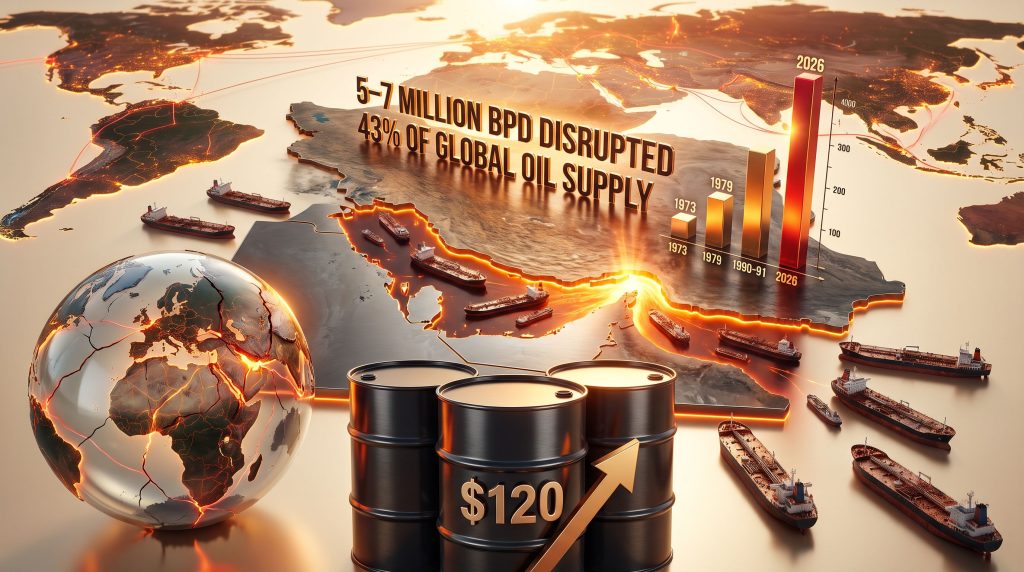
| 2026 Iran War + Multi-Front Disruptions | 5-7 million (Gulf alone) | ~+50% (peak) | Ongoing |
Based on Reuters calculations using International Energy Agency data, countries affected by active conflict collectively produced approximately 45 million barrels per day of oil based on 2025 output benchmarks. That figure represents more than 43% of total global oil supply, a concentration of geopolitical risk across productive capacity that no previous crisis has come close to matching.
The IEA has characterised the current disruption as the largest supply crisis in the recorded history of global oil markets, placing 2026 above every prior geopolitical energy shock in terms of volume and systemic reach.
What distinguishes this episode further is the compounding nature of the disruption. Unlike past crises that involved one region and one mechanism, the Iran war global oil supply crisis has simultaneously engaged the world's most critical maritime chokepoint, a major European producer's refining network, a chronically unstable North African supplier, and a Latin American producer locked out of accessible export markets by sanctions. These are not additive problems — they are multiplicative ones, because each disruption removes buffer capacity that the global system would normally use to absorb the others. Furthermore, the oil market impacts extend well beyond the immediate conflict zones, rippling across global trade and finance.
The Strait of Hormuz and the Limits of Maritime Workarounds
Why the Hormuz Chokepoint Is So Critical
The Strait of Hormuz has long been recognised as the world's most consequential energy chokepoint. Under normal conditions, approximately 20 million barrels per day pass through this narrow passage, representing roughly one-fifth of all globally traded oil. Saudi Arabia, the UAE, Kuwait, Iraq, and Iran itself all depend on this corridor for the majority of their export volumes.
When the Iran war effectively disrupted Hormuz transit, flows through the passage collapsed from that 20 million bpd baseline to what analysts have described as a trickle. The response from Gulf exporters has been a combination of rerouting and covert operations. Saudi Arabia has redirected volumes through Red Sea pathways, whilst other Gulf producers have attempted limited exports through partially restricted Hormuz passages, operating outside normal transit frameworks.
The net result of these partial workarounds, according to analyst estimates reported by Reuters, is a current Gulf oil flow disruption of between 5 million and 7 million barrels per day. That range itself carries significant uncertainty, because the covert export volumes are by definition difficult to track with precision.
Why No Alternative Route Can Fill the Gap
The reason no adequate alternative route exists at scale comes down to infrastructure reality:
- Pipeline bypass capacity across the Arabian Peninsula was built to supplement Hormuz, not replace it, and cannot absorb full transit volumes
- The Red Sea corridor, which Saudi Arabia has leaned on most heavily, experienced its own targeted attacks in July 2026, demonstrating that the workaround carries material security risk
- Egypt's Suez Canal zone has been drawn into the threat perimeter, further narrowing viable export pathways for producers attempting to reach European and Asian markets
- Floating storage and ship-to-ship transfer operations, whilst operationally feasible at small scale, cannot substitute for a functioning 20 million bpd maritime corridor
The July 2026 attacks near Egypt's Suez Canal represent a particularly concerning escalation, because they signal that conflict actors understand the strategic value of attacking the rerouting alternatives, not just the primary corridor.
According to analysis from The Conversation, oil shortages escalating from the Iran and Ukraine conflicts show few signs of near-term relief, with structural constraints limiting any swift market recovery.
Four Concurrent Crises: Mapping the Full Supply Disruption
The Iran war global oil supply crisis does not exist in isolation. It has been compounded by three other simultaneous supply disruption vectors, each of which would independently constitute a significant market event.
| Conflict Zone | Primary Supply Impact | Secondary Impact |
|---|---|---|
| Iran War / Gulf Region | 5-7 million bpd disrupted | Hormuz closure, LNG disruption |
| Russia-Ukraine War | Refining capacity reduced ~10% | Diesel/gasoline export ban |
| Libya Civil Conflict | Chronic output suppression | North African supply instability |
| Venezuela Sanctions | Export market restriction | Latin American supply gap |
Ukraine's long-range strike campaign against Russian energy infrastructure has been more strategically sophisticated than early-war operations. Facilities as far as Omsk, approximately 2,700 kilometres from Ukrainian-held territory, have been reached and damaged. Russia, facing domestic fuel shortages as a consequence, has banned gasoline and diesel exports to protect internal availability.
The combined effect of Gulf refining disruption and Russian refining damage has reduced global refining capacity by approximately 10%, a structural constraint that affects the diesel and gasoline markets independently of crude availability. Libya and Venezuela contribute differently to the picture. Their disruptions are not acute escalation events but chronic suppressions of supply that would, under normal market conditions, serve as a buffer against Gulf volatility. With that buffer eliminated, the global system has less spare capacity to draw on precisely when it needs it most.
Beyond Crude: The Commodity Cascade
A dimension of the current crisis that receives insufficient analytical attention is the breadth of commodity markets affected beyond crude oil itself. The Gulf trade corridor is not only a crude oil export route. It is also a critical pathway for LNG shipments, petrochemical feedstocks, and the raw materials that underpin fertiliser production.
The downstream disruptions include:
- LNG: Gulf-origin liquefied natural gas cargoes have been disrupted, tightening gas markets particularly for Asian importers who had structured supply agreements around Gulf LNG sources
- Diesel and gasoline: U.S. diesel prices have reached record levels despite domestic refiners operating at peak utilisation, reflecting the combined effect of Russian export bans and Gulf refining damage
- Jet fuel: Aviation fuel supply chains with exposure to Middle Eastern refining capacity face tightening availability, with airlines in Asia-Pacific most directly affected
- Fertilisers: Petrochemical feedstocks critical to nitrogen fertiliser production have been disrupted, creating a slow-moving secondary shock that could affect agricultural output in import-dependent economies through 2027
The fertiliser dimension of this crisis is particularly under-examined. Disruptions to petrochemical feedstocks do not translate into food supply impacts immediately — they translate into them with a 6-to-18-month lag, which means the agricultural consequences of the current energy crisis may not fully materialise until 2027.
Emergency Responses and Their Structural Limits
The International Energy Agency coordinated what is now the largest emergency petroleum reserve release on record, drawing approximately 400 million barrels from member nations' strategic stockpiles. This intervention provided meaningful short-term cushioning of the supply shock. However, these releases are now largely complete, and global inventories continue to decline even after accounting for the drawdowns.
Strategic petroleum reserve systems were architected around a different threat model. The assumption embedded in their design was that disruptions would be geographically contained, relatively short in duration, and followed by recovery periods during which reserves could be replenished. A multi-front conflict affecting 43% of global supply with no clear resolution timeline is simply outside the design envelope of those systems.
The practical consequence is that the global oil market is now operating without a meaningful emergency buffer, in an environment where the underlying supply deficit is not resolving. That combination — exhausted reserves plus ongoing structural undersupply — is what makes the current situation qualitatively different from prior crises that emergency reserve releases were able to meaningfully stabilise.
U.S. crude production has emerged as the primary accessible swing supplier in this environment, but that role comes with its own vulnerabilities. Severe weather events have intermittently disrupted domestic U.S. output and logistics during the crisis period, introducing a layer of weather-related supply risk that markets are now pricing alongside geopolitical risk premiums. The result is a volatility structure that markets are poorly equipped to manage. Furthermore, OPEC's market influence has been significantly tested, with the organisation struggling to coordinate an adequate collective response to these unprecedented conditions.
The next major ASX story will hit our subscribers first
Inflation, Debt, and the Macro Transmission Mechanism
The price transmission from wellhead disruption to broader economic damage follows a well-established pathway, but the scale and persistence of the current disruption has amplified each stage of that mechanism:
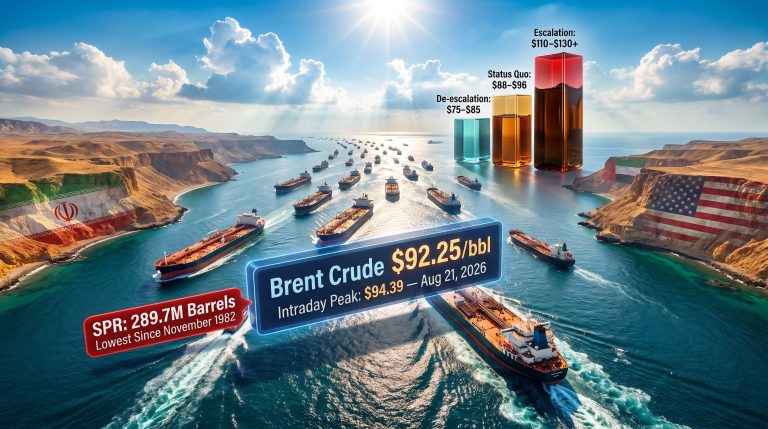
- Upstream disruption reduces crude availability, driving spot price escalation. Prices rose approximately 50% at peak, with crude briefly approaching $120 per barrel during the most acute phase of Hormuz disruption
- Refining capacity loss widens diesel and gasoline crack spreads, pushing fuel price inflation at the retail level independently of crude price movements
- Fuel price inflation elevates transport and logistics costs across the economy, feeding into broader consumer price index pressure across virtually every goods category
- Sustained inflation generates central bank rate responses, raising borrowing costs globally and compressing the fiscal headroom of indebted sovereigns
That final stage is where the intersection of the energy crisis with pre-existing structural vulnerabilities becomes most consequential. U.S. national debt has reached a record $40 trillion, with energy-driven inflation and debt pressures identified as material contributing factors to the debt trajectory. Higher fuel prices feeding into sustained inflation, sustaining elevated interest rates, and compounding debt servicing costs on a $40 trillion base is not a linear problem — it is a feedback loop with meaningful tail risk characteristics.
Three Scenarios for the Global Oil Market
Forecasting under conditions of active multi-front conflict carries exceptional uncertainty. The following scenarios represent a range of plausible trajectories, not predictions. Readers should treat these as analytical frameworks rather than market guidance.
Scenario 1: Partial Stabilisation (Base Case)
Diplomatic de-escalation allows partial restoration of Hormuz transit within 6 to 12 months. Oil prices stabilise in the $90 to $110 per barrel range. Global refining capacity begins gradual recovery. Inflation remains elevated but begins moderating by mid-2027.
Scenario 2: Prolonged Disruption (Adverse Case)
Conflict extends beyond 12 months with no clear resolution pathway. Red Sea and Suez Canal attacks intensify, eliminating the Saudi rerouting alternative. IEA reserve capacity is fully exhausted with no replenishment pathway. Oil prices sustain above $120 per barrel, triggering demand destruction in emerging markets.
Scenario 3: Escalation and Systemic Shock (Tail Risk)
Conflict spreads to additional Gulf producers, drawing UAE or Saudi Arabian infrastructure into the damage envelope. Global supply loss expands beyond 10 million bpd. Coordinated G7 emergency responses become necessary, with potential rationing in energy-import-dependent economies. Recessionary conditions emerge across multiple major economies within 12 to 18 months.
Regional Vulnerability: Who Bears the Most Exposure?
Asia
Asia is structurally the most exposed. China, India, Japan, and South Korea collectively source the majority of their crude imports from the Persian Gulf. Hormuz disruption has forced Asian refiners to seek alternative suppliers at significant cost premiums, restructuring procurement frameworks that were built around Gulf supply relationships. India, which had expanded Gulf crude imports significantly in recent years, faces particularly acute supply chain restructuring pressure.
Europe
Europe confronts a dual-front vulnerability that is analytically distinct from the Asian exposure. European markets simultaneously face reduced Russian pipeline and refined product availability — restrictions that predate the Iran war — alongside Gulf crude disruption. LNG import infrastructure expanded rapidly after 2022 is now being tested at full capacity, with limited additional import capacity available.
Emerging Market Economies
Emerging market economies face the most severe consequences with the least capacity to absorb them. Limited foreign exchange reserves amplify import cost escalation. Fuel subsidy programmes across South and Southeast Asia are under acute fiscal strain. In economies where fertiliser supply disruption compounds fuel price inflation, food security risks are materialising alongside energy access constraints, creating compounding vulnerability across multiple dimensions simultaneously.
The Long-Term Structural Legacy
Beyond the immediate supply shock, the crisis is generating structural shifts that will reshape energy markets for years after any resolution. Three dynamics stand out as having lasting significance.
First, the crisis has exposed the design limits of strategic petroleum reserve architecture. Policy discussions are intensifying around whether reserve levels, release mechanisms, and replenishment timelines are calibrated appropriately for 21st-century geopolitical risk profiles. Multi-front conflicts affecting near-half of global supply are now a demonstrated possibility rather than a theoretical tail risk.
Second, sustained oil prices above $100 per barrel materially alter the economics of energy transition. Renewable energy alternatives and electric vehicle adoption become comparatively more attractive at these price levels. Governments facing energy security vulnerabilities are accelerating domestic clean energy investment as a strategic hedge, and the broader energy transition trends suggest that the crisis is likely to compress clean energy investment timelines in both advanced and emerging economies.
Third, the Hormuz crisis has renewed investment interest in pipeline bypass infrastructure, alternative maritime corridors, and floating storage capacity. Long-range structural diversification away from single-chokepoint dependency is likely to reshape global energy infrastructure investment priorities for the next decade. As Grist reports, the reasons the Iran conflict has not yet triggered an even more severe global crisis reveal important insights about both market resilience and the structural vulnerabilities that remain.
Readers seeking further context on the evolving dynamics of the Iran war global oil supply crisis can explore ongoing coverage and analysis at ET EnergyWorld, published by the Economic Times at energy.economictimes.indiatimes.com.
Disclaimer: This article contains forward-looking scenario analysis and market projections that involve significant uncertainty. All scenarios and price forecasts are analytical frameworks only and should not be construed as financial or investment advice. Geopolitical situations are inherently unpredictable, and actual market outcomes may differ materially from those discussed.
Want to Stay Ahead of the Next Major Commodity Discovery?
Whilst geopolitical shocks reshape global energy markets, Discovery Alert's proprietary Discovery IQ model scans ASX announcements in real time, instantly identifying significant mineral discoveries across more than 30 commodities — from oil and gas to the critical minerals driving the energy transition — and you can explore historic discoveries and their exceptional market returns before starting your 14-day free trial at Discovery Alert.