June 12, 2026
When Forecasts Diverge, Markets Listen: Decoding the 2026 Oil Demand Outlook
Energy markets operate on expectations as much as fundamentals. When the gap between what producers believe and what consuming-nation agencies project widens to its current magnitude, that divergence is not noise — it is a signal. The OPEC lowers 2026 global oil demand growth forecast story sits at precisely this kind of inflection point, where three of the world's most authoritative forecasting institutions are pointing in materially different directions, and where a single maritime chokepoint has upended assumptions that seemed reasonable just twelve months ago.
Understanding what each forecast actually says, why the methodologies produce such different conclusions, and what the underlying scenarios mean for energy markets through 2027 requires going well beyond the headline numbers. Furthermore, this geopolitical oil price analysis becomes even more critical when placed within the context of a rapidly evolving supply landscape.
When big ASX news breaks, our subscribers know first
The Three-Agency Forecast Gap and What It Actually Represents
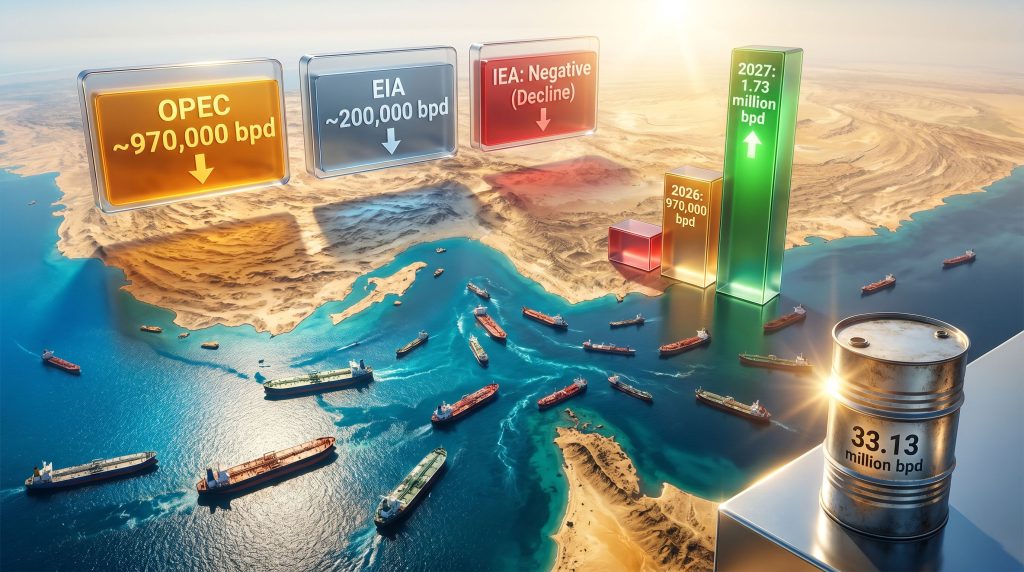
OPEC lowers 2026 global oil demand growth forecast for the second consecutive month, revising its estimate down to 970,000 barrels per day (bpd) from a prior projection of 1.17 million bpd. That revision alone would be notable. However, the story becomes structurally significant when placed alongside the positions held by the U.S. Energy Information Administration and the International Energy Agency.
| Forecasting Body | 2026 Demand Growth Estimate | Revision Direction | 2027 Outlook |
|---|---|---|---|
| OPEC | ~970,000 bpd | Downward (second consecutive cut) | Raised to 1.73 million bpd |
| EIA | ~200,000 bpd | Downward (from ~600,000 bpd) | Not specified |
| IEA | Negative (outright decline) | Downward contraction | Not specified |
The spread between OPEC's relatively optimistic position and the IEA's projection of an outright demand contraction is not a rounding error. It represents a fundamental disagreement about what kind of event the energy world is currently experiencing. For context, the OPEC demand revisions of recent months provide important background on how this forecast trajectory has evolved.
Why Methodology Drives the Divergence
Three distinct analytical frameworks are producing three distinct answers:
- OPEC's demand model assigns heavier weighting to non-OECD consumption, particularly across South Asia, Southeast Asia, and sub-Saharan Africa. In these regions, fuel subsidies blunt the price sensitivity that drives demand destruction in wealthier markets, and the structural shift toward vehicle ownership and industrial activity is still accelerating.
- The EIA incorporates high-frequency trade and industrial data with greater sensitivity to near-term geopolitical shocks, making its models more reactive to the supply disruption currently reshaping physical oil flows.
- The IEA applies the most aggressive weighting to energy transition acceleration, treating elevated fuel prices not merely as a demand suppression mechanism but as a structural catalyst for permanent fuel switching in OECD economies.
The deepest analytical fault line runs between how each agency interprets the type of demand reduction currently underway. OPEC characterises it as deferred consumption — a temporary pullback that returns to market once prices normalise. The EIA and IEA, however, treat a meaningful portion of it as destroyed demand that does not return, accelerated by investment in efficiency and alternative energy infrastructure that geopolitical instability has paradoxically encouraged.
According to Reuters reporting on the latest revision, OPEC's monthly report confirmed this downward trajectory while simultaneously raising its 2027 growth outlook — a combination that underscores the group's conviction in a delayed rather than destroyed demand thesis.
Key analytical point: This distinction between deferred demand and destroyed demand is arguably the most consequential variable in global oil market modelling right now. If OPEC is right, 2027 is a recovery year. If the EIA and IEA are right, 2026 may mark a structural inflection point in the long-run demand trajectory.
The Strait of Hormuz: A Chokepoint That Changed the Market Architecture
Approximately 20 to 21 percent of globally traded oil flows through the Strait of Hormuz on a daily basis, according to historical U.S. Energy Information Administration data. The effective closure of this passage has not merely disrupted one producer's export capacity. It has simultaneously constrained Middle Eastern supply across multiple sovereign producers whilst injecting a severe cost shock into global fuel prices.
The physical consequences for OPEC+ production have been direct and measurable:
| Metric | April 2026 | May 2026 | Net Change |
|---|---|---|---|
| OPEC+ Combined Crude Output | ~33.32 million bpd | 33.13 million bpd | -190,000 bpd |
| Iran Production Trend | Elevated (pre-blockade) | Sharp decline | Largest individual drop |
| UAE Membership Status | Active OPEC+ member | Departed 1 May 2026 | Structural realignment |
Iran recorded the steepest month-on-month output decline within the entire OPEC+ group during May 2026, driven by a U.S. naval blockade that sharply curtailed tanker departures. The May aggregate figure still includes the UAE, which formally departed OPEC and OPEC+ on 1 May 2026, meaning the headline decline actually understates the degree of disruption on a like-for-like membership basis.
The Dual Shock Paradox
What makes the Hormuz closure analytically unusual is that it functions as both a supply constraint and a demand suppressor simultaneously.
- On the supply side, producers cannot export volumes they physically cannot route through available maritime passages.
- On the demand side, the fuel price surge flowing from that supply constraint compresses industrial output, freight activity, and consumer spending, reducing the consumption that would otherwise absorb those barrels.
This interaction breaks conventional price-volume modelling assumptions. In a standard supply shock, reduced supply lifts prices, which in turn incentivises production increases elsewhere and eventually draws demand back toward equilibrium. The Hormuz closure short-circuits this mechanism because the supply response from alternative producers takes months to scale, and the demand destruction begins almost immediately.
Three Scenarios for 2026 to 2027: How the Pathways Diverge
Scenario 1: OPEC's Base Case — Cyclical Disruption with Structural Recovery
OPEC's June 2026 monthly report described the global economy's first-half performance as resilient despite the geopolitical environment, leaving its macroeconomic growth forecasts unchanged alongside the demand revision. Under this reading:
- The 2026 slowdown to ~970,000 bpd represents a geopolitically induced cyclical trough, not a permanent demand shift.
- Deferred consumption from price-sensitive sectors re-enters the market as prices normalise following Hormuz reopening.
- The 2027 demand growth recovery to 1.73 million bpd (up 190,000 bpd from the prior forecast) reflects OPEC's conviction that the emerging market demand engine remains fundamentally intact.
- India, China's secondary demand centres, and sub-Saharan Africa continue contributing structurally to long-run oil consumption growth through the early 2030s.
This scenario's validity depends heavily on a relatively near-term diplomatic or military resolution to the Hormuz closure — a geopolitical assumption that carries substantial uncertainty. In addition, OPEC's market influence over price expectations remains a critical variable in whether this base case holds throughout the second half of 2026.
Scenario 2: The Bear Case — Structural Demand Erosion
The EIA's revised 2026 growth estimate of approximately 200,000 bpd and the IEA's projection of an outright demand decline represent a framework where disruption leaves permanent marks:
- Elevated fuel prices function as a structural demand destruction mechanism, particularly across price-sensitive manufacturing hubs and long-haul transport operators.
- The price shock accelerates fuel efficiency investment and fleet electrification in OECD economies at rates that would not have occurred under a stable price environment.
- Slowing Chinese industrial output, combined with post-pandemic aviation demand normalisation, removes two consumption pillars that had been expected to support 2026 growth.
- The EIA's ~200,000 bpd figure, if accurate, would represent one of the lowest annual oil demand growth readings published by the agency in over a decade.
Furthermore, the broader oil market impact of ongoing trade tensions adds an additional layer of complexity to already strained demand fundamentals.
Scenario 3: Prolonged Conflict Tail Risk
If the Hormuz closure extends through the third quarter of 2026 without resolution, the market faces a materially different risk profile:
- Middle Eastern accessible supply could face an additional reduction of 1.5 to 2.5 million bpd, pushing Brent crude into a structurally elevated price band and triggering potential IEA strategic petroleum reserve releases.
- Alternative routing via the Suez Canal, East African port infrastructure, and overland pipeline networks would add an estimated $4 to $8 per barrel in logistics costs, permanently repricing Middle Eastern crude's competitive position relative to Atlantic Basin producers.
- Non-OPEC producers in the United States, Canada, Brazil, and Guyana face a structural windfall opportunity to capture displaced market share at scale, potentially reshaping the long-term OPEC+ market position.
- OPEC's 2027 recovery forecast of 1.73 million bpd becomes arithmetically difficult to achieve without full Hormuz reopening, since the deferred demand thesis requires that supply routes actually reopen to allow the consumption recovery to materialise.
Speculative but analytically grounded: The tail risk scenario also raises a less commonly discussed dynamic. Extended Hormuz closure would compress the capital investment available to Gulf state producers for upstream development, potentially creating a supply deficit in 2028 to 2030 even if geopolitical resolution eventually occurs, because the production capacity expansion pipelines would have been disrupted during a critical investment window.
The UAE's OPEC+ Departure: What It Signals Beyond the Headlines
The UAE's formal exit from OPEC+ on 1 May 2026 deserves more analytical attention than it typically receives in commodity market coverage. Abu Dhabi has been publicly targeting a production capacity of over 5 million bpd by 2027 — an ambition that has grown increasingly incompatible with the group quota architecture.
Operating outside OPEC+ constraints provides several strategic advantages for the UAE:
- Commercial flexibility to ramp production without quota negotiation, particularly valuable as alternative routing through non-Hormuz corridors becomes more strategically significant.
- Competitive positioning relative to other OPEC+ members that remain constrained by collective output agreements.
- Price taking rather than price setting — a strategic pivot that reflects Abu Dhabi's confidence in its cost structure and its preference for volume over price in the current market environment.
- Precedent setting, potentially signalling to other Gulf producers with surplus capacity ambitions that departure from OPEC+ is a viable option, which could accelerate structural fragmentation of the alliance.
The UAE's departure also complicates the interpretation of OPEC+ production data. Future aggregate figures that exclude UAE output will appear lower by default, making trend analysis across pre- and post-departure periods methodologically complex for analysts tracking the group's compliance and effective production capacity.
Geopolitical Risk Pricing: The Variables Forecasters Cannot Fully Model
The Iran conflict has introduced several transmission mechanisms into oil market dynamics that extend beyond simple supply volume reduction:
- War risk insurance premiums on tanker voyages through Hormuz-adjacent waters have surged, adding indirect cost pressure across every supply chain that depends on Middle Eastern crude. These costs are partially absorbed by refiners, partially passed through to end consumers, and partially reflected in wider oil price differentials between Middle Eastern and Atlantic Basin grades.
- Cargo rerouting logistics create time-lag effects in supply delivery that are distinct from volume effects. Even if a barrel eventually reaches its destination via an alternative route, the extended transit time removes that cargo from the immediately available physical market for weeks, tightening spot supply without changing underlying production volumes.
- Demand-side feedback loops operate through channels that are genuinely difficult to model with precision. Higher fuel prices reduce industrial output in manufacturing economies, which reduces freight demand, which further compresses oil consumption in a compounding sequence.
| Factor | Short-Term Impact (H2 2026) | Medium-Term Impact (2027) |
|---|---|---|
| Hormuz closure (supply constraint) | High, directly limits exportable barrels | Moderate, assumes partial resolution |
| Elevated fuel prices (demand suppression) | High, compresses industrial and consumer demand | Low to moderate, demand rebounds as prices normalise |
| OPEC+ quota disagreements | Moderate, limits coordinated response | High, structural cohesion risk |
| UAE departure from OPEC+ | Low immediate impact | High, sets precedent for further defections |
| Non-OPEC supply growth (U.S., Brazil, Guyana) | Moderate, partially offsets Middle East losses | High, accelerates market share shift |
Consequently, an oil price rally driven by supply constraints does not necessarily translate into straightforward demand recovery — particularly when the shock originates from a strategic chokepoint rather than a conventional production outage.
The next major ASX story will hit our subscribers first
Emerging Market Demand: The Structural Floor Beneath the Cyclical Noise
Despite the near-term compression in demand growth projections across all three agencies, the structural demand drivers underpinning OPEC's longer-term outlook retain genuine analytical validity:
- India is widely projected to account for the largest incremental share of global oil demand growth through 2030, driven by vehicle ownership expansion, petrochemical feedstock requirements, and aviation sector growth from a relatively low per-capita baseline.
- Sub-Saharan Africa presents a demand growth trajectory that is structurally insulated from near-term EV penetration pressures. Infrastructure constraints, import cost barriers for electric vehicles, and rapid urbanisation create conditions where liquid fuel consumption growth is likely to continue regardless of OECD energy transition trajectories.
- Southeast Asia is experiencing a manufacturing geography shift as production relocates from China, with Vietnam, Indonesia, and the Philippines all recording elevated industrial energy demand growth that translates directly into oil consumption.
There is a paradox embedded in the current geopolitical situation that is rarely articulated clearly. The same instability that is suppressing 2026 demand growth is simultaneously slowing the capital investment flows required to build the renewable energy infrastructure that would structurally reduce emerging market oil dependency over time. Disruption is both constraining near-term demand and, perversely, entrenching the conditions for continued fossil fuel consumption in the medium term.
What the 2026 Divergence Tells Investors and Market Participants
For those positioning across energy markets, the analytical uncertainty embedded in the three-agency forecast gap translates into several practical considerations:
- Scenario-weighted positioning is more appropriate than conviction-based directional bets when the forecasting range spans from modest positive growth to outright contraction.
- Non-OPEC producer equities in the U.S., Canada, Brazil, and Guyana carry asymmetric upside under Scenarios 2 and 3, where Middle Eastern supply disruption persists long enough to allow Atlantic Basin producers to capture structural market share.
- The 2027 rebound narrative priced into OPEC's raised forecast carries geopolitical conditionality that markets should evaluate carefully rather than treating as a baseline assumption.
- Tanker and logistics infrastructure investments are benefiting from the physical rerouting requirements regardless of which demand scenario ultimately prevails, representing a relatively scenario-agnostic exposure within the broader energy complex.
As Ecofina Agency has noted, the downward revision to global oil consumption reflects an economic slowdown dynamic that extends well beyond the immediate geopolitical flashpoints, reinforcing the case for scenario-weighted rather than directional market approaches.
Disclaimer: This article contains forward-looking analysis, scenario projections, and market commentary that involve inherent uncertainty. Nothing in this article constitutes financial advice. All forecasts cited reflect the published positions of OPEC, the EIA, and the IEA as of June 2026, and are subject to revision. Readers should conduct independent research before making investment decisions.
Frequently Asked Questions
Why did OPEC lower its 2026 oil demand growth forecast?
OPEC reduced its 2026 global oil demand growth estimate to approximately 970,000 barrels per day, down from a prior projection of 1.17 million bpd, citing the economic impact of the Iran conflict and the resulting disruption to Middle Eastern oil supply routes, including the effective closure of the Strait of Hormuz. The elevated fuel prices generated by the supply shock have reduced consumption across industrial and consumer sectors globally, though OPEC characterises this as a temporary rather than structural reduction.
How does OPEC's 2026 forecast compare to the EIA and IEA?
The three agencies hold materially different positions. OPEC projects modest positive demand growth of approximately 970,000 bpd; the EIA has reduced its 2026 growth estimate to approximately 200,000 bpd from a prior 600,000 bpd; and the IEA projects an outright demand decline for the full year. The divergence reflects different methodological weightings applied to emerging market resilience, geopolitical risk duration, and energy transition acceleration rates.
What is OPEC's oil demand forecast for 2027?
OPEC raised its 2027 global oil demand growth forecast to 1.73 million bpd, an upward revision of 190,000 bpd from its previous estimate. This reflects the group's analytical position that the current disruption is temporary and that deferred consumption will re-enter the market as supply routes normalise. However, as discussed above, this outlook carries meaningful geopolitical conditionality.
What happened to OPEC+ production in May 2026?
OPEC+ combined crude output fell to 33.13 million bpd in May 2026, a decline of approximately 190,000 bpd from April. Iran recorded the largest individual output drop within the group, driven by a U.S. naval blockade that sharply curtailed tanker departures. The UAE, which formally exited OPEC+ on 1 May 2026, is still included in the May aggregate figure.
Why did the UAE leave OPEC+?
The UAE's departure from OPEC+ on 1 May 2026 reflects long-standing tensions over quota allocation relative to the country's expanded production capacity ambitions. Operating outside the OPEC+ framework provides Abu Dhabi with greater commercial flexibility to pursue its production expansion target of over 5 million bpd by 2027 — a strategic priority that is structurally incompatible with group-wide output restriction agreements.
Want To Stay Ahead of the Next Major Commodity Market Shift?
Discovery Alert's proprietary Discovery IQ model delivers real-time alerts on significant ASX mineral discoveries, transforming complex market data into actionable investment insights — ideal for navigating volatile commodity environments like the one reshaping global energy markets today. Explore historic discoveries and their remarkable returns, then begin your 14-day free trial at Discovery Alert to position yourself ahead of the market.