June 9, 2026
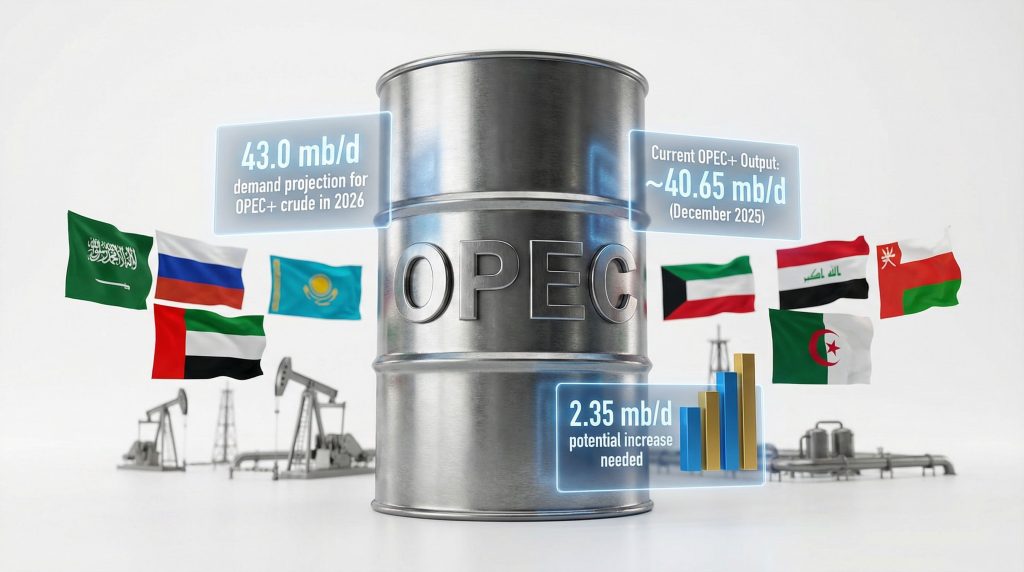
The global oil market operates within complex regulatory frameworks that shape production decisions across major producing nations. Understanding these mechanisms becomes crucial as market participants anticipate how regulatory pressures, capacity constraints, and demand projections will influence OPEC oil output December 2026 strategies. Furthermore, the intricate balance between political agreements, physical production limits, and external sanctions creates a multifaceted environment where traditional supply-demand economics intersect with geopolitical realities, as evidenced by recent oil price movements analysis.
Understanding OPEC+ Production Coordination Mechanisms Through 2026
The current production framework governing OPEC+ operations reveals significant structural challenges that will likely persist through December 2026. Market monitoring data demonstrates how quota allocation systems interact with compensation mechanisms to create outcomes that often diverge from stated policy intentions.
Core Alliance Production Architecture
Eight nations form the operational backbone of OPEC+ production coordination: Saudi Arabia, Russia, UAE, Kazakhstan, Kuwait, Iraq, Algeria, and Oman. These countries collectively manage production decisions through tiered compliance mechanisms where certain members absorb compensation cuts to balance aggregate output levels.
Recent production data illustrates the complexity of this system. In December 2025, 28.40 million barrels per day represented total OPEC output, marking a 100,000 barrel per day decline from November levels according to OPEC monthly reports. This reduction occurred despite agreements by five OPEC members to increase production by 85,000 barrels per day.
The disparity between intended and actual production increases reveals capacity constraints beyond quota mechanisms. In addition, compensation cut requirements totaling 135,000 barrels per day for Iraq and UAE effectively neutralised most planned output growth, reducing intended gains by approximately 76%.
Quota Compliance and Monitoring Systems
Secondary source monitoring utilises flow data from LSEG and companies such as Kpler that track oil movements globally. This methodology combines multiple data streams to provide comprehensive market oversight:
- Flow data analysis from financial tracking systems
- Company monitoring information from vessel and port tracking
- Direct input from oil company sources and OPEC representatives
- Consultant verification through independent energy analysis firms
The Reuters survey methodology demonstrates how measurement and transparency challenges affect market understanding. However, estimates for major producers vary significantly, with external sources often reporting higher output than countries themselves declare. This variance creates uncertainty in market balance calculations that extends through forecasting periods.
Monthly adjustment protocols show lag effects between announced policy changes and measurable market impact. Consequently, the December 2025 results, where members achieved only 20,000 barrels per day increase from an 85,000 barrel per day commitment, demonstrate binding capacity constraints in key producing regions.
When big ASX news breaks, our subscribers know first
Sanctions Architecture and Production Capacity Impacts
External sanctions regimes continue reshaping production capacity across multiple OPEC members, creating constraints that operate independently of internal quota systems. These restrictions affect both current output levels and capacity planning for December 2026 targets.
Iranian Export Constraints and Market Impact
Iranian crude supply experienced a 100,000 barrel per day decline in December 2025, directly attributable to U.S. sanctions targeting oil exports related to nuclear programme activities. These measures, announced in December 2025, demonstrate how sanctions timing creates immediate market effects that compound over monthly periods.
Export volatility represents a technical challenge beyond production control mechanisms. Monthly fluctuations occur as ships return from completing previous deliveries, creating timing variations that affect market availability independent of production facility operations. This shipping cycle dependency means Iranian market participation varies significantly based on vessel availability and delivery completion schedules, as detailed in recent Reuters reporting.
The sanctions architecture specifically targets export mechanisms rather than production wells themselves, creating a distinction between production capacity and market delivery capability. This structure allows production to continue while restricting market access, forcing inventory accumulation and creating artificial supply constraints.
Venezuelan Storage and Export Dynamics
Venezuela's export patterns reveal how blockade mechanisms affect market participation differently than production facility constraints. Furthermore, venezuela export dynamics show dramatic monthly variations:
| Month | Export Volume | Production Estimate | Storage Impact |
|---|---|---|---|
| November 2025 | 952,000 bpd | ~1.1 million bpd | Minimal accumulation |
| December 2025 | 498,000 bpd | ~1.1 million bpd | ~600,000+ bpd to storage |
This 47.7% export decline occurred while production capacity remained stable near 1.1 million barrels per day. The U.S. blockade creates shipping constraints through vessel availability limitations, insurance complications, and port access restrictions rather than direct production facility failures.
Energy Aspects analysis indicates that Venezuelan production capacity maintains stability while export restrictions force accumulation in onshore and floating storage facilities. Ship monitoring data and PDVSA export records confirm this export-production gap, demonstrating how external constraints create artificial market tightness.
January 2026 forecasts project crude and condensate production slipping to 950,000 barrels per day from December's 1.1 million barrels per day. Consequently, sustained export restrictions may eventually impact production facility operations through storage capacity limitations.
Production Capacity Constraints and Technical Limitations
Physical production capabilities across OPEC+ members face multiple constraint categories that will determine December 2026 output potential. These limitations operate through different mechanisms than political quota systems, creating binding constraints that affect market supply independently of policy decisions.
Spare Capacity Distribution and Utilisation
Current capacity utilisation patterns reveal uneven spare capacity distribution across member nations. December 2025 production attempts demonstrate these constraints practically: despite 85,000 barrel per day collective commitments, members achieved only 20,000 barrel per day increases, indicating that available spare capacity is either limited or allocated to compliance obligations.
Key findings from recent production data include:
- Saudi Arabia and UAE possess technical spare capacity but face compensation cut obligations
- Iraq reports output approaching quota limits with minimal expansion capability
- Russia maintains production levels but faces technology and investment restrictions
- Smaller members operate near maximum sustainable production rates
The compensation cut mechanism consumes spare capacity allocations for compliance rather than market expansion. In addition, Iraq and UAE carry forward obligations from previous months, effectively reserving available capacity for quota compliance rather than production increases.
Infrastructure and Investment Bottlenecks
Long-term capacity expansion requires significant capital expenditure that many members struggle to finance under current market conditions. Infrastructure bottlenecks affect both current production optimisation and future capacity development through several channels:
Well Completion and Maintenance:
- Aging well infrastructure requires ongoing investment for sustained production
- New well development faces extended timeline requirements
- Enhanced oil recovery techniques demand specialised equipment and expertise
Transportation and Export Infrastructure:
- Pipeline capacity limitations restrict production growth in landlocked regions
- Export terminal constraints affect market delivery capability
- Storage facility limitations impact production flexibility during market disruptions
Technology and Equipment Access:
- International sanctions limit technology transfer for some members
- Equipment procurement faces financing and availability challenges
- Maintenance capabilities vary significantly across member nations
Currency and economic pressures compound these infrastructure challenges. However, members facing fiscal pressures struggle to maintain capital expenditure programmes necessary for capacity expansion, creating longer-term constraints on production growth potential.
Economic Scenarios and Market Balance Considerations
Multiple economic scenarios could trigger significant OPEC production adjustments before December 2026, each operating through different transmission mechanisms and creating varying response requirements from the organisation. For instance, global tariff impacts could significantly influence demand patterns.
Fiscal Breakeven Analysis and Price Sensitivity
OPEC member nations operate with varying fiscal breakeven requirements that influence their production policy preferences. These breakeven prices create natural tension between market share maintenance and revenue optimisation strategies.
Historical analysis suggests most OPEC members require oil prices above $70-80 per barrel to balance government budgets. However, specific requirements vary based on:
- Government spending commitments and social programme obligations
- Debt service requirements and external financing needs
- Economic diversification progress and non-oil revenue development
- Currency stability and foreign exchange reserve management
Price band targeting mechanisms historically aimed for $100-120 per barrel ranges. Nevertheless, these targets adjust based on global economic conditions and competitive dynamics with non-OPEC producers.
Global Economic Growth Impact Scenarios
Several economic scenarios could significantly affect oil demand and thereby influence OPEC production decisions:
Scenario 1: Economic Acceleration
- Strong global growth drives increased industrial and transportation demand
- China's economic recovery accelerates, boosting import requirements
- OPEC+ may need to increase production to prevent excessive price rises
Scenario 2: Economic Deceleration
- Recession risks create demand destruction in major consuming regions
- Industrial production slowdowns reduce oil consumption
- OPEC+ likely implements production cuts to support price stability
Scenario 3: Energy Transition Acceleration
- Electric vehicle adoption accelerates beyond current projections
- Industrial electrification progresses faster than anticipated
- OPEC+ faces structural demand decline requiring production strategy reassessment
Energy Transition Policy Implications for Production Strategy
Energy transition policies increasingly influence OPEC production strategy considerations as member nations evaluate long-term demand sustainability and investment planning horizons. Furthermore, trade war global impact considerations affect these strategic assessments.
Peak Oil Demand Timeline Considerations
Different perspectives on peak oil demand timing create strategic divergences within OPEC+ membership. Some members advocate for market share preservation strategies, while others prioritise price optimisation during remaining high-demand periods.
Market Share Preservation Approach:
- Maintain competitive pricing to discourage alternative fuel adoption
- Invest in production capacity to serve market during transition period
- Accept lower prices to maintain long-term market participation
Price Optimisation Approach:
- Manage production to optimise revenue during peak demand years
- Focus on margin improvement over volume growth
- Accelerate revenue generation before structural demand decline
Carbon Pricing and Climate Policy Effects
Emerging carbon pricing mechanisms and climate policies create additional complexity for production planning. These policies affect demand patterns through multiple channels:
- Transportation sector transformation through electric vehicle mandates and incentives
- Industrial process changes driven by carbon pricing and emissions regulations
- Power generation shifts toward renewable energy sources
- Aviation and shipping decarbonisation efforts affecting fuel demand
OPEC+ members increasingly consider these policy trajectories in production capacity planning. Consequently, they balance short-term revenue optimisation against longer-term market participation strategies.
Meeting Schedules and Decision-Making Processes Through 2026
OPEC+ employs quarterly review mechanisms with scheduled meetings in March, June, September, and December 2026. These decision points create specific windows for production policy adjustments based on evolving market conditions.
Quarterly Review Protocols
Each quarterly meeting incorporates multiple data streams for decision-making:
- Production compliance monitoring from secondary source data
- Market balance assessment through supply and demand forecasting
- Price trend analysis and volatility impact evaluation
- Member nation economic conditions and fiscal requirement updates
Data lag considerations affect production adjustment timing, as market conditions continue evolving between decision points and implementation periods. However, emergency meeting protocols exist for responding to major market disruption events that require immediate policy responses.
Consensus Building Challenges
Political consensus building within OPEC+ faces several structural challenges that affect December 2026 production outcomes:
Saudi-Russian Coordination:
- Both nations must align on fundamental market management philosophy
- Production capacity differences create varying optimisation incentives
- Geopolitical considerations sometimes conflict with economic objectives
Smaller Member Integration:
- Limited production capacity restricts smaller members' adjustment flexibility
- Revenue dependence creates pressure for maximum sustainable production
- Compliance capabilities vary based on technical and administrative capacity
Burden Distribution Negotiations:
- Production cuts typically distributed based on historical quota allocations
- Some members face greater adjustment capability than others
- Compensation requirements for previous overproduction create ongoing complexity
The next major ASX story will hit our subscribers first
Risk Assessment Framework for December 2026 Production Levels
Multiple risk factors will determine final OPEC oil output December 2026 levels, requiring comprehensive assessment of interconnected variables that could drive production policy adjustments.
Geopolitical Risk Factors
Regional conflicts and political instability create production disruption risks that could force emergency policy responses:
- Red Sea shipping route security affecting export logistics for Middle Eastern producers
- Iraq-Iran regional tensions potentially disrupting production or export infrastructure
- Libya political stability impacting North African production consistency
- Nigeria security situation affecting West African production reliability
Pipeline and export terminal vulnerability assessments indicate several chokepoints where disruptions could significantly affect market supply. Consequently, disruptions could potentially require compensatory production increases from other members.
Market Psychology and Investor Sentiment
Oil market psychology operates through several transmission mechanisms that affect both demand patterns and price formation:
Speculative Investment Flows:
- Financial market participants increasingly influence oil price discovery
- ETF and commodity fund flows create volatility independent of physical supply-demand
- Algorithm-driven trading amplifies price movements during market stress periods
Consumer Behaviour Adaptation:
- High oil prices accelerate conservation behaviours and alternative fuel adoption
- Price volatility increases uncertainty in long-term consumption planning
- Regional price differences affect global trade and consumption patterns
Strategic Petroleum Reserve Coordination
Consumer nations maintain strategic petroleum reserves that can affect market dynamics during supply disruptions. Furthermore, coordination between OPEC+ production policy and consumer nation reserve management creates additional complexity for production planning, as detailed in oil price rally insights.
Emergency response coordination protocols between producers and consumers may influence OPEC+ production decisions during crisis periods. However, reserve releases can temporarily offset production disruptions while longer-term policy adjustments develop.
Investment Strategy Implications and Market Outlook
OPEC oil output December 2026 decisions will significantly affect energy sector investment strategies and broader market positioning through multiple transmission channels.
Portfolio Risk Management Considerations
Energy-dependent industries require comprehensive risk assessment frameworks that account for OPEC production policy uncertainty:
Oil Price Volatility Hedging:
- Forward contract strategies for input cost management
- Options-based approaches for asymmetric risk protection
- Financial instrument diversification across multiple price scenarios
Supply Chain Risk Mitigation:
- Alternative supplier development for energy-intensive operations
- Inventory management strategies for price volatility periods
- Geographic diversification of energy-dependent activities
Infrastructure Development Timing
Uncertain supply environments affect optimal timing for energy infrastructure investments:
- Refining capacity expansion projects face uncertain crude supply scenarios
- Renewable energy development accelerates during high oil price periods
- Transportation infrastructure planning incorporates multiple fuel transition scenarios
Conclusion: Strategic Framework for Navigating Production Uncertainty
OPEC oil output December 2026 will emerge from complex interactions between capacity constraints, sanctions regimes, demand scenarios, and political consensus requirements. Understanding these dynamics requires comprehensive analysis of technical, economic, and geopolitical factors that operate across different time horizons.
Market participants must prepare for multiple scenarios ranging from production increases driven by economic growth to cuts necessitated by demand destruction or geopolitical disruptions. Furthermore, the organisation's ability to respond effectively depends on spare capacity availability, member nation consensus, and external constraint evolution.
Risk management frameworks should incorporate the reality that OPEC+ production decisions reflect broader strategic considerations beyond simple supply-demand balancing. Consequently, energy transition policies, sanctions regimes, and geopolitical developments will continue influencing production capacity and policy flexibility through December 2026 and beyond.
Disclaimer: This analysis contains forward-looking assessments based on current market conditions and publicly available information. Oil market conditions remain subject to significant uncertainty from geopolitical events, economic changes, and policy developments that could materially affect actual outcomes. Readers should conduct independent research and risk assessment before making investment or planning decisions based on these projections.
Looking to Position Yourself in Energy Markets Ahead of Major Policy Changes?
Discovery Alert's proprietary Discovery IQ model delivers real-time insights on ASX mineral discoveries, helping investors capitalise on significant market opportunities including energy and commodity transitions that could reshape global markets through 2026. Start your 30-day free trial today to gain immediate access to actionable investment intelligence and position yourself ahead of the broader market.