August 4, 2026
The Hidden Architecture Behind OPEC+ Supply Policy: Why 2026 Marks a Structural Inflection Point
Global oil markets rarely move on supply data alone. Trader psychology, geopolitical signalling, and the gap between announced policy and physical barrels delivered to market all play equally powerful roles in price formation. Understanding this distinction is essential context for evaluating what it actually means when the OPEC+ output increase cycle ends in September 2026 — a moment that carries far more structural significance than a single monthly quota decision might suggest.
The conclusion of this hike cycle is not simply an administrative footnote. It closes one chapter of OPEC+ supply governance while opening a considerably more complicated one, involving verified production capacity audits, politically charged quota negotiations, and a membership base with increasingly divergent interests heading into 2027.
When big ASX news breaks, our subscribers know first
Two Layers of Restraint: Understanding the OPEC+ Supply Architecture
To accurately interpret what the end of the output increase cycle means, it is necessary to first understand that OPEC+ has been operating two distinct and separate tiers of supply restraint simultaneously.
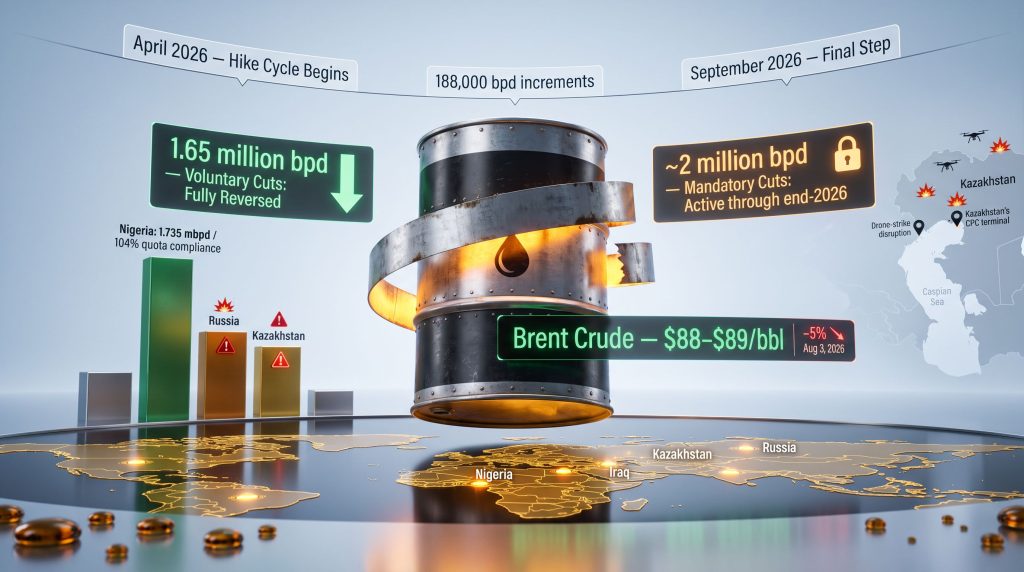
The first layer consists of the mandatory production cuts of approximately 2 million barrels per day introduced in late 2022. These cuts were never part of the monthly hike sequence and remain fully intact through the end of 2026.
The second layer is the voluntary reduction of 1.65 million barrels per day, agreed upon in 2023 and subsequently adjusted after the United Arab Emirates departed from the voluntary cut arrangement in May 2026. This voluntary layer is what the monthly quota increases, running from April through September 2026, were systematically dismantling. OPEC production decisions have played a central role in shaping this two-tier framework.
| Supply Layer | Volume | Status as of September 2026 |
|---|---|---|
| 2023 Voluntary Cuts (unwound) | 1.65 million bpd | Fully reversed by September 2026 |
| 2022 Mandatory Baseline Cuts | ~2 million bpd | Unchanged — active through end-2026 |
| Net Monthly Hike Cycle Increment | ~188,000 bpd per step | Concluded after September increase |
The September increment of 188,000 barrels per day completes the reversal of the voluntary layer. What persists untouched is the 2022 mandatory reduction, which will become the subject of separate and likely contentious negotiations in 2027.
The Gap Between Paper Quotas and Physical Barrels
One of the most underappreciated dynamics of the 2026 hike cycle is how little of it actually translated into real additional supply reaching the market. OPEC+ official data recorded total alliance production at 36.28 million barrels per day in June 2026 — a figure sitting nearly 7 million barrels per day below pre-conflict output levels.
The monthly quota increases approved throughout 2026 were largely theoretical in nature. Real-world output remained constrained by active conflict zones, damaged export infrastructure, and persistent underperformance among key members, meaning the market impact of each announced increase was structurally diluted before it reached physical supply.
Three conflict-related disruptions account for much of this shortfall:
-
Iran: Ongoing geopolitical oil price pressures have kept Iranian production and export flows well below potential capacity.
-
Russia: The International Energy Agency confirmed that Russian output ran 910,000 barrels per day below its own quota in June 2026, with Ukrainian drone strikes disrupting refinery operations. Russian Deputy Prime Minister Alexander Novak acknowledged in June that national oil production had declined since the beginning of the year, according to OilPrice reporting.
-
Kazakhstan: Repeated drone attacks targeting the Caspian Pipeline Consortium terminal in the Black Sea have persistently limited Kazakhstan's ability to fulfil its export potential, creating a structural mismatch between quota allocation and deliverable volumes.
This reality matters enormously for market interpretation. Each announced quota increase was priced by traders as a supply event, yet the underlying physical delivery remained constrained by forces entirely outside OPEC+'s policy control.
How Oil Markets Responded: The September Announcement and the Iran Shock
When OPEC+ formally approved the 188,000 bpd final increment for September, Brent and WTI futures were trading between $88 and $89 per barrel, according to Trading Economics data from that weekend session.
What followed on Monday, August 3, 2026, illustrated precisely how rapidly geopolitical signals can override supply-side policy decisions. U.S. President Donald Trump announced resumed diplomatic engagement with Iran and simultaneously signalled a suspension of military strikes. Brent crude fell to approximately $83-$84 per barrel in a single session, representing a decline of close to 5%.
| Price Event | Brent Crude Level | Trigger |
|---|---|---|
| OPEC+ September announcement (weekend) | ~$88-$89/bbl | Final quota increase approved |
| Monday, August 3, 2026 session | ~$83-$84/bbl | Trump-Iran talks resumed; strikes suspended |
| Net single-session move | ~-5% | Dual demand-supply sentiment shift |
This episode is a textbook example of what energy traders call geopolitical risk premium compression. When armed conflict or diplomatic breakdown elevates perceived supply disruption risk, that anxiety gets embedded in futures prices well before any barrel is actually lost. When the risk suddenly recedes, the premium exits just as rapidly, often producing violent single-day price swings that dwarf the impact of a routine quota decision. Consequently, oil market volatility during this period has been particularly pronounced.
What Happens During the Pause: The Q4 2026 Holding Pattern
Rather than continuing to add monthly increments into a market facing softening demand signals and surplus risk, OPEC+ has elected to pause further increases while conducting a comprehensive production capacity audit across all 19 member states.
Jorge Leon, an analyst at Rystad Energy, described the strategic logic of this approach clearly in comments cited by Business Recorder. His assessment characterised the Q4 2026 period as a preparation phase: the alliance has completed its voluntary cut unwinding and must now manage the transition to a verified, data-anchored quota framework before deciding its next policy steps.
The audit process itself is more complex than it might appear. Production capacity assessments in the oil sector involve:
-
Independent verification of sustainable output rates at existing producing fields.
-
Accounting for infrastructure constraints, including pipeline capacity, terminal throughput limits, and refinery configuration.
-
Distinguishing between nameplate production potential and deliverable export capacity — two figures that diverge significantly in conflict-affected or infrastructure-constrained environments.
-
Establishing baseline figures that will serve as the mathematical foundation for 2027 quota allocations across all member states.
Without this verification step, any new quota framework risks encoding politically motivated capacity claims rather than physical realities, which is precisely the tension that has undermined OPEC+ compliance in previous cycles. Furthermore, OPEC's market influence over pricing outcomes depends heavily on the credibility of this audit process.
The 2027 Quota Negotiations: Where Alliance Cohesion Will Be Tested
The pause sets the stage for what may be the most contentious internal negotiation OPEC+ has faced in several years. Multiple member states are entering these discussions with ambitious upward quota demands, each backed by legitimate but conflicting rationales.
Nigeria presents the most striking case. Africa's largest oil producer achieved 104% of its production quota in June 2026, its strongest compliance performance in 74 months, with combined output reaching 1.735 million barrels per day according to figures from the Nigerian Upstream Petroleum Regulatory Commission. Building on this performance, NNPC Chief Executive Bashir Bayo Ojulari has signalled that Nigeria will seek a 2027 quota of 2 million barrels per day — a 33% increase from the current 1.5 million bpd allocation, according to OilPrice.
| Member | June 2026 Status | Key Constraint | 2027 Quota Ambition |
|---|---|---|---|
| Nigeria | 104% of quota (1.735 mbpd) | None — outperforming | 2.0 mbpd (up 33%) |
| Russia | ~910,000 bpd below quota | Ukrainian strikes on refineries | Capacity-adjusted baseline |
| Kazakhstan | Below quota | Drone attacks on CPC terminal | Conflict-adjusted quota |
| Iraq | Below quota | Infrastructure and compliance gaps | Higher capacity-reflective quota |
| UAE | Departed voluntary cut arrangement (May 2026) | Independent position | Standalone baseline |
The structural tension here is significant. Nigeria is demanding higher quotas from a position of demonstrated delivery. Kazakhstan and Russia are requesting conflict-adjusted baselines to avoid being penalised for output constraints driven by circumstances entirely outside their operational control. Iraq is seeking allocations that better reflect its actual reservoir capacity rather than the politically negotiated figures assigned in prior rounds.
If Kazakhstan successfully argues that drone attack disruptions justify a conflict-adjusted quota, it sets a precedent that other members facing infrastructure or geopolitical constraints could invoke in future rounds — fundamentally altering the logic of OPEC+ quota allocation methodology.
The next major ASX story will hit our subscribers first
Scenario Modelling: Three Possible Outcomes Through Q1 2027
The interplay between the audit process, the geopolitical environment, and member negotiating positions creates a meaningful range of possible market outcomes over the next two quarters.
| Scenario | Key Assumption | Brent Crude Outlook |
|---|---|---|
| Managed Pause (Base Case) | OPEC+ holds steady; audit proceeds smoothly | $80-$88/bbl range |
| Diplomatic Breakthrough on Iran | Iranian exports resume at meaningful scale | Downward pressure; $70-$78/bbl |
| Quota Negotiation Breakdown | Member defection or non-compliance surge | Volatility spike; $90+/bbl possible |
The base case assumes the alliance maintains its current production posture while the audit proceeds. Brent crude would likely hold within a relatively stable band, with upward pressure constrained by demand-side concerns and downward pressure limited by the continuing 2 million bpd mandatory cut block.
The Iranian scenario represents the most significant potential downside catalyst. A substantive diplomatic resolution that permits Iranian exports to return to full capacity could add considerable volumes to a market already navigating surplus risk. Conversely, a breakdown in quota negotiations — driven by irreconcilable differences between high-capacity underperformers and high-ambition overperformers — could trigger the kind of compliance deterioration that historically precedes price spikes. CNBC has reported extensively on the incremental nature of these quota decisions and the risks they carry.
Frequently Asked Questions: The OPEC+ Output Increase Cycle Ending in 2026
Has OPEC+ Completely Ended All Production Cuts?
No. The conclusion of the monthly hike sequence only reverses the 2023 voluntary reductions totalling 1.65 million barrels per day. A separate block of approximately 2 million bpd in mandatory production restraint, introduced in 2022, remains fully intact through the end of 2026 and will be subject to independent negotiations next year.
Why Is OPEC+ Pausing Rather Than Continuing Output Increases?
The alliance requires a verified production capacity dataset across all 19 member states before it can rationally construct a 2027 quota framework. Proceeding without this audit risks allocating quotas based on politically motivated estimates rather than deliverable physical output, which historically generates compliance failures and price volatility.
Which Members Are Most Likely to Seek Higher 2027 Quotas?
Nigeria, Iraq, and Kazakhstan have each signalled intent to pursue upward revisions. Nigeria's case is the strongest numerically, given its demonstrated compliance record and the NNPC's explicit 2 million bpd target — a 33% increase from current allocation. Iraq and Kazakhstan are seeking capacity-reflective and conflict-adjusted baselines respectively.
What Does the 188,000 bpd September Increment Actually Represent?
It is the final monthly step in the graduated rollback of the 2023 voluntary production cuts. Once implemented, the cumulative unwinding of the 1.65 million bpd voluntary reduction is complete, formally closing the OPEC+ output increase cycle ends and transitioning the alliance into its quota governance phase.
What the Structural Shift Signals for Energy Strategy
The transition from a monthly-hike cycle to a quota-negotiation phase represents a structural evolution in how OPEC+ manages collective supply. The alliance is moving from short-term reactive adjustments toward a longer-horizon governance model anchored in verified production capacity — a shift with significant implications for price discovery, member compliance, and market credibility.
For energy traders, the Q4 2026 period demands heightened awareness of headline risk. Diplomatic developments involving Iran, compliance data releases, and early signals from the quota audit process all have the capacity to move prices rapidly and without warning.
For sovereign producers and long-term investors in energy infrastructure, the audit-and-negotiate sequence that follows the OPEC+ output increase cycle ends in September 2026 will reshape revenue planning assumptions for years ahead. Quota baselines established in early 2027 will anchor fiscal projections, upstream investment decisions, and national development budgets across the membership.
The deeper story is not about one month's quota decision. It is about whether a 19-member alliance with diverging production realities, conflict-affected export infrastructure, and politically sensitive capacity claims can construct a durable and credible framework for managing nearly a third of global oil supply through the remainder of the decade.
Further coverage of OPEC+ production policy and global energy market dynamics is available through Ecofin Agency at ecofinagency.com, which provides ongoing reporting on energy sector developments across African and global markets.
Want to Stay Ahead of the Next Major Resource Discovery Driving Energy Markets?
While OPEC+ supply architecture and geopolitical risk premiums reshape global commodity markets, Discovery Alert's proprietary Discovery IQ model delivers real-time alerts on significant ASX mineral discoveries — instantly translating complex resource data into actionable investment insights for traders and long-term investors alike. Explore how historic mineral discoveries have generated extraordinary returns and begin your 14-day free trial today to position yourself ahead of the broader market.