
July 23, 2026
When Quota Headlines Diverge From Physical Reality
Oil markets have a long history of responding to announcements before the physical consequences of those announcements ever materialise. Production quotas, output ceilings, and supply adjustments issued by producer coalitions travel through financial markets in milliseconds, yet the actual barrels underpinning those decisions take weeks or months to reach refineries. This structural lag between policy signal and physical delivery is not a new phenomenon, but it becomes acutely consequential when simultaneous geopolitical disruptions, demand forecast revisions, and coalition realignments are all operating at once.
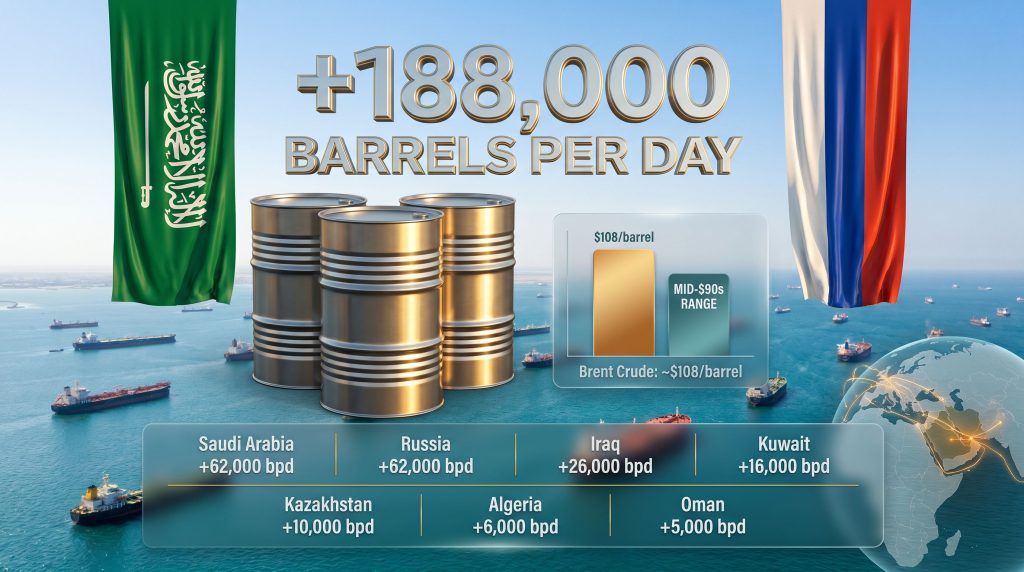
That is precisely the environment surrounding the decision by seven OPEC+ member nations to collectively raise output by 188,000 barrels per day in June 2026. OPEC+ boosts output in June as part of a structured unwinding of voluntary cuts, but on closer examination, the announcement becomes something considerably more nuanced than a straightforward supply addition.
When big ASX news breaks, our subscribers know first
Why the June OPEC+ Boost Is Smaller Than It Appears
Quota vs. Deliverable Supply: A Critical Distinction
The concept of an OPEC+ production increase carries an implicit assumption that the announced volume will actually reach the market. In practice, this assumption has consistently overestimated real-world supply delivery. The coalition has historically operated with member shortfalls running close to 9 million barrels per day against stated targets, a structural compliance gap that fundamentally limits the real-world impact of any incremental quota adjustment.
When OPEC+ boosts output in June by 188,000 bpd, that figure represents a change to a production target, not a confirmed injection of physical supply. Whether those barrels actually reach buyers depends on member state infrastructure, fiscal incentives, geopolitical constraints, and in the current environment, whether tanker traffic through the Strait of Hormuz can operate without disruption.
Against global oil consumption running near 100 million barrels per day, the June increase represents less than 0.2% of total daily demand. This contextualisation matters because it establishes the adjustment as a marginal policy signal, not a structural supply shift. Furthermore, understanding OPEC's global influence helps clarify why even modest quota changes carry outsized market significance.
The Pattern of Incremental Scaling
The June figure of 188,000 bpd is also smaller than the prior two monthly increases, which ran at approximately 206,000 bpd during both March and April 2026. This reduction in adjustment size coincides precisely with the UAE's withdrawal from OPEC+, effective May 1, 2026, and the transition from an eight-member voluntary adjustment group to a seven-member configuration. The directional decline in monthly adjustment size reflects reduced coalition capacity, not a deliberate tightening of supply policy.
Importantly, this entire phase-out sequence originates from voluntary cuts first announced in April 2023. The June increase is not a new supply decision but rather a continuation of a structured, multi-month unwinding of cuts implemented more than three years earlier. OPEC meeting outcomes from prior sessions have consistently demonstrated how such incremental adjustments shape broader market expectations.
How the 188,000 bpd Is Divided Across Seven Nations
Country-by-Country Allocation
The distribution of the June increase, as published in the official OPEC statement, reveals a highly concentrated adjustment architecture:
| Member Nation | June Increase (bpd) | June Required Production (bpd) | Share of Total Increase |
|---|---|---|---|
| Saudi Arabia | +62,000 | 10,291,000 | 32.98% |
| Russia | +62,000 | 9,762,000 | 32.98% |
| Iraq | +26,000 | 4,352,000 | 13.83% |
| Kuwait | +16,000 | 2,628,000 | 8.51% |
| Kazakhstan | +10,000 | 1,599,000 | 5.32% |
| Algeria | +6,000 | 989,000 | 3.19% |
| Oman | +5,000 | 826,000 | 2.66% |
| Total | +188,000 | — | 100% |
Saudi Arabia and Russia as the Adjustment Anchors
Saudi Arabia and Russia each contribute 62,000 bpd, with their combined share accounting for nearly 66% of the entire June adjustment. The identical allocation between the two nations suggests coordinated bilateral agreement rather than a formulaic capacity-based distribution model.
Applying each nation's adjustment as a percentage of its required June production reveals a remarkably consistent ratio. Saudi Arabia's adjustment represents approximately 0.602% of its required output, while Russia's equates to 0.635%. Iraq, Kuwait, and Kazakhstan fall within a similar band. This consistency implies a proportional methodology applied across the coalition, rather than ad hoc bilateral negotiation at the individual member level.
By contrast, Algeria's 6,000 bpd and Oman's 5,000 bpd contributions are operationally minimal. Their participation functions more as coalition signal than material supply contribution, reinforcing the principle that OPEC+ decisions carry political and psychological weight beyond their physical barrel count.
The Compliance and Compensation Framework
The OPEC statement accompanying the June decision includes language committing the seven nations to compensate for overproduced volumes dating back to January 2024. The Joint Ministerial Monitoring Committee (JMMC) is tasked with tracking this conformity.
This compensation mechanism creates a meaningful ceiling on net new supply. If member nations that have overproduced are simultaneously required to compensate for those excess barrels through future production restraint, the gross increase of 188,000 bpd is partially offset by ongoing compensation deductions. The net supply addition reaching the market could be considerably lower than the headline figure suggests.
Three Scenarios Shaping Where Oil Prices Go From Here
The June OPEC+ output decision does not operate in a vacuum. Its market impact is contingent on three simultaneous variables: geopolitical risk premiums embedded in current pricing, the trajectory of IEA demand revisions, and whether Strait of Hormuz shipping conditions normalise. Analysts at Zaye Capital Markets characterised this as a fragile balance, noting that while OPEC+ supply signals can exert downward pressure on prices, conflict risk and physical shipping disruptions constrain the downside.
Scenario 1: Diplomatic Progress and Shipping Normalisation
If Iran-related tensions ease and tanker traffic through the Strait of Hormuz resumes without disruption, the 188,000 bpd June addition could compound with improved logistics to create meaningful downward price pressure. Under this scenario, Brent crude, currently trading near $108 per barrel, could retreat toward the mid-$90s range as the conflict premium embedded in current pricing unwinds.
This outcome requires not just a quota increase but a resolution of the physical shipping constraint that currently prevents announced supply from translating into deliverable barrels. The interplay between oil geopolitics and OPEC decisions has repeatedly demonstrated how quickly diplomatic developments can shift market sentiment.
Scenario 2: Conflict Escalation and Tanker Route Disruption
If negotiations stall, tanker incidents increase, or Hormuz restrictions tighten further, the quota adjustment becomes largely irrelevant to physical market dynamics. In this environment, Brent crude would likely rebuild toward the $110 to $115 range, driven by renewed conflict premium repricing rather than any fundamental demand growth.
Zaye Capital Markets analysts note that current pricing already reflects a conflict risk premium that is "masking underlying demand weakness." If geopolitical deterioration continues, that premium could expand rather than contract, rendering the 188,000 bpd increase price-neutral at best and bullish at worst.
Scenario 3: Demand Contraction Outpaces Supply Additions
The IEA's April 2026 Oil Market Report, released on April 14, 2026, projects global oil demand to contract by 80,000 bpd in 2026. This represents a downward revision of 730,000 bpd in a single month, one of the sharpest single-month forecast revisions in recent IEA reporting history.
The report specifically projects a 1.5 million bpd demand decline in Q2 2026, characterised as the steepest contraction since COVID-19 disrupted global fuel consumption. If this demand erosion accelerates, the net effect of OPEC+'s June supply increase could prove price-neutral or even bearish. In addition, trade war oil effects continue to weigh on demand forecasts across major consuming economies.
The June output increase does not operate in isolation. It intersects with geopolitical risk premiums, IEA demand revisions, and structural compliance gaps simultaneously. Treating the 188,000 bpd figure as a standalone supply event misrepresents the actual market calculus entirely.
The UAE's Exit and What It Changes for OPEC+ Coalition Dynamics
The Withdrawal and Its Immediate Structural Impact
The UAE's formal withdrawal from OPEC and OPEC+, effective May 1, 2026, represents the most significant structural development within the coalition in recent years. The May 3 virtual meeting, the first convened after the UAE's departure, proceeded without formal acknowledgment of the exit in official OPEC communications, a notable omission given the scale of the change.
The comparative impact of the UAE's departure can be framed across several metrics:
| Metric | Pre-UAE Exit | Post-UAE Exit (June 2026) |
|---|---|---|
| Monthly adjustment scope | ~206,000 bpd | ~188,000 bpd |
| Active voluntary adjustment members | 8 nations | 7 nations |
| UAE's prior monthly contribution | ~18,000 bpd | 0 bpd |
| Coalition cohesion risk | Moderate | Elevated |
The Coalition Within a Coalition
The seven-member voluntary adjustment group, comprising Saudi Arabia, Russia, Iraq, Kuwait, Kazakhstan, Algeria, and Oman, has effectively become a decision-making entity operating within the broader OPEC+ framework. These seven nations control the near-term supply signal, while the wider membership retains formal participation in the broader coalition.
The UAE's exit removes one of the coalition's more technically sophisticated members, one with significant spare capacity and historically strong compliance with quota frameworks. Whether the remaining seven can maintain cohesion under sustained low-price scenarios, or whether the UAE's departure emboldens other members to reassess their participation, becomes an important medium-term risk variable. According to Reuters analysis, the boost remains largely symbolic despite its strategic signalling value.
The Strait of Hormuz: The Variable That Overrides Everything Else
Why Chokepoint Risk Dominates Quota Arithmetic
Approximately 20% of global oil trade transits the Strait of Hormuz. Any meaningful restriction to that flow creates immediate physical scarcity that cannot be offset by quota adjustments announced in Vienna or Riyadh. A nation may have the production capacity to deliver additional barrels, but if those barrels cannot be loaded onto tankers or those tankers face hostile passage, the capacity is irrelevant to the market.
This distinction between production capacity and deliverable supply is the most underappreciated variable in the current OPEC+ narrative. Brent crude near $108 per barrel reflects a market pricing both physical scarcity and geopolitical risk simultaneously. The price architecture currently contains multiple embedded layers:
- Fundamental supply/demand value: Based on pre-conflict production and demand trajectories
- Conflict risk premium: Reflecting uncertainty about Iranian oil supply continuity and potential escalation
- Shipping disruption surcharge: Accounting for elevated tanker insurance, route diversions, and reduced effective throughput
The IEA's Revised Demand Outlook as a Bearish Counterweight
The IEA explicitly identifies the Iran conflict as the primary driver behind its sweeping demand contraction forecast. A 730,000 bpd downward revision in a single month reflects the scale of uncertainty now embedded in institutional energy forecasting. Conflict-driven demand destruction operates through mechanisms distinct from cyclical softness: reduced industrial activity in affected regions, trade route disruptions that inflate logistics costs across global supply chains, and broader economic slowdown effects that reduce transportation fuel demand.
The convergence of supply disruption (Hormuz constraints) and demand destruction (IEA revisions) creates an unusual market condition where both upside and downside price catalysts are active simultaneously, producing the "elevated but unstable" characterisation that market analysts have applied to current Brent pricing. Monitoring crude oil price trends through this period will be essential for understanding where equilibrium ultimately settles.
The next major ASX story will hit our subscribers first
The Strategic Architecture of OPEC+'s Gradual Unwinding
Optionality as Policy Design
The June increase is part of a deliberate, structured multi-month phase-out of voluntary cuts, but the OPEC statement is careful to preserve maximum flexibility. The official language explicitly retains the right to pause, reverse, or accelerate the phase-out based on evolving market conditions. This optionality is not incidental: it is the core policy design.
By framing each monthly increase as conditional rather than committed, the coalition retains the ability to reverse course rapidly if prices deteriorate or geopolitical conditions shift. This approach has functional parallels to central bank forward guidance frameworks, where the signal itself influences market behaviour even before physical implementation occurs.
Monthly Meetings as a Continuous Price Signalling Mechanism
The seven-member group has committed to monthly virtual meetings throughout 2026, with the next session scheduled for June 7, 2026. This meeting cadence functions as a forward guidance mechanism, keeping traders in a state of continuous anticipation regarding the next supply decision.
Each meeting creates a recurring opportunity for the coalition to recalibrate its supply signal based on current market data. The monthly frequency is notably higher than traditional OPEC ministerial meeting schedules and reflects the unusual level of market volatility and geopolitical uncertainty characterising the current period. Reporting from The National News confirms that producers have reaffirmed their commitment to market stability through this ongoing mechanism.
Long-Term Implications for Energy Investors
As OPEC+ gradually unwinds voluntary cuts, the theoretical ceiling on global supply expands. However, actual deliverable capacity remains constrained by infrastructure investment levels, compliance behaviour, and geopolitical conditions that no quota decision can fully resolve.
For institutional energy investors and sovereign wealth funds, this supply uncertainty creates a challenging valuation environment for long-duration energy assets. The combination of demand contraction forecasts and supply delivery uncertainty compresses the analytical confidence interval around future oil price projections.
Key investment implications worth monitoring include:
- Compliance trajectory: Whether the seven-member group achieves its stated June targets or repeats historical shortfall patterns
- UAE's independent production strategy: How the UAE prices and markets its output outside the OPEC+ framework
- IEA demand revision direction: Whether July and August reports show further downward revision or stabilisation
- Hormuz shipping normalisation: The single variable with the greatest capacity to shift the supply-demand balance
Frequently Asked Questions: OPEC+ June Output Increase
How much is OPEC+ increasing oil production in June 2026?
Seven OPEC+ member nations collectively agreed to raise output by 188,000 barrels per day in June 2026, drawn from the voluntary production adjustments originally established in April 2023.
Which countries are part of the June 2026 OPEC+ output decision?
The seven participating nations are Saudi Arabia, Russia, Iraq, Kuwait, Kazakhstan, Algeria, and Oman. Saudi Arabia and Russia each contribute the largest individual allocations at 62,000 bpd apiece.
Why did OPEC+ boost output when global demand is contracting?
The increase reflects a pre-established phase-out schedule for voluntary cuts rather than a response to demand growth. The coalition retains explicit flexibility to pause or reverse the adjustment if market conditions deteriorate.
What does the UAE's OPEC+ exit mean for the June decision?
The UAE's withdrawal, effective May 1, 2026, reduced the collective adjustment capacity of the group. The June increase of 188,000 bpd is lower than prior monthly figures of approximately 206,000 bpd, partly reflecting the loss of the UAE's contribution to the voluntary adjustment framework.
Where is Brent crude trading following the OPEC+ announcement?
Following the May 3 announcement, Brent crude was trading near $108 per barrel, characterised by Zaye Capital Markets analysts as elevated but unstable given competing supply relief and geopolitical risk signals. (Source: Rigzone, May 4, 2026)
Will the June OPEC+ output increase lower oil prices?
The outcome depends on three concurrent variables: Strait of Hormuz shipping conditions, the trajectory of the Iran conflict, and the pace of demand contraction. Physical supply constraints limit the downward price impact of quota increases alone, meaning headline increases do not automatically translate into price relief.
Key Takeaways
- 188,000 bpd is a quota adjustment, not a guaranteed supply injection — actual physical delivery depends on member compliance, shipping infrastructure, and geopolitical conditions
- Saudi Arabia and Russia anchor the coalition, contributing nearly two-thirds of the total June increase between them
- The IEA's demand contraction forecast of -80,000 bpd for 2026, revised down 730,000 bpd in a single month, creates a powerful bearish counterweight to supply additions
- Brent crude near $108 per barrel reflects conflict risk premiums that quota decisions alone cannot fully offset
- The UAE's exit introduces a new structural variable into OPEC+ coalition dynamics with implications for future quota negotiations and collective ceiling capacity
- Monthly meetings through 2026 signal that supply policy remains highly reactive and data-dependent, preserving maximum optionality for the coalition at the cost of market predictability
- The Strait of Hormuz remains the dominant variable controlling physical market outcomes, overriding quota arithmetic when shipping conditions deteriorate
This article is intended for informational purposes only and does not constitute financial or investment advice. Oil price projections and scenario analyses involve inherent uncertainty and should not be relied upon as forecasts of future market conditions. Readers should conduct independent research before making any investment decisions.
Want To Stay Ahead Of The Next Major Resource Discovery Reshaping Markets?
While oil market dynamics and OPEC+ supply signals demand close attention, the most significant investment opportunities often emerge from real-time mineral discoveries on the ASX — and Discovery Alert's proprietary Discovery IQ model instantly identifies these high-potential announcements, transforming complex data across 30+ commodities into clear, actionable insights. Start your 14-day free trial with Discovery Alert today, or explore the historic returns major discoveries have generated to understand the scale of opportunity available to well-positioned investors.