
July 23, 2026
Why Pre-FID Evidence Matters More Than the Decision Itself in Large-Scale Mining
In large-scale mining development, the most analytically rich period is rarely the moment a Final Investment Decision is announced. It is the months and years beforehand, when engineering advances from conceptual to buildable, when site conditions are tested against feasibility assumptions, and when social and logistical variables are resolved through observable action rather than modelled projection. Investors who focus exclusively on the FID announcement as a signal of project quality are, in effect, reading last season's data.
The distinction matters because FID is a confirmation event, not an originating one. By the time a board approves capital deployment, the variables that will ultimately determine whether a project is built on schedule and within budget have largely been shaped by what happened before that decision. Engineering completion rates, geotechnical findings, resettlement status, and procurement groundwork each carry independent, assessable information that precedes and informs the FID rather than following from it.
The Lifezone Metals Kabanga nickel project construction readiness case sits squarely in this pre-FID analytical window, offering investors a growing body of site-level, operational, and financial evidence to assess long before the formal capital commitment arrives.
When big ASX news breaks, our subscribers know first
From Feasibility Study to Execution Readiness: A Qualitative Step Change
Completing definitive feasibility studies is a necessary condition for project advancement, but it is not sufficient evidence of construction readiness. The July 2025 Kabanga Nickel Project Feasibility Study established the technical and economic parameters for the project, with sustainability considerations integrated throughout the study itself rather than appended as a compliance afterthought. That integration is analytically significant because it means environmental and social planning is already aligned with the sequencing of construction activities, rather than running on a separate, lagging track.
Following feasibility completion, Lifezone Metals (NYSE: LZM) obtained board approval to transition into a formal execution readiness phase. This is a meaningfully different operational state from study completion. Where feasibility work is fundamentally desk-based, drawing on drilling data, metallurgical testwork, and cost databases to model project parameters, execution readiness involves physical activity at site that tests those modelled assumptions against observable conditions.
The gap between a completed feasibility study and a genuinely construction-ready project is where the majority of execution risk either accumulates or gets retired. Investors who can accurately read that gap gain a material informational advantage over those who wait for the FID announcement.
The board's decision to direct pre-FID resources toward site preparation rather than further study refinement reflects a deliberate capital allocation philosophy: that reducing observable execution uncertainty is more valuable at this stage than incrementally improving the precision of already-established feasibility parameters.
What Is Actually Happening on the Ground at Kabanga
Geotechnical Drilling and Subsurface Characterisation
The early works program at Kabanga includes geotechnical drilling mobilised across multiple fronts, with test pits being excavated to directly characterise subsurface conditions. This activity replaces modelled geotechnical assumptions, which carry inherent uncertainty regardless of how carefully they are constructed, with observed data from the actual site.
In underground mining development, geotechnical confidence is foundational to construction cost and schedule reliability. Rock mass quality classifications, ground support requirements, and excavation rates all depend on subsurface conditions that cannot be fully characterised through surface-based methods alone. Physical test pitting and drilling at the North boxcut area directly addresses this uncertainty category before EPCM contracts are signed.
Water Availability and Site Infrastructure
Water boreholes are being drilled to establish site water availability and quality parameters. This is a frequently underestimated construction readiness activity. Water requirements during mining construction are substantial, spanning concrete production, dust suppression, equipment cooling, and worker accommodation. Projects that enter construction without having confirmed water source capacity and quality face the risk of discovering constraints that require costly redesign or alternative sourcing mid-build.
Access road preparation is also advancing, providing the logistical infrastructure required for contractor mobilisation and heavy equipment movement. Access quality directly influences the cost and schedule of equipment delivery during bulk earthworks.
Camp Infrastructure and Workforce Readiness
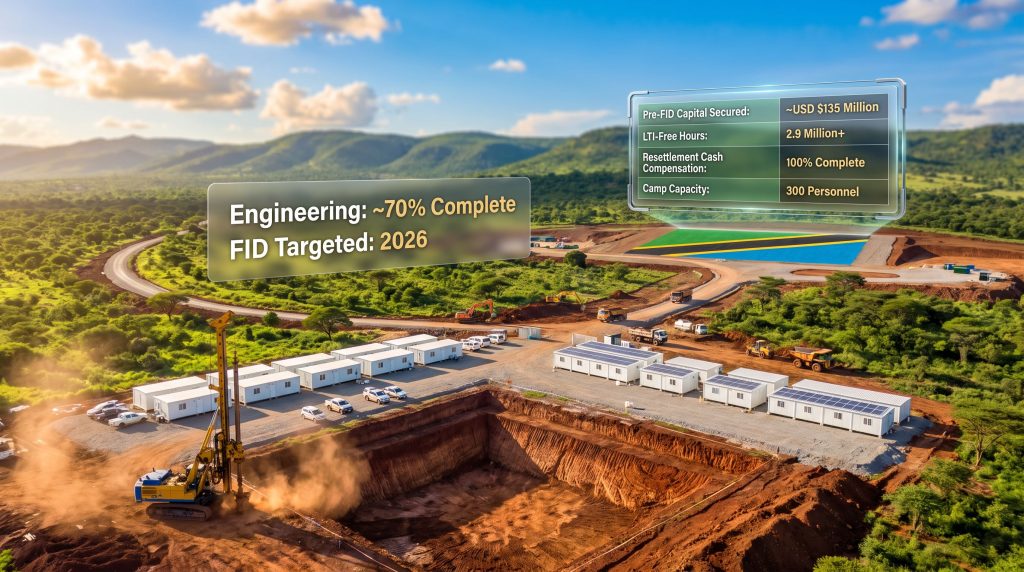
Camp upgrades have been completed, with the facility now capable of accommodating approximately 300 personnel following the installation of new leased accommodation units. This is not merely a comfort measure. Workforce accommodation capacity is a hard constraint on construction mobilisation rates. A camp configured for 300 people sets the upper bound for simultaneous contractor workforce size during early construction phases, and expanding that capacity ahead of FID removes a logistical bottleneck that could otherwise slow mobilisation following capital commitment.
Engineering Advancement: Closing the Gap Between Model and Build
Third-party assessments indicate that engineering for the Kabanga project is approximately 70% complete, with the remaining work concentrated on detailed design packages required for EPCM contractor engagement. This progression from feasibility-level specifications toward construction-ready design documentation represents a systematic reduction in a specific category of risk: the possibility that design assumptions will not translate cleanly into buildable specifications.
The significance of this distinction is often lost on investors unfamiliar with how engineering progresses through mining project development stages. Feasibility-level engineering, sometimes referred to as Class 4 or Class 5 engineering in capital cost estimation frameworks, carries accuracy ranges typically spanning plus or minus 15 to 25 percent. Construction-ready engineering narrows that range substantially, reducing the probability that actual construction costs will diverge materially from the capital estimate presented in the feasibility study.
With engineering at 70% completion, Lifezone is approaching the threshold at which EPCM contractors can engage with sufficient design specificity to provide meaningful cost and schedule commitments, a prerequisite for the broader project financing discussions that remain on the critical path to FID. Furthermore, Lifezone Metals' 2026 FID announcement outlines the company's expectations for how this engineering progression supports their targeted decision timeline.
Procurement Strategy and Tender Activity
Procurement planning is actively progressing alongside engineering advancement. The procurement strategy has been finalised and requests for tender have been issued for priority packages. Early tendering serves multiple functions beyond simply finding contractors:
- It establishes current market pricing for key construction inputs, testing whether feasibility cost assumptions remain valid in the current cost environment
- It assesses contractor appetite and available capacity for a project of Kabanga's scale and location
- It provides the project team with feedback that can inform detailed design decisions before those designs are finalised
- It compresses the lag between FID approval and contract execution, since tendering relationships and preliminary terms are already established
Capital Secured and Financing Structure
Pre-FID activity at this scale requires dedicated funding, and Lifezone has addressed that requirement through a combination of debt and equity instruments.
| Funding Instrument | Amount (USD) | Primary Application |
|---|---|---|
| Taurus Bridge Facility | $60 million | Early works, engineering, site preparation |
| H2 2025 Registered Direct Offerings | $75 million | Pre-FID activities, camp upgrades, procurement |
| Total Pre-FID Capital Secured | ~$135 million | Execution readiness through to FID |
Lifezone has confirmed that pre-FID activities are fully funded through the capital secured in the second half of 2025, which removes near-term financing uncertainty from the construction readiness equation. The Taurus bridge facility and the equity raises serve complementary functions within this structure: the bridge facility provides structured debt capital for early works execution, while the equity raises preserve balance sheet flexibility for the broader pre-FID program.
The larger-scale project financing required to fund full construction, including EPCM contracts, bulk earthworks, and underground development, remains subject to ongoing capital market discussions. FID itself is contingent on the completion of that broader financing package, meaning that the pace of capital market engagement constitutes a parallel critical path alongside the physical construction readiness activities underway at site.
Operational Track Record as Execution Credibility Evidence
Safety Performance and Management Systems
Lifezone has recorded more than 2.9 million hours worked without a Lost Time Injury (LTI) across its Kabanga operations. The analytical relevance of this figure extends beyond its immediate humanitarian significance. The management systems that generate strong safety outcomes during pre-construction phases are the same systems that govern construction-phase execution. Projects with demonstrated pre-construction operational discipline have historically shown greater consistency during construction, not because safety performance directly determines cost outcomes, but because both are products of the same underlying organisational capability.
Resettlement: Social Risk Retired Before Construction Begins
Resettlement completion represents one of the most concrete forms of social risk retirement available in the pre-FID period.
| Resettlement Metric | Current Status |
|---|---|
| Cash compensation payments to affected parties | 100% completed |
| Resettlement agreements signed | 97% |
| Remaining funds (outstanding agreements) | Placed into escrow |
The practical connection between resettlement and construction readiness is direct: physical site access for geotechnical drilling, test pitting, and road construction depends on resettlement resolution. These workstreams are operationally linked. The near-complete resolution of resettlement obligations has already enabled the early works program currently underway, and clears the category of social risk that has materially delayed or derailed comparable projects elsewhere in sub-Saharan Africa at precisely the construction-entry stage.
Lifezone's Head of Sustainability, Catherine Nichas, has articulated the company's focus as one centred on building foundations strong enough to support the transition into construction, with stakeholder trust treated as a prerequisite for project delivery rather than a secondary consideration.
The next major ASX story will hit our subscribers first
Jurisdictional and Structural Advantages Worth Understanding
The Special Mining Licence and State Ownership Alignment
Kabanga holds a Special Mining Licence, which provides a secured mining permitting position and reduces the regulatory uncertainty that typically represents a meaningful source of pre-construction risk in emerging market jurisdictions. The Tanzanian government holds a 16% ownership interest in the project, a structural arrangement that is analytically distinct from a simple royalty or tax relationship.
A direct equity stake creates a different incentive structure than fiscal instruments alone. With 16% ownership, the Tanzanian government's financial returns are tied to project delivery and production outcomes, creating an active economic interest in facilitating permitting, infrastructure access, and regulatory processes rather than simply extracting value from a completed operation. This alignment is a structural feature of the project's design, not a function of any specific policy environment.
Grid Power Transition and Operating Cost Structure
The planned transition to TANESCO grid power reduces long-term exposure to diesel-linked operating costs, which are both higher in absolute terms and more volatile in price than grid electricity. For a project with a first-quartile AISC position, the grid power transition contributes to maintaining that cost advantage through the operational life of the mine rather than only at the point of initial construction. In addition, Australia's critical materials strategy highlights how secure power infrastructure increasingly features as a factor in assessing long-term project viability for battery-relevant metals.
Key Risk Categories Remaining Before FID
Acknowledging construction readiness progress requires equal attention to the risks that remain outstanding. Investors should weigh the following categories carefully:
- Large-scale financing completion risk: The construction financing package required for full project execution has not been secured. Its size, terms, and timeline will materially influence both project economics and equity dilution outcomes for existing shareholders
- Engineering completion risk: With approximately 30% of detailed design work remaining, schedule risk exists if technical complexity or design modifications emerge during the final engineering phase, potentially affecting the 2026 FID timeline
- Construction scale transition risk: The step from early works scale (test pits, boreholes, access roads) to full construction scale (North boxcut, underground development, processing plant) is operationally significant; the management systems being tested now will face considerably larger demands post-FID
- Nickel market price risk: Indonesian nickel supply dynamics and battery chemistry evolution continue to shape the nickel price environment into which Kabanga's production will eventually enter; first-quartile cost positioning provides structural protection but does not eliminate commodity price exposure
However, the nickel market outlook for 2025 and beyond suggests that projects with credible first-quartile cost structures may be better positioned to weather continued price volatility than higher-cost peers. Furthermore, an independent analysis of Kabanga's development positioning notes that the project's cost structure provides meaningful insulation against the sustained oversupply conditions that have pressured nickel prices in recent years.
Pre-FID Progress Summary: What Has Been Achieved and What Remains
Demonstrably Completed
- Feasibility Study completed in July 2025 with sustainability fully integrated into the study framework
- Board approval of execution readiness phase obtained
- Geotechnical drilling and site preparation mobilised across multiple work fronts
- Camp capacity expanded to accommodate approximately 300 personnel
- Procurement strategy finalised; priority package tenders issued to market
- More than 2.9 million hours worked without a Lost Time Injury
- 100% of cash compensation payments completed; 97% of resettlement agreements signed
- Special Mining Licence held; 16% Tanzanian government ownership interest in place
- Pre-FID activities fully funded through approximately USD $135 million in secured capital
Outstanding Before and After FID
- Completion of remaining approximately 30% of detailed engineering design
- Securing large-scale construction financing package
- FID approval (targeted 2026)
- EPCM contractor mobilisation following FID
- North boxcut commencement and underground development initiation
Analytical Takeaway: The Lifezone Metals Kabanga nickel project construction readiness case rests on a growing volume of site-level, operational, and financial evidence that extends meaningfully beyond what the feasibility study alone could demonstrate. The project has not yet reached construction, and material execution and financing risks remain. What has changed is the nature and volume of verifiable, observable evidence available to investors assessing the probability that Kabanga will transition from execution readiness into active construction on its stated timeline.
Disclaimer: This article is for informational purposes only and does not constitute financial or investment advice. Forecasts, timelines, and economic projections referenced in this article are forward-looking statements subject to material risks and uncertainties. Past operational performance is not necessarily indicative of future construction or production outcomes. Investors should conduct their own due diligence before making any investment decisions.
Readers seeking additional context on the Kabanga Nickel Project's development trajectory and investment positioning may find value in exploring related analysis published by Crux Investor at cruxinvestor.com.
Want to Track the Next Major Mineral Discovery Before the Market Catches On?
Discovery Alert's proprietary Discovery IQ model scans ASX announcements in real time, instantly converting complex mineral data into actionable investment insights — visit the Discovery Alert discoveries page to explore how historic mineral discoveries have generated substantial returns, and begin your 14-day free trial to position yourself ahead of the broader market.