Iltani Resources Ltd
- ASX Code: ILT
- Market Cap: $32,686,996
Ore Sorting Delivers Standout Results at Iltani's Orient Silver-Indium Project
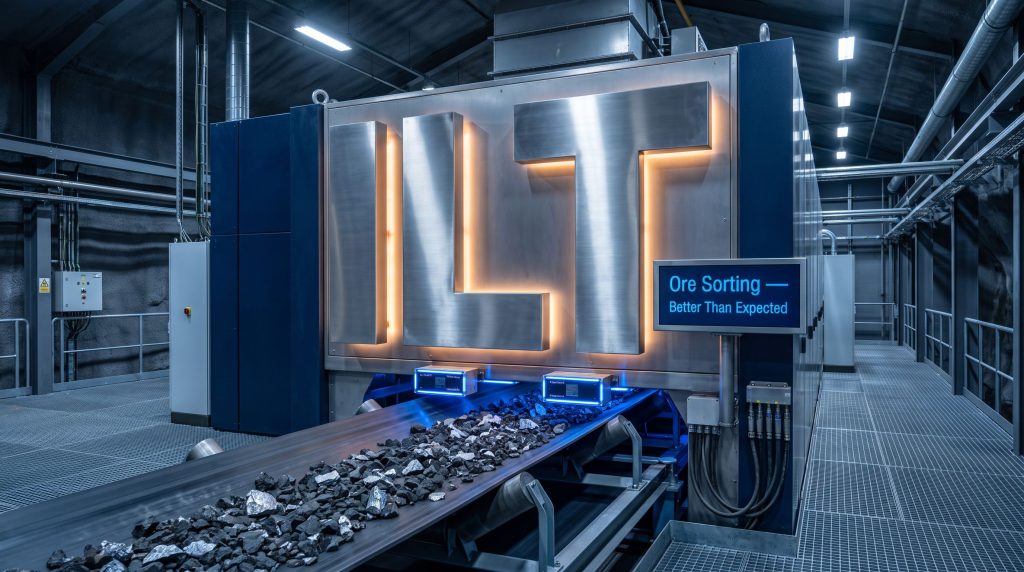
Iltani Resources (ASX: ILT) has reported first-pass ore sorting test work at its Orient Silver-Indium Project in North Queensland, with Iltani Resources Orient Silver-Indium Project ore sorting results from global sorting specialist TOMRA exceeding expectations across both high-grade and low-grade sample types.
According to the announcement, the test work used TOMRA's X-ray Transmission (XRT) platform and confirmed that Orient's sulphide mineralisation is amenable to pre-concentration sorting. This finding has significant implications for how the project could be developed and what it might cost to build and operate.
When big ASX news breaks, our subscribers know first
What the Results Show
TOMRA tested two RC chip samples from Orient — one high-grade and one low-grade — over a screened 6–25 mm particle size fraction. The objective was to produce a high-grade sulphide product in a single sorting stage whilst minimising metal losses to the waste stream.
Run 01: High-Grade Sample
| Metal | Feed Grade | Product Grade | Upgrade Factor |
|---|---|---|---|
| Silver (Ag) | 130 g/t | 265 g/t | 2.0x |
| Indium (In) | 199 g/t | 427 g/t | 2.1x |
| Lead (Pb) | 1.8% | 3.6% | 2.0x |
| Zinc (Zn) | 4.3% | 9.1% | 2.1x |
This run achieved a 58% mass rejection relative to TOMRA feed, with grades roughly doubling across all four metals in a single sort pass.
Run 02: Low-Grade Sample
| Metal | Feed Grade | Product Grade | Upgrade Factor |
|---|---|---|---|
| Silver (Ag) | 26 g/t | 325 g/t | 12.5x |
| Indium (In) | 27 g/t | 437 g/t | 16.1x |
| Lead (Pb) | 0.57% | 7.27% | 12.7x |
| Zinc (Zn) | 0.80% | 9.27% | 11.5x |
This sample recorded a 96% mass rejection, with an average upgrade factor of 13.2x across all metals reported. Starting from material grading just 26 g/t silver and 27 g/t indium, the sorter produced a concentrated product carrying 325 g/t silver and 437 g/t indium.
Why the Low-Grade Result Matters
The high-grade test confirms ore sorting works at Orient. The low-grade result, however, points to something potentially larger: the ability to render marginal mineralisation into commercially attractive material through pre-concentration alone.
"Particularly impressive are the upgrades to the low grade sample, ranging from x11.5 (zinc grade) to x16.1 (indium grade). If we can use ore sorting technology to remove a significant proportion of waste prior to the milling circuit, this will have significant benefits for the Orient Silver-Indium Project," said Donald Garner, Managing Director of Iltani Resources.
Orient's mineral resource includes a substantial lower-grade envelope. At a 30 g/t Ag Eq. cut-off, the project hosts a JORC resource of 62.5 Mt at 22.8 g/t Ag, 11.6 g/t In, 0.55% Pb and 0.67% Zn. The ability to pre-concentrate this material before it enters the processing plant may, consequently, change the economics of what can be viably processed.
Understanding XRT Ore Sorting
What Is XRT Ore Sorting?
X-ray Transmission (XRT) ore sorting is a technology that uses X-ray beams to measure the atomic density of individual rock particles as they pass along a conveyor. Dense particles — such as sulphide minerals like galena (lead sulphide) and sphalerite (zinc sulphide) — absorb X-rays strongly and appear as dark particles in the imaging output. Lighter, siliceous host rock transmits X-rays more easily and is classified as waste.
Once classified, high-pressure air jets separate the dense sulphide-rich particles from the lighter waste material, producing a high-grade product stream and a waste reject stream on a particle-by-particle basis.
Why Does It Work at Orient?
Two geological characteristics support the technology's application at Orient:
- Strong density contrast between the sulphide minerals and siliceous host rock, which makes them easy for XRT to distinguish.
- Coarse sulphide distribution, meaning the sulphide minerals occur in coarse particles that remain intact and identifiable after crushing to the 6–25 mm feed size used in testing.
Why Does It Matter to Investors?
Ore sorting used as a pre-concentration step ahead of the mill has the potential to:
- Reduce the size and cost of the processing plant, particularly the milling circuit
- Lower operating costs by sending less total mass through energy-intensive grinding
- Reduce tailings storage requirements
- Potentially upgrade lower-grade material into higher-grade mill feed
Milling is typically one of the most capital-intensive and energy-intensive components of a mineral processing operation. Furthermore, reducing throughput requirements through upstream rejection of waste rock could compress both capital and ongoing operating costs, subject to confirmation through further test work.
The Resource Behind the Results
Orient is described as Australia's largest known silver-indium deposit, located approximately 120 km southwest of Cairns in Queensland's Herberton Mineral Field — an area with mining history dating to 1880 and more than 2,400 historical mines and prospects across the broader Herberton–Mt Garnet region.
At 60 g/t Ag Eq. Cut-Off Grade
| Category | Tonnes (Mt) | Ag (g/t) | In (g/t) | Pb (%) | Zn (%) | Ag Eq. (g/t) |
|---|---|---|---|---|---|---|
| Indicated | 21.5 | 31.8 | 15.4 | 0.74 | 0.90 | 110.1 |
| Inferred | 12.7 | 30.5 | 19.5 | 0.73 | 0.91 | 111.0 |
| Total | 34.2 | 31.3 | 16.9 | 0.74 | 0.90 | 110.4 |
Contained metal at this cut-off includes 34.4 Moz silver, 579 tonnes of indium, 252 Kt lead and 308 Kt zinc.
At 30 g/t Ag Eq. Cut-Off Grade
| Category | Tonnes (Mt) | Ag (g/t) | In (g/t) | Pb (%) | Zn (%) | Ag Eq. (g/t) |
|---|---|---|---|---|---|---|
| Indicated | 38.8 | 23.2 | 10.8 | 0.55 | 0.68 | 81.7 |
| Inferred | 23.7 | 22.3 | 12.9 | 0.55 | 0.66 | 81.2 |
| Total | 62.5 | 22.8 | 11.6 | 0.55 | 0.67 | 81.5 |
At this broader cut-off, contained metal grows to 45.9 Moz silver and 725 tonnes of indium — a metal that carries significant value in electronics and photovoltaic manufacturing.
The company has also reported an Exploration Target of 15.4 to 18.8 Mt at 95–117 g/t Ag Eq. (60 g/t cut-off), which Iltani intends to progress toward a mineral resource estimate through infill drilling over the next six to twelve months. It is worth noting that the potential quantity and grade of the Exploration Target is conceptual in nature, and it is uncertain whether further exploration will result in a Mineral Resource being estimated.
The Indium Angle
Indium is a rare, high-value critical mineral used primarily in indium tin oxide (ITO), a transparent conductor found in flat-panel displays, touchscreens and thin-film solar cells. Global primary indium production is, furthermore, concentrated among a small number of countries.
Orient carries 725 tonnes of contained indium at the 30 g/t Ag Eq. cut-off. Historical test work has indicated that indium is recoverable into a zinc-indium-silver concentrate. The Iltani Resources Orient Silver-Indium Project ore sorting results now show that even low-grade material can be upgraded to carry 437 g/t indium in the product fraction, underlining the deposit's potential to generate meaningful indium-in-concentrate volumes, subject to further test work confirmation.
What Happens Next
The first-pass tests used RC chip samples, which generate a higher proportion of fine material than crushed diamond core. All reported results are relative to the screened 6–25 mm fraction only, and the unsorted fines fraction is not included in the reported upgrade factors. Consequently, the headline numbers reflect only part of the total sample.
The next phase is designed to generate a more representative picture of overall ore sorting performance.
| Milestone | Details |
|---|---|
| PQ Diamond Drilling | Seven-hole program, planning commenced |
| Bulk Ore Sorting Test Work | Approximately 700 kg at TOMRA Sydney facility |
| Multi-fraction Sorting Evaluation | Across mineralisation styles |
| Flotation Test Work | On sorted products and waste fractions |
| Flowsheet and Economic Studies | Integration of ore sorting outcomes |
Iltani has commenced planning for a seven-hole diamond drilling program using 85 mm diameter PQ core. Crushing PQ core is expected to produce significantly less fines than RC chips, generating a more representative sorting feed.
This will be followed by large-scale bulk sorting test work at TOMRA's Sydney facility, evaluation across multiple size fractions and mineralisation styles, downstream comminution and flotation test work on sorted products and waste fractions, and eventual integration into process flowsheet development and economic studies.
The Investment Case
Proof-of-concept has been established. Both high-grade and low-grade material responded to XRT sorting, with the low-grade result delivering upgrade factors that few deposits could match according to the reported data.
The resource scale provides potential leverage. A project hosting 62.5 Mt at 81.5 g/t Ag Eq., including nearly 725 tonnes of contained indium, provides a tonnage base that could support a long-life operation. In addition, ore sorting offers a potential tool to manage processing economics.
Ore sorting has the potential to influence project economics. Management has pointed to the potential for:
- Reduced upfront capital cost through a smaller processing plant and milling circuit
- Lower operating costs through reduced mass throughput
- A smaller tailings storage footprint, pending confirmation at scale through further test work
There is further resource upside. The 15.4 to 18.8 Mt Exploration Target sits outside the current resource estimate and is targeted for infill drilling over the next six to twelve months.
The technical pathway is defined. Iltani's next steps are sequenced, covering PQ drilling, bulk sorting, flotation test work and flowsheet integration, with each stage intended to deliver incremental data to support future economic studies.
Why Investors Should Watch Iltani Resources
Iltani has completed a technical milestone that addresses one of the central processing questions for a deposit of Orient's scale and grade distribution. The Iltani Resources Orient Silver-Indium Project ore sorting results, combined with a clearly sequenced work programme, create a series of identifiable upcoming catalysts — including the PQ drilling programme, bulk sorting results, and their eventual integration into economic modelling.
Key Takeaway: Iltani Resources has reported ore sorting test work confirming the technology's applicability at Orient, with upgrade factors of up to 16.1x recorded on low-grade material and a 62.5 Mt resource base underpinning the project. The company's next steps, including PQ diamond drilling and bulk sorting test work, are aimed at building a representative technical case for potential future processing options at Orient.
The next major ASX story will hit our subscribers first
Glossary of Key Terms
- XRT (X-ray Transmission): A sorting technology that discriminates particles by atomic density using X-ray beams; dense sulphide minerals absorb more radiation and are separated from lighter waste rock.
- Mass rejection: The proportion of feed material directed to the waste stream; a 96% mass rejection means only 4% of feed mass reports to the product stream.
- Upgrade factor: The ratio of product grade to feed grade; an upgrade factor of 16x means the product is 16 times richer in that metal than the original feed.
- PQ core: Large-diameter (85 mm) diamond drill core that produces less fine material when crushed than RC chips, making it more representative for ore sorting test work.
- ROM (Run of Mine): Ore as it comes directly from the mine, before any processing or sorting.
- JORC Code: The Australasian Code for Reporting of Exploration Results, Mineral Resources and Ore Reserves, the standard used for resource reporting in Australia.
- Ag Eq. (Silver Equivalent): A single metric combining the value of multiple metals (silver, lead, zinc, indium) into a silver-equivalent grade using commodity prices and assumed metallurgical recoveries.
- Indium: A rare critical mineral used in flat-panel displays and thin-film solar cells, typically recovered as a by-product of zinc smelting.
- Epithermal system: A type of mineral deposit formed at relatively shallow crustal depths from hydrothermal fluids, often associated with high precious metal grades in vein structures.
Want to Learn More About Iltani Resources and the Orient Silver-Indium Project?
With ore sorting upgrade factors of up to 16.1x on low-grade material, a 62.5 Mt resource base, and a clearly sequenced technical work programme ahead, Iltani Resources (ASX: ILT) offers investors a defined set of upcoming catalysts to follow. To explore the Orient Silver-Indium Project in greater detail and stay across the company's progress, visit the Iltani Resources website.