August 5, 2026
Gold Mining's Consolidation Era Reaches a Pivotal Inflection Point
The gold mining industry has long operated in cycles of fragmentation and consolidation, with periods of elevated metal prices historically triggering waves of merger activity as producers race to capture scale advantages and reduce per-ounce costs. What distinguishes the current consolidation cycle from previous ones is the increasing premium placed not merely on production volume, but on jurisdictional quality, free cash flow generation, and long-term reserve endowment. Furthermore, gold stock cycles suggest that these structural shifts tend to accelerate during secular bull markets. Against this backdrop, the shareholder approval of the Orla Mining and Equinox Gold combination represents one of the most consequential structural shifts in the North American gold sector in recent years.
When big ASX news breaks, our subscribers know first
Understanding the Architecture of the Orla-Equinox All-Share Transaction
When Orla shareholders approve Equinox merger resolutions at a special meeting held on 22 July 2026, the vote was not merely a formality. It was the culmination of a strategic evolution that transformed Orla from a single-asset development company into an intermediate producer with a diversified North American portfolio, and then into a constituent of what will become Canada's second-largest gold producer.
How the Exchange Mechanics Work
The transaction is structured as a court-approved plan of arrangement, a legal mechanism commonly used in Canadian corporate law that requires both shareholder approval and judicial sanction before it becomes binding. Under the terms of the deal:
- Each Orla common share is exchanged for one Equinox Gold share plus a nominal cash consideration of US$0.0001
- Existing Equinox shareholders retain approximately 67% ownership in the enlarged entity
- Former Orla shareholders hold the remaining ~33% stake
- The combined entity carries an approximate market valuation of $18.5 billion
The all-share structure is significant from an investor psychology standpoint. Rather than receiving cash and exiting, Orla shareholders are being rolled directly into the combined vehicle, meaning they retain full exposure to the upside of what becomes a considerably larger, more liquid, and more diversified gold producer.
What Still Needs to Happen Before Closing
Both Orla and Equinox shareholder groups voted on their respective resolutions on the same date. However, the transaction is not yet legally complete. The remaining conditions include:
- A final order from the Supreme Court of British Columbia confirming the plan of arrangement
- Satisfaction of any outstanding regulatory conditions across the relevant jurisdictions
- Completion of standard closing mechanics and share issuance processes
Investors should monitor court scheduling timelines closely, as delays in obtaining a final order, while uncommon in uncontested arrangements, can affect expected closing dates and short-term share price dynamics.
The Combined Entity: Production Scale, Asset Geography, and Financial Firepower
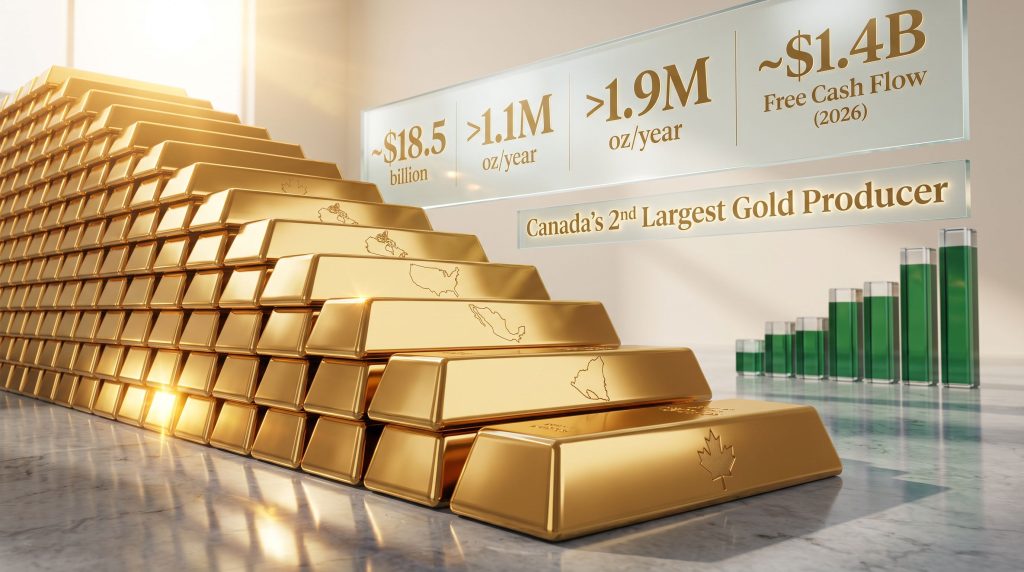
The merged company's financial and operational profile is materially different from either predecessor on a standalone basis. The numbers below illustrate the scale of what is being created.
| Metric | Combined Entity |
|---|---|
| Current annual gold production | >1.1 million oz/year |
| Long-term growth target | >1.9 million oz/year |
| Number of operating mines | 6 |
| Combined free cash flow forecast (2026) | ~$1.4 billion |
| Combined market capitalisation | ~$18.5 billion |
| Canadian producer ranking | 2nd largest |
A combined free cash flow forecast of approximately $1.4 billion for 2026 is particularly noteworthy. In senior gold producer analysis, free cash flow yield is one of the primary metrics institutional investors use to assess re-rating potential. When a company generates substantial free cash flow relative to its market capitalisation, it creates optionality: the ability to fund organic growth, pay dividends, reduce debt, or pursue further acquisitions without diluting shareholders.
Geographic Diversification as a Risk Management Tool
One of the less-discussed but strategically critical dimensions of this merger is the jurisdictional spread of the combined asset portfolio. Operating mines and development assets span Canada, the United States, Mexico, and Nicaragua, creating one of the most geographically diversified senior gold producer profiles listed on the TSX.
This matters for a reason that goes beyond simple portfolio theory. Single-jurisdiction gold producers are exposed to concentrated regulatory, political, and operational risk. A labour dispute, permitting delay, or policy shift in one country can devastate production guidance for a company that lacks geographic optionality. The four-jurisdiction footprint of the combined Equinox-Orla entity substantially reduces this concentration risk.
A multi-jurisdiction operating base across politically stable and mining-friendly environments provides a structural buffer against the kind of single-country disruptions that have historically derailed intermediate and senior gold producers at critical growth inflection points.
Why Scale Matters More Than Ever in the Senior Gold Producer Category
There is a structural reason why mid-tier gold producers consistently trade at lower valuation multiples than their senior-tier counterparts, and it has less to do with asset quality than with liquidity and institutional accessibility.
Large asset managers and sovereign wealth funds operating at the scale of billions in capital allocation cannot take meaningful positions in companies with limited daily trading volumes or small market capitalisations. The index inclusion thresholds, minimum liquidity requirements, and portfolio weighting mechanics of institutional investment effectively exclude smaller producers from the investor pools that generate premium valuations.
By crossing the $18.5 billion market capitalisation threshold and projecting gold production above 1.1 million ounces annually, the combined entity positions itself within the orbit of senior gold indices and institutional mandates that were previously inaccessible to either company independently. In addition, this scale advantage is consistent with broader gold M&A activity trends reshaping the global mining landscape.
Comparing Producer Tiers in the Canadian Gold Landscape
| Producer Tier | Annual Output Range | Key Structural Differentiator |
|---|---|---|
| Senior (post-merger) | >1.1M oz current / >1.9M oz target | Multi-jurisdiction, high liquidity, index eligible |
| Mid-tier | 500K to 1M oz | Single or dual jurisdiction, limited institutional access |
| Intermediate | 150K to 500K oz | Development pipeline, early cash flow generation |
The jump from intermediate to senior is not linear. It requires a simultaneous leap in production volume, geographic diversification, balance sheet strength, and investor relations infrastructure. The Orla-Equinox combination achieves all four in a single transaction, and consequently, it mirrors the broader gold merger trend accelerating across the sector.
The Role of Mineral Reserve Endowment in Long-Term Investor Confidence
Sophisticated gold investors distinguish sharply between production sustained by existing proven and probable reserves versus production that depends on continuous exploration success to replace depleted ounces. A company with a large, well-defined mineral reserve base has a fundamentally more predictable earnings profile than one relying on exploration upside.
The combined entity's growth target of exceeding 1.9 million ounces per year is underpinned, according to the merger rationale endorsed by independent proxy advisers, by a sizeable mineral reserve endowment. This reserve foundation is critical to the re-rating investment thesis because it signals that the production growth trajectory does not depend on speculative exploration outcomes, but on the systematic development of already-defined ore bodies.
Independent proxy advisory firms concluded that the transaction strengthens long-term production optionality and broadens strategic flexibility across the combined asset base, a finding that helped secure the overwhelming institutional support reflected in the 22 July vote outcome.
What the Unanimous Vote Signals About Institutional Sentiment
The shareholder vote outcome deserves careful interpretation. Unanimous or near-unanimous approval at special meetings of mining company shareholders is not automatic. Institutional investors, particularly those with environmental, social, and governance mandates, will often withhold votes or vote against transactions they perceive as dilutive, poorly structured, or insufficiently accretive.
The fact that Orla shareholders approve Equinox merger proposals so decisively suggests that the exchange ratio, the strategic rationale, and the independent valuation support provided by proxy advisers were collectively persuasive. It also reflects a broader institutional conviction in the gold sector consolidation thesis: that larger, more diversified producers offer better risk-adjusted returns over a full commodity cycle than smaller, concentrated single-asset operators. However, it is worth noting that gold equities performance does not always move in lockstep with the gold price itself, making structural quality increasingly important to long-term investors.
The next major ASX story will hit our subscribers first
Frequently Asked Questions: Orla Shareholders Approve Equinox Merger
What did Orla shareholders vote on?
Orla securityholders voted to approve a court-supervised plan of arrangement under which Equinox Gold will acquire all issued and outstanding Orla common shares on an all-share basis, with each Orla share exchanged for one Equinox share plus a nominal cash consideration of US$0.0001.
What ownership stake will former Orla shareholders hold?
Upon completion, former Orla shareholders are expected to hold approximately 33% of the enlarged combined entity, with existing Equinox shareholders retaining the remaining 67%.
How large will the combined gold producer be?
The merged company is projected to produce more than 1.1 million ounces of gold annually from six mines, with a longer-term growth target exceeding 1.9 million ounces per year. The combined entity carries an approximate valuation of $18.5 billion and is positioned as Canada's second-largest gold producer.
Is the deal fully approved and closed?
Both Orla and Equinox shareholders approved their respective resolutions on 22 July 2026. The transaction remains subject to a final court order from the Supreme Court of British Columbia and satisfaction of remaining closing conditions before it formally completes.
Why did proxy advisers support the transaction?
Independent proxy advisory firms determined that the deal strengthens asset diversification, improves long-term production potential, and expands strategic optionality across the combined portfolio. Furthermore, for those interested in undervalued mining stocks, this kind of structural re-rating event is precisely the catalyst that can close the gap between asset value and market price.
Key Takeaways for Investors and Market Observers
- Unanimous shareholder endorsement reflects strong institutional conviction in the consolidation rationale and the quality of the exchange terms
- A $1.4 billion combined free cash flow forecast for 2026 provides a powerful financial foundation and supports meaningful re-rating potential
- A six-mine operating base across four North American jurisdictions structurally reduces single-asset and single-country concentration risk
- The 1.9-million-ounce growth target, underpinned by a defined mineral reserve base, positions the combined company as a credible long-term challenger to the most established senior gold producers globally
- Court and regulatory approvals remain the final conditions before the transaction formally closes, and investors should monitor these milestones closely
- The transition from intermediate to senior producer status unlocks institutional investor pools that were previously inaccessible to either company on a standalone basis
Disclaimer: This article is intended for informational purposes only and does not constitute financial advice. Forecasts, production targets, and financial projections referenced herein are based on company disclosures and are subject to material risks and uncertainties. Readers should conduct their own due diligence before making any investment decisions.
Want to Capitalise on the Next Major Gold Discovery Before the Market Catches On?
Discovery Alert's proprietary Discovery IQ model delivers real-time alerts on significant ASX mineral discoveries, instantly transforming complex mineral data into actionable investment insights — explore the historic returns major discoveries have generated and begin your 14-day free trial at Discovery Alert to position yourself ahead of the next consolidation catalyst.