
June 18, 2026
When the Road Becomes a Chokepoint: The Oyu Tolgoi Copper Concentrate Export Blockade Explained
Resource-rich nations have long wrestled with a fundamental paradox: the presence of vast mineral wealth does not automatically translate into broadly shared prosperity. When the gap between corporate extraction value and community-level benefit becomes too visible, the result is rarely passive. In June 2026, that tension reached a flashpoint in Mongolia's South Gobi Desert, where Oyu Tolgoi copper concentrate exports blocked by protestors sent shockwaves through global mining markets. The event was not simply a labour dispute or a localised grievance — it was a concentrated signal of structural stress running through one of the world's most strategically significant copper operations.
When big ASX news breaks, our subscribers know first
Understanding Oyu Tolgoi's Weight in Mongolia's Economic Architecture
To appreciate why blocking a single road corridor sent shockwaves through Mongolia's fiscal planning, it is necessary to understand just how disproportionately important this one operation is to the country's economic foundations.
Oyu Tolgoi, operated by Rio Tinto through its majority-owned subsidiary Turquoise Hill Resources (now fully absorbed into Rio Tinto following its 2022 acquisition), sits in the South Gobi Desert and contains one of the largest known copper and gold deposits on Earth. The mine's underground expansion, known as Hugo Dummett North, has been ramping up production through a block caving method projected to make it one of the top five copper producers globally once it reaches full operational capacity.
The scale of its fiscal contribution to Mongolia is striking:
- Oyu Tolgoi contributes approximately 9% of Mongolia's total government tax revenues
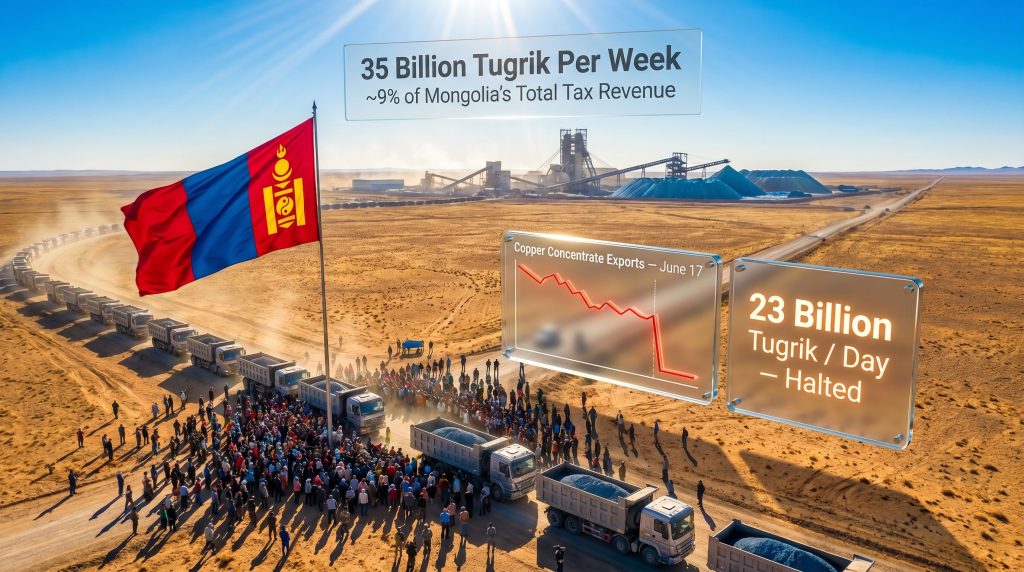
- Daily economic activity generated by the operation is estimated at roughly 23 billion Mongolian tugrik per day
- Mongolia's broader economy remains heavily tied to extractive industries, with mining accounting for over 20% of GDP and the vast majority of export earnings
- The mine's copper and gold production feeds directly into Chinese smelting and refining supply chains via overland trucking corridors
This concentration creates what risk analysts describe as sovereign fiscal dependency on a single private asset. When that asset is disrupted, the consequences are felt not at the corporate level alone, but at the level of national budget planning.
Block Caving: The Underground Method Reshaping Oyu Tolgoi's Output Profile
One element that is not widely understood outside specialist mining circles is the operational significance of block caving at Oyu Tolgoi's underground deposit. Unlike conventional underground mining methods that extract ore in discrete sections, block caving is a mass-mining technique where large volumes of rock are undercut and allowed to collapse under gravity into draw points below. It is highly efficient at scale but requires enormous upfront capital investment and years of development before production begins in earnest.
The underground expansion at Oyu Tolgoi took years longer than originally planned and ran significantly over budget, creating a turbulent history between Rio Tinto, the Mongolian government, and minority shareholders. The cost overruns and delays led to prolonged renegotiations of the project's funding structure. Furthermore, they contributed to lasting community scepticism about whether the project's financial architecture genuinely serves Mongolian interests. The Oyu Tolgoi training program introduced by Rio Tinto has been one attempt to demonstrate local commitment, though broader structural grievances persist.
Block caving operations, once at full capacity, produce copper concentrate continuously and at high volumes. This means any interruption to the downstream logistics chain, particularly export trucking, creates inventory buildup and contractual pressure almost immediately.
What Happened on June 17, 2026: The Mechanics of the Blockade
The protest action commenced on June 17, 2026, when a domestic advocacy group organised demonstrators to physically obstruct the primary road transport corridor used to move processed copper concentrate from the Oyu Tolgoi concentrator facility toward the Mongolian-Chinese border crossing points. According to reporting from Mining Weekly, the disruption was significant enough to halt multiple cargo shipments almost immediately.
Unlike port-based mining operations where disruption typically involves industrial action at loading facilities, Oyu Tolgoi's export dependency on overland trucking made it uniquely exposed to ground-level obstruction. The operational mechanics of this vulnerability are worth examining closely:
- Copper concentrate is produced continuously at the concentrator as ore is processed and separated from waste material
- The resulting concentrate, a dense powder containing roughly 25-30% copper along with gold and silver by-products, must be loaded onto trucks and transported hundreds of kilometres to the border
- There is limited on-site storage capacity for concentrate volumes at the scale Oyu Tolgoi produces
- Contractual delivery schedules with Chinese buyers are time-sensitive and legally binding
- A blockade lasting even a matter of days triggers a cascade of obligation reviews and potential force majeure assessments
The protesters' core demand centred on a more equitable redistribution of mining revenues toward Mongolian citizens, a grievance with deep historical roots in the country's experience of large-scale foreign-operated resource extraction.
The Financial Arithmetic of Disruption
The economic stakes of even a brief interruption are quantifiable and substantial:
| Metric | Estimated Figure |
|---|---|
| Daily economic contribution halted | ~23 billion tugrik |
| Tax revenue loss per week of disruption | ~35 billion tugrik |
| Share of Mongolia's total tax base affected | ~9% |
| Primary export destination | China (copper smelting sector) |
| Key export mechanism | Overland trucking corridors |
These numbers illustrate a systemic vulnerability that goes beyond operational inconvenience. A 35 billion tugrik weekly tax revenue shortfall is not an abstract accounting problem. It represents real pressure on government spending commitments, infrastructure funding, and social programmes in a country where public finances are already sensitive to commodity price cycles.
Concentrate Grade and Quality: Why Chinese Buyers Care
Copper concentrate from Oyu Tolgoi is notable not only for its copper content but for its meaningful gold and silver credits. When a smelter purchases copper concentrate, the payment formula accounts for the base metal content plus valuable by-products, minus penalties for contaminants such as arsenic or bismuth. Oyu Tolgoi's concentrate profile, with its associated precious metal credits, makes it a commercially attractive feed source for Chinese custom smelters operating on tight treatment charge margins.
This quality dimension adds another layer to the disruption risk. Chinese smelters that have optimised their blending strategies around Oyu Tolgoi's specific concentrate chemistry cannot simply substitute with an equivalent product from another source at short notice. Blend mismatches affect smelter efficiency, recovery rates, and ultimately the economics of the refining operation.
The tightening of global copper concentrate treatment charges in recent years, which fell to historic lows in 2024 and 2025, has made Chinese smelters increasingly dependent on reliable, high-quality feed sources. A supply interruption from a major producer like Oyu Tolgoi does not merely reduce volume; it disrupts carefully calibrated blending programmes.
Resource Nationalism in Mongolia: A Pattern, Not an Anomaly
The June 2026 blockade did not emerge from a vacuum. Mongolia has a well-documented history of tension between its aspirations to benefit more substantially from its mineral endowments and the structural realities of large-scale foreign investment in capital-intensive mining operations.
Key episodes in this history include:
- The 2009 Investment Agreement that established Oyu Tolgoi's ownership structure, granting the Mongolian government a 34% stake through Erdenes Oyu Tolgoi, with Rio Tinto controlling the remainder through Turquoise Hill
- Repeated legislative debates about revising the terms of the agreement as copper prices rose and the project's value became clearer
- The protracted dispute over cost overruns, shareholder loan interest charges, and the timing of dividend distributions to the Mongolian state
- Growing civil society activism focused on the perception that foreign operators have captured the majority of value while Mongolian communities bear the environmental and social costs
This pattern is not unique to Mongolia. Across resource-rich developing economies from Peru to Papua New Guinea, the sequence tends to follow a recognisable arc: foreign capital develops a major deposit under terms negotiated during lower price environments, production ramps up during a commodity bull cycle, and communities who see revenues flowing outward demand renegotiation. Mining geopolitical risk of this nature is increasingly factored into how institutional investors assess emerging market exposure.
The Social Licence Deficit: What ESG Frameworks Miss
Institutional ESG frameworks have increasingly incorporated social licence to operate as a scored category, but the Oyu Tolgoi blockade exposes a methodological gap in how that risk is typically assessed. Most ESG scoring models evaluate disclosed grievance mechanisms, community investment programme expenditure, and stakeholder consultation records.
What they do not always capture adequately is the structural legitimacy deficit that emerges when communities perceive the overall revenue distribution architecture as fundamentally unfair, regardless of how well individual community programmes are managed. An operation can score acceptably on community engagement metrics while simultaneously accumulating latent social instability rooted in systemic revenue inequality. The blockade is a manifestation of that latent pressure becoming kinetic.
Global Copper Market Implications
Oyu Tolgoi's relevance to global copper markets extends well beyond its role in Mongolia's national economy. As the mine's underground expansion approaches full production capacity, it is positioned to contribute meaningfully to global copper supply at a time when the world faces a structural demand surge. The copper demand drivers underpinning this surge — electrification, grid expansion, and electric vehicle manufacturing — make supply disruptions at major producers particularly consequential.
Furthermore, the broader copper supply crunch already challenging the industry means any additional interruption from a top-tier operation compounds existing market tightness. The short to medium-term market implications of a sustained disruption can be mapped across several timeframes:
| Timeframe | Likely Market Impact |
|---|---|
| Immediate (Days 1-7) | Shipment stoppage; contractual obligation review by Chinese buyers |
| Short-Term (1-4 Weeks) | Spot concentrate market tightening; alternative sourcing activated |
| Medium-Term (1-3 Months) | Investor reassessment of Mongolia sovereign risk premium |
| Long-Term (3+ Months) | Potential policy response; possible revenue framework review |
It is worth noting that copper concentrate markets operate differently from refined copper markets. When concentrate supply tightens, smelters lose bargaining power and treatment charge rates decline further, compressing smelter margins. This dynamic was already playing out across the industry before the blockade, making any additional supply disruption from a major producer particularly sensitive.
The next major ASX story will hit our subscribers first
What the Mongolian Government Must Navigate
The Mongolian government occupies an uncomfortable position in this situation. On one side sits its obligation to maintain the credibility of Mongolia as a stable foreign investment destination, particularly at a time when the country is seeking to attract capital for additional resource development projects. On the other side is legitimate domestic political pressure to demonstrate that the country's mineral wealth is genuinely benefiting its citizens.
Any government response that is perceived as simply suppressing protest without addressing the underlying revenue distribution concerns risks inflaming the situation. Conversely, any move toward unilateral renegotiation of Oyu Tolgoi's investment framework could deter future capital inflows. The most likely constructive pathway involves formal mediation processes leading to incremental adjustments to community benefit-sharing arrangements, potentially including mechanisms such as local procurement requirements, royalty-linked community development funds, or accelerated dividend distribution timelines for the state-owned equity stake.
Investor Risk Framework: Assessing Social Disruption Exposure
For investors with exposure to emerging market mining assets, the Oyu Tolgoi blockade provides a useful framework for evaluating social disruption risk more systematically. Understanding mining investment risk in this context requires going beyond standard financial metrics. The following checklist reflects the key vulnerability indicators this situation has made visible:
- Does the operation rely on a single overland transport corridor with no alternative export routing?
- Is the host government's fiscal position materially dependent on a single mining asset, creating political pressure to intervene or appease community demands?
- Has the project's historical development involved cost overruns, timeline slippage, or renegotiation of original terms in ways that created lasting community distrust?
- Does the operator's ESG reporting address the structural equity of revenue distribution, or primarily focus on community programme outputs?
- Is the concentrate product sufficiently specialised in terms of grade or chemistry that downstream buyers cannot easily substitute from alternative sources?
- Has the operator maintained independent verification of its community grievance mechanisms, or does internal reporting dominate the disclosed record?
Investors who apply this kind of granular social risk lens are better positioned to anticipate disruption events before they materialise in operational or financial results. The Oyu Tolgoi situation demonstrates that the gap between a well-managed ESG disclosure programme and genuine social stability can be significant and consequential.
Frequently Asked Questions: Oyu Tolgoi Copper Export Blockade
What is Oyu Tolgoi and why does it matter globally?
Oyu Tolgoi is one of the world's largest known copper and gold deposits, located in Mongolia's South Gobi Desert and operated by Rio Tinto. It contributes approximately 9% of Mongolia's total government tax revenues and is a major supplier of copper concentrate to Chinese smelting operations. Its underground block caving expansion is expected to make it one of the top five copper-producing mines globally at full capacity.
When did the blockade of Oyu Tolgoi copper exports begin?
Demonstrators organised by a domestic advocacy group began physically obstructing the primary copper concentrate export transport route on June 17, 2026. ABC News international coverage confirmed that the protest action successfully halted copper exports to China from the Rio Tinto-operated mine.
What were the protesters demanding?
The central demand was a more equitable distribution of mining revenues and economic benefits for Mongolian citizens, reflecting long-standing concerns about the balance between foreign corporate returns and domestic community benefit under the mine's investment agreement structure.
What is the estimated weekly economic cost of the disruption?
The mine operator indicated that each week of blocked exports represents approximately 35 billion tugrik in lost tax revenue for the Mongolian government, on top of the approximately 23 billion tugrik in daily economic activity that the operation normally generates.
How does this affect global copper markets?
Because Oyu Tolgoi's concentrate has a distinctive grade profile including valuable gold and silver credits, Chinese smelters that rely on it as part of blended feed programmes cannot easily substitute from alternative sources at short notice. In an environment where treatment charges are already compressed, any supply disruption from a major producer places additional pressure on smelter margins and concentrate market dynamics.
Key Structural Lessons from the Oyu Tolgoi Disruption
The events of June 2026 at Oyu Tolgoi carry implications that extend well beyond this single operation or this single country. Several structural lessons emerge:
- Fiscal concentration amplifies disruption risk: when one asset represents 9% of a sovereign tax base, operational interruptions carry consequences that are genuinely national in scale
- Overland export dependency is a structurally distinct risk category: road-corridor logistics are categorically more exposed to ground-level community disruption than port-based export infrastructure
- Social licence deficits are not resolved by community programme spending alone: the underlying architecture of revenue distribution must be perceived as equitable by affected communities, not merely disclosed as compliant by operators
- Concentrate quality creates buyer dependency: the specialised chemistry of Oyu Tolgoi's concentrate makes Chinese smelter customers less resilient to supply interruptions than standard commodity supply chains
- Resource nationalism is a durable, structural trend: in economies where extraction revenues are large relative to GDP but community-level benefits remain limited, political pressure for renegotiation will recur regardless of formal contractual protections
Disclaimer: This article contains forward-looking analysis, market projections, and scenario assessments that are inherently speculative. Readers should not treat any content herein as financial or investment advice. All figures referenced are based on publicly available reporting and estimated data; actual outcomes may differ materially. Investors should conduct their own due diligence and seek independent professional advice before making investment decisions.
Want to Stay Ahead of Major Mineral Discoveries Before the Market Moves?
Discovery Alert's proprietary Discovery IQ model delivers real-time alerts on significant ASX mineral discoveries, transforming complex mineral data into actionable insights for both short-term traders and long-term investors — explore historic discovery returns on Discovery Alert's dedicated discoveries page to understand just how consequential major finds can be, then begin your 14-day free trial at Discovery Alert to position yourself ahead of the market.