
June 18, 2026
The Political Economy of Copper: Why Resource Nationalism Is Reshaping Mining's Risk Map
Every commodity supercycle eventually collides with a political one. As global demand for copper accelerates on the back of electrification, grid expansion, and industrial decarbonisation, the mines that supply this critical metal are increasingly located in jurisdictions where the social contract between government, community, and foreign operator is being actively renegotiated. The Oyu Tolgoi protest blocks copper shipments story playing out in Mongolia's South Gobi desert is not an isolated flare-up. It is a preview of the governance pressures that will define large-scale mining for the next decade.
When big ASX news breaks, our subscribers know first
Oyu Tolgoi: Scale, Location, and Strategic Weight in Global Copper Markets
Situated approximately 80 kilometres north of the Chinese border in Mongolia's remote South Gobi region, Oyu Tolgoi is one of the most consequential copper-gold deposits on the planet. Its sheer scale places it in a category occupied by only a handful of projects worldwide, and as it continues progressing toward full operational capacity, it is projected to rank as the fourth-largest copper mine globally by production volume.
The mine's geographic position is a defining commercial feature. China consumes more copper than any other nation, accounting for roughly half of global refined copper demand. Oyu Tolgoi effectively sits at the edge of China's industrial doorstep, making it a near-captive supplier to the world's most voracious copper processing and manufacturing ecosystem.
Furthermore, among the largest copper mines globally, few combine this level of geographic proximity to Chinese demand with the scale of reserves that Oyu Tolgoi holds. Ownership of the asset follows a structure that has become the source of persistent political friction:
| Stakeholder | Ownership Share | Role |
|---|---|---|
| Rio Tinto (ASX: RIO) | 66% | Operator and majority shareholder |
| Mongolian Government | 34% | State equity partner |
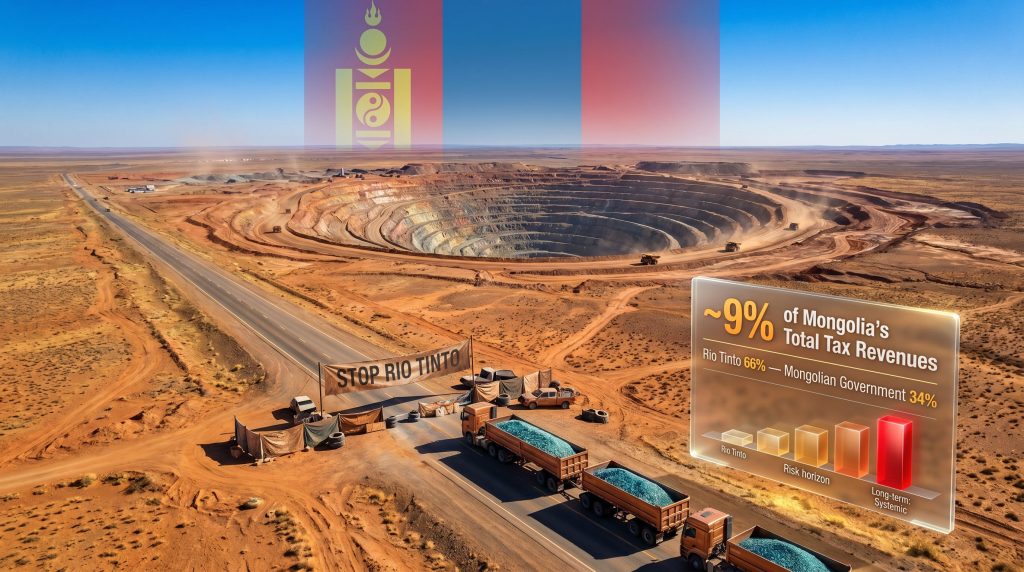
This split matters enormously. Rio Tinto absorbs the majority of operational costs and benefits, but the Mongolian state holds a meaningful equity position that has paradoxically intensified rather than resolved political pressure around revenue distribution. Holding 34% while watching a foreign operator control two-thirds of a nationally symbolic resource project creates an inherently combustible dynamic in any democratic system.
What the June 2026 Blockade Revealed About Supply Chain Fragility
On June 17, 2026, the Oyu Tolgoi protest blocks copper shipments narrative moved from abstract political risk to operational reality. A road blockade organised by a group identifying itself as the Radical Reform Movement commenced at 9am local time, physically preventing trucks carrying copper concentrate from departing the mine site toward China.
The mechanics of the disruption were deliberately targeted. The primary export route from the mine is a two-lane road, and protesters used barriers and a banner reading Stop Rio Tinto to halt outbound traffic. The visual imagery was strategic as well as logistical, designed for social media amplification and international attention.
Operational Reality Check: Copper concentrate is not stored indefinitely at mine sites. It is a semi-processed intermediate product that must move continuously through the supply chain to Chinese smelters, which convert it into refined copper cathode. Any halt in concentrate flow creates feedstock pressure downstream within days, not weeks.
The immediate consequences extended well beyond delayed truck movements:
- Contractual copper concentrate delivery obligations to downstream buyers faced potential breach
- Chinese smelter feedstock scheduling, which operates on tight inventory cycles, came under pressure
- Rio Tinto issued a public statement warning that the disruption could generate significant consequences for Mongolia's state budget and damage the country's reputation in international mining circles
- The company subsequently declined to provide further comment, a standard crisis communications posture that nonetheless left information gaps in the market
Copper Concentrate and the Smelter Dependency Chain
To understand why Oyu Tolgoi protest blocks copper shipments in ways that reverberate far beyond Mongolia's borders, it helps to understand the technical structure of the copper supply chain. In addition, Chinese smelter dependency means that disruptions at the mine level translate almost immediately into feedstock pressure across the entire downstream processing network.
Copper ore extracted from the mine is processed on-site into copper concentrate, a material typically containing between 25% and 35% copper by weight, alongside gold and silver by-products. This concentrate is not usable in industrial applications directly. It must be further processed in smelters, the overwhelming majority of which are located in China.
This creates a structural dependency that amplifies supply disruptions:
- Mine extracts and concentrates ore on-site
- Concentrate is loaded onto trucks and transported overland to the Chinese border
- Concentrate crosses into China and moves to smelting facilities
- Smelters convert concentrate to refined copper via pyrometallurgical processing
- Refined copper cathode enters manufacturing supply chains
A blockade at step two effectively freezes the entire sequence. Chinese smelters that rely on Oyu Tolgoi feedstock cannot simply switch suppliers overnight. Long-term offtake agreements, which are the contractual backbone of concentrate supply relationships, typically include force majeure clauses that can be triggered by supply disruptions, creating legal and financial exposure that cascades upstream to the mine operator and downstream to buyers simultaneously.
Mongolia's Fiscal Vulnerability: When One Mine Defines a Budget
The scale of Mongolia's economic dependence on Oyu Tolgoi is striking. The mine contributes an estimated 9% of Mongolia's total tax revenues, a level of fiscal concentration that transforms any sustained operational disruption into a macroeconomic event rather than simply a commercial one.
This concentration creates a genuinely difficult governance environment. Mongolia is not unique in this predicament, but it represents one of the more acute examples globally:
| Country | Mine / Project | Dispute Type | Outcome |
|---|---|---|---|
| Mongolia | Oyu Tolgoi | Revenue share renegotiation | Ongoing |
| Chile | Escondida | Labour and wage disputes | Periodic strikes |
| Peru | Las Bambas | Community access disputes | Repeated blockades |
| DRC | Cobalt sector | State royalty increases | Legislative change |
| Indonesia | Grasberg | Divestiture mandate | Partial nationalisation |
The pattern is consistent across jurisdictions. As commodity prices rise and the strategic value of mineral assets becomes more visible, host governments and communities recalibrate what they consider a fair share of revenues. The Radical Reform Movement's central demand, that Mongolia receive a larger proportion of the wealth generated by its copper reserves, places it squarely within this global wave of mining geopolitical risk.
Historical Parallel: Indonesia's Grasberg copper-gold mine, operated by Freeport-McMoRan, went through a protracted divestiture process that ultimately required the company to cede majority control to Indonesian state interests. Mongolia's trajectory may not follow the same path, but the direction of political pressure is comparable.
The Mongolian Government's Dual Role: Co-Owner, Regulator, and Political Actor
Few governance complexities in the extractive sector are as analytically interesting as a situation where the government simultaneously holds equity in an asset and must respond to public protests targeting that same asset.
Mongolian Prime Minister Uchral Nyam-Osor responded to the blockade by directing cabinet ministers to enforce applicable laws and ensure that individuals obstructing lawful commercial operations face legal accountability. The communication was delivered via official government social media channels, indicating both urgency and a desire for public visibility.
However, the government faces two contradictory pressures that cannot be resolved through law enforcement alone:
- Domestic political legitimacy: Mongolian voters increasingly expect that the country's world-class mineral endowment should translate into tangible improvements in living standards. The perception that foreign operators extract disproportionate value is a powerful electoral narrative.
- International investment credibility: Mongolia needs to attract and retain foreign direct investment, particularly in capital-intensive resource projects. Appearing unable or unwilling to protect lawful commercial operations from disruption damages the country's standing as a stable investment destination.
These pressures do not cancel each other out. They compound. A government seen as too aggressive in dispersing protesters loses domestic legitimacy. A government seen as too passive loses international credibility. Navigating this tension is the central governance challenge Mongolia faces.
The next major ASX story will hit our subscribers first
Supply Chain Risk Assessment: Short-Term Disruption Versus Structural Exposure
The June 2026 blockade was resolved in the near term, but the underlying conditions that produced it have not changed. Consequently, investors and supply chain analysts should think about the risk profile of Oyu Tolgoi across multiple time horizons:
| Risk Horizon | Impact Level | Key Driver |
|---|---|---|
| Immediate (days) | Moderate | Delayed truck shipments, contractual strain |
| Short-term (weeks) | High | Smelter feedstock gaps, force majeure triggers |
| Medium-term (months) | Very High | Reputational damage to Mongolia as investment destination |
| Long-term (years) | Systemic | Revenue renegotiation outcomes affecting project economics |
The long-term systemic risk deserves particular attention. If Mongolia successfully renegotiates its revenue share arrangement at Oyu Tolgoi, the financial model underpinning Rio Tinto's 66% stake changes materially. This is not merely a bilateral commercial negotiation. It would set a precedent observed closely by resource-rich governments from Zambia to Papua New Guinea.
Furthermore, the broader copper supply crunch already pressuring global markets means that any prolonged disruption to Oyu Tolgoi's output carries amplified consequences for buyers worldwide.
Speculative Consideration: Some analysts have theorised that the timing of protest actions at major mines is not always spontaneous. Blockades that coincide with ongoing revenue renegotiation discussions can function as a form of political leverage, whether or not the protest organisers have direct connections to official negotiating teams. This theory remains speculative, but the pattern of timing at multiple global mining disputes warrants attention.
Social Licence as Operational Infrastructure
The mining industry has used the phrase social licence to operate for decades, but the concept is often treated as a communications problem rather than an engineering one. The Oyu Tolgoi situation demonstrates that social licence is better understood as a form of operational infrastructure, as foundational to a mine's function as its haul roads and processing plants.
When social licence degrades, the consequences are not soft or reputational. They are physical. Trucks stop moving. Concentrate piles up. Smelters go short. Contracts face breach reviews. Share prices respond.
The broader implications for major miners operating in frontier or politically sensitive jurisdictions include:
- Community benefit agreements that distribute value locally are increasingly a baseline expectation, not a discretionary gesture
- Transparent and independently audited revenue-sharing frameworks reduce the information asymmetry that fuels protest movements
- Local content requirements, employment programmes, and infrastructure co-investment are now standard components of operating licences in the practical sense
- The cost of proactive community investment is typically a fraction of the economic damage caused by a sustained blockade
What Global Copper Markets Should Watch
As Oyu Tolgoi approaches full operational capacity, its share of global copper supply will increase materially. A mine destined to become the world's fourth-largest copper producer carries systemic relevance to global markets in ways that smaller operations do not. This relevance is further amplified by the surging critical minerals demand driven by the global energy transition.
The Oyu Tolgoi protest blocks copper shipments dynamic is not a one-off event. It is a recurring feature of the political landscape surrounding this asset, and it will remain so until the underlying revenue sovereignty questions are resolved. For copper market participants, this means:
- Building geopolitical risk premiums into copper price forecasting models that incorporate Mongolian supply corridor vulnerabilities
- Monitoring the status of revenue renegotiation discussions between Rio Tinto and the Mongolian government as a leading indicator of operational stability
- Watching Chinese smelter inventory levels as a near-term gauge of concentrate feedstock tightness following disruption events
- Tracking Mongolian government communications and political positioning ahead of any future elections, which historically amplify resource nationalism rhetoric
For those seeking detailed reporting on the blockade's immediate commercial impact, coverage from the Financial Post outlines how cargoes were disrupted and the downstream implications for buyers relying on Oyu Tolgoi concentrate flows.
Disclaimer: This article contains forward-looking analysis and speculative observations regarding commodity markets, geopolitical risk, and corporate strategy. Nothing in this article constitutes financial or investment advice. Readers should conduct independent research and seek professional advice before making investment decisions.
Want to Stay Ahead of the Next Major Copper Discovery Before the Market Moves?
Discovery Alert's proprietary Discovery IQ model scans ASX announcements in real time, instantly identifying significant mineral discoveries across copper and 30+ other commodities — turning complex data into clear, actionable opportunities for investors at every level. Explore how historic discoveries have delivered exceptional returns on Discovery Alert's dedicated discoveries page, and begin your 14-day free trial today to secure a market-leading edge before the next major find is priced in.