May 11, 2026
The Uranium Supply Squeeze Nobody Fully Priced In
For most of the past decade, uranium supply chains operated under the long shadow of Fukushima. Production curtailments, mine closures, and a prolonged bear market in U₃O₈ pricing reshaped the global supply landscape in ways that are still working themselves out today. The structural consequence was straightforward: a thinning of the production base outside Kazakhstan and Russia at precisely the moment when nuclear energy's long-term role was beginning to reassert itself in serious energy policy circles.
Against that backdrop, the Paladin Energy Langer Heinrich ramp up represents something more analytically interesting than a single company's operational recovery. It reflects the broader challenge of rebuilding uranium supply capacity that was deliberately switched off and must now be carefully, expensively switched back on. Namibia, consistently ranked among the world's top five uranium-producing nations by output volume, provides one of the more geopolitically stable environments for that process to unfold.
Understanding what the numbers from the nine months to 31 March 2026 actually reveal requires moving past the headline figures and examining the mechanics of how a restarted open-pit uranium operation translates engineering improvements into audited financial results.
When big ASX news breaks, our subscribers know first
Why Langer Heinrich's Return to Full Capacity Carries Supply Chain Weight
The Geopolitical Logic Behind Namibian Uranium
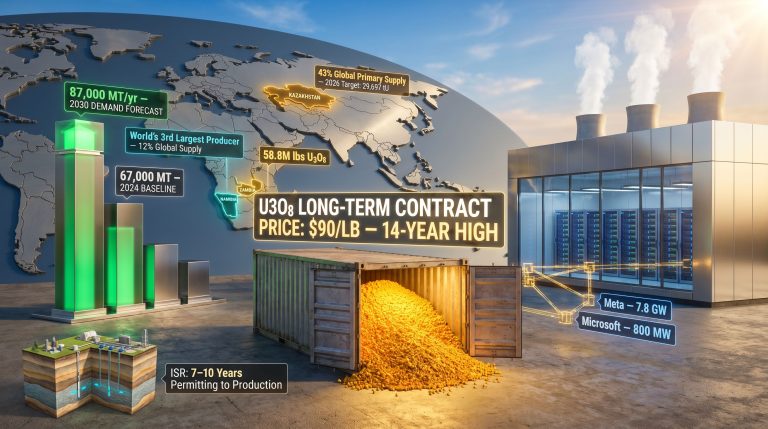
The global uranium supply picture is not simply about volume. It is about origin, reliability, and the degree to which Western nuclear utilities can construct procurement portfolios that reduce exposure to geopolitically sensitive counterparties. Kazakhstan's Kazatomprom dominates world uranium production by a substantial margin, and Russian-linked supply chains have faced increasing scrutiny from utility procurement departments in North America and Europe.
Namibia sits outside both of those risk categories. Its regulatory framework for mining is well-established, its export infrastructure is functional, and its government has demonstrated a consistent commitment to the sector over multiple decades. Langer Heinrich and the nearby Husab and Rössing operations collectively make Namibia one of the few jurisdictions globally where large-scale uranium production from established mines operates under relatively predictable conditions.
The significance of the Paladin Energy Langer Heinrich ramp up, viewed through this lens, extends beyond what it does for one ASX-listed company's revenue line. Each incremental pound of U₃O₈ produced at Langer Heinrich represents supply that is available to utilities seeking to diversify away from Kazakh or Russian origin material. In a market where spot prices recovered substantially from decade-long lows — partly because this diversification demand is real and ongoing — the timing of the restart matters structurally. Furthermore, the growing uranium supply deficit in Western markets makes Namibian output increasingly critical to utility procurement strategies.
What Open-Pit Uranium Mining at Scale Actually Involves
Most uranium mine restarts are not straightforward. Unlike a gold or copper operation where marginal price changes rapidly alter extraction economics, uranium mines sit within a regulatory and contractual web that makes ramp-up schedules both predictable and inflexible. Long-term supply contracts with utilities are negotiated years in advance. Delivery windows are fixed. The relationship between production output and sales realisation is therefore not linear in the short term.
Langer Heinrich is an open-pit operation, meaning ore is excavated from a surface deposit and transported to a processing plant where uranium is extracted through a series of chemical leaching and precipitation steps. The final product, uranium oxide concentrate — commonly referred to as yellowcake or U₃O₈ — is then packaged and shipped to conversion facilities before reaching reactor fuel fabricators.
Three processing variables determine total output at any given throughput level:
- Ore throughput rate — the volume of ore processed per unit time, measured in tonnes per day or per year
- Feed grade — the concentration of uranium in the ore being delivered to the processing plant, expressed in parts per million or as a percentage
- Recovery rate — the proportion of uranium in the feed ore that is successfully captured during processing, expressed as a percentage
The multiplicative relationship between these three variables is what makes simultaneous improvement in all three so operationally significant. A 5% gain in throughput, combined with a 5% improvement in feed grade and a 3% improvement in recovery, does not produce a 13% output increase. The compounding effect produces something closer to 14.5%. At production scales of several million pounds annually, even small percentage improvements in each variable translate into meaningful additional output. In addition, broader uranium market dynamics suggest that this kind of operational leverage will become increasingly valuable as supply constraints tighten.
The Engineering Reality Behind the US$120 Million Refurbishment
Care and Maintenance: What It Actually Does to a Mine
When a uranium mine enters care and maintenance, it does not simply pause production. The physical plant continues to age. Reagent storage systems require ongoing management. Water management obligations continue. Skilled personnel leave for other roles. The institutional knowledge of how a specific processing circuit behaves under varying ore conditions gradually disperses.
Restarting from care and maintenance therefore involves more than flipping a switch. Equipment that sat idle requires inspection, refurbishment, or replacement. Processing circuits need to be recommissioned carefully to avoid damage from early operational irregularities. The workforce must be rebuilt and trained. And critically, ore supply to the plant must be carefully managed to avoid feeding the processing circuit at rates it cannot yet handle reliably.
The US$120 million refurbishment program at Langer Heinrich addressed these challenges across several dimensions: removing throughput bottlenecks that constrained the processing plant's capacity, improving plant availability by refurbishing equipment that had deteriorated during the care and maintenance period, and upgrading specific elements of the processing infrastructure to lift recovery rates. Notably, Paladin's Namibia operations have previously demonstrated just how quickly production can be affected when mine-level conditions shift — underscoring the importance of the refurbishment investment.
What the Revised Capex Guidance Communicates to the Market
One of the more analytically informative data points in the FY2026 interim period is the revision to capital expenditure guidance. The original FY2026 capex and exploration guidance of US$26 to US$32 million was revised down to US$15 to US$17 million, a reduction of between US$11 million and US$15 million. This is not a trivial adjustment.
Management's decision to defer or cancel that quantum of planned expenditure during an active ramp-up phase signals something important: the processing plant is performing well enough that previously scheduled enhancement work is not required on the original timetable. In mining project management, capex deferrals during a ramp-up can be a warning signal if driven by cash constraints. In this case, the company simultaneously held US$219.5 million in unrestricted cash, making a cash-driven deferral explanation implausible.
The capex reduction is better read as a management signal that the processing plant has reached operational stability ahead of schedule, reducing the urgency of supplementary improvement works.
The revised guidance range of US$15 to US$17 million also narrows the band of uncertainty compared to the original US$26 to US$32 million range, suggesting improved visibility over remaining work scope.
The FY2026 Production Guidance Upgrade: Reading Between the Numbers
What the Revised Range Tells Investors About Operational Confidence
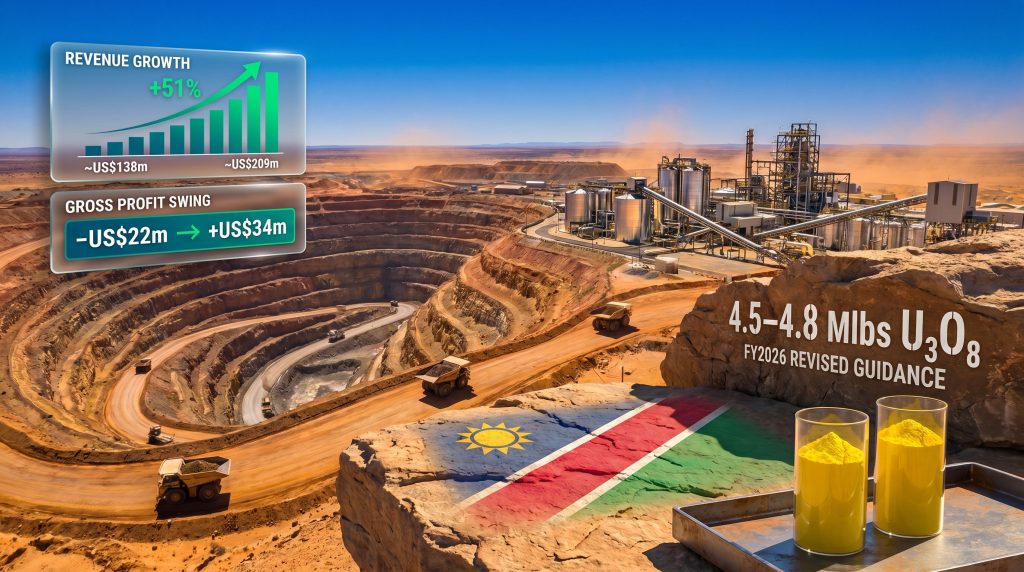
Paladin upgraded its FY2026 production guidance for Langer Heinrich from 4.0 to 4.4 million pounds of U₃O₈ to a revised range of 4.5 to 4.8 million pounds. With year-to-date production through the first three quarters reaching approximately 3.6 million pounds, the arithmetic is straightforward.
| Metric | Original FY2026 Guidance | Revised FY2026 Guidance | Change |
|---|---|---|---|
| Production (Mlbs U₃O₈) | 4.0 to 4.4 | 4.5 to 4.8 | +0.4 Mlbs at both ends |
| Capex + Exploration (US$m) | 26 to 32 | 15 to 17 | Down US$11 to US$15m |
| Sales Guidance (Mlbs U₃O₈) | 3.8 to 4.2 | 3.8 to 4.2 | Unchanged |
With 3.6 million pounds already produced across three quarters, achieving the lower end of the upgraded guidance range (4.5 million pounds) requires approximately 0.9 million pounds from the remaining quarter. Hitting the upgraded ceiling of 4.8 million pounds requires approximately 1.2 million pounds in the final quarter, consistent with the quarterly run rate implied by year-to-date production.
The guidance upgrade is therefore not aspirational. It is an extrapolation from demonstrated recent performance, calibrated against remaining mine plan and processing plant conditions.
The Analytically Interesting Divergence: Production Up, Sales Unchanged
Sales guidance held steady at 3.8 to 4.2 million pounds despite the production upgrade. This divergence is worth examining carefully because it contains information about how uranium supply contracts work in practice.
There are three plausible explanations for a production upgrade that is not accompanied by a corresponding sales upgrade:
- Inventory accumulation — production is running ahead of contractual delivery schedules, with the excess building in inventory awaiting fixed delivery windows
- Deliberate sales timing — management is holding back discretionary sales volumes to optimise pricing against expected future spot price movements or to capture premium pricing under specific contract terms
- Logistical constraints — shipping cadence, container availability, or export logistics are constraining the pace at which produced material can be transferred to customers
The working capital data supports the first explanation most directly. Inventories increased by approximately US$59 million across the nine-month period, consistent with a scenario where production has ramped faster than the delivery schedule requires. This is a structural feature of uranium supply contracts, which typically specify fixed delivery windows negotiated well in advance rather than flexible delivery on demand.
Nine Months of Financials: What the Printed Numbers Actually Confirm
Revenue and Profitability: From Loss to Profit in One Reporting Period
The financial transformation at the Namibia segment level across the nine months to 31 March 2026 is the clearest evidence available that the Paladin Energy Langer Heinrich ramp up has crossed from promise to reality.
| Financial Metric | Prior Comparative Period | Nine Months to 31 March 2026 | Change |
|---|---|---|---|
| Revenue (US$m) | ~US$138m (implied) | US$209m | +51% |
| Gross Profit / (Loss) (US$m) | -US$22m | +US$34m | +US$56m swing |
| Namibia Segment Profit / (Loss) (US$m) | -US$23.5m | +US$31.2m | +US$54.7m swing |
| Q3 Quarterly Revenue (US$m) | US$28.7m | US$70.7m | +US$42m |
The Q3 comparison requires a technical note. The prior year Q3 figure of US$28.7 million included revenue recognised through a contract liability accounting mechanism, a non-cash item that inflated the reported revenue line without representing actual U₃O₈ sales at point of transfer. The Q3 FY2026 figure of US$70.7 million reflects direct sales of U₃O₈ with no such mechanism in play. This makes the current quarter's revenue line technically cleaner and more representative of the underlying commercial activity.
Understanding the Operating Cash Outflow: A Critical Distinction
The net operating cash outflow of US$36.4 million across the nine-month period is the figure most likely to attract negative interpretation from investors scanning the headline numbers. However, the context transforms the reading entirely.
The primary driver of the outflow was the inventory build of approximately US$59 million, reflecting production running ahead of scheduled customer delivery windows. Customer receipt timing lagged revenue recognition, a standard feature of uranium contracts with fixed delivery obligations rather than variable spot sales.
An operating cash outflow generated by inventory accumulation during a production ramp-up is categorically different from an outflow caused by cost overruns, weak demand, or operational underperformance. The source of the outflow matters as much as its size.
When those inventoried pounds are delivered against contract, the cash receipts will follow. The working capital build is therefore temporary by design, not structural.
Balance Sheet Architecture: How the Debt Restructure Changed the Risk Profile
From a Single Large Facility to a Split Structure
The December 2025 debt facility restructure reduced total facility capacity from US$150 million to US$110 million, but the composition change is more strategically significant than the size reduction.
| Facility Component | Pre-Restructure | Post-Restructure |
|---|---|---|
| Total Facility Capacity | US$150m | US$110m |
| Term Loan Component | Part of US$150m blended | US$40m amortising |
| Revolving Credit Facility | Part of US$150m blended | US$70m (undrawn) |
| Term Loan Balance (March 2026) | Not separately disclosed | US$36m |
Splitting the facility into an amortising term loan and a separate revolving credit line achieves two things simultaneously. The term loan provides a structured, predictable repayment schedule that actively reduces the outstanding balance over time. The revolving credit facility provides liquidity optionality without requiring drawdown, functioning as an insurance mechanism rather than a funding tool.
The US$4 million scheduled repayment made during Q3 FY2026 demonstrates that the term loan is amortising as designed. The balance has already declined from US$40 million to US$36 million. Against US$219.5 million in unrestricted cash and short-term investments plus the undrawn US$70 million revolving credit facility, the implied net cash position of approximately US$183 million represents a fundamentally different balance sheet posture than the company carried twelve months earlier.
One accounting item worth contextualising: the loss on debt modification of US$2.5 million, which flows through finance costs and contributes to the headline loss for the period. This is a one-time accounting entry required under the applicable financial reporting standard when a debt facility is substantially modified. It does not represent a recurring cash expense and should be excluded from any assessment of ongoing operational financial performance.
The next major ASX story will hit our subscribers first
Two Legal Overhangs That Operational Data Cannot Resolve
Patterson Lake South: The Long-Dated Asset With a Regulatory Cloud
Patterson Lake South in Saskatchewan, Canada, represents Paladin's primary growth asset beyond Langer Heinrich, with first production currently targeted for 2031. The Métis Nation of Saskatchewan launched a judicial review challenging the Environmental Impact Statement approval for the project. Paladin filed its defence in March 2026, and the matter is currently in the discovery phase with no publicly disclosed resolution timeline.
It is worth being precise about what this means for the investment case. The judicial review does not affect Langer Heinrich's operating licence, production capacity, or near-term cash flows in any way. The operational transformation in Namibia is a standalone development that is fully insulated from the Canadian legal process. Consequently, Saskatchewan uranium development timelines remain a separate variable that investors must track independently of Namibian performance.
What the judicial review does affect is the market's ability to attribute full valuation to Patterson Lake South as a growth asset. With first production already a 2031 target, any schedule extension caused by a prolonged legal process adds time to an already long development timeline. Investors pricing in full optionality from the Canadian asset are doing so against a backdrop of meaningful schedule uncertainty.
| Scenario | Current Status | Potential Valuation Impact |
|---|---|---|
| PLS judicial review resolved in Paladin's favour | Discovery phase, no timeline disclosed | Unlocks re-rating of Canadian growth asset |
| Class action settled or dismissed | Defence filed, liability contested | Removes tail-risk discount on equity |
| Both matters remain unresolved through FY2027 | Possible given typical legal timelines | Operational re-rating continues, legal discount persists |
The Victorian Class Action: Scope and Materiality
A shareholder class action filed in the Supreme Court of Victoria covers trading in Paladin shares across the period from June 2024 to March 2025. Paladin filed its defence in March 2026 and is contesting liability. The period covered coincides with the early operational phase of the Langer Heinrich restart, when investor scrutiny of production guidance and operational progress was at its most intense.
The potential financial exposure from a class action of this type is difficult to quantify at the discovery phase. What is quantifiable is the shadow it casts over the equity valuation. Until the matter resolves, some portion of the market will apply a discount to account for potential settlement or damages exposure, regardless of the strength of Paladin's defence position.
Can Langer Heinrich Fund Patterson Lake South Without Further Equity Dilution?
Mapping the Cash Flow Bridge to a Final Investment Decision
This is the central question that the FY2026 interim results reframe without fully resolving. The inputs to the analysis are becoming clearer.
- Current net cash position: approximately US$183 million
- Revised FY2026 capex guidance: US$15 to US$17 million, down materially from original guidance
- Patterson Lake South pre-FID expenditure requirements: not yet fully quantified in public disclosures
- Langer Heinrich steady-state production trajectory: tracking toward the upper end of upgraded guidance
The case for Langer Heinrich being sufficient rests on several conditions holding simultaneously. Uranium prices need to remain supportive enough to generate meaningful free cash flow from Namibian operations on top of sustaining capital. Production at Langer Heinrich needs to maintain or approach the upper end of guidance consistently rather than reverting toward the lower bound. And the Patterson Lake South judicial review timeline needs to progress within a reasonable window to avoid extended cash preservation requirements.
The case for further dilution rests on the opposite set of conditions. A uranium price correction, a production miss at Langer Heinrich, or a multi-year judicial review process could each — individually or in combination — erode the cash runway before a Patterson Lake South final investment decision is reached. For context, examining the largest uranium mines globally illustrates just how capital-intensive sustaining production at this scale can be over time.
The Variables Investors Need to Track
Four specific variables will determine how this plays out:
- Uranium spot price trajectory — Langer Heinrich's free cash flow generation capacity is materially sensitive to the realised price per pound, particularly for any sales made outside fixed long-term contracts
- Realised price under contract versus spot — A portion of Paladin's sales are locked into long-term contracts at pre-negotiated prices, which may limit upside capture if spot prices rise sharply but also provides downside protection if prices soften
- PLS judicial review timeline — Every additional quarter the matter remains in discovery extends the period during which management must hold precautionary cash balances
- Langer Heinrich steady-state production consistency — Achieving 4.5 to 4.8 million pounds in FY2026 is important; demonstrating the same or better in FY2027 would materially strengthen the cash flow bridge argument
Management has also flagged operational risk factors that could cause costs to diverge from guidance. These include shipping lane disruption risks affecting U₃O₈ export from Namibia, as well as commodity and fuel price volatility affecting operating costs at Langer Heinrich. These are identified risks rather than current operational disruptions, but they represent the variables most likely to compress margins if conditions deteriorate.
Frequently Asked Questions: Paladin Energy Langer Heinrich Ramp Up
What is the Langer Heinrich uranium mine and where is it located?
Langer Heinrich is an open-pit uranium oxide mine located in the Namib Desert of Namibia, operated by Paladin Energy (ASX: PDN). It produces uranium oxide concentrate, commonly referred to as U₃O₈ or yellowcake, and sits within one of Africa's most established uranium-producing regions alongside the larger Husab and Rössing operations.
When did Langer Heinrich restart and what triggered the original shutdown?
The mine entered care and maintenance following the prolonged uranium price downturn of the mid-2010s, a period triggered partly by the post-Fukushima demand shock that reduced near-term nuclear power expansion plans globally. Active production resumed in 2024 following a US$120 million refurbishment program that returned the plant to operational readiness.
What is Paladin Energy's FY2026 production guidance for Langer Heinrich?
Paladin upgraded its FY2026 production guidance to 4.5 to 4.8 million pounds of U₃O₈, from an original range of 4.0 to 4.4 million pounds. Year-to-date production through the first three quarters of FY2026 reached approximately 3.6 million pounds, tracking toward the upper boundary of the original range.
What is Patterson Lake South and why does it matter for Paladin's investment case?
Patterson Lake South is a uranium development project in Saskatchewan, Canada, representing Paladin's primary long-dated growth asset beyond the Namibian operation. First production is currently targeted for 2031. A judicial review initiated by the Métis Nation of Saskatchewan is currently in the discovery phase, creating uncertainty around the development schedule.
How much cash does Paladin Energy hold as of March 2026?
As at 31 March 2026, Paladin held US$219.5 million in unrestricted cash and short-term investments, plus an undrawn revolving credit facility of US$70 million, against US$36 million in outstanding term loan debt. This implies a net cash position of approximately US$183 million.
Why did Paladin report an operating cash outflow despite strong revenue growth?
The net operating cash outflow of US$36.4 million across the nine months to March 2026 was driven primarily by an inventory build of approximately US$59 million. This reflects production ramping faster than contractual delivery schedules require, a structural feature of long-term uranium supply agreements rather than a signal of operational weakness.
What the Langer Heinrich Numbers Confirm and What They Leave Open
The Transformation That Is Now a Matter of Record
The Paladin Energy Langer Heinrich ramp up has moved from investment thesis to audited financial reality. The Namibia segment swung from a US$23.5 million loss to a US$31.2 million profit before tax and finance costs across the nine-month period. Revenue grew 51% year on year. Gross profit shifted from a US$22 million loss to a US$34 million positive. The balance sheet holds approximately US$183 million in net cash. The debt facility has been restructured to reduce refinancing risk and improve liquidity optionality. Capex guidance has been reduced in a manner consistent with operational confidence rather than financial pressure.
These are not projections or management commentary. They are printed interim financial results.
What the Debate Has Now Shifted To
The operational transformation is no longer what investors are arguing about. The remaining investment debate has narrowed to three distinct questions:
- Whether Namibian cash generation, combined with existing treasury, is sufficient to fund Patterson Lake South to a final investment decision without requiring further equity issuance
- Whether the Patterson Lake South judicial review resolves within a timeframe that allows the Canadian growth asset to be priced into the equity with any degree of confidence
- Whether the Victorian class action creates a financial liability material enough to affect the balance sheet position that currently underpins the investment case
Each of these questions sits outside the operational domain. Langer Heinrich's production data, processing performance, and financial contribution cannot answer them. What the nine-month results have done is remove the operational risk from the centre of the debate entirely, leaving legal resolution timelines and long-dated development optionality as the primary variables determining where the equity trades from here.
This article is intended for informational purposes only and does not constitute financial advice. Readers should conduct their own independent research and consult a licensed financial adviser before making any investment decisions. References to financial figures are drawn from Paladin Energy's condensed interim financial report for the nine months to 31 March 2026 as reported. Forward-looking statements involve uncertainty and actual outcomes may differ materially from projections discussed.
Want to Stay Ahead of the Next Major Uranium Discovery on the ASX?
Discovery Alert's proprietary Discovery IQ model delivers real-time alerts the moment significant mineral discoveries — including uranium — are announced on the ASX, translating complex data across more than 30 commodities into clear, actionable insights for both traders and long-term investors. Explore why historic discoveries have generated extraordinary returns and begin your 14-day free trial today to position yourself ahead of the broader market.