July 22, 2026
Why Uranium Processing Efficiency Is the Hidden Driver of Mine Economics
In uranium mining, the gap between a good operation and a great one rarely comes down to how much ore lies in the ground. It comes down to what happens after the ore is mined — specifically, how efficiently the processing plant converts raw feed into finished uranium oxide concentrate, commonly known as yellowcake or U₃O₈. Recovery rates, plant throughput consistency, and ore feed quality are the metrics that separate operations generating genuine margin from those merely covering their costs.
This is precisely why the Paladin Energy Langer Heinrich uranium mine results for FY2026 deserve close examination beyond the headline production number. A 60% year-on-year production increase is eye-catching, but the deeper story lies in the processing circuit performance, the cost architecture, and what the operational data reveals about the mine's trajectory as it transitions from restart mode into sustained steady-state production.
When big ASX news breaks, our subscribers know first
Namibia's Position in the Global Uranium Supply Chain
Namibia consistently ranks among the world's top five uranium-producing nations, and its significance is growing rather than diminishing. The country hosts some of the largest open-pit uranium mines on earth, operating in a relatively stable political and regulatory environment that stands in sharp contrast to producing jurisdictions such as Niger, which has faced significant operational disruption in recent years.
The Namibian uranium sector is currently in a phase of simultaneous expansion across multiple operations. Furthermore, understanding these global uranium reserves and their distribution provides important context for evaluating Namibia's growing strategic role:
- Rössing, one of the world's longest-operating uranium mines, continues to produce roughly 5 to 6 million pounds of U₃O₈ annually under Chinese state ownership.
- Husab, operated by Swakop Uranium and also majority Chinese-owned, is one of the highest-capacity uranium mines in the world at approximately 10 to 12 million pounds per annum.
- Langer Heinrich, restarted by Paladin Energy in March 2024 after an extended care-and-maintenance period, is now ramping toward the 5 million pound threshold.
- Deep Yellow's Tumas project has recently awarded major construction contracts, signalling that a fourth significant Namibian uranium mine is moving toward production.
- Arkle's Erongo uranium project has expanded its RC drilling programme, adding to the pipeline of Namibian uranium development activity.
This concentration of uranium output from a single country creates both supply resilience and geopolitical relevance. For uranium buyers seeking to reduce reliance on Central Asian or African politically volatile supply, Namibia offers an unusually attractive combination of geological endowment and jurisdictional stability.
Understanding Langer Heinrich's Alkaline Leach Processing Circuit
What Makes This Mine's Metallurgy Technically Distinctive
Not all uranium processing is alike. Langer Heinrich uses an alkaline leach circuit rather than the acid leach process common at many other uranium operations globally. This distinction matters more than most commentary acknowledges.
In alkaline leach processing, sodium carbonate and sodium bicarbonate solutions are used to dissolve uranium from crushed ore, rather than sulfuric acid. The approach is particularly suited to carbonate-bearing ores, which are characteristic of the Langer Heinrich deposit. Using acid on carbonate ore would consume reagents at an economically prohibitive rate due to acid-carbonate neutralisation reactions.
The practical implications of this processing choice include:
- Lower reagent costs per tonne of ore processed compared to acid leach operations treating carbonate-rich feed
- A more selective dissolution chemistry that reduces co-dissolution of unwanted gangue minerals
- Greater sensitivity to ore grade variability, as the alkaline circuit requires consistent feed characteristics to maintain optimal recovery
- Longer circuit stabilisation periods after a restart, since carbonate systems require careful pH and ionic balance management before reaching peak recovery efficiency
This last point explains why the progression from FY2025's average recovery rate of approximately 84% to FY2026's ~92% is technically significant rather than merely incremental. Bringing an alkaline leach circuit back to near-peak recovery after years on care and maintenance requires systematic optimisation of reagent dosing, residence times, and solid-liquid separation stages.
Technical insight: In uranium alkaline leach circuits, each percentage point of recovery improvement at a processing scale of 6 million tonnes of ore per year represents a meaningful volume of additional U₃O₈ output achieved at near-zero incremental cost, since the primary fixed costs of ore mining and plant operation are already committed.
FY2026 Production Performance: A Quarter-by-Quarter Analysis
The Paladin Energy Langer Heinrich uranium mine results across FY2026 reveal a clear operational maturation curve. Rather than a linear progression, the quarterly data shows a mine finding its rhythm through the first half of the year and then consolidating at a higher production plateau through the second half.
| Quarter | Production (Mlb U₃O₈) | Sales (Mlb U₃O₈) | Key Operational Notes |
|---|---|---|---|
| Q1 FY2026 | 1.07 | 0.53 | Early ramp-up, lower sales velocity |
| Q2 FY2026 | 1.23 | 1.43 | Sales exceeded production; inventory drawdown |
| Q3 FY2026 | 1.29 | 1.03 | Recovery rate reached approximately 92% |
| Q4 FY2026 | 1.23 | 1.35 | Average realised price US$70.6/lb |
| FY2026 Total | 4.82 | 4.35 | Full-year guidance exceeded |
Several patterns within this data are worth unpacking:
- The Q1 sales figure of just 0.53 million pounds against production of 1.07 million pounds reflects deliberate inventory accumulation, likely timed to align with higher-value scheduled sales under term contracts.
- Q2's sales exceeding production by 0.20 million pounds signals active inventory management rather than reactive selling, suggesting a structured offtake programme rather than spot-market opportunism.
- Q3's 1.29 million pounds represented the peak production quarter, coinciding with the 92% recovery milestone that indicates the processing circuit had reached its designed operating envelope.
- Q4 maintained 1.23 million pounds of production while achieving the highest average realised sales price of the year at US$70.6 per pound.
FY2026 vs. FY2025: Measuring the Ramp-Up Gradient
The year-on-year comparison is where the scale of operational progress becomes most visible.
| Metric | FY2025 | FY2026 | Year-on-Year Change |
|---|---|---|---|
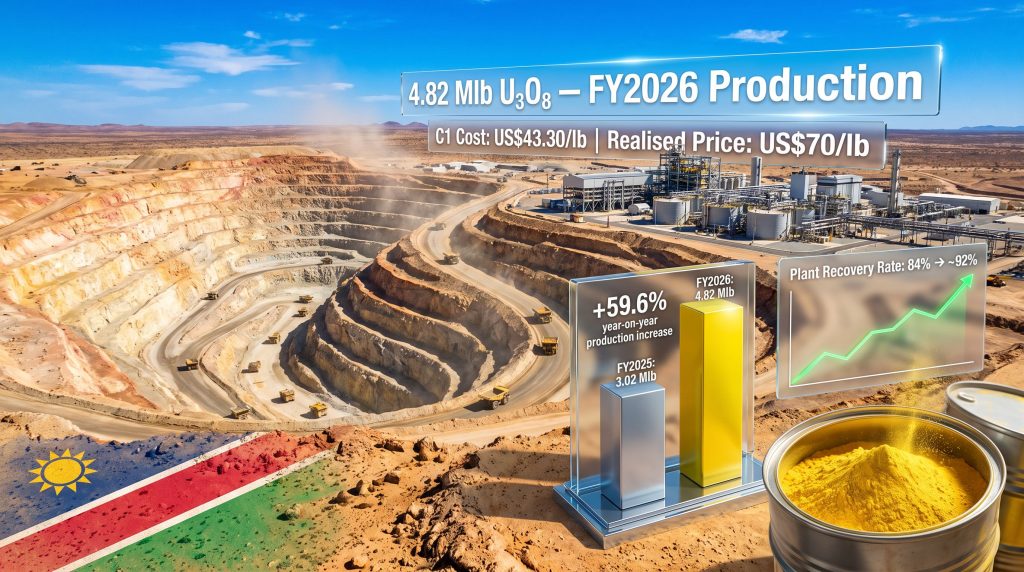
| Production (Mlb U₃O₈) | 3.02 | 4.82 | +59.6% |
| Sales (Mlb U₃O₈) | 2.71 | 4.35 | +60.5% |
| Ore Processed (Mt) | 3.6+ | 6.09 | +69.2% |
| Average Recovery Rate | ~84% | ~92% | +8 percentage points |
The ore processing throughput increase of 69% is the operational foundation upon which everything else is built. Processing 6.09 million tonnes versus 3.6 million tonnes in the prior year did not require proportional cost increases, because the mine's fixed infrastructure — including its leach tanks, counter-current decantation circuit, precipitation and drying stages, and water treatment systems — is largely sized for throughput well above FY2025 levels.
This is the unit cost dilution effect in practice: fixed processing infrastructure costs are distributed across a materially larger production base, lowering the per-pound cost of production even as total expenditure grows modestly in absolute terms.
The Cost Architecture: Where Langer Heinrich Sits Globally
Breaking Down the FY2026 Cost Position
Langer Heinrich's FY2026 production cost of US$43.30 per pound of U₃O₈ positions it within the lower-cost quartile of conventional uranium producers currently in operation globally. For context, industry estimates for conventional open-pit uranium production costs typically range from US$35 to US$60 per pound, with higher-cost operations in underground or more technically demanding settings reaching well above US$70 per pound.
Against the US$70 per pound average realised sales price across FY2026, the implied operating margin per pound at the mine gate is approximately US$26.70. On full-year sales of 4.35 million pounds, this translates to a gross operating contribution in the vicinity of US$116 million before corporate costs, royalties, and capital expenditure.
Margin context: At US$43.30/lb all-in production cost versus a US$70/lb realised price, Langer Heinrich demonstrates a margin structure that places it comfortably within the category of genuinely profitable conventional uranium producers, even in a uranium price environment that is moderate by historical standards.
The Leverage Dynamic Most Investors Underestimate
One of the least appreciated dynamics in uranium producer economics is price leverage at low-cost operations. At Langer Heinrich's cost structure, every US$5 per pound increase in average realised sales price generates an additional US$21 to 27 million in operating margin based on annual sales volumes between 4.35 and 5.3 million pounds.
This leverage is non-linear in investor impact terms: at a US$80 per pound price, the mine's margin nearly doubles from its US$70 per pound base — a dynamic that is often underpriced in resource sector equity valuations during periods of commodity price uncertainty. Consequently, broader uranium market trends remain a critical variable for assessing Langer Heinrich's forward earnings potential.
Capital Expenditure Discipline
FY2026 capital expenditure was maintained within guidance parameters. The operational philosophy reflected a deliberate decision to minimise capital intensity during the ramp-up phase, thereby preserving cash generation while completing the processing circuit stabilisation work. The FY2027 capex guidance of US$29 to 35 million represents a step-up in investment allocation, directed at mine expansion and infrastructure development rather than simply sustaining current output.
The next major ASX story will hit our subscribers first
Mining Operations: Material Movement and Throughput Metrics
What the FY2026 Mining Data Reveals
The full-year material movement data provides a window into the mine's operational intensity and fleet utilisation:
- Total material moved: 24.41 million tonnes across FY2026
- Ore tonnes mined: 6.09 million tonnes
- Implied strip ratio: approximately 3:1 waste-to-ore, consistent with open-pit uranium operations of this type and scale
- Peak quarterly performance: Q4 FY2026 recorded 7.45 million tonnes of total material moved, the highest since production resumed
- Q4 ore processed: 1.19 million tonnes through the processing plant
The record Q4 mining rate is a forward-looking operational signal. It indicates that the mining fleet is operating at or above designed capacity and that the mine schedule is generating sufficient ore exposure to support the FY2027 production uplift without requiring immediate major fleet expansion.
A less commonly discussed aspect of the Langer Heinrich operation is its strategic ore stockpile. During FY2026, the mine built a run-of-mine stockpile that provides a buffer between mining activity and plant feed. This decoupling of mining and processing schedules is a sophisticated operational practice that allows the plant to maintain consistent throughput even during periods when pit access or weather conditions temporarily constrain ore delivery. In an arid environment like Namibia's Erongo region, where the mine is located, this buffer function has additional operational value.
Reserve and Resource Base: Quantifying the Production Runway
What the Geological Inventory Means for Long-Term Planning
| Resource Category | Quantity (Mlb U₃O₈) |
|---|---|
| Measured Uranium Resources | 91.35 |
| Proven and Probable Ore Reserves | 77.5 |
The distinction between measured resources and proven and probable reserves is important for production planning purposes. Measured resources reflect geological confidence without the additional economic, mining, and processing filters that reserves must satisfy. Proven and probable reserves represent the subset of the resource that has been assessed as economically extractable under current or reasonable assumptions about price, cost, and processing recovery.
At the midpoint of FY2027 guidance of approximately 5.35 million pounds per year, Langer Heinrich's proven and probable reserve base of 77.5 million pounds supports a production runway of approximately 14 to 15 years at current extraction rates. Critically, there is a pathway to extending this runway further through the conversion of the additional measured resources into the reserve category as mining progresses and geological knowledge improves.
It is also worth noting that the mine's ore deposit characteristics — specifically the surficial calcrete-hosted uranium mineralisation typical of the Namib Desert geological environment — present a different risk profile to hard-rock underground uranium mines. Surficial deposits generally offer lower geotechnical risk, simpler mine planning, and more predictable ore grade continuity across large plan areas.
FY2027 Guidance: Is the Target Achievable?
Production and Financial Guidance Framework
| Guidance Metric | FY2027 Range |
|---|---|
| Production (Mlb U₃O₈) | 5.1 to 5.6 |
| Sales (Mlb U₃O₈) | 4.8 to 5.3 |
| Production Cost (US$/lb) | US$44 to US$48 |
| Capital Expenditure (US$M) | US$29 to US$35 |
The FY2027 production target represents a 5.8% to 16.2% increase over FY2026 actuals. Importantly, this is a measured rather than aggressive growth trajectory. The Q4 FY2026 annualised run rate of approximately 4.92 million pounds per year already approaches the lower bound of FY2027 guidance, suggesting that the base case is well within operational reach without requiring step-change improvements in processing performance.
The modest cost escalation from US$43.30 per pound to a guidance range of US$44 to 48 per pound reflects genuine inflationary pressures on key input categories — including sodium carbonate reagents, fuel, labour, and energy — rather than any deterioration in operational efficiency. Namibia's mining sector has experienced input cost inflation consistent with broader Southern African industrial cost trends.
Scenario projection: If Langer Heinrich achieves the upper end of FY2027 guidance, producing 5.6 million pounds and selling 5.3 million pounds at a realised price of US$70 per pound or above, annual uranium sales revenue could approach US$370 to 380 million, representing a material step-change in cash generation capacity compared to the FY2026 base.
Competitive Benchmarking: African Uranium Operations
| Operation | Country | Approx. Annual Output | Mining Method | Status |
|---|---|---|---|---|
| Langer Heinrich (Paladin) | Namibia | ~4.82 Mlb (FY2026) | Open-pit | Post-ramp-up |
| Rössing (China NFC) | Namibia | ~5 to 6 Mlb | Open-pit | Operating |
| Husab (Swakop Uranium) | Namibia | ~10 to 12 Mlb | Open-pit | Operating |
| Somair (Orano) | Niger | ~3 to 4 Mlb | Open-pit | Operating (disrupted) |
Langer Heinrich's FY2027 production target positions it to close the gap with Rössing on an output basis, potentially matching or exceeding its Namibian neighbour within two years. The simultaneous operation of three major uranium mines within Namibia's borders, with a fourth in construction, reinforces the country's structural importance to global uranium supply. Indeed, a broader comparison of the largest uranium mines globally underscores how competitive Namibia's output profile has become.
The contrast with Niger is instructive. Orano's Somair operation has faced significant disruption following political instability, reducing a previously reliable African uranium supply source. This redirection of buyer attention toward Namibian supply has enhanced the strategic value of Langer Heinrich and its peers, not through explicit designation but through straightforward supply chain risk management by uranium purchasers.
Market Supply Implications and Price Dynamics
Where Langer Heinrich Fits in the Global Uranium Supply Picture
Global uranium mine production is estimated at approximately 170 to 180 million pounds of U₃O₈ equivalent per annum. Langer Heinrich's FY2026 output of 4.82 million pounds represents roughly 2.5 to 3% of that total, a meaningful increment from a single operation.
The uranium market's structural characteristics differ substantially from most commodity markets. Approximately 75% of global uranium demand is supplied under long-term contracts rather than spot market purchases, with nuclear power utilities typically securing supply years or even decades in advance. This means Paladin's realised price of US$70 per pound does not necessarily reflect spot market prices during FY2026, when uranium traded in a range roughly between US$65 and US$100 per pound through 2024 and into 2025 before moderating.
Long-term contract coverage serves as a natural hedge against uranium supply-demand volatility, providing revenue predictability that supports capital investment decisions. For Langer Heinrich, the combination of long-term contract coverage and a cost structure comfortably below the prevailing contract price creates an unusually stable economic foundation.
One speculative dimension worth acknowledging: if nuclear power capacity additions in Asia, particularly in China and India, proceed at the rates currently planned, the demand increment from this single region alone could consume the equivalent of several Langer Heinrichs worth of new supply by the early 2030s. Whether existing and emerging Namibian mines can collectively scale fast enough to capture this demand growth is one of the more consequential unanswered questions in uranium market analysis today.
Investment Considerations and Risk Factors
Key Upside Drivers
- Uranium price appreciation above the US$70 per pound level generates disproportionate margin improvement given Langer Heinrich's fixed-cost base
- FY2027 production outperformance relative to the upper end of guidance
- Reserve conversion from the measured resource base extending mine life beyond current estimates
- Continued processing circuit performance at or above 90% recovery, compounding production volumes over time
Key Risk Factors Investors Should Monitor
- Uranium spot price volatility, particularly if utility procurement cycles shift or reactor construction timelines slip
- Input cost inflation in Namibia, specifically reagent, energy, and labour cost trajectories
- Water availability constraints in the Erongo region, where arid conditions make water management a genuine operational consideration for all Namibian uranium mines
- Ore grade variability as mining progresses into different zones of the pit, which can affect plant recovery performance and per-pound costs
This article is intended for informational purposes only and does not constitute financial or investment advice. Past operational performance does not guarantee future results. Investors should conduct independent due diligence and consider their own risk tolerance before making investment decisions related to uranium equities or commodity exposure.
Frequently Asked Questions: Paladin Energy Langer Heinrich Uranium Mine Results
What was Langer Heinrich's total uranium production in FY2026?
Langer Heinrich produced 4.82 million pounds of U₃O₈ across FY2026, exceeding the upper end of production guidance and representing a year-on-year increase of approximately 60% over FY2025 output of 3.02 million pounds.
What is the production cost at Langer Heinrich?
The mine's FY2026 production cost was US$43.30 per pound of U₃O₈, against an average realised sales price of approximately US$70 per pound, implying a gross operating margin of roughly US$26.70 per pound.
When did Langer Heinrich resume production?
The mine recommenced commercial production in March 2024 following an extended care-and-maintenance period. FY2025 was the first full year of post-restart operations, and FY2026 marked the completion of the processing ramp-up phase.
What are Paladin's FY2027 production targets?
Paladin has guided for 5.1 to 5.6 million pounds of U₃O₈ production in FY2027, with sales of 4.8 to 5.3 million pounds, supported by capital expenditure of US$29 to 35 million. For additional context on these FY2027 production targets, Paladin's official guidance documentation provides further detail.
How large are Langer Heinrich's uranium reserves?
The mine holds 77.5 million pounds of proven and probable ore reserves, with 91.35 million pounds of measured uranium resources, providing a production runway of more than 14 years at FY2027 guidance rates.
What was the peak mining rate achieved in FY2026?
The June 2026 quarter recorded the highest quarterly material movement since production resumed, with 7.45 million tonnes of total material moved and 1.19 million tonnes of ore processed through the plant.
What Langer Heinrich's FY2026 Results Signal for Paladin Energy and Namibia's Uranium Sector
Operational Maturity and What Comes Next
The completion of the ramp-up phase at Langer Heinrich fundamentally changes the risk profile of the operation. During a post-restart ramp-up, investors and analysts must apply uncertainty discounts to production forecasts because processing circuits are unstable, throughput is sub-optimal, and cost structures are elevated by underutilised fixed capacity. All of those dynamics have now resolved.
The mine has demonstrated consistent quarterly output in the 1.2 to 1.3 million pounds range, processing circuit recovery has stabilised above 90%, and the cost structure has settled below US$44 per pound. What this means in practical terms is that Langer Heinrich now functions as a predictable operating asset rather than a development-stage risk.
The FY2027 production uplift is therefore not predicated on things going right for the first time, but on things continuing to work well while incremental improvements and expanded mine development add output at the margin.
The Namibian Uranium Cluster Effect
Perhaps the most underappreciated dimension of the Paladin Energy Langer Heinrich uranium mine results story is its contribution to a broader cluster effect developing within Namibia's uranium sector. With three major mines operating, Deep Yellow's Tumas project advancing through construction contracting, and Arkle's Erongo project expanding its drilling programme, Namibia is developing the infrastructure, labour market depth, contractor ecosystem, and supply chain maturity of a genuine uranium mining province.
This cluster dynamic historically reduces operating costs over time as shared services, local procurement, and technical knowledge diffuse across operations. For Langer Heinrich specifically, operating within a maturing Namibian uranium sector provides access to a deepening pool of skilled local workers, established reagent supply chains, and proven regulatory frameworks — all of which reduce execution risk relative to operating in a greenfield jurisdiction.
Moreover, the Kazakhstan uranium dominance in global supply highlights precisely why diversified sources of reliable uranium production, such as Namibia's expanding cluster, are attracting increasing attention from buyers and investors alike. The combined trajectory of Namibian uranium production growth, Langer Heinrich's operational consolidation, and the structural supply constraints facing the global uranium market create a set of conditions that will be closely watched by uranium buyers, resource investors, and energy policy analysts in the years ahead.
Want to Stay Ahead of the Next Major Mineral Discovery on the ASX?
Discovery Alert's proprietary Discovery IQ model scans ASX announcements in real time, delivering instant alerts on significant mineral discoveries — including uranium and other critical commodities — so subscribers can act before the broader market catches on. Explore historic discoveries and their returns, then start your 14-day free trial to secure a genuine market-leading edge.