
June 11, 2026
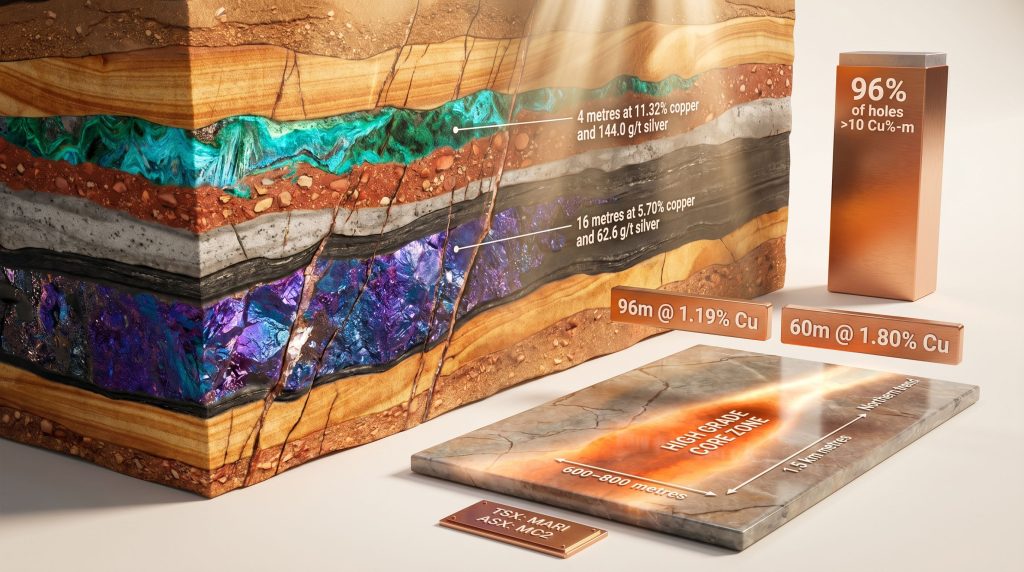
From Exploration Grid to Resource Construction: The Mechanics Behind Pampa Medina's Maiden MRE
Sediment-hosted copper deposits occupy a unique position in the global resource landscape. Unlike porphyry systems, where bulk tonnage and consistent low-grade distribution can be modelled relatively early in a drill programme, manto-type deposits reward patience and methodical delineation. Their grade architecture tends to concentrate in distinct horizons, meaning the difference between an exploration intercept and a resource-ready dataset comes down to grid density, lateral continuity, and the willingness of a company to commit capital to systematic infill rather than chasing the next step-out discovery. That transition point is precisely where the Pampa Medina maiden Mineral Resource Estimate programme sits today.
When big ASX news breaks, our subscribers know first
Why Drill Spacing Is the Operative Trigger for Resource Classification
In mineral resource reporting, whether under JORC or NI 43-101 frameworks, the Inferred category represents the lowest confidence tier at which a deposit can be formally classified. It does not require the certainty of Indicated or Measured resources, but it does demand a statistically defensible basis for estimating tonnage and grade across a defined volume of rock.
The operative mechanism for reaching that threshold is drill spacing. At Pampa Medina, the transition from reconnaissance and step-out holes drilled at approximately 300-metre intervals to a systematic 150-metre by 150-metre grid is not a cosmetic programme redesign. Halving the nominal spacing in both horizontal directions increases grid density by a factor of four, which means the data density required to support geostatistical estimation is being built at an accelerated rate relative to the earlier exploration phase.
A useful way to appreciate the scale of this commitment is to consider the aggregate drilling target within context. Furthermore, interpreting drill results correctly at each stage is essential to understanding classification progress:
- The total delineation campaign targets approximately 35,000 metres of drilling
- The defined area of interest covers 3 kilometres by 1.5 kilometres, or 4.5 square kilometres
- That translates to more than 7,700 metres of drilling per square kilometre across the area of interest
- Every metre drilled within the 150-metre grid feeds directly into the maiden MRE dataset, which freezes at the September 2026 cutoff
The independent resource geologist overseeing the programme has indicated that a completed grid at this spacing is expected to satisfy Inferred classification criteria, based specifically on the lateral continuity conditions observed within Pampa Medina itself rather than continuity assumptions borrowed from analogous deposits. That distinction matters: the classification rationale is grounded in empirical observation at this deposit, not modelled inference from elsewhere.
The Deposit Architecture: Why Manto Geometry Creates Both Opportunity and Complexity
Structural Setting and Host Rock Sequence
Pampa Medina is classified as a manto-type copper deposit, hosted within Jurassic-Triassic sedimentary sequences that include sandstones, conglomerates, tuffs, and black shales. The mineralised horizons sit beneath a cap of andesitic volcanics and above an Upper Palaeozoic basement complex, a structural sandwich that has focused and preserved copper mineralisation across multiple stacked horizons rather than concentrating it in a single lens.
This stacked manto architecture is both the deposit's defining characteristic and its most commercially significant attribute. Unlike a single-horizon system where grade variability in any one interval directly undermines the resource case, a multi-horizon deposit distributes risk across several mineralised packages. Confirmation of stacking in the second delineation hole was therefore a material data point, not simply an additional intercept.
The Two-System Structure: Sulphides and Oxides
Pampa Medina's mineralisation operates across two vertically separated but geologically related domains:
- A deeper sulphide system dominated by bornite and chalcocite, representing the primary MRE target
- A shallower oxide component with open-pittable geometry and lower-grade characteristics suited to a satellite resource role
The sulphide system's dominant copper species carry a processing implication that is not always appreciated in early-stage resource narratives. Both bornite and chalcocite are amenable to leaching, which distinguishes Pampa Medina from typical sulphide copper deposits that require flotation as the primary processing route. This leachability profile opens the door to heap or tank leaching configurations that can deliver cathode copper directly, rather than a concentrate requiring further downstream processing.
Scale Parameters: What the Area of Interest Actually Represents
| Parameter | Measurement |
|---|---|
| Total area of interest | 3 km x 1.5 km |
| High-grade core (N-S extent) | 1.5 km |
| High-grade core (E-W extent) | 600 to 800 m |
| Northern mineralised trend extension | 3 to 4 km beyond current focus |
| Total campaign drilling target | ~35,000 metres |
| Distance from Marimaca Oxide Deposit | ~28 km east |
A critical nuance for investors to understand is that the Pampa Medina maiden Mineral Resource Estimate will not represent the full extent of the mineralised system identified to date. Management has been explicit that the initial resource statement will cover only the delineated area of interest. The northern and western extensions, which include an identified mineralised trend stretching 3 to 4 kilometres beyond the current focus zone, remain outside the initial MRE boundary and will be tested through step-out drilling running concurrently with the resource compilation period.
The maiden MRE should be understood as a floor, not a ceiling. The delineated area captures the high-grade core. The surrounding system remains open in multiple directions, with step-out drilling designed to expand the resource envelope in subsequent estimate updates.
Drill Intercept Analysis: What Grade and Width Performance Reveals
First Delineation Hole: Broad Envelope with Ultra-High-Grade Core
The first delineation hole delivered a dataset that confirms the 150-metre grid is capturing the deposit's full mineralised architecture rather than sampling only the peripheral margins. Consequently, drill results interpretation at this stage provides meaningful confidence in the resource model being constructed:
| Interval | Width | Copper Grade | Silver Grade | Depth From |
|---|---|---|---|---|
| Broad sulphide envelope | 96 m | 1.19% Cu | 11.7 g/t Ag | 692 m |
| Bridging interval | 60 m | 1.80% Cu | 18.4 g/t Ag | 694 m |
| High-grade sub-interval | 16 m | 5.70% Cu | 62.6 g/t Ag | 704 m |
| Ultra-high-grade core | 4 m | 11.32% Cu | 144.0 g/t Ag | 706 m |
The nested structure of these intervals is geologically significant. The 4-metre ultra-high-grade intersection at 11.32% copper and 144.0 g/t silver represents a bornite-dominant core sitting within progressively wider, lower-grade envelopes. This concentric architecture is characteristic of well-preserved manto systems and provides confidence that the mineralising event was both focused and laterally persistent.
Second Delineation Hole: Stacked Manto Confirmation
The second delineation hole added a separate and equally important data point by confirming the stacked manto interpretation across a different grid location. In addition, understanding true vs apparent widths in these intersections is important when evaluating the economic significance of each interval:
- 22 metres at 1.97% copper and 9.2 g/t silver from 610 metres (sulphide zone)
- 140 metres at 0.35% copper from 366 metres (broad mixed zone), including stacked sub-intervals:
- 32 metres at 0.71% copper and 4.1 g/t silver from 468 metres
- 10 metres at 0.95% copper and 7.4 g/t silver from 484 metres
The 140-metre mixed zone, while lower-grade at the composite level, contains multiple discrete mineralised horizons that individually meet economic grade thresholds. This is a textbook stacked manto signature: a series of copper-bearing sedimentary beds separated by unmineralised or weakly mineralised waste intervals, each representing a separate depositional or diagenetic mineralisation event.
Grade Consistency as a Statistical Argument, Not a Cherry-Picked Narrative
One of the more compelling aspects of the Pampa Medina dataset is how it performs when evaluated statistically rather than through headline intercepts alone. The copper percent-metre metric, which multiplies intersection width by grade to produce a single composite value, allows comparison across holes of varying width and geometry. Furthermore, applying rigorous cut-off grade economics to each interval ensures that only genuinely mineable material informs the eventual resource statement.
| Copper Percent-Metre Threshold | Proportion of Drill Holes Meeting Threshold |
|---|---|
| Greater than 10 CuPctM | 96% of all holes |
| Greater than 20 CuPctM | 58% of all holes |
| Returning economic widths and grades | All but two holes in the delineation grid |
For context, the Kupferschiefer copper system in Europe, a sediment-hosted deposit that management cites as a structural analogue to Pampa Medina, averages approximately 4.5 metres of mineralised package thickness. Pampa Medina's individual zones have reached up to 26 metres in mineralised package thickness, a difference of nearly six times the Kupferschiefer benchmark. CEO Hayden Locke has described grade and width delivery across the delineation grid as exceeding Kupferschiefer benchmarks in virtually every hole drilled to date.
The Kupferschiefer comparison is instructive precisely because it is a producing system with known economic parameters. When Pampa Medina's per-hole performance consistently exceeds those benchmarks, it provides an external reference point for evaluating what the resource numbers may ultimately look like.
The next major ASX story will hit our subscribers first
The Inferred Classification: What It Means and Why Continuity Is the Governing Variable
Understanding Resource Categories in This Context
Inferred resources sit at the base of the JORC and NI 43-101 classification pyramids for a reason. They are supported by geological evidence sufficient to estimate tonnage and grade, but not at the confidence level required for Indicated or Measured classification. For investors, this means the maiden MRE number should be treated as a technically credible starting point rather than a bankable figure ready for feasibility input.
What gives the Inferred classification expectation credibility at Pampa Medina is that it rests on two reinforcing lines of evidence:
- Observed lateral continuity of the high-grade sulphide mantos across the defined area of interest, confirmed through multiple delineation holes rather than isolated intercepts
- The independent resource geologist's assessment that the 150-metre grid spacing is sufficient to capture that continuity for classification purposes
The second point is worth emphasising. The expert determination is based on what the deposit has demonstrated through drilling, not on a theoretical continuity model or an analogue-based assumption. This distinction strengthens the classification expectation while acknowledging that it remains conditional on completion of the full grid.
Timeline to the Pampa Medina Maiden Mineral Resource Estimate
| Milestone | Target Date |
|---|---|
| Completion of 150-metre delineation campaign | End of September 2026 |
| Data cutoff for maiden MRE | Upon campaign completion |
| Resource compilation period | 6 to 7 months post-cutoff |
| Maiden MRE delivery | 2027 |
Management's framing of the Pampa Medina maiden Mineral Resource Estimate as an initial reference point rather than a comprehensive inventory is an important signal for how investors should interpret the eventual resource number. The step-out drilling that begins after the September 2026 data cutoff will run in parallel with the compilation period, meaning that by the time the maiden MRE is published, additional data from distal zones may already be available to inform a subsequent estimate update.
Hayden Locke has described the programme's objective in terms that reflect this sequencing logic: the approximately 35,000 metres of remaining drilling will be completed by the end of September, followed by a six-to-seven-month compilation period. However, the resulting resource will provide investors with an initial quantified reference point for a system that management believes extends well beyond the initial delineation boundary.
Processing Optionality and Development Scenarios
Why Mineralogy Drives More Than Metallurgy
The dominance of bornite and chalcocite in Pampa Medina's sulphide system has a cascading effect on development scenario design that goes beyond laboratory metallurgy. Both minerals are high-copper-content species, with bornite carrying approximately 63% copper by weight and chalcocite approximately 80%, compared to chalcopyrite's 35%. Their leachability means that acid-based hydrometallurgical processing is a credible alternative or complement to conventional flotation.
Locke has indicated that an extended leaching operation is among the development pathways being considered for the sulphide system, alongside a concentrator component. The final configuration will be determined through post-MRE scenario analysis, and eventually a definitive feasibility study will formally assess the most economically robust development pathway. The leaching route, if adopted at meaningful scale, would potentially allow Pampa Medina's sulphide copper to be delivered as cathode product through processes similar to those already in use at the Marimaca Oxide Deposit.
The Oxide Satellite: District-Level Integration Logic
The shallow oxide component at Pampa Medina is being assessed as a potential satellite feed to the MOD's existing cathode production infrastructure. The estimated incremental production contribution is approximately 25,000 tonnes per year of additional cathode output, with integration offering capital efficiency benefits by leveraging existing processing assets rather than requiring standalone development.
This district integration logic is a dimension of the Pampa Medina story that often receives less attention than the sulphide system's headline intercepts. Nevertheless, it represents a near-term development pathway that does not depend on the maiden MRE or post-MRE scenario analysis for its basic feasibility argument.
Key Risk Factors and Investment Considerations
What Investors Should Monitor Before the 2027 MRE
The delineation data assembled to date establishes a credible evidence base, but several material uncertainties remain:
- Resource scale versus system scale: The maiden MRE will capture the delineated area of interest only. Investors should resist treating the initial resource number as representative of the deposit's full mineralised extent
- Development pathway unresolved: Whether Pampa Medina ultimately becomes a leaching operation, a concentrator project, or a hybrid system remains unanswered pending post-MRE scenario analysis
- Timing execution risk: The September 2026 data cutoff and the subsequent six-to-seven-month compilation period represent two sequential milestones, each carrying scheduling risk that could push maiden MRE delivery beyond the 2027 target
- Classification conditionality: The Inferred classification expectation is contingent on completion of the full 150-metre grid and confirmation that observed lateral continuity holds across the remaining undrilled grid cells
Disclaimer: This article is for informational purposes only and does not constitute financial advice. Forward-looking statements, timelines, resource estimates, and development scenarios discussed herein are subject to material risks and uncertainties. Investors should conduct independent due diligence before making any investment decisions.
Frequently Asked Questions: Pampa Medina Maiden Mineral Resource Estimate
What is the Pampa Medina maiden Mineral Resource Estimate?
The maiden MRE will be the first formally classified resource statement for the Pampa Medina copper deposit, compiled from the dataset generated by Marimaca Copper's 150-metre by 150-metre delineation drilling campaign. It is expected to carry an Inferred classification and is targeted for delivery in 2027.
What drill spacing is required for an Inferred resource at Pampa Medina?
The independent resource geologist overseeing the programme has indicated that a completed 150-metre by 150-metre grid is expected to satisfy Inferred classification conditions, based on lateral continuity observed within the deposit through actual drilling results.
When will the Pampa Medina maiden MRE be released?
The delineation campaign is targeted for completion by the end of September 2026, triggering the data cutoff. A six-to-seven-month resource compilation period follows, placing maiden MRE delivery in 2027.
What copper grades has Pampa Medina's delineation drilling returned?
Key intercepts include 96 metres at 1.19% copper from 692 metres depth, 16 metres at 5.70% copper and 62.6 g/t silver from 704 metres, and 4 metres at 11.32% copper and 144.0 g/t silver from 706 metres. These results have been widely noted, with Global Mining Review reporting on how the broader system has been defined across sedimentary and volcanic-hosted manto settings.
What processing options are being considered for the sulphide system?
The dominant copper minerals, bornite and chalcocite, are both leachable, making an extended leaching operation one of the development scenarios under consideration alongside a concentrator component. Final processing configuration will be determined through scenario analysis following the maiden MRE.
How does Pampa Medina compare to the Kupferschiefer copper system?
The Kupferschiefer system averages approximately 4.5 metres of mineralised package thickness. However, Pampa Medina's individual zones have reached up to 26 metres, with grade and width performance exceeding Kupferschiefer benchmarks across virtually all delineation holes drilled to date, according to management commentary.
Readers seeking additional context on Marimaca Copper's broader project portfolio and the Pampa Medina delineation programme can explore related coverage at Crux Investor, which publishes ongoing analysis of the project's development progress.
Want To Be Alerted the Moment a Major Copper Discovery Hits the ASX?
Discovery Alert's proprietary Discovery IQ model scans ASX announcements in real time, instantly identifying high-potential mineral discoveries across more than 30 commodities — giving subscribers an actionable edge before the broader market reacts. Explore historic discovery returns on Discovery Alert's dedicated discoveries page to understand what early positioning in transformative finds has meant for investors, then begin your 14-day free trial at Discovery Alert to start receiving alerts the moment the next significant copper or mineral discovery is announced.