June 6, 2026
The Silver Supply Paradox That's Reshaping Precious Metals Mining
Most commodities respond to price signals with relatively predictable supply adjustments. When copper prices rise, miners accelerate drilling programmes and expand processing capacity. When gold climbs, marginal deposits suddenly become economically viable. Silver, however, operates under a fundamentally different set of rules, and understanding this distinction is central to grasping why Pan American Silver growth strategy and M&A approach carries such structural logic.
Approximately 71% of global silver production is extracted as a by-product of base metal mining, meaning zinc, lead, copper, and gold operations determine the majority of silver supply, not dedicated silver miners. This creates a remarkable market dynamic: silver prices can surge, yet primary silver mine supply can remain essentially flat or even decline. The lever simply does not connect the way most investors assume.
Layer onto this the reality that industrial demand now consumes an estimated 60 to 65% of all silver used globally, driven by solar photovoltaics, EV charging infrastructure, and advanced electronics, and the picture becomes even more compelling. Unlike investment demand, which can evaporate overnight when sentiment shifts, industrial demand creates a persistent consumption floor that is increasingly divorced from macroeconomic mood swings.
The convergence of structurally constrained supply and accelerating industrial consumption has produced what multiple commodity analysts describe as a projected six-year silver supply deficits period in silver markets, a backdrop against which scale, reserve depth, and operational capability become decisive competitive advantages.
When big ASX news breaks, our subscribers know first
Why Pan American Silver's Growth Strategy Centres on Becoming Bigger, Not Just Better
The Philosophy Behind Scale
Pan American Silver CEO Michael Steinmann has articulated a clear conviction that the mining industry's future belongs to larger, more financially self-sufficient operators. Speaking at the company's 2026 investor day, he expressed a firm belief in building stronger, larger mining companies, arguing that the trajectory of the industry demands it. This is not marketing language; it reflects a thesis grounded in geological, financial, and operational realities that are reshaping the competitive landscape.
The geological argument is compelling and underappreciated. Steinmann, himself a geologist, has pointed out that within roughly two decades, most of the world's accessible open-pit deposits will either have been mined out or already discovered. What comes next is a generational shift toward large-scale underground mining operations, projects that require substantially higher capital intensity, advanced technical expertise, and the kind of community engagement capability that takes decades to build.
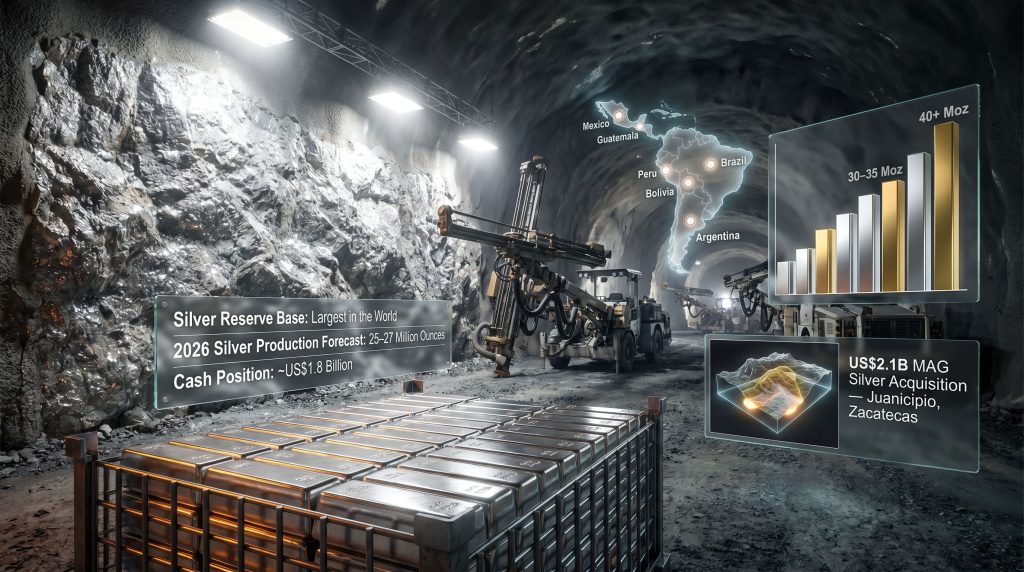
Companies that lack the balance sheet depth to fund these builds from operating cash flow will face an uncomfortable choice: dilute shareholders or take on significant debt. Pan American has explicitly ruled out the first option. The company's last equity raise to fund a construction project was in 2009, and management has stated clearly that there is no intention to return to shareholders for project financing. With approximately US$1.8 billion in cash at the end of Q1 2026 and growing free cash generation, the self-funding model remains intact.
Pan American Silver at a Glance: Metrics That Define a Precious Metals Major
Understanding the current scale of Pan American's platform is essential context for evaluating the growth runway ahead. Furthermore, silver's dual role as both a precious and industrial metal reinforces why reserve depth matters so significantly to long-term strategy.
| Metric | Current Position |
|---|---|
| Market Capitalisation | ~US$20 billion |
| 2026 Silver Production Forecast | 25–27 million oz |
| Annual Gold Production | ~730,000 oz |
| Gold as % of Revenue (current prices) | Up to 60% |
| Silver Reserve Base | Largest globally (primary silver producers) |
| Target Silver Revenue Range | 35–55% of total over time |
| 2026 Exploration Budget | US$135 million (predominantly brownfield) |
| 20-Year Reserve Replacement Rate | ~65% of silver mined |
| Average Reserve Replacement Cost | ~US$0.80/oz |
| Q1 2026 Cash Position | ~US$1.8 billion |
One metric deserves particular attention: the US$0.80 per ounce average cost of reserve replacement over two decades. In an industry where greenfield discovery costs can exceed US$10 to 15 per ounce, Pan American's brownfield-focused exploration strategy has delivered exceptional capital efficiency. The US$135 million 2026 exploration budget is predominantly directed at drilling around and beneath existing operations, a discipline that compounds value over time rather than chasing speculative discoveries.
How M&A Has Transformed Pan American Silver's Competitive Position
The Yamana Transaction: A Structural Step-Change
The 2023 Yamana Gold acquisition was the defining corporate event of Pan American's recent history. The deal materially expanded the company's scale, diversified its geographic earnings base across Latin America, and accelerated its evolution from a mid-tier silver specialist into a precious metals analysis benchmark. Post-acquisition, Pan American engaged in active portfolio rationalisation, divesting non-core assets including La Arena in Peru and recycling proceeds into higher-return priorities.
This pattern — acquiring scale through transformational transactions then optimising the resulting portfolio — reflects a sophisticated capital allocation discipline that distinguishes Pan American from many peers.
The MAG Silver Acquisition: Accessing the World's Most Productive Silver District
In May 2025, Pan American agreed to acquire MAG Silver for approximately US$2.1 billion, adding exposure to the Juanicipio mine in Zacatecas, Mexico. The strategic rationale was clear: Juanicipio is a high-grade, large-scale, low-cost silver asset situated in what Steinmann described as the most productive silver-producing district on the planet. For further detail on this transaction, Pan American's acquisition of MAG Silver provides comprehensive analysis of the deal's structure and implications.
The transaction was structured to deploy approximately US$500 million of existing cash and investments, preserving meaningful balance sheet flexibility for ongoing capital returns and future growth. This measured deployment reflects the same financial discipline that has characterised Pan American's approach to every major decision.
What Pan American Actually Looks for in an Acquisition Target
Pan American's business development senior vice president Sam Drier has described the company's M&A criteria as simultaneously ambitious and disciplined. Attractive silver opportunities are characterised as genuinely scarce, reinforcing a quality-over-volume approach. The specific filters the company applies include:
- Geographic preference: Americas-focused, leveraging existing operational expertise and stakeholder relationships built over decades
- Asset quality threshold: Long-life deposits with meaningful exploration upside that generate positive margins at metal prices materially below current spot levels
- Silver revenue weighting: Targets must support the long-term portfolio balance of 35 to 55% silver revenue
- Scale requirement: Acquisitions must add high-margin ounces capable of displacing lower-quality assets in the existing portfolio
- Self-funding compatibility: All transactions must be financeable without recourse to shareholder equity issuance
Organic Growth: The Pipeline Behind the Production Targets
La Colorada Skarn: A Once-in-a-Career Discovery
Perhaps the most geologically remarkable aspect of Pan American's organic growth pipeline is the La Colorada Skarn project in Zacatecas, Mexico. Steinmann, drawing on his background as a professional geologist, has noted that discovering a world-class silver deposit directly beneath an existing operating mine is an extraordinarily rare geological outcome. In his words, he had never previously encountered this phenomenon in his career.
The discovery is significant not just for what it adds to Pan American's reserve base, but for what it signals about the exploration potential of the company's broader brownfield portfolio. If a tier-one deposit was hidden beneath an established operation, the probability that other operations conceal undiscovered mineralisation becomes a genuine investment thesis rather than speculative hope.
The High-Optionality Assets: Escobal and Navidad
Two assets sit within Pan American's portfolio that carry enormous potential but no near-term production certainty. Consequently, investors should consider these as long-dated options rather than near-term production contributors.
| Asset | Location | Potential Output | Current Status | Key Constraint |
|---|---|---|---|---|
| Escobal | Guatemala | ~21 Moz silver/year | Suspended | Protracted community consultation process |
| Navidad | Argentina | Large-scale primary silver | Pre-development | Awaiting provincial mining law amendment |
The arithmetic around Escobal is striking. At its nameplate capacity of approximately 21 million ounces per annum, a return to full production would position Pan American as the world's largest silver producer by output, a status that would complement its already-confirmed position as holder of the world's largest silver reserve base among primary producers. No firm timeline for resolution of the consultation process exists, and investors should treat Escobal as a genuine option rather than a near-term production assumption.
Capital Returns and Growth Investment: Running Both Programmes Simultaneously
The 2026 Shareholder Return Programme
Following Q1 2026 results, Pan American announced a commitment to return US$1 billion to shareholders during 2026, comprising approximately US$305 million in dividends and approximately US$700 million in share buybacks. Pan American's investor relations page provides further detail on the structure and timeline of these commitments.
This scale of capital return, delivered alongside a US$135 million exploration budget and active M&A capacity, is only sustainable at current metal prices. Management has acknowledged this explicitly, noting that the programme's continuation is contingent on prevailing gold and silver price levels.
Investor Note: The simultaneous execution of a US$1 billion return programme and large-scale growth investment requires exceptional free cash generation. Investors should stress-test these commitments against a scenario where gold prices retreat materially from current levels, given gold's contribution of up to 60% of Pan American's current revenues.
Why Latin America Remains the Strategic Core
Pan American's operating portfolio spans Mexico, Peru, Bolivia, Brazil, Argentina, and Guatemala, a deliberate geographic strategy grounded in the conviction that Latin America hosts some of the world's highest-grade silver and gold deposits. Steinmann has argued that exposure to this region through a diversified, multi-country operator is preferable to concentrated single-country risk.
This perspective reflects hard-won operational experience. Building and operating mines across multiple Latin American jurisdictions over decades creates institutional knowledge, community relationships, and regulatory understanding that cannot be replicated quickly by new entrants. That accumulated capability is itself a form of competitive moat. In addition, the broader context of silver supply constraints across Latin America reinforces why this geographic concentration carries strategic merit.
The next major ASX story will hit our subscribers first
Three Scenarios for Where Pan American Silver Goes From Here
Scenario 1: Base Case — Organic Growth Plus MAG Integration
La Colorada Skarn advances on schedule, Juanicipio contributes full-year silver production post-MAG acquisition, and Jacobina and Timmins deliver incremental gold output gains. Silver production grows toward 30 to 35 million ounces within a three-to-five year horizon, and brownfield reserve replacement continues at approximately US$0.80 per ounce.
Scenario 2: Accelerated Case — Organic Growth Plus Further M&A
A further transformational acquisition meeting Pan American's strict quality criteria adds a high-calibre silver asset, portfolio rationalisation continues with non-core asset divestiture, and the silver output trajectory approaches 40 million ounces or more over a five-to-seven year horizon.
Scenario 3: Full Optionality Realisation
Escobal returns to production at approximately 21 million ounces per year following resolution of the consultation process, and Navidad advances following Argentine provincial mining law reform. Combined with organic growth and the MAG acquisition, Pan American achieves the status of world's largest silver producer by output, complementing its existing reserve leadership position. Monitoring the gold-silver ratio will also be critical in evaluating relative value under this scenario.
Broader Context: The structural silver supply-demand dynamic described by Pan American's leadership aligns with widely cited industry projections of multi-year deficits driven by electrification demand growth outpacing primary mine supply capacity. Edison Group's research coverage of Pan American provides independent verification worth reviewing for readers conducting investment due diligence. Past performance and current management commitments do not guarantee future results. This article contains forward-looking analysis that involves assumptions and uncertainties.
The central thesis behind Pan American Silver growth strategy and M&A programme is ultimately straightforward: in a world where primary silver supply cannot be meaningfully scaled through price signals alone, where industrial demand is structurally rising, and where the next generation of large deposits will require underground development expertise that few companies possess, scale combined with financial self-sufficiency and operational track record is not merely advantageous. According to Pan American's leadership, it is becoming the only viable path to sustained sector leadership.
Further coverage of Pan American Silver and the broader precious metals sector is available through Mining Beacon at miningbeacon.com, including reporting from major industry events such as Resourcing Tomorrow and IMARC.
Want To Be First When The Next Major Silver Discovery Hits The ASX?
Discovery Alert's proprietary Discovery IQ model delivers real-time alerts on significant ASX mineral discoveries — turning complex data across 30+ commodities into clear, actionable insights the moment they're announced. Start your 14-day free trial at Discovery Alert today, or explore how historic mineral discoveries have generated substantial returns for investors who positioned themselves early.