June 12, 2026

Silver's Structural Moment: Why Q1 2026 Matters More Than a Single Quarter
Every commodity cycle eventually reaches a point where the gap between a producer's theoretical potential and its demonstrated financial performance begins to close. For diversified silver miners operating across multiple Latin American jurisdictions, that convergence point is rarely clean or linear. It involves navigating currency fluctuations, by-product price volatility, community relations complexities, and the ever-present tension between rewarding shareholders today and building production capacity for tomorrow.
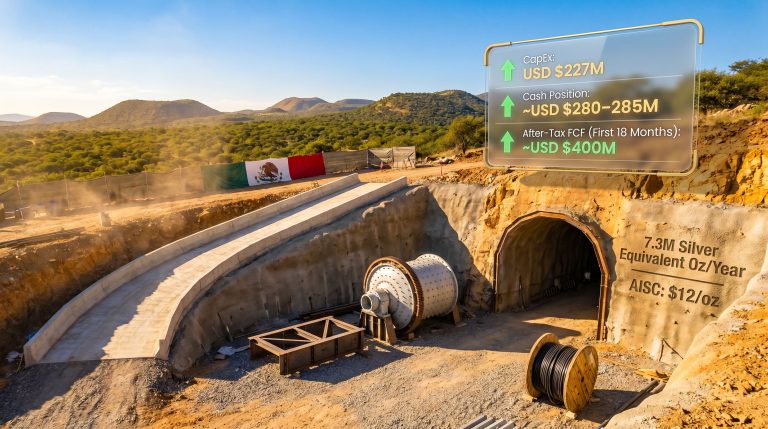
Pan American Silver first quarter financial results, released on May 5, 2026, arrive against precisely this kind of backdrop. The company, consistently ranked among the world's largest primary silver producers by annual output, reported three headline achievements that institutional analysts tend to weight heavily when assessing a miner's operational maturity: a record cash balance, strong mine operating earnings, and an enhanced shareholder return framework. A conference call and webcast followed on May 6, 2026, providing management the opportunity to contextualise these results within the company's strategic trajectory.
Understanding what these results actually signal requires more than reading the headline numbers. It demands an examination of how Pan American Silver's multi-metal production model, its geographic diversification across Latin America, and its capital allocation philosophy interact with broader silver market dynamics in early 2026.
When big ASX news breaks, our subscribers know first
The Silver Market Environment That Shaped Q1 2026 Performance
Silver occupies an unusual position among commodity metals. Unlike gold, which functions primarily as a monetary and safe-haven asset, or copper, which serves as a pure industrial bellwether, silver's dual role straddles both categories simultaneously. Roughly half of annual global silver demand comes from industrial applications, including photovoltaic solar cells, electronics manufacturing, electric vehicle charging components, and medical devices. The remaining demand is split between investment products, jewellery, and silverware.
This dual-demand structure creates a unique pricing dynamic. When monetary conditions are uncertain and real interest rates are low or negative, investment demand for silver accelerates alongside gold. Simultaneously, if industrial production is expanding, the physical demand from manufacturers applies additional upward pressure on pricing. In early 2026, both of these forces appear to have been operating in concert, providing a constructive pricing environment for primary silver producers.
Furthermore, silver supply deficits have added an additional structural dimension to the pricing environment, reinforcing the case for producers with strong operational foundations.
Sector Context: For a company like Pan American Silver, where silver constitutes the primary revenue driver, even modest sustained improvements in the silver price translate into disproportionate earnings leverage given the fixed-cost nature of underground and open-pit mining operations.
The solar energy sector deserves particular attention in this context. The photovoltaic industry has become one of the fastest-growing sources of silver consumption globally, with each solar panel requiring a meaningful quantity of silver paste for electrical conduction. As solar installation targets accelerate across North America, Europe, and Asia, the structural floor for industrial silver demand continues to rise. This is not a speculative thesis; it is a demand dynamic already visible in annual silver consumption data tracked by industry bodies such as the Silver Institute.
How Mine Operating Earnings Function as an Analytical Tool
Before examining Pan American Silver's Q1 2026 mine-level performance, it is worth clarifying why institutional analysts consistently prioritise mine operating earnings over headline net income when evaluating a precious metals producer's operational health.
Net income in mining is heavily distorted by non-cash items. Depreciation and depletion charges on mining assets can be substantial given the capital intensity of the sector. Impairment charges, foreign exchange translation gains or losses, and mark-to-market adjustments on derivatives can swing reported net income dramatically from quarter to quarter without reflecting anything meaningful about the underlying physical business of extracting ore and converting it into saleable metal.
Mine operating earnings, by contrast, capture revenue less production costs and depletion at the mine level. This metric strips out corporate overhead, finance costs, and one-off items, providing a cleaner view of how efficiently each operation is converting its mineral resource into cash margin. For a company like Pan American Silver with a multi-mine, multi-jurisdiction portfolio, tracking mine operating earnings by asset allows analysts to identify which operations are delivering returns above the cost of capital and which may be candidates for restructuring or disposal.
Pan American Silver's portfolio spans operations across Peru, Mexico, Argentina, Bolivia, and Chile, creating meaningful geographic and jurisdictional diversification. This breadth functions as a natural hedge against single-country political risk, though it also introduces currency complexity since costs are incurred in multiple local currencies while revenues are predominantly received in US dollars.
The Multi-Metal Revenue Engine: Silver, Gold, Zinc, and Lead
One of the less appreciated structural advantages of Pan American Silver's business model is the role that by-product metals play in managing reported production costs. The company produces not only silver and gold but also meaningful quantities of zinc and lead from its polymetallic ore bodies.
| Metal | Portfolio Function | Cost Impact |
|---|---|---|
| Silver | Primary revenue and production metric | Core earnings driver |
| Gold | Secondary precious metal revenue | Margin enhancement in lower silver price environments |
| Zinc | By-product credit against silver AISC | Direct cost reduction per silver ounce |
| Lead | By-product credit against silver AISC | Additional cost offset mechanism |
The All-In Sustaining Cost (AISC) per silver ounce is the mining industry's standard measure of full-cycle production costs, encompassing operating costs, royalties, sustaining capital expenditure, and corporate general and administrative expenses. For a polymetallic producer, by-product revenues from zinc, lead, and gold are subtracted from the gross cost base before dividing by silver ounces produced. This results in a net AISC that can be substantially lower than a pure silver miner's cost structure.
This is a structurally important advantage during periods of base metal price strength. When zinc and lead prices are elevated, Pan American Silver's net AISC per silver ounce compresses even if silver production costs remain constant, effectively widening margins without any operational improvement. Conversely, when base metal prices weaken, the cost advantage diminishes. Understanding this dynamic is essential for investors assessing the company's margin resilience across commodity cycles.
Record Cash Balance: What It Reveals About Operational and Financial Discipline
A record cash balance at the end of Q1 is a particularly meaningful data point in the mining sector because the first calendar quarter is traditionally not the highest-revenue period for Latin American miners. Seasonal factors, including wet season impacts on certain open-pit operations in South America and the timing of concentrate shipments, can suppress operating cash flow relative to Q3 and Q4. Achieving a record cash position in this context implies that the underlying cash generation capacity of the business is genuinely elevated, not merely a product of favourable timing.
In the precious metals sector, a strong balance sheet is not merely a defensive attribute. It functions as a strategic weapon. Companies with substantial liquidity can:
- Pursue countercyclical acquisitions when distressed assets become available at discounts to intrinsic value
- Accelerate development of organic project pipelines without dilutive equity issuance
- Sustain or grow shareholder returns through commodity price weakness without compromising operational investment
- Reduce debt to lower financial leverage and improve credit ratings, reducing future borrowing costs
- Withstand operational disruptions such as community blockades, regulatory interventions, or equipment failures without cutting essential capital expenditure
For Pan American Silver, whose historical growth has included significant acquisition activity — including the transformational acquisition of Tahoe Resources in 2019, which significantly expanded its Latin American footprint — a record cash position also signals readiness to participate in any future consolidation of the global silver production landscape.
Shareholder Return Architecture: The AGM Context and Capital Allocation Philosophy
Five days before the Q1 2026 results release, Pan American Silver convened its Annual General Meeting on April 30, 2026. The proximity of these two events is analytically significant. AGM outcomes, including resolutions on executive compensation, board composition, and capital allocation policies, directly inform how shareholders should interpret subsequent financial results.
Pan American Silver targets up to $1 billion in shareholder returns through its enhanced framework, which can manifest through one or more of the following mechanisms:
- An increase in the quarterly dividend per share
- The introduction or expansion of a share buyback authorisation
- A formal capital return policy linking payout ratios to free cash flow generation
- A hybrid structure combining base dividends with variable supplemental distributions tied to commodity price performance
The sustainability question for any precious metals producer's return framework is ultimately a free cash flow coverage test. A dividend or buyback programme that consumes more cash than the business generates at current commodity prices is not sustainable across a full commodity cycle. Conversely, a return framework sized conservatively relative to free cash flow can be maintained through moderate price corrections while providing management the flexibility to accelerate returns during periods of commodity strength.
Investor Consideration: When evaluating silver sector dividend sustainability, investors should examine not just the current yield but the free cash flow coverage ratio at multiple silver price scenarios, including prices materially below current spot levels.
The next major ASX story will hit our subscribers first
Jurisdictional and Operational Risk: The Latin American Operating Reality
No analysis of Pan American Silver first quarter financial results is complete without acknowledging the operational complexity inherent in running a multi-mine portfolio across Latin America. The region offers significant geological richness, with several of the world's highest-grade silver and polymetallic deposits located in the Andes mountain range and across Mexico's silver belt. However, this geological endowment comes with corresponding operational and jurisdictional challenges.
Key risk factors that investors in Pan American Silver and its peers must continuously monitor include:
- Community and social licence dynamics: Latin American mining operations are subject to ongoing community relations requirements. Failure to maintain constructive engagement with local communities can result in operational blockades, even in the absence of any legal or regulatory violation.
- Water availability and environmental regulation: Mining operations in arid high-altitude regions such as parts of Peru and Chile face increasing scrutiny regarding water usage. Regulatory changes to water rights or environmental impact requirements can affect production plans.
- Currency volatility: Costs incurred in Peruvian soles, Mexican pesos, Argentine pesos, and Bolivian bolivianos are subject to exchange rate movements against the US dollar. The Argentine peso in particular has experienced significant volatility in recent years, creating both cost inflation risks and, at times, cost relief through devaluation.
- Fiscal and royalty regimes: Several Latin American governments have proposed or implemented changes to mining royalty structures and tax frameworks in recent years. Any changes to the fiscal take from operations materially affect free cash flow per ounce calculations.
- Security and operational continuity: In certain regions of Mexico, security conditions affecting personnel and logistics represent a genuine operational consideration for mining companies.
Pan American Silver's geographic diversification across five countries provides meaningful mitigation against any single jurisdiction's risk materialising severely. However, investors should understand that diversification reduces rather than eliminates jurisdictional risk exposure.
Full-Year 2026 Outlook: Reading the Leading Indicators
Q1 financial results function as one of the most reliable leading indicators of full-year free cash flow for mining companies. The reasoning is straightforward: if a company's cost structure, production rates, and commodity price realisations are consistent with its published annual guidance in Q1, the probability that full-year guidance will be achieved increases substantially. Conversely, Q1 underperformance relative to guidance often foreshadows later guidance revisions.
The current gold and silver trends through the remainder of 2026 appear constructively supported by several intersecting structural drivers. In addition, the gold-silver ratio continues to attract analytical attention as a valuation signal for silver's relative positioning. Silver's demand outlook is consequently reinforced by:
- Global solar installation capacity continuing to expand, with the Silver Institute estimating that photovoltaic applications account for a growing share of annual industrial silver demand
- Electric vehicle adoption increasing the per-vehicle demand for silver used in charging infrastructure and vehicle electronics
- Monetary policy uncertainty in major economies continuing to support investment demand for physical silver and silver-backed financial instruments
- Mine supply growth from primary silver producers being constrained by years of underinvestment in exploration and development during lower-price periods
Furthermore, Pan American Silver's Q1 2026 earnings beat forecasts, with the stock surging as profit results exceeded analyst expectations — a response that underscores the market's recognition of the company's operational momentum. Analysts following the sector noted that strong Q1 2026 earnings and EPS gains may have materially shifted investor sentiment around the stock's valuation prospects.
Bottom Line: Pan American Silver first quarter financial results reflect a company operating with genuine momentum during a structurally supportive commodity cycle. A record cash position, strong mine-level earnings, and an enhanced return framework collectively signal that the business is converting favourable market conditions into durable shareholder value rather than simply riding a price cycle passively.
Investors and analysts seeking to verify or expand upon the Q1 2026 data points discussed in this article are encouraged to consult the company's official financial statements and investor relations materials, available through the Financial Reports and Filings section at panamericansilver.com.
This article contains forward-looking statements and general analytical commentary based on publicly available industry information and structural analysis. It does not constitute financial advice. Readers should conduct independent due diligence and consult a qualified financial adviser before making investment decisions. Specific financial figures referenced as Q1 2026 results should be verified against Pan American Silver's official unaudited financial statements released May 5, 2026.
Want to Catch the Next Major Silver Discovery Before the Market Moves?
Discovery Alert's proprietary Discovery IQ model delivers real-time alerts on significant ASX mineral discoveries, instantly transforming complex geological data into actionable investment insights for both short-term traders and long-term investors. Explore historic mineral discovery returns on Discovery Alert's dedicated discoveries page and begin your 14-day free trial to secure a market-leading edge on the next major find.