June 10, 2026
The Economics of a Fully Funded Mine Build in a Recovering Regulatory Environment
Across the global silver mining industry, the gap between a viable deposit and a producing mine is rarely defined by geology. It is defined by capital access, permitting timelines, and the institutional knowledge required to navigate both simultaneously. For most development-stage companies, these three variables represent sequential hurdles. For a select few, they converge into a single strategic moment.
The GoGold Resources Los Ricos South permit approval in Mexico's Jalisco state represents precisely that kind of convergence. With construction now officially underway following board-level sanction of the mine build decision, the project enters a new phase that rewards years of deliberate preparation undertaken during an unexpectedly extended permitting period.
When big ASX news breaks, our subscribers know first
Understanding Mexico's Regulatory Landscape for Underground Mining Projects
How SEMARNAT's Dual Authorization Works in Practice
Mexico's environmental permitting framework for mining projects operates through SEMARNAT, the federal agency responsible for evaluating both environmental impact and land-use change applications. For any underground mine development, obtaining SEMARNAT approval represents the definitive regulatory threshold before capital-intensive construction activities can legally commence.
The approval process under SEMARNAT requires applicants to demonstrate compliance across 23 distinct environmental parameters, encompassing hydrology, biodiversity, air quality, soil stability, and socio-economic impact assessments. Underground mining projects have historically navigated this process more efficiently than open-pit operations, primarily because subterranean extraction methods generate substantially fewer surface disturbances — a distinction that carries meaningful weight in the regulatory evaluation framework.
For Los Ricos South, the authorisation package covered a comprehensive multi-year baseline environmental study across the project area in Jalisco, with particular attention to karstic geological formations that influence regional groundwater behaviour. The approval effectively removes the final bureaucratic constraint separating a development-stage asset from an active construction site. Furthermore, understanding grade, king, and permitting dynamics helps contextualise why this milestone carries such significant weight.
The Presidential Transition Factor and Its Impact on Permitting Velocity
One of the less-discussed dynamics shaping the GoGold Resources Los Ricos South permit timeline involves the nuanced relationship between political continuity and administrative policy in Mexico. The permitting process for Los Ricos South extended for approximately three years and two months — a duration that Brad Langille, CEO of GoGold Resources, directly attributes in part to a change in federal administration despite continuity of political party affiliation.
President Claudia Sheinbaum, who assumed office in late 2024 and has been governing for approximately two years as of mid-2026, has adopted a materially more receptive posture toward mining development than her predecessor. This policy shift carries significant implications not just for Los Ricos South, but for the broader pipeline of projects seeking environmental approvals across Mexico's mining-active states.
The precedent set by Silver Tiger Metals receiving an open-pit permit for its Cruz de Mayo project in Sonora near the end of 2025 signals that the current regulatory environment is broadening beyond underground-only approvals. The market is also watching closely for decisions on open-pit permit applications from other operators, including Agnico Eagle's San Nicolas project in Zacatecas, which if approved would further validate the normalisation of permitting timelines under the current administration.
What Los Ricos South Actually Is and Why Its Economics Are Exceptional
Project Architecture: Bulk Tonnage Underground Mining with Ramp Access
Los Ricos South is a bulk underground silver-gold mining operation designed around wide, high-grade epithermal structures amenable to high-productivity extraction methods. The project sits in Jalisco state, a region characterised by Miocene-age volcanic sequences that host some of Mexico's most significant intermediate sulfidation epithermal systems.
The mine design employs an all-ramp access approach with no shaft component — a decision that reduces both capital complexity and the timeline to achieving underground production zones. This architectural choice is not incidental. It directly shapes the sequencing of ore access, concentrating early production on the highest-grade portions of the deposit.
GoGold's Multi-Asset Portfolio in Context
Understanding the strategic weight of the Los Ricos South permit requires situating it within GoGold's broader operational footprint:
| Asset | Stage | Key Financial Metric | Location |
|---|---|---|---|
| Parral Tailings Operation | Active Production | USD $70-80M free cash flow/year | Chihuahua, Mexico |
| Los Ricos South | Construction Commenced | 7.3M silver equivalent oz/year projected | Jalisco, Mexico |
| Los Ricos North | Pre-Feasibility and Infill Drilling | $12/oz AISC projected | Jalisco, Mexico (~18km north) |
The Parral operation has now achieved 12 consecutive years of uninterrupted production, with approximately five years of remaining mine life. Its steady cash generation has been the financial engine funding GoGold's preparation activities throughout the Los Ricos South permitting delay, effectively converting regulatory uncertainty into operational readiness.
The All-In Sustaining Cost Position: Why $12 Per Silver Equivalent Ounce Matters
An AISC of $12 per silver equivalent ounce places Los Ricos South in the first quartile of global silver production cost curves. With silver trading well above that threshold, the project's operating margin per ounce is substantial. In addition, silver's dual nature as both a precious metal and industrial commodity underpins the structural demand supporting these margins. More importantly, this cost structure is projected to be replicated at Los Ricos North, establishing a district-level cost advantage that compounds as the second project advances toward production.
How Three Years of Waiting Became a Strategic Preparation Phase
Detailed Engineering as a Construction Accelerator
Perhaps the most distinctive aspect of GoGold's approach to the Los Ricos South development is the degree of technical preparation completed prior to permit receipt. Rather than treating the feasibility study as the endpoint of pre-construction planning, the company converted it into fully detailed engineering blueprints during the permitting period.
Key preparation milestones completed before permit issuance include:
- Approximately 75% of detailed engineering finalised and converted to construction-ready specifications
- Deposits placed on critical long-lead equipment, including the SAG mill and filter presses, approximately four months before the permit was received
- Construction contract awarded to the largest underground mining contractor operating in Mexico
- Earthworks contracts let and mobilisation planning completed for near-immediate site activity
- Construction of a 36-kilometre power transmission line from a hydroelectric source initiated and progressed
Brad Langille describes this accumulated preparation by stating that Los Ricos South is the most thoroughly engineered project he has broken ground on across a 32-year career spanning five mine builds in Mexico. The feasibility study, now approximately 18 months old, has been stress-tested through the detailed engineering phase, with contractor bids on surface and process plant components tracking in line with feasibility estimates despite the inflation experienced across the construction sector since the study's publication.
Capital Allocation During the Permitting Delay
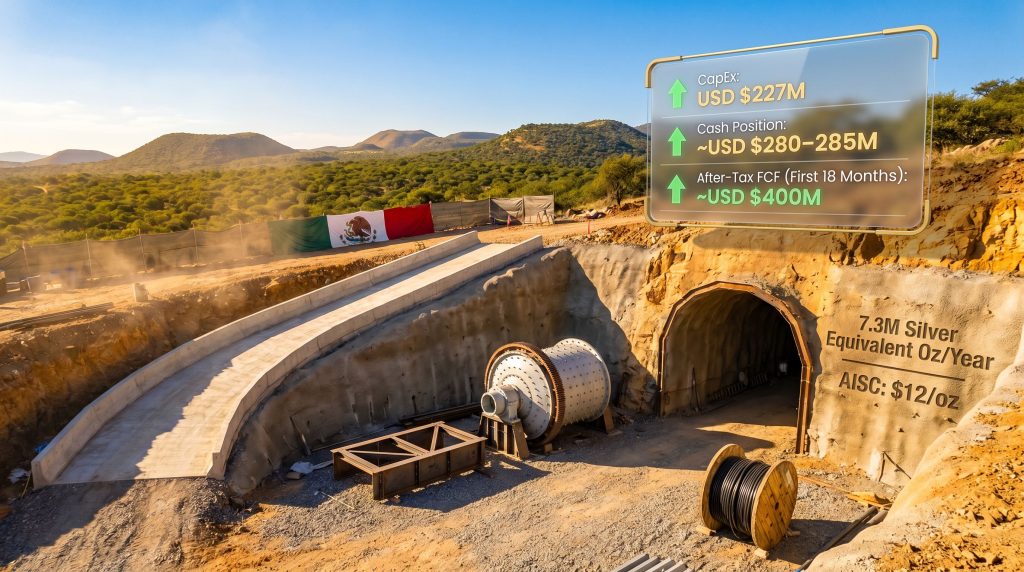
The financial discipline exercised by GoGold during the permitting period stands apart from typical junior mining developer behaviour. Rather than raising capital upon permit issuance, the company entered construction with approximately $280-285 million in cash against a $227 million capital expenditure requirement, having already deployed approximately $7 million from that envelope on pre-construction procurement.
This funding surplus eliminates three variables that typically constrain construction velocity for development-stage miners:
- Financing risk is neutralised entirely, with no requirement for debt facilities, streaming arrangements, or equity issuances
- Dilution risk is removed as a consideration for existing shareholders during the construction period
- Capital market timing risk is irrelevant, meaning the construction schedule is not dependent on favourable equity or credit market conditions
The ability to build a $227 million mine without accessing capital markets mid-construction represents a structural advantage that distinguishes GoGold from the vast majority of development-stage mining companies globally. Fewer than 5% of precious metals development projects achieve this degree of pre-construction funding certainty.
The 24-Month Construction Timeline: Phase by Phase
What the First Six Months Look Like on the Ground
Construction commencement following the official board-level mine build decision follows a well-sequenced phase plan. Within approximately two weeks of permit receipt, earthworks equipment begins mobilising to site. The first six months are characterised by simultaneous activity across four distinct workstreams:
- Earthworks mobilisation and initial site preparation including topographic modification and access road upgrades
- Mill foundation construction commencing in parallel with earthworks to avoid sequential scheduling delays
- Portal development establishing the underground mine entrance at the designated collar location
- Ramp decline construction targeting mining areas by late 2026, with initial stoping zones accessible in the latter part of the year
The 36-kilometre hydroelectric power transmission line continues progressing concurrently, representing one of the most capital-efficient power infrastructure decisions available to a Jalisco-region mining operation. Hydroelectric power access provides both cost stability and environmental credibility compared to diesel generation alternatives.
Underground Architecture and the Sub-Level Optimisation Opportunity
The feasibility study assumed 20-metre sub-level spacing as a conservative baseline for underground development planning. GoGold is currently conducting additional geotechnical drilling to evaluate whether the actual ground conditions support extending sub-levels to 30 metres — a modification that would reduce underground development metres required by approximately 30% and materially improve unit economics.
This optimisation is a post-permit activity with a direct financial upside if confirmed. The distinction between 20-metre and 30-metre sub-level spacing represents not merely a cost-saving measure but a signal of the confidence GoGold has in the rock mass quality of the Los Ricos South deposit. Underground geotechnical performance is where residual execution risk is concentrated in the project — a point Langille acknowledges directly, whilst characterising it as non-binary and bounded in scope.
Timeline Compression Potential from Pre-Completed Engineering
Standard mine construction schedules typically allocate the first several months of a 24-month build programme to completing detailed engineering. Because GoGold has already achieved approximately 75% completion of this workstream, the effective timeline from construction commencement to first pour may be meaningfully shorter than the headline 24-month figure suggests.
Because detailed engineering typically occupies a substantial portion of a standard construction Gantt chart, its near-completion status at construction commencement creates a real opportunity to compress the schedule. This is a compounding benefit of the preparation work undertaken during the permitting period.
Financial Returns: What the Numbers Actually Project
Capital Payback Analysis Against Current Metal Prices
The financial profile of Los Ricos South is built around a combination of high-grade early access zones and a low-cost operating structure. The following table summarises the key financial metrics:
| Metric | Figure |
|---|---|
| Total Project CapEx | USD $227 million |
| Projected After-Tax Free Cash Flow (First 18 Months of Full Production) | ~USD $400 million |
| Implied Payback Period | Less than 18 months of commercial production |
| Annual Production Rate | 7.3 million silver equivalent ounces |
| All-In Sustaining Cost | USD $12 per silver equivalent ounce |
The deposit geometry plays a critical role in generating this payback profile. The ramp access design aligns mine sequencing with the highest-grade mineralisation zones during initial stoping phases, meaning the ore processed in the first 18 months of commercial production is disproportionately high-value relative to the life-of-mine average. This is not a coincidence of design — it is a deliberate sequencing strategy that maximises early cash generation and minimises the payback period on the $227 million capital investment.
Life-of-Mine Plan Optimisation Under Evolving Metal Prices
At elevated silver and gold prices, life-of-mine plans are subject to grade envelope expansion. As underground access is established and short-term mine planning replaces feasibility-level assumptions, the operating team will evaluate whether including lower-grade material that becomes economic at current prices is value-accretive. This scenario would effectively increase total ounces recovered without a corresponding increase in fixed capital costs, improving overall project NPV.
Conversely, higher throughput scenarios may be evaluated as underground ground conditions become better characterised post-portal development. These are optimisation opportunities rather than risk factors, and they represent the category of decisions that well-capitalised operators with experienced underground teams are positioned to exploit.
The next major ASX story will hit our subscribers first
The District-Scale Strategy: South First, Then North
Los Ricos North as the Sequential Development Target
The strategic logic connecting Los Ricos South and Los Ricos North extends beyond geographic proximity. Both projects share nearly identical geological characteristics: wide, high-grade epithermal structures amenable to bulk underground mining methods, and both carry projected AISCs of $12 per silver equivalent ounce.
| Characteristic | Los Ricos South | Los Ricos North |
|---|---|---|
| Deposit Style | Wide epithermal structures, high grade | Comparable geology, same district |
| Mining Method | Bulk underground, ramp access | Underground and/or open pit (under evaluation) |
| All-In Sustaining Cost | $12/oz silver equivalent | $12/oz silver equivalent (projected) |
| Permitting Status | Fully permitted, construction commenced | Pre-feasibility, permitting pending |
| Distance Between Projects | Reference point | ~18 km north of Los Ricos South |
The 24-month Los Ricos South construction window is explicitly designed to run in parallel with the completion of the Los Ricos North feasibility study and permitting process. The objective is operational continuity: transfer the experienced construction team directly from Los Ricos South commissioning to Los Ricos North groundbreaking, without the productivity loss associated with team dispersal and re-assembly.
Why Los Ricos North Permitting May Be Substantially Faster
Langille characterises the Los Ricos North permitting pathway as resembling an extension application rather than a de novo environmental review. The rationale is straightforward. The environmental baseline studies conducted for Los Ricos South cover flora, fauna, hydrology, and soil classification data across Jalisco terrain that shares direct geological and ecological continuity with the northern project area.
Regulatory familiarity with the district, combined with the current administration's more permissive posture toward mining applications, supports a significantly compressed approval timeline. Drilling programmes already completed across the district further strengthen the technical foundation of any forthcoming application.
Los Ricos North also introduces an open-pit mining scenario as a potential alternative or complementary approach to underground extraction. Open-pit configurations typically generate better NPV outcomes at comparable grades due to lower development capital requirements, and the project area's relatively sparse population density reduces the socio-environmental complexity of such an application. The permitting outcomes for other operators pursuing open-pit approvals in Mexico will inform GoGold's ultimate approach to the northern project.
Risk Profile: Where Execution Uncertainty Actually Resides
Categorising Residual Risk for Los Ricos South
With financing risk effectively neutralised by the balance sheet position, the genuine risk categories for Los Ricos South are narrower than for most comparable mine builds. They fall into three areas:
- Underground geotechnical variability: Whether actual ground conditions support 30-metre sub-level spacing or revert to the conservative 20-metre feasibility assumption
- Inflation-driven cost variance: The approximately $220 million of remaining CapEx is subject to contractor and materials cost inflation, though detailed engineering bids received to date are tracking in line with feasibility estimates
- Grade reconciliation: Whilst Langille expresses high confidence in the tightly drilled resource model and 2P reserves, the transition from reserve estimation to actual mine production always carries reconciliation uncertainty
None of these represent binary project risks. They are bounded variables with upside and downside scenarios, managed by an experienced construction and operations team that has built multiple mines in Mexico over three decades.
With financing risk effectively neutralised, the residual execution risks for Los Ricos South are concentrated in underground geotechnical conditions and inflation-driven cost variance on remaining CapEx. Neither represents a binary threat to project viability.
Parral as a Liquidity Buffer Throughout Construction
The Parral tailings reprocessing operation contributes $70-80 million in annual free cash flow, providing ongoing liquidity reinforcement throughout the 24-month construction period. Having reached 12 consecutive years of continuous production with approximately five more years of mine life remaining, Parral represents a de-risked, cash-generating asset that functions as a financial backstop against unforeseen cost variances during the Los Ricos South build. Furthermore, silver supply deficits persisting into 2025 reinforce the broader market tailwinds supporting the project's financial case.
FAQ: GoGold Resources Los Ricos South Permit and Mine Build
What permits did GoGold receive for Los Ricos South?
GoGold secured both the environmental impact assessment approval and the land-use change permit issued by SEMARNAT, Mexico's federal environmental authority. These represent the final regulatory requirements before substantial construction capital could be committed. The final permits approval marked a pivotal turning point for the project's development trajectory.
How long will it take to build Los Ricos South?
The construction timeline from commencement to first pour is approximately 24 months. Given that detailed engineering is approximately 75% complete at construction commencement, the effective timeline to production may be shorter than the standard 24-month benchmark.
Does GoGold need to raise capital to build Los Ricos South?
No. With approximately $280-285 million in cash against a $227 million capital requirement, GoGold has sufficient capital on hand to fund construction entirely without debt, streaming arrangements, or equity issuances.
What is the projected production from Los Ricos South?
Los Ricos South is projected to produce 7.3 million silver equivalent ounces per year at an all-in sustaining cost of $12 per silver equivalent ounce. Consequently, construction approval at Los Ricos South represents one of the most significant development milestones in the company's history.
What is the relationship between Los Ricos South and Los Ricos North?
Both projects are located in the same Jalisco district approximately 18 kilometres apart, sharing comparable geology and projected cost profiles. GoGold's strategy is to complete Los Ricos South construction and then transition the build team directly to Los Ricos North.
How does the Parral operation relate to the Los Ricos South construction?
Parral is an active tailings reprocessing operation generating $70-80 million in annual free cash flow. It provides ongoing liquidity support during the construction period and has approximately five years of remaining mine life.
This article contains forward-looking statements and financial projections sourced from company disclosures and executive commentary. Projected production rates, cash flow figures, cost estimates, and construction timelines are subject to change based on actual geological conditions, metal prices, regulatory developments, and construction execution. This content does not constitute financial advice. Readers should conduct independent due diligence before making any investment decisions.
Want to Know When the Next Major Silver Discovery Hits the ASX?
Discovery Alert's proprietary Discovery IQ model scans ASX announcements in real time, instantly identifying high-potential mineral discoveries across silver, gold, and 30+ other commodities — so subscribers can act before the broader market catches on. Explore Discovery Alert's discoveries page to see the historic returns major mineral discoveries have delivered, and begin your 14-day free trial today to position yourself ahead of the next significant find.