June 17, 2026
The Chemistry Shift Reshaping U.S. Grid Storage from the Ground Up
Battery storage has long been treated as a commodity play — whoever delivers the most megawatt-hours at the lowest cost wins the contract. But a more nuanced reality is emerging across U.S. grid infrastructure planning. The chemistry inside the battery matters enormously, and the assumptions that made lithium-iron-phosphate (LFP) the default choice for stationary storage are being stress-tested by two converging forces: the explosive power demands of AI data centres, and the strategic imperative to reduce dependency on Chinese-manufactured battery components.
Against this backdrop, the Peak Energy and GM sodium-ion battery partnership announced on June 9, 2026, represents more than a commercial agreement between two companies. It signals a structural reconfiguration of how the United States intends to build, supply, and operate its next generation of grid-scale energy storage.
When big ASX news breaks, our subscribers know first
Why LFP's Grip on Grid Storage Is Loosening
Lithium-iron-phosphate chemistry achieved market dominance through a combination of cost reductions, manufacturing scale, and adequate performance across most stationary applications. For much of the last decade, grid operators had little reason to look elsewhere. That calculus is shifting, however, as battery storage expansion accelerates the need for more diverse and resilient chemistry options.
Three structural vulnerabilities have accumulated beneath LFP's surface dominance:
- Geographic concentration: The overwhelming majority of global LFP manufacturing capacity sits within China, exposing U.S. grid infrastructure to supply chain risk that policymakers and independent power producers are increasingly unwilling to accept.
- Thermal management burden: LFP systems require active cooling infrastructure, which consumes parasitic energy, introduces maintenance overhead, and adds capital cost. Over multi-year grid contracts, these factors compound into material total cost of ownership (TCO) disadvantages.
- Cycling limitations: LFP chemistry degrades faster under volatile charge-discharge cycles — precisely the operating profile that AI data centre power applications impose. As data centre energy demand intensifies, this limitation becomes commercially significant.
These aren't theoretical concerns. They are actively driving grid operators and independent power producers toward alternative chemistries. Sodium-ion is the most commercially advanced of those alternatives.
Sodium-Ion vs. Lithium-Ion: What the Numbers Actually Show
Understanding why sodium-ion is attracting serious industrial capital requires moving beyond headline claims and examining the performance characteristics that matter for grid-scale deployment.
Technical Performance Comparison
| Performance Metric | Sodium-Ion | Lithium-Ion (LFP) |
|---|---|---|
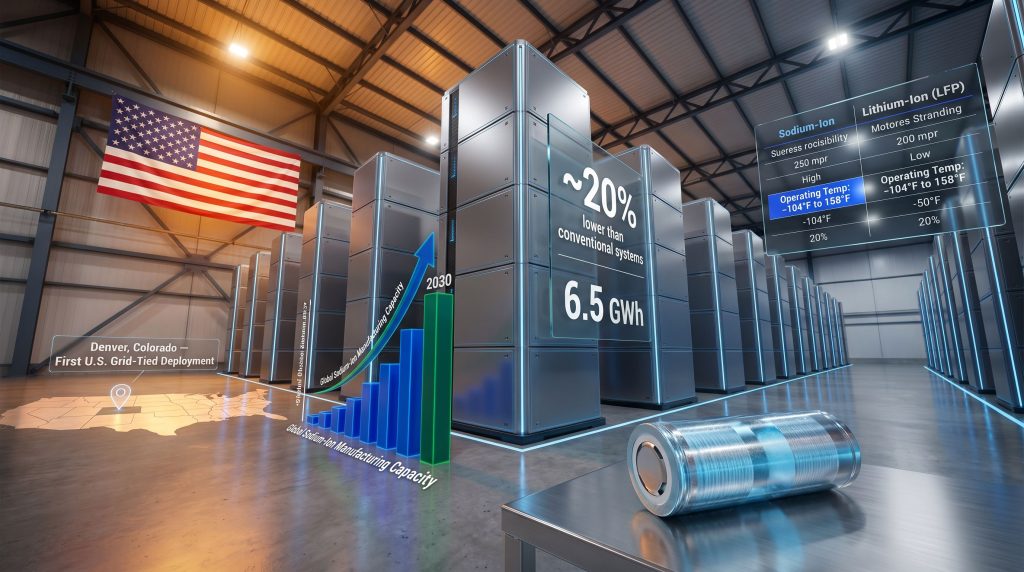
| Estimated cost advantage | ~20% below conventional systems | Baseline |
| Operating temperature range | −104°F to 158°F | Narrower range |
| Capacity retention at −104°F | ~90% | Significantly reduced |
| Cooling system requirement | Passive | Active |
| Cycle life under volatile conditions | Superior | Accelerated degradation |
| Primary application fit | Grid storage, data centres | EVs, grid storage |
One figure deserves particular attention: sodium-ion batteries retain approximately 90% of operational capacity at −104°F, according to data published by the International Energy Agency. To contextualise that threshold — no temperature ever recorded on Earth's surface has breached it. This means sodium-ion systems can be deployed across virtually every geographic environment in the United States without performance derating, eliminating the need for the thermal management infrastructure that LFP installations require in both extreme cold and heat.
The Passive Cooling Advantage: More Than an Engineering Detail
Peak Energy's systems use passive rather than active cooling architecture. For grid operators modelling 15- to 20-year asset lifecycles, this distinction is financially meaningful:
- Active cooling systems in LFP installations draw continuous parasitic power, reducing round-trip efficiency across the system's entire operating life.
- Passive cooling eliminates these operational energy costs, improving net energy throughput over the contract term.
- Lower mechanical complexity translates directly into reduced maintenance frequency and cost.
- Peak Energy has reported system availability exceeding 99%, a figure that reflects both the reliability benefits of passive architecture and the importance of uptime in grid ancillary service markets.
When aggregated across a large installed base, these efficiency gains are substantial. A wholesale transition from LFP to sodium-ion across U.S. grid battery systems could reduce annual energy waste by up to 2 TWh per year, based on projections associated with Peak Energy's system design. At the scale of U.S. grid infrastructure, that figure represents a material contribution to both grid efficiency and carbon intensity reduction.
How the Peak Energy and GM Sodium-Ion Battery Partnership Is Structured
The architecture of this partnership is worth examining carefully, because it differs meaningfully from a conventional technology licensing or supply agreement. Furthermore, the structure is specifically designed to address the supply chain vulnerabilities that have long characterised U.S. battery infrastructure.
General Motors will develop sodium-ion battery cells at its Michigan-based battery laboratories and holds exclusive manufacturing rights for those cells. This exclusivity is not incidental — it creates a structural moat around Peak Energy's domestic supply chain, insulating it from the import dependency that currently defines the majority of U.S. sodium-ion deployments.
Peak Energy will integrate GM-manufactured cells into its proprietary passively cooled energy storage systems, combining GM's industrial-scale manufacturing infrastructure with Peak's system engineering expertise and its cell engineering centre in Colorado.
GM Ventures has made a strategic equity investment in Peak Energy as part of the agreement. This detail is significant. An equity stake aligns GM's financial interests directly with Peak's commercial success — it moves the relationship beyond transactional supply dynamics into genuine strategic alignment. According to Peak Energy's official announcement, when a manufacturer of GM's scale makes an equity commitment to an emerging battery chemistry company, it typically marks the transition from niche technology to mainstream deployment trajectory.
The "Mine-to-Grid" Domestic Supply Chain Vision
Peak Energy's stated ambition is to establish a fully domestic U.S. sodium-ion supply chain, from raw material sourcing through to finished grid storage systems. GM's manufacturing infrastructure and supply chain access provide the industrial backbone this ambition requires. The company plans to announce the location of a 4 GWh/year domestic manufacturing facility in summer 2026, with GM-co-developed cells targeting commercialisation by approximately 2028.
The systems developed under this partnership will build on Peak's current design architecture but are expected to achieve improved energy density, further reducing per-MWh operating costs beyond the 20% cost advantage already demonstrated.
Peak Energy's Deployment Pipeline and Order Book
The commercial momentum behind this partnership is grounded in a concrete order book. As of June 2026, Peak Energy has booked approximately 6.5 GWh in orders, anchored by two significant milestones:
| Milestone | Detail | Timeframe |
|---|---|---|
| First U.S. grid-tied sodium-ion deployment | 3.5 MWh system near Denver, Colorado | Late 2025 |
| Jupiter Power agreement | Up to 4.75 GWh of sodium-ion systems | By 2030 |
| Jupiter Power initial delivery | 720 MWh | 2027 deployment |
| Jupiter Power capacity reservation | Up to 4 GWh additional | 2028–2030 |
| Domestic manufacturing facility announcement | Location TBA | Summer 2026 |
| GM cell commercialisation target | Michigan manufacturing | ~2028 |
The Denver installation deserves recognition as more than a demonstration project. Commissioned in late 2025, it was the first grid-scale sodium-ion installation in the United States — a proof-of-concept that has now been followed by one of the country's largest industrial battery partnerships within months.
Systems are designed to support four- to 12-hour discharge durations, positioning Peak's technology across both short-duration peaking applications and longer-duration grid resilience use cases.
AI Data Centres: The Demand Driver Most Analysts Are Underweighting
Grid balancing gets most of the attention in energy storage discussions. However, the more analytically interesting demand driver for sodium-ion may be AI data centre power infrastructure — and it's a market dynamic that remains underappreciated in mainstream coverage.
AI workloads impose fundamentally different power demands than conventional computing. The rapid, repeated cycling of charge and discharge events that characterise data centre power buffering accelerates degradation in lithium-ion battery systems. This isn't a marginal performance gap — it represents a genuine reliability and replacement cost challenge at scale.
Sodium-ion chemistry's high cycle life and lower degradation rates under volatile cycling conditions make it structurally better suited to this application environment. Consider three plausible scenarios for how this plays out:
Scenario A — LFP Continues to Dominate Data Centre Storage:
Data centres accept higher replacement frequency, maintain active thermal management infrastructure, and sustain dependency on Chinese LFP manufacturing. TCO remains elevated relative to alternatives.
Scenario B — Sodium-Ion Achieves Scale via Domestic Production:
U.S.-manufactured sodium-ion cells reduce import dependency, lower TCO over system lifetime, and improve data centre energy economics. The Peak Energy and GM sodium-ion battery partnership is specifically designed to enable this outcome.
Scenario C — Hybrid Chemistry Deployment Emerges:
Data centres deploy sodium-ion for bulk energy storage and lithium-ion for high-power burst applications, optimising chemistry selection across different functions within a single facility.
The direction of travel appears to favour Scenario B, at least for new builds where procurement decisions are being made now with a 2027–2030 deployment horizon in mind.
The next major ASX story will hit our subscribers first
The China Dominance Problem and What Domestic Manufacturing Actually Requires
The scale of China's current advantage in sodium-ion manufacturing is not widely appreciated outside specialist circles. The overwhelming majority of operating sodium-ion stationary storage systems globally are located in China. So is the dominant share of global manufacturing capacity. In addition, a Chinese battery recycling breakthrough in 2025 further reinforced China's position across the broader battery supply chain.
The International Energy Agency projects that global sodium-ion manufacturing capacity will increase approximately sixfold by 2030, according to IEA data published in 2025. The trajectory of that growth is heavily weighted toward China. Consequently, the battery raw materials market dynamics are becoming increasingly central to how domestic manufacturers plan their supply chains.
| Region | Current Manufacturing Position | 2030 Outlook |
|---|---|---|
| China | Dominant — majority of global capacity | Continued leadership expected |
| United States | Minimal — early-stage domestic buildout | Growth dependent on partnerships like Peak–GM |
| Europe | Limited | Emerging investment activity |
Source: International Energy Agency sodium-ion battery manufacturing capacity data, 2025
Peak Energy's planned 4 GWh/year facility represents one of the most structurally significant U.S. efforts to change this picture. But it also illustrates the scale of the challenge: 4 GWh/year of domestic capacity, while meaningful, is modest relative to the installed base China is building. The Peak Energy and GM sodium-ion battery partnership matters not just as a commercial milestone, but as a template for the kind of industrial collaboration that closing this gap will require.
Startups alone cannot replicate what GM brings to this equation. Michigan-based battery manufacturing infrastructure, established supply chain relationships, and the capital depth to sustain a multi-year cell development and commercialisation programme are assets that only an industrial-scale partner can provide. Furthermore, the broader critical minerals demand landscape — shaped by the global energy transition — makes domestic sourcing strategies an increasingly urgent priority.
Key Milestones: A Forward-Looking Timeline
| Date / Timeframe | Event |
|---|---|
| Late 2025 | First U.S. grid-tied sodium-ion deployment commissioned (3.5 MWh, near Denver) |
| November 2025 | Jupiter Power supply agreement announced (up to 4.75 GWh by 2030) |
| June 9, 2026 | Peak Energy–GM partnership announced |
| Summer 2026 | Domestic manufacturing facility location announcement |
| 2027 | Jupiter Power initial 720 MWh delivery |
| ~2028 | GM-co-developed sodium-ion cell commercialisation |
| 2028–2030 | Jupiter Power capacity reservation (up to 4 GWh) |
| By 2030 | IEA projected sixfold increase in global sodium-ion manufacturing capacity |
Frequently Asked Questions: Peak Energy and GM Sodium-Ion Battery Partnership
What is the Peak Energy and GM sodium-ion battery partnership?
Peak Energy and General Motors have formed a strategic partnership to develop and manufacture sodium-ion battery cells for grid-scale stationary energy storage in the United States. GM will produce the cells in Michigan under exclusive manufacturing rights, while Peak Energy integrates them into its proprietary passively cooled storage systems. GM Ventures has also made a strategic equity investment in Peak Energy as part of the arrangement.
How does sodium-ion compare to lithium-ion for grid storage?
Sodium-ion batteries offer several structural advantages for stationary grid storage: they operate across a wider temperature range, retaining approximately 90% capacity at −104°F; they require passive rather than active cooling; and they are estimated to cost around 20% less than conventional lithium-based systems. They also demonstrate superior cycle life under volatile, multi-cycle daily operating conditions. Technologies such as direct lithium extraction continue to evolve in parallel, highlighting how rapidly the broader battery technology landscape is advancing.
Why is GM targeting stationary storage with sodium-ion rather than EVs?
Sodium-ion's current energy density profile is better suited to stationary applications than high-performance EV propulsion. GM's broader battery strategy centres on deploying the most appropriate chemistry for each application, rather than forcing a single chemistry across all use cases. Stationary grid storage represents a distinct and growing revenue stream for GM's battery manufacturing capabilities.
What is Peak Energy's current order book?
As of June 2026, Peak Energy has approximately 6.5 GWh of orders booked, including an agreement to supply up to 4.75 GWh of sodium-ion systems to independent power producer Jupiter Power by 2030. RenewEconomy's analysis of the deal notes it represents one of the most significant domestic battery storage commitments announced in the United States this year.
When will Peak Energy's domestic manufacturing facility open?
Peak Energy has indicated it will announce the location of a planned 4 GWh/year domestic facility in summer 2026, with GM-co-developed cells targeting commercialisation by approximately 2028.
Why does sodium-ion suit AI data centre applications?
AI data centres impose highly variable power demands requiring frequent charge and discharge cycling. Sodium-ion batteries' high cycle life and lower degradation under repeated cycling make them more durable in this environment than lithium-ion alternatives, which experience accelerated wear under similar operating conditions.
The Broader Signal for U.S. Grid Storage Competitiveness
The Peak Energy and GM sodium-ion battery partnership carries implications that extend well beyond two companies closing a commercial deal. It represents the most structurally significant attempt to date to establish a domestic U.S. sodium-ion supply chain with genuine industrial-scale backing.
The dual-market thesis is compelling: grid resilience and AI data centre power infrastructure are converging demand drivers that both favour the thermal, cycling, and cost characteristics of sodium-ion chemistry. The supply chain sovereignty dimension adds a further layer of strategic rationale that transcends pure commercial economics.
What remains to be proven, however, is execution. A 4 GWh/year manufacturing facility, GM cell commercialisation by 2028, and a 6.5 GWh order book are credible foundations — but the distance between announced ambition and operational domestic supply chain remains considerable in any advanced manufacturing sector. Investors and grid operators alike would be wise to track milestone delivery with the same rigour applied to the partnership's headline figures.
Disclaimer: This article contains forward-looking statements and projections based on publicly available information and announced partnership details. Actual outcomes may differ materially from those described. Nothing in this article constitutes financial or investment advice. Readers should conduct their own due diligence before making investment decisions.
Want to Track the Next Major Mineral Discovery Before the Market Does?
Discovery Alert's proprietary Discovery IQ model delivers real-time alerts on significant ASX mineral discoveries — cutting through complex data to surface actionable opportunities the moment they're announced, whether in battery materials, critical minerals, or the commodities powering the global energy transition. Explore historic discoveries and their returns to understand the scale of what early positioning can mean, then begin your 14-day free trial at Discovery Alert to secure your market-leading edge.