June 29, 2026
When Refining Headlines Hide an Upstream Crisis
The story of a state oil company is rarely told accurately through a single quarter's numbers. It is better understood through the slow divergence between what a company can process and what it can actually pull from the ground. That gap, when left unaddressed long enough, eventually becomes a structural problem that no amount of financial engineering or downstream investment can paper over. That is precisely the dynamic now playing out inside Mexico's Petróleos Mexicanos, and the PEMEX 1Q results published this week make the tension impossible to ignore.
When big ASX news breaks, our subscribers know first
PEMEX 1Q26 Results: The Numbers Behind the Headlines
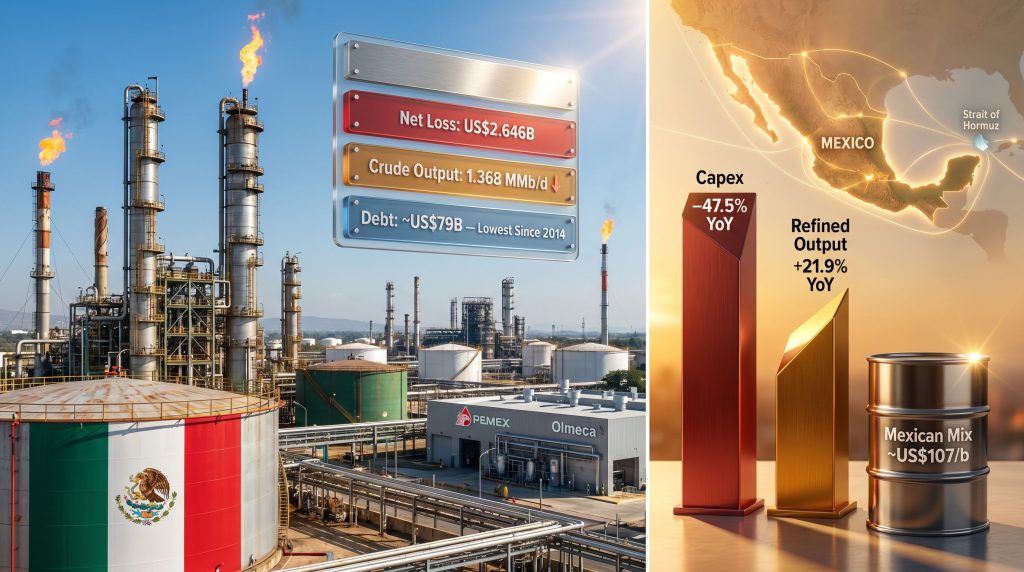
The top-line figures from PEMEX's first quarter of 2026 paint a company that is simultaneously improving and deteriorating, depending on which side of the operations ledger you examine. Total revenues fell 7.6% year-on-year to MX$365.7 billion, with export volumes contracting 25.3% even as global crude prices climbed well above the Mexican government's planning assumptions. The net loss widened to approximately MX$46 billion (US$2.646 billion), a 6.1% deterioration from the MX$43.3 billion loss recorded in the same period of 2025, marking the company's weakest opening quarter since 2020.
The institutional tracker published by IMCO, which monitors PEMEX's quarterly operational and financial health, identified the divergence between refining improvements and upstream deterioration as the defining narrative of the period. Furthermore, official quarterly results published directly by PEMEX confirm the scale of the financial deterioration across multiple operating segments.
PEMEX 1Q26 Core Performance Summary
| Metric | 1Q26 Value | Year-on-Year Change |
|---|---|---|
| Net Loss | MX$46B (US$2.646B) | -6.1% (worse) |
| Total Revenue | MX$365.7B | -7.6% |
| Export Volumes | Contracted | -25.3% |
| Gross Financial Debt | MX$1.43T (~US$79B) | -30.5% |
| Capital Investment | MX$54.2B | -47.5% |
| Crude Output | 1.368 MMb/d | Near 16-year Q1 low |
| Refined Product Output | 1.110 MMb/d | +21.9% |
| Diesel Production | Olmeca-driven | +69.9% |
| Gasoline Production | Olmeca-driven | +27.7% |
| Cumulative Govt. Transfers (since 2019) | MX$1.8 trillion | Cumulative |
The revenue decline is particularly striking given the global price environment. The Mexican Mix crude benchmark was trading near US$107 per barrel during the quarter, significantly above the government's US$77.3/b budget baseline. Under Mexico's fiscal framework, each dollar above that baseline generates approximately MX$9.6 billion in additional government revenue. Yet that windfall flowed to the federal treasury rather than stabilising PEMEX's own income statement, which continued to be eroded by asset impairments, foreign exchange losses, and elevated financial costs.
Debt Reduction in Context: Progress That Doesn't Solve the Core Problem
The one headline that PEMEX can present with genuine credibility is its debt trajectory. Gross financial debt fell 30.5% year-on-year to MX$1.43 trillion, equivalent to approximately US$79 billion, the lowest level the company has carried since 2014. Cumulative government capital injections and debt relief transfers since 2019 have now reached MX$1.8 trillion, reflecting the extraordinary and sustained fiscal commitment required simply to keep the company solvent and operational.
Despite this progress, PEMEX retains the distinction of carrying the largest debt load of any oil company in the world. The debt reduction is structurally meaningful, but it exists alongside a capital investment programme that has collapsed to levels incompatible with sustaining production. According to the IMCO tracker, capital expenditure fell 47.5% year-on-year to MX$54.2 billion, the lowest investment figure in eight years.
The paradox of PEMEX's current position is that the company is shrinking its balance sheet liabilities while simultaneously starving the assets that generate the revenue needed to service those liabilities. Lower debt without investment recovery is not a path to sustainability; it is a managed retreat.
The compounding logic here matters for anyone watching Mexico's energy sector closely. Upstream oil production is a time-lagged business. Fields take years to develop, and the consequences of underinvestment do not appear immediately in production data. They appear three to five years later, when wells begin depleting faster than new capacity can replace them. PEMEX has now been running below replacement-level investment for long enough that the production data is beginning to reflect exactly that consequence.
Olmeca's Refining Gains Cannot Compensate for Upstream Decline
The most visually positive element of the PEMEX 1Q results is the refining performance, and it deserves genuine recognition. Total refined product output grew 21.9% year-on-year to 1.110 MMb/d, with diesel production surging 69.9% and gasoline output rising 27.7%. Both gains are attributable to the expanding operational contribution of the Olmeca refinery, Mexico's newest and most modern processing facility.
Olmeca's growing throughput is not a trivial development. Mexico has historically been a net importer of refined products despite being a crude oil producer, a structural inefficiency that has cost the country billions of dollars in annual foreign exchange. Olmeca's ramp-up is beginning to address that imbalance, reducing exposure to imported fuel price volatility, particularly relevant during the current period of extreme global energy market disruption.
Upstream vs. Downstream Performance Comparison, 1Q26
| Segment | Key Metric | Direction | Primary Driver |
|---|---|---|---|
| Upstream (Crude) | 1.368 MMb/d | Near 16-year Q1 low | Underinvestment, field depletion |
| Downstream (Refining) | 1.110 MMb/d | +21.9% YoY | Olmeca refinery ramp-up |
| Diesel | Volume output | +69.9% YoY | Olmeca throughput |
| Gasoline | Volume output | +27.7% YoY | Olmeca throughput |
However, the structural tension is real. Crude output of 1.368 MMb/d represents the second-lowest first-quarter production figure recorded over the past 16 years. A refinery cannot process crude it does not receive, and no volume of downstream efficiency gains changes the fundamental upstream trajectory. Mexico's Energy Minister Luz Elena González acknowledged Olmeca's buffering role in an El Financiero column published this week, specifically citing the facility's domestic throughput as reducing the country's exposure to imported fuel price swings. That point is valid. But it sidesteps the harder question of what happens to refining output if crude production continues declining at the current rate.
Environmental and Safety Metrics: The Underreported Deterioration
Financial coverage of PEMEX's quarterly results tends to focus on revenue, debt, and production volumes. What receives considerably less attention is the environmental and safety performance data embedded in the same reporting period, and the 1Q26 figures represent a material deterioration across multiple indicators simultaneously.
- Gas venting surged 78.6% year-on-year, raising serious questions about methane management and Mexico's ability to meet its environmental commitments
- Sulphur oxide (SOx) emissions reached their highest first-quarter level recorded since 2012, reversing incremental improvements made over the preceding decade
- The accident frequency index rose 41.3%, indicating a significant worsening of workplace safety performance across PEMEX's operations
These are not peripheral metrics. For ESG-oriented institutional investors, international lenders applying environmental covenants, and Mexico's own regulatory agencies, a simultaneous deterioration across venting, emissions, and safety performance in a single quarter is a meaningful risk signal.
The gas venting increase is particularly significant from a climate perspective. Methane, which is the primary component of vented gas, carries a global warming potential approximately 80 times greater than CO2 over a 20-year horizon. A 78.6% year-on-year surge in venting is not a rounding error; it represents a structural operational issue that demands explanation and remediation. Whether this increase reflects equipment failures, reduced maintenance investment, changes in operational methodology, or deliberate decisions under financial pressure is not specified in the available data, but the scale of the increase suggests something beyond normal operational variance.
Mexico's Fuel Subsidy Mechanism Under Global Price Shock Conditions
Mexico's IEPS-based fuel price containment system, a mechanism through which the government absorbs the difference between market prices and regulated retail prices by forgoing tax collection rather than writing cheques, has been operating under extreme stress during the current period of elevated global crude prices.
Energy Minister González made the case publicly this week that without the subsidy intervention, retail gasoline prices would have exceeded MX$30 per litre and diesel would have surpassed MX$35 per litre under prevailing market conditions. The government has been effectively sacrificing between MX$3 and MX$6 per litre in forgone tax revenue to keep pump prices at levels that protect household purchasing power. At the height of the oil price spike, that translated to approximately US$280 million per week in fiscal cost.
The minister framed this policy as a structurally grounded response to what she characterised as the most significant reshaping of the global energy order since the disruptions of the 1970s, a comparison that reflects both the severity of the current supply shock and the political weight being placed on the subsidy mechanism as a social stabilisation tool.
The fiscal maths, however, create a complex picture. The same elevated oil prices that trigger subsidy costs also generate fiscal upside through the Mexican Mix premium. With crude trading near US$107/b against a US$77.3/b budget baseline, and each dollar above the baseline generating approximately MX$9.6 billion in additional revenue, the government's overall fiscal position from hydrocarbons may be more balanced than the subsidy headline figure suggests. But the distribution of that benefit across government revenue lines and PEMEX's own accounts is not symmetrical.
The next major ASX story will hit our subscribers first
Project Freedom and the Strait of Hormuz: The Global Supply Shock Driving Mexico's Energy Calculus
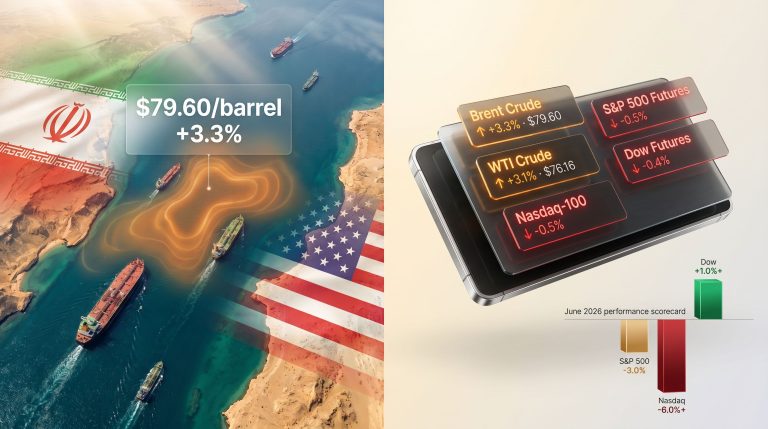
Understanding PEMEX's current operating environment requires contextualising the extraordinary disruption to global oil supply that has been unfolding since late February 2026. On May 4, the US military launched an operation designated Project Freedom, deploying guided-missile destroyers, more than 100 aircraft, and approximately 15,000 service members to escort two US-flagged merchant vessels through the Strait of Hormuz, marking the first American commercial transit through the waterway since hostilities began on February 28.
Brent crude settled at US$114.44 per barrel in the wake of the operation. Iran simultaneously launched four cruise missiles toward the UAE; three were intercepted and one fell into the sea. A separate drone strike ignited a fire at the Fujairah oil hub during the same period.
Goldman Sachs has estimated that the Hormuz closure has effectively removed approximately 14.5 MMb/d from accessible global markets. Both the CEO of ExxonMobil and the CEO of Chevron have publicly cautioned that supply normalisation will take months even after a diplomatic resolution, given the operational complexity of sweeping naval mines and redeploying hundreds of stranded tankers that have accumulated throughout the disruption period.
For Mexico, this supply shock environment is simultaneously a fiscal opportunity and an operational challenge. The premium over budget assumptions on the Mexican Mix generates meaningful additional government revenue, but it also sustains pressure on the IEPS subsidy mechanism and complicates PEMEX's own cost structure.
Cuba Oil Trade: The Geopolitical Risk Hiding in PEMEX's Subsidiary Structure
One of the less-discussed but potentially consequential developments in this week's PEMEX news cycle involves the rebranding of the subsidiary formerly known as Gasolinas Bienestar, the entity used to channel oil and fuel exports to Cuba since 2023. The subsidiary has been renamed Servicios Logísticos Integrales Mumiya, stripping the politically charged branding of the previous administration from a commercial vehicle now operating under significant US regulatory scrutiny.
The timing of the rebrand is not coincidental. It follows the signing of a US executive order authorising tariffs on nations that continue selling oil to Cuba, and arrives during the active USMCA review period when US-Mexico trade relations are under close examination. PEMEX's own SEC filings documented US$500 million in Cuba oil exports during 2025 while explicitly flagging uncertainty about the consequences of evolving US policy toward that trade.
A January 2026 shipment was suspended under Washington pressure. PEMEX Director Víctor Rodríguez has characterised the trade as purely commercial, pointing to Cuba's consistent payment record. However, analysts have noted an uncomfortable irony: PEMEX's own regulatory disclosures to US securities authorities effectively document the case against continuing the arrangement, by quantifying the exposure and acknowledging the policy risk in language designed for compliance rather than advocacy.
The combination of an active US executive order, USMCA review leverage, and PEMEX's own SEC-disclosed risk warnings creates a compounding geopolitical exposure that goes beyond routine commercial risk and into territory that could affect Mexico's broader bilateral trade position.
Amigo LNG and the Pipeline Capacity Problem That Could Kill Pacific Coast Exports
Mexico's ambitions as a Pacific-facing LNG exporter have long been complicated by infrastructure realities, and a March 2026 analysis published by the Institute for Energy Economics and Financial Analysis (IEEFA) has crystallised the specific technical bottleneck that threatens the Amigo LNG project.
The Sásabe-Guaymas pipeline, which would serve as the feedgas supply route for Amigo LNG, operates at a maximum capacity of 812 MMcf/d. The proposed terminal's feedgas demand alone is estimated at between 745 and 800 MMcf/d. That leaves as little as 12 MMcf/d of available capacity for the four existing gas-fired power stations in Sonora that currently depend on the same pipeline for fuel supply. Running an LNG export terminal and keeping Sonora's power grid operational simultaneously through this single pipeline is mathematically impossible at the proposed project scale.
The situation is further complicated by permitting sequencing. Amigo LNG's US Department of Energy export authorisation expires in December 2027, before the project's revised startup date of the second quarter of 2028. This means the project will need to reapply for export authorisation before it can actually begin operations, a sequencing error that closely mirrors the permitting failure that contributed to the collapse of the Saguaro LNG project.
Pacific Coast LNG Project Status Overview
| Project | Current Status | Key Issue |
|---|---|---|
| Amigo LNG | At significant risk | Pipeline capacity conflict; DOE permit expires before startup |
| Saguaro LNG | Failed | Permitting sequencing error |
| Energía Costa Azul (Sempra) | Delayed | Construction and regulatory delays |
| Vista Pacífico LNG | Cancelled | Project abandoned |
The pattern across all four projects is not coincidental. Pacific coast LNG development in Mexico has consistently encountered either infrastructure constraints that were inadequately assessed during project design, or permitting processes that were not properly sequenced against realistic construction timelines. The Amigo LNG situation suggests that lesson has not yet been fully absorbed by project developers or regulators.
Mexico's Biofuels Framework: Legislative Foundation Without Investment Clarity
Beyond the immediate quarterly results, Mexico is advancing a longer-term energy diversification strategy through its national biofuels programme. The legislative architecture is in place, with the Biofuels Law published in March 2025 and the Circular Economy Law providing the statutory framework. Coordinating institutions include SEMARNAT, SENER, CNE, INECC, and Banobras, with technical assistance from the Inter-American Development Bank focusing on converting organic waste and wastewater streams into usable biofuel.
The resource base is not trivial. Mexico generates approximately 139,000 tonnes of urban solid waste daily, with close to half classified as organic material. The vast majority of this feedstock is currently not recovered for energy purposes, representing a significant untapped supply base for a domestic biofuels industry.
PEMEX has presented bioethanol as a component of its emissions reduction strategy, citing its existing logistics and distribution infrastructure as a natural integration pathway for biofuel blending and distribution. President Sheinbaum has confirmed that exploratory discussions with Brazil's Petrobras on biodiesel and ethanol technology transfer are underway, though no formal agreements have been concluded.
Experts presenting at a recent Senate forum acknowledged meaningful development opportunities in the bioethanol space but consistently flagged three interconnected gaps that limit near-term scalability:
- Regulatory clarity: The framework exists, but specific blending mandates, quality standards, and subsidy structures remain undefined
- Investment pathways: Private sector participation models have not been adequately developed, leaving Banobras as the primary financing vehicle
- Scalability infrastructure: Converting organic waste to biofuel at commercially meaningful scale requires processing infrastructure that does not yet exist in sufficient quantity
What the PEMEX 1Q26 Results Tell Investors About Mexico's Energy Trajectory
Taken together, the PEMEX 1Q results reveal a company and an energy sector navigating several simultaneous stress points, each with a different time horizon and risk profile. In addition, reporting from Mexico News Daily underscores the mounting concern that even government bailout support and rising global prices have failed to prevent another quarter of deepening losses.
- Financial losses deepened in absolute terms despite meaningful debt reduction and a highly favourable global price environment, signalling that structural cost and revenue problems persist independent of commodity cycles
- Upstream production continues declining toward multi-decade lows, while capital investment has fallen to levels that make a production recovery without a fundamental strategy shift increasingly difficult to envision
- Environmental and safety performance deteriorated sharply across multiple indicators in a single quarter, a development with implications for international financing, regulatory standing, and Mexico's own energy transition commitments
- The Cuba oil trade creates a geopolitical risk profile that sits at the intersection of US executive action, USMCA review dynamics, and PEMEX's own SEC-disclosed uncertainties
- Pacific coast LNG infrastructure ambitions face technical and permitting constraints serious enough to threaten project viability for the second or third consecutive project cycle
- The biofuels legislative foundation is genuine but the investment and regulatory specificity required for commercial-scale deployment remains absent
Disclaimer: This article contains forward-looking analysis and references to financial projections, policy scenarios, and market forecasts. These should not be construed as investment advice. All financial metrics referenced are sourced from IMCO's PEMEX quarterly tracker and Mexico Business News reporting dated May 7, 2026. Readers should consult primary PEMEX financial filings and independent financial advisors before making investment decisions based on any information contained herein.
Want Real-Time Alerts on the Next Major Mineral Discovery Before the Broader Market Catches On?
While PEMEX navigates upstream decline and structural debt challenges, Discovery Alert's proprietary Discovery IQ model is scanning the ASX daily to identify significant mineral discoveries the moment they are announced — visit the Discovery Alert discoveries page to see how historic finds have delivered extraordinary returns, and begin your 14-day free trial at Discovery Alert to position yourself ahead of the market.