May 16, 2026
When Balance Sheets Outweigh Barrels: The New Calculus at the Top of PEMEX
State-owned energy giants rarely pivot their leadership philosophy overnight. For decades, the archetypal national oil company director came from a lineage of engineers, geologists, and energy economists, individuals whose credibility was built on reservoir data and production curves. Yet something is shifting across the global landscape of sovereign petroleum institutions. As debt loads accumulate, credit agencies sharpen their pencils, and capital markets grow increasingly impatient with companies that blend political mandates with commercial obligations, the profile of the ideal NOC leader is quietly being rewritten. The appointment of Juan Carlos Carpio Fragoso as PEMEX Director General is one of the clearest expressions of this transformation anywhere in the world.
When big ASX news breaks, our subscribers know first
Why Financial Expertise Has Become PEMEX's Most Valuable Leadership Asset
There is a telling contrast embedded in this leadership transition. The outgoing director, Víctor Rodríguez Padilla, arrived at PEMEX equipped with a physics degree, a master's in energy engineering, and a doctorate in energy economics from the University of Grenoble. His appointment reflected an institutional belief that PEMEX's recovery would be driven by a well-architected operational and strategic vision. The resulting product of his tenure, the Strategic Plan 2025-2035, published in August 2025, provided exactly that: a comprehensive roadmap framing 2027 as the year PEMEX would reach financial self-sufficiency, ending its structural dependence on federal transfers.
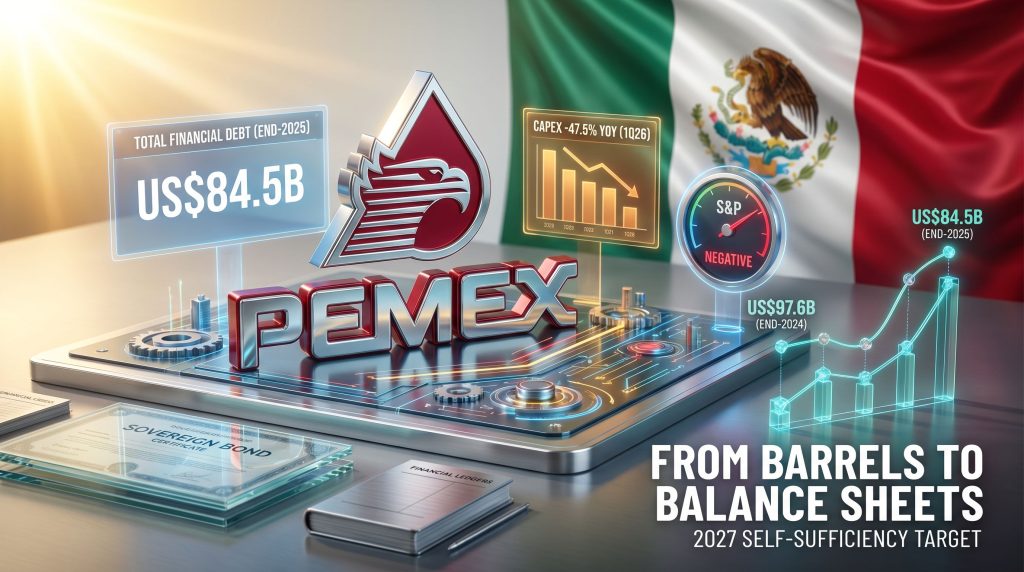
What that roadmap could not resolve, however, was the mounting tension between ambition and arithmetic. By the first quarter of 2026, PEMEX reported a net loss of MX$46 billion, capital expenditure had contracted by 47.5% year-on-year, and crude oil production remained stubbornly below the 1.8 million barrels per day threshold the Strategic Plan identified as foundational. Furthermore, as crude oil price trends in 2025 added external pressure to an already strained balance sheet, selecting a career public finance specialist as the new Director General communicates something unmistakable: the Sheinbaum administration now views debt architecture as the central problem, not production optimisation.
The Institutional Pressure Table: Mapping PEMEX's Financial Landscape
| Indicator | Figure |
|---|---|
| Total Financial Debt (end-2025) | US$84.5 billion |
| Total Financial Debt (end-2024) | US$97.6 billion |
| Consecutive Years of Debt Reduction | 5 years |
| Capex Change (1Q26 vs. 1Q25) | -47.5% |
| Net Loss (1Q26) | MX$46 billion |
| Early Debt Retirement (1Q26) | US$1.126 billion |
| S&P Global Ratings Outlook | Revised to Negative |
| Crude Production Target | 1.8 MMb/d (currently unmet) |
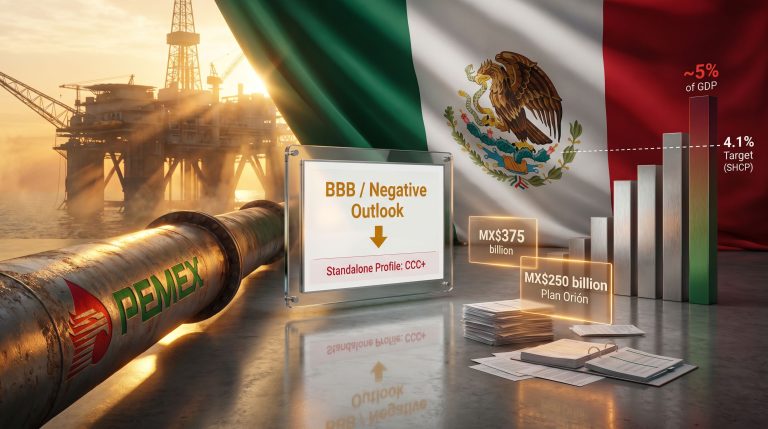
The five consecutive years of debt reduction represent genuine progress. PEMEX has shed more than US$13 billion in financial obligations in a single year, moving from US$97.6 billion at end-2024 to US$84.5 billion at end-2025. Yet credit agencies have not rewarded this trajectory with confidence. S&P Global Ratings revised the company's outlook from stable to negative, a signal that structural dependency on public funds and PEMEX's contribution to Mexico's widening fiscal deficit are concerns that debt reduction alone cannot neutralise.
Who Is Juan Carlos Carpio Fragoso? A Career Built on Public Finance
Understanding why this appointment carries strategic weight requires mapping Carpio's professional formation with precision. Mexico's President announced the resignation of the previous PEMEX CEO, paving the way for this significant leadership shift.
Academic and Professional Background
- Undergraduate Degree: Economics, Universidad Nacional Autónoma de México (UNAM)
- Postgraduate Degree: Master's in Public Management (Gerencia Pública), Centro de Investigación y Docencia Económicas (CIDE)
- Public Sector Experience: More than 20 years
- Core Disciplines: Financial administration, sovereign debt management, public finance, and fiscal governance
CIDE, where Carpio completed his postgraduate studies, is not a conventional economics institution. It is widely regarded as one of Mexico's most rigorous centres for public policy analysis and government administration, producing a disproportionate share of the country's senior fiscal technocrats. A master's degree from CIDE in public management signals a very specific intellectual formation: one oriented toward institutional finance mechanics rather than market economics or energy systems theory.
Career Trajectory: From Mexico City to PEMEX's Top Office
| Period | Position | Institution |
|---|---|---|
| During Sheinbaum's Mexico City administration | Director General of Financial Administration | Mexico City Finance Ministry |
| 2024 to May 2026 | Corporate Director of Finance | PEMEX |
| May 2026 (appointed) | Director General (CEO) | PEMEX |
This career path reveals something that goes beyond credentials. During his time at the Mexico City Finance Ministry, Carpio worked directly under Luz Elena González, who now serves as Mexico's Minister of Energy and sits at the apex of the federal government's energy policy architecture. That institutional relationship did not dissolve when their respective roles changed; it deepened and expanded.
When González moved into the federal Energy Ministry and Carpio joined PEMEX as Corporate Director of Finance in 2024, the working relationship was effectively transposed into the national energy governance structure. The result is a policy triangle connecting President Sheinbaum, Minister González, and now Juan Carlos Carpio PEMEX Director General — three figures with overlapping institutional histories and aligned strategic priorities.
This configuration is not incidental in Mexico's state-led energy model. In an institutional environment where PEMEX's financial decisions carry direct consequences for federal fiscal balances, the coherence of the decision-making chain between the presidency, the energy ministry, and the company's leadership is a functional prerequisite for policy execution.
The S&P Negative Outlook: What Credit Markets Are Actually Saying
A negative outlook from S&P Global Ratings is frequently misread by general audiences as a minor administrative adjustment. In practice, it functions as a formal warning mechanism within the credit rating system, communicating that a downgrade to the underlying rating is more probable than not if current conditions persist over the following 12 to 24 months.
For PEMEX, the specific concerns embedded in the S&P revision centre on two interlocking vulnerabilities:
-
Structural dependency on federal transfers — PEMEX continues to require direct support from the Mexican federal government to sustain operations. This dependency means that PEMEX's credit risk is partially a function of Mexico's own sovereign fiscal position, creating a circular pressure dynamic.
-
Contribution to Mexico's fiscal deficit — The government's financial support for PEMEX is not fiscally neutral. Each peso transferred to PEMEX widens Mexico's fiscal deficit, which in turn affects sovereign credit metrics and borrowing costs at the national level.
The practical consequences of this negative outlook are immediate and compounding. In addition, broader US economy tariff pressures in 2025 have introduced further uncertainty into the macroeconomic environment within which PEMEX must navigate its refinancing obligations:
- Future international bond issuances carry higher risk premiums, increasing the effective cost of debt
- Institutional investors with credit-quality mandates may reduce or restrict PEMEX holdings
- Sovereign bond pricing for Mexico more broadly absorbs some of the reputational pressure associated with PEMEX's fiscal drag
- The timeline pressure on the 2027 self-sufficiency target intensifies, as any delay extends the period of federal subsidy dependency
The February 2026 Bond Placement: A Signal Worth Decoding
One of the most instructive data points for understanding PEMEX's near-term financing trajectory is the February 2026 domestic bond issuance. The placement of MX$31.5 billion in local bonds was the largest ever executed by a private-sector issuer in Mexico's domestic capital market. The issuance was oversubscribed by a factor of 2.5 times, meaning investor demand exceeded the available supply by 150%.
This result matters for several reasons that extend beyond the headline figure:
- It demonstrates that domestic institutional investors maintain appetite for PEMEX paper under the right pricing and structural conditions
- It established a precedent that Carpio can leverage in evaluating a return to international bond markets
- The oversubscription ratio suggests that the negative S&P outlook has not uniformly suppressed investor interest, though international markets would apply a different risk calculus than domestic ones
- The transaction was executed under Carpio's direct oversight as Corporate Director of Finance, effectively serving as a live demonstration of his capabilities before assuming the top role
Finance Minister Édgar Amador Zamora has confirmed that the government and PEMEX's finance leadership are actively assessing international financing alternatives, with the explicit condition that market conditions will be evaluated at each stage before any international issuance proceeds.
Three Priority Pillars Shaping Carpio's Agenda
1. Re-engaging International Debt Markets
The domestic bond success of February 2026 creates a foundation, but not a replacement, for international capital market access. PEMEX's debt profile requires diversification across currency denominations and investor bases. Carpio's first months in the Director General role will likely involve intensive engagement with international institutional investors to assess appetite, benchmark pricing, and determine the optimal timing for a potential international issuance.
2. Resolving Supplier Payment Arrears
Chronic delays in payments to contractors and suppliers represent one of PEMEX's most operationally damaging structural problems. When suppliers lack confidence in payment timelines, they adjust contract terms, reduce credit extensions, and in some cases exit the Mexican market entirely. This erodes the operational ecosystem PEMEX depends on for drilling, maintenance, and infrastructure work. Carpio's prior engagement in supplier payment negotiations during his finance directorship gives him institutional knowledge of this problem that an external appointment would lack.
3. Anchoring the Strategic Plan 2025-2035 to Financial Reality
Carpio's public statements following his appointment emphasised continuity within the existing strategic framework. This is a deliberate signal: the Sheinbaum administration is not abandoning the ambitious operational targets and sovereignty doctrine embedded in the 2025-2035 plan. Instead, the leadership transition reflects a recalibration of how that plan gets financed, not what it aspires to achieve. Consequently, understanding how commodity prices impact mining and energy company performance in 2025 provides useful context for evaluating whether PEMEX's revenue assumptions remain grounded in market reality.
The next major ASX story will hit our subscribers first
PEMEX's Refining System: An Underreported Operational Bright Spot
Amid the pressures dominating PEMEX's financial narrative, one operational metric stands out as genuinely encouraging. In the first quarter of 2026, PEMEX's refining network recorded its highest quarterly processing volume in 11 years. This is a meaningful benchmark, not only because it demonstrates operational capacity recovery, but because domestic refining output directly reduces Mexico's dependence on fuel imports.
A higher-functioning refining system creates downstream financial benefits: lower import expenditure, greater domestic fuel supply stability, and improved margin capture within PEMEX's own value chain. For Juan Carlos Carpio PEMEX Director General, the refining performance provides a credible operational narrative to accompany the financial restructuring story when engaging with credit agencies and bond market investors.
Scenarios for PEMEX Under the Carpio Era
No forward-looking analysis of PEMEX's trajectory should be treated as predictive. The variables involved — including global oil prices, Mexico's sovereign fiscal position, capital market conditions, and domestic production curves — are too numerous and interconnected for confident forecasting. However, what can be mapped are plausible scenario pathways, particularly given how trade war dynamics continue to affect oil markets in ways that create additional complexity for sovereign energy companies.
| Scenario | Key Conditions | Probable Outcome |
|---|---|---|
| Successful Debt Restructuring | International issuance succeeds; supplier arrears resolved | S&P outlook stabilises; 2027 target gains credibility |
| Constrained Progress | Capex limits production recovery; market conditions delay issuance | 2027 timeline extends; federal transfers persist |
| Accelerated Policy Integration | Sheinbaum-González-Carpio axis enables rapid coordination | Nearshoring demand offsets production gaps; refining margins improve |
Note: The above scenarios are analytical projections based on publicly available information and should not be interpreted as financial advice or investment guidance. All forward-looking assessments involve material uncertainty.
Frequently Asked Questions: Juan Carlos Carpio PEMEX Director General
Who announced the appointment of Juan Carlos Carpio as PEMEX Director General?
President Claudia Sheinbaum announced the appointment on May 14, 2026, confirming Carpio's transition from Corporate Director of Finance to the company's top executive role.
Why did Víctor Rodríguez Padilla leave PEMEX?
Rodríguez Padilla accepted the Director General role under a pre-agreed condition that his tenure would not exceed 18 months, after which he intended to return to academic work. His departure reflected the fulfilment of that original agreement rather than any policy dispute or performance failure.
What makes Carpio's background different from previous PEMEX leaders?
Most prior PEMEX directors came from energy engineering, geology, or energy economics backgrounds. Carpio's formation is rooted in public finance, fiscal administration, and sovereign debt management — disciplines directly relevant to the company's current balance sheet challenges but representing a clear departure from the traditional leadership archetype.
What is the significance of PEMEX's five consecutive years of debt reduction?
Reducing financial debt from US$97.6 billion to US$84.5 billion over a single year is operationally significant. However, credit agencies have flagged that debt reduction does not resolve the structural issue of ongoing dependency on federal transfers, which continues to strain Mexico's fiscal accounts.
Is the 2027 financial self-sufficiency target realistic?
Rating agencies and independent analysts have expressed scepticism given current capital expenditure constraints, production levels below the 1.8 MMb/d strategic threshold, and the structural complexity of eliminating federal transfer dependency within the timeframe. The target remains officially in place but is widely regarded as highly challenging to achieve without material improvement across multiple operational and financial indicators. Furthermore, an oil price rally driven by tariff dynamics could prove consequential in determining whether PEMEX's revenue assumptions hold through the remainder of the strategic plan period.
Want To Stay Ahead of the Next Major Resource Discovery?
Discovery Alert's proprietary Discovery IQ model delivers real-time alerts on significant ASX mineral discoveries, transforming complex data across more than 30 commodities into clear, actionable investment insights — ideal for both short-term traders and long-term investors. Explore historic discoveries and their exceptional market returns, then begin your 14-day free trial at Discovery Alert to position yourself ahead of the broader market.