May 16, 2026
The Sovereign Trap: When a National Oil Company Becomes a Fiscal Liability
Few financial relationships in emerging markets carry as much systemic risk as the bond between a sovereign government and its flagship state-owned energy company. When that relationship functions well, the national oil company serves as a revenue engine, funding public services and insulating the sovereign balance sheet from external shocks. When it breaks down, the dynamic inverts entirely: the sovereign becomes the lifeline, and the act of providing support begins to erode the very creditworthiness it is meant to protect.
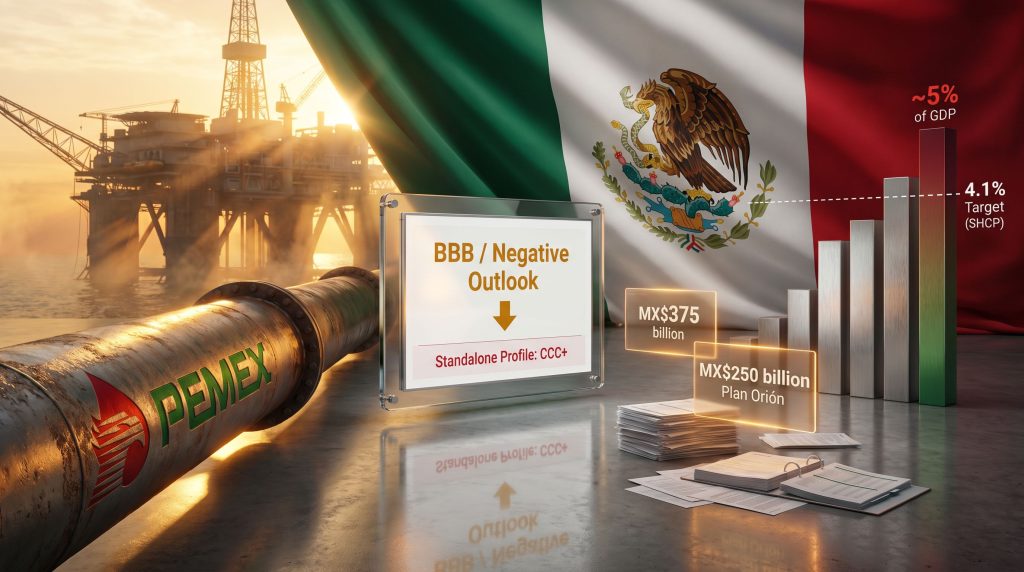
This is precisely the dynamic that S&P Global Ratings formalised on May 13, 2026, when S&P revises PEMEX outlook to negative, maintaining the BBB rating but placing the company on a trajectory that could intersect with speculative-grade territory within 12 to 24 months. The timing was not incidental. The same revision had been applied to Mexico's sovereign outlook just one day earlier, a sequence that communicates something analytically precise: the agency views PEMEX and the Mexican sovereign as structurally inseparable, and deterioration in one is expected to propagate directly into the other.
When big ASX news breaks, our subscribers know first
Understanding the Mechanics Behind the S&P PEMEX Outlook Revision
Credit Linkage and Why the One-Day Gap Matters
In sovereign-linked rating methodology, a government-related entity such as PEMEX does not carry an independent credit assessment in isolation. Its rating is a composite of two distinct inputs: its own operational and financial profile, and the sovereign's assessed capacity and willingness to provide support. S&P's analytical framework makes this explicit, and the one-day gap between Mexico's sovereign revision and the PEMEX action reflects how mechanically tight that linkage has become.
The distinction between an affirmed rating and a revised outlook is critical for fixed-income investors. An affirmed BBB rating means the agency is not yet characterising PEMEX as speculative-grade debt. A negative outlook, however, is a formal probabilistic statement: under current trajectories, a downgrade is a credible outcome within the next 12 to 24 months. This matters enormously because BBB represents the lowest rung of investment-grade status. A single-notch cut to BB+ would reclassify PEMEX debt as high-yield, or colloquially, junk.
"The gap between PEMEX's supported rating of BBB and its standalone credit profile of CCC+ is among the widest recorded for any major national oil company that maintains investment-grade status. This spread represents the full magnitude of implicit sovereign subsidy embedded in the rating."
The Three Triggers S&P Has Identified for Acceleration
S&P has outlined the conditions that would accelerate a formal downgrade beyond the 12 to 24 month window:
- Continued failure to achieve meaningful fiscal consolidation at the sovereign level, leaving Mexico's deficit trajectory elevated relative to peers at the same rating category.
- An expansion of government transfers to PEMEX that further widens the fiscal deficit, creating a feedback loop in which supporting the company actively damages the sovereign's own credit position.
- Deterioration in PEMEX's operational metrics, including production output, reserve replacement rates, or cash flow generation, which would increase the probability that government support requests escalate in scale.
- A formal sovereign downgrade, which under S&P's methodology would automatically trigger a corresponding cut to PEMEX's rating regardless of any operational changes at the company itself.
The fourth trigger is the most mechanically straightforward and, arguably, the most immediately consequential for institutional debt holders.
The Cascading Institutional Consequences of a PEMEX Downgrade
What Happens When Investment-Grade Status Is Lost
A loss of BBB status for PEMEX would not simply be a symbolic deterioration. It would activate structural sell-off mechanisms embedded in the mandates of a significant class of institutional investors globally. Many pension funds, insurance portfolios, and sovereign wealth vehicles operate under mandates that prohibit holding speculative-grade debt. A PEMEX downgrade would force involuntary disposals from these portfolios, compressing bond prices at precisely the moment liquidity is most critical.
The four PEMEX subsidiaries affected by the current outlook revision would face the same trajectory:
| Entity | Current Rating | Outlook | Standalone Profile |
|---|---|---|---|
| PEMEX (Sovereign-Supported) | BBB | Negative | CCC+ |
| PMI Trading DAC | Linked to PEMEX | Negative | Not rated independently |
| PMI Norteamérica | Linked to PEMEX | Negative | Not rated independently |
| Mex Gas Supply | Linked to PEMEX | Negative | Not rated independently |
| Deer Park Refining | Linked to PEMEX | Negative | Not rated independently |
The loss of investment-grade access would furthermore restrict PEMEX's ability to tap international capital markets on commercially viable terms, a constraint with direct implications for the already-strained capital expenditure programme the company depends upon for any operational recovery. Consequently, these commodity price impacts extend well beyond Mexico's borders, influencing investor confidence across emerging market energy sectors.
Mexico's Fiscal Architecture: The Two-Way Dependency Trap
From Revenue Engine to Capital Recipient
For decades, PEMEX was the primary mechanism through which Mexico extracted and monetised its hydrocarbon wealth, channelling revenues into federal coffers and effectively subsidising public expenditure. The relationship was asymmetric in the sovereign's favour: the company produced, the government taxed, and the fiscal system functioned.
That relationship has structurally reversed. PEMEX is no longer a net revenue contributor in the traditional sense; it has become a net capital recipient, requiring government transfers simply to maintain operational continuity and service debt obligations. S&P characterises this ongoing support obligation as a source of fiscal rigidity for the sovereign, meaning the government cannot easily withdraw support without triggering a disorderly collapse, yet providing support consumes fiscal space the sovereign increasingly cannot spare.
This dynamic is compounded by simultaneous obligations to CFE, Mexico's state electricity utility, which is also operating under a revised S&P outlook, effectively creating a dual SOE support burden on a sovereign balance sheet already under pressure.
Quantifying the Fiscal Strain
The numbers involved are not marginal. At the close of the first quarter of 2026, PEMEX's outstanding obligations to its supplier network stood at MX$375 billion, representing the second-highest level of supplier arrears recorded in the past 16 years. The Plan Orión financing vehicle, a MX$250 billion credit facility administered through Banobras, was designed to address these arrears but was scoped exclusively to 2025-vintage invoices. Pre-2025 legacy obligations remain entirely unaddressed.
Banobras Director General Jorge Mendoza Sánchez confirmed at the 2026 COA Conference that Plan Orión has been fully drawn down, and that the institution stands ready to expand the programme if formally instructed by the executive, SENER, or the Ministry of Finance. As of the time of this writing, no such instruction has been issued.
"Despite the full deployment of the MX$250 billion Plan Orión vehicle, PEMEX's supplier arrears remain at MX$375 billion, a gap that illustrates clearly that existing support mechanisms have not closed the structural funding shortfall. A second facility informally called Orión 2 is reportedly under development but carries no confirmed timeline or disclosed scale."
The projected fiscal deficit trajectory compounds the concern. Mexico's Secretariat of Finance and Public Credit (SHCP) has set a target of 4.1% of GDP. IMEF, the Mexican Institute of Finance Executives, projects that if the current global oil supply disruption persists through the end of 2026, fiscal revenue losses could exceed MX$220 billion, pushing the actual deficit toward approximately 5% of GDP, driven primarily by the escalating cost of fuel subsidies administered through the IEPS mechanism.
Finance Minister Edgar Amador Zamora has stated publicly that existing policy measures are adequate to restore a stable credit trajectory. Whether rating agencies and market participants will find that assessment credible, given the structural scale of the imbalance, is a separate and more consequential question.
PEMEX's Standalone Financial Reality: CCC+ and What It Actually Means
A Capital Structure That Cannot Self-Finance
The CCC+ standalone profile assigned by S&P is not a minor technical footnote. It reflects an agency judgement that, without external support, PEMEX's capital structure is unsustainable under current conditions. The core drivers of this assessment include:
- Persistent negative free operating cash flow, which is a structural feature of PEMEX's current operations rather than a cyclical response to commodity price movements.
- A debt burden that is disproportionate relative to production output and reserve replacement rates, meaning the company is not generating sufficient hydrocarbon volumes to justify its leverage.
- An inability to self-finance capital expenditure at the levels required to arrest or reverse the production decline trajectory.
Production output has been declining for years, and the capacity to reverse that trend depends on capital investment that the company structurally cannot fund without external intervention. This creates a particularly difficult loop: without investment, production falls; without production, revenue falls; without revenue, the government transfer burden grows; and as the transfer burden grows, the sovereign's own fiscal position deteriorates.
Grupo Carso's Zama Accumulation: A Private Sector Signal
Against this backdrop, Grupo Carso's continued accumulation of Zama field equity carries a strategic message that extends beyond the immediate transaction. The conglomerate, through its Zamajal vehicle, has agreed to acquire an additional 5% stake in the Zama offshore field from Harbour Energy for US$75.25 million, bringing total Zamajal ownership to approximately 17.84%.
Post-closing, the Zama ownership structure will be as follows:
| Stakeholder | Ownership Share |
|---|---|
| PEMEX | 50.43% |
| Harbour Energy | 27.26% |
| Zamajal (Grupo Carso) | 17.84% |
| Talos Energy | 4.47% |
The Zama field itself holds 600 to 800 million barrels of oil equivalent in recoverable reserves, with projected peak production of 180,000 barrels per day by 2029, a volume representing roughly 10% of Mexico's stated national production target. Separately, Grupo Carso has acquired Lukoil's Mexican subsidiary and entered a mixed contract for the Macavil field, establishing the conglomerate as Mexico's most significant domestic private upstream actor.
The pattern is worth noting analytically: private capital is systematically accumulating the highest-quality upstream assets in Mexico's hydrocarbon basin at a moment when PEMEX's fiscal capacity to develop those assets is structurally constrained. Whether this represents a transfer of productive capacity from the public sector to private hands, or a necessary injection of private capital to sustain output that PEMEX cannot fund, depends substantially on one's perspective regarding the appropriate role of state enterprise in energy development.
Global Supply Shocks and Mexico's Compounding Fiscal Exposure
The Iran Crisis as a Transmission Mechanism
The geopolitical disruption surrounding Iran has introduced a supply shock of historic proportions into an already strained global oil market. Understanding these global oil market disruptions is essential context for assessing Mexico's fiscal vulnerability. According to IEA data, global oil reserves fell by a combined 246 million barrels across March and April 2026, the fastest drawdown on record. Iran's closure of the Strait of Hormuz, combined with a US naval blockade on Iranian ports, has removed approximately 12.8 million barrels per day of cumulative supply from global markets since February.
Brent crude has surpassed US$120 per barrel in response. The IEA authorised a strategic reserve release of 400 million barrels, of which 164 million barrels have been mobilised. Airlines have begun issuing warnings about potential aviation fuel shortages if the disruption extends into summer 2026.
For Mexico, this translates into a specific fiscal exposure through the IEPS mechanism, which functions as an implicit fuel subsidy. When international benchmark prices for diesel and gasoline rise, the gap between the regulated domestic price and the import-parity cost expands, and the Mexican government must absorb the difference. Elevated crude prices theoretically boost PEMEX revenue, but that theoretical benefit is substantially eroded by the growing IEPS subsidy obligation and PEMEX's structurally high cost base.
The US Distillate Shortage: A Secondary Risk with Direct Mexican Exposure
Commodity analytics firm Sparta and investment bank UBS have both flagged US distillate inventories as a risk that markets may be underweighting. US distillate stocks are tracking toward 26-year lows according to their analysis, with structural drivers that predate the Iran conflict:
- The permanent closure of LyondellBasell's 290,000 barrel-per-day Houston refinery has removed a material portion of US Gulf Coast distillate production capacity.
- Phillips 66's 139,000 barrel-per-day Wilmington facility has also been permanently shut down, compounding the supply gap.
- The Iran conflict has simultaneously restricted access to the heavy crude grades that Gulf Coast refineries require for optimal diesel yield, meaning the remaining refining capacity is operating at reduced efficiency for distillate production.
The US Energy Information Administration projects that combined gasoline, distillate, and jet fuel inventories will finish 2026 at their lowest aggregate level since 2000. US gasoline prices have already reached US$4.48 per gallon, approximately 50% above pre-conflict levels, with GasBuddy flagging potential pricing of US$5 per gallon if conditions do not improve. For Mexico, any sustained increase in international diesel benchmarks directly expands the IEPS subsidy gap that Olmeca's rising domestic diesel output can only partially and temporarily offset.
The next major ASX story will hit our subscribers first
Comparative Framework: PEMEX Among Sovereign-Linked National Oil Companies
Where PEMEX Sits Relative to Global Peers
Understanding the significance of the point at which S&P revises PEMEX outlook to negative requires placing it within the broader landscape of sovereign-linked national oil company ratings. The analytical framework S&P applies to government-related entities distinguishes between two dimensions: the sovereign's willingness to provide support, and its capacity to do so.
For most highly rated NOC pairings, such as Saudi Aramco and the Saudi sovereign, both dimensions are assessed as robust. For PEMEX, the willingness dimension has historically been strong, but the capacity dimension is now visibly under pressure. This is further complicated by shifts in OPEC's influence on oil markets, which continue to shape the broader environment in which PEMEX must operate.
The CCC+ standalone profile places PEMEX in a structurally weaker position than comparably rated sovereign-linked oil companies globally. The gap between BBB supported and CCC+ standalone implies that approximately four to five notches of rating elevation are attributable entirely to government support. If that support is ever assessed as constrained or uncertain, the rating mathematics shift dramatically and rapidly.
Three Scenarios for PEMEX's Credit Trajectory Over 24 Months
| Scenario | Key Conditions | Likely Rating Outcome |
|---|---|---|
| Stabilisation | Fiscal consolidation achieved; IEPS burden contained; operational metrics improve | Outlook returns to stable; BBB rating maintained |
| Formal Downgrade | Sovereign downgrade triggers linkage mechanism; support capacity visibly constrained | PEMEX cut to BB+ or below; institutional sell-off pressure activated |
| Accelerated Deterioration | Global supply shock persists through year-end; Orión 2 delayed; supplier arrears expand further | Multi-notch sovereign and PEMEX downgrade; international market access severely restricted |
This table represents analytical scenarios based on publicly disclosed rating methodologies and economic projections. It does not constitute investment advice, and actual rating outcomes will depend on conditions that cannot be predicted with certainty.
Frequently Asked Questions: S&P Revises PEMEX Outlook to Negative
What exactly did S&P announce regarding PEMEX's credit rating?
S&P Global Ratings affirmed PEMEX's BBB credit rating on May 13, 2026, while simultaneously revising the credit outlook from stable to negative. The BBB rating itself was not changed, meaning PEMEX remains technically investment-grade. However, the negative outlook formally signals that a downgrade is a credible possibility within the next 12 to 24 months if financial or operational conditions worsen.
Why is PEMEX rated CCC+ on a standalone basis?
Without any contribution from implicit sovereign support, S&P assesses PEMEX's capital structure as unsustainable. This judgement reflects persistent negative free operating cash flow, a debt level that exceeds what current production volumes can service on a standalone basis, and the company's fundamental inability to self-finance the capital expenditure required to stabilise or grow output.
Which subsidiaries were included in the negative outlook revision?
Four PEMEX-linked entities had their outlooks revised to negative in the same action: PMI Trading DAC, PMI Norteamérica, Mex Gas Supply, and Deer Park Refining. All four carry ratings that are structurally tied to PEMEX's sovereign-supported profile.
What is Plan Orión and why has it not resolved PEMEX's supplier debt problem?
Plan Orión is a MX$250 billion credit facility operated through Banobras, Mexico's national development bank, designed to address PEMEX's outstanding supplier obligations. The vehicle has been fully drawn down, but it was structured to cover only invoices from 2025 onward. Pre-2025 legacy supplier obligations, which are substantial, remain entirely outside the scope of Plan Orión and continue to accumulate on PEMEX's balance sheet. Total supplier arrears stood at MX$375 billion at the end of the first quarter of 2026.
What would automatically trigger a PEMEX downgrade?
A downgrade of Mexico's sovereign credit rating would automatically trigger a corresponding downgrade of PEMEX under S&P's rating linkage methodology. Because PEMEX's BBB rating depends structurally on the sovereign's assessed capacity and willingness to provide support, any deterioration in the sovereign rating directly and mechanically reduces the ceiling available to PEMEX.
Key Takeaways for Investors and Market Observers
The situation in which S&P revises PEMEX outlook to negative is not a standalone credit event. It is a signal about the structural health of the relationship between Mexico's federal government and its most consequential state-owned enterprise, at a moment when that relationship is being stress-tested simultaneously by deteriorating operational performance, an unresolved supplier debt crisis, and a global supply shock of historic proportions.
In addition, the broader context of sanctions and oil trading globally has demonstrated how quickly energy sector credit positions can deteriorate when geopolitical pressures combine with pre-existing financial vulnerabilities. Several factors deserve particular attention over the next 12 to 24 months:
- The timeline and scale of the Orión 2 financing vehicle represent the single most consequential near-term policy variable for PEMEX's liquidity position.
- Grupo Carso's systematic accumulation of Zama equity signals that private capital has formed a clear view about which upstream assets hold durable value in Mexico's energy landscape, and is acting accordingly.
- The IEPS subsidy transmission channel means that global oil market disruptions translate directly into Mexican fiscal deficits, a structural exposure that cannot be resolved through monetary policy or exchange rate adjustment.
- Institutional investors holding PEMEX or Mexico sovereign debt in investment-grade mandates should monitor the sovereign rating trajectory closely, as any formal sovereign downgrade would activate automatic PEMEX rating cuts and mandatory portfolio rebalancing obligations.
The broader emerging market principle at work here is instructive beyond Mexico's borders. Furthermore, in the context of a multipolar global economy, the sovereign-SOE support dynamic is increasingly being scrutinised by rating agencies across multiple jurisdictions. When a sovereign's SOE support relationship transitions from fiscal tool to fiscal constraint, the rating arithmetic for both entities shifts in ways that can accelerate faster than policymakers anticipate. The question for Mexico is not whether that transition has begun, but how far along the curve it has already travelled.
This article is intended for informational purposes only and does not constitute investment advice. Credit rating actions, fiscal projections, and commodity price forecasts involve material uncertainty and may not reflect future outcomes. Readers should conduct their own due diligence before making any investment decisions.
Want to Stay Ahead of Major ASX Mineral Discoveries Before the Broader Market?
Discovery Alert's proprietary Discovery IQ model delivers real-time alerts on significant ASX mineral discoveries, transforming complex data across more than 30 commodities into clear, actionable insights for both short-term traders and long-term investors — begin your 14-day free trial today. To understand how historic discoveries have generated substantial returns, explore Discovery Alert's dedicated discoveries page and see what becoming an early mover can mean for your portfolio.