May 16, 2026
When Geopolitics Overrides Geology: The Sanctions Risk Reshaping Mining Investment
The mining industry has long operated on a simple premise: go where the ore is. For decades, resource companies accepted elevated political risk as the price of access to world-class deposits, structuring their investments through joint ventures, local partnerships, and carefully designed legal arrangements designed to insulate operations from the volatility of host-country politics. That calculus is being fundamentally rewritten.
The forced withdrawal of Sherritt International from its Cuban nickel and cobalt operations illustrates a new and more dangerous dimension of geopolitical risk, one that originates not in the host country but thousands of kilometres away in Washington. The Sherritt Cuba mining venture sanctions case is not simply a story about one Canadian company losing one joint venture. It is a signal to every mining operator with exposure to geopolitically contested jurisdictions that the rules of the game have changed, and changed permanently.
When big ASX news breaks, our subscribers know first
The Structural Logic of Foreign Mining in Isolated Economies
Resource-dependent nations that face restricted access to international capital markets have historically relied on foreign mining partnerships to monetise their geological endowments. The arrangement is mutually beneficial in theory: the host country provides access to mineral deposits and operating licences, while the foreign partner contributes capital, technical expertise, and crucially, access to international commodity markets and refining infrastructure.
Cuba's nickel and cobalt sector represents one of the most enduring examples of this model in the Western Hemisphere. The island's laterite nickel deposits, concentrated in the Moa Bay region of Holguín Province, are among the most significant of their type outside of Indonesia and the Philippines. Laterite nickel ores are geologically distinct from sulphide deposits: they form through intense tropical weathering of ultramafic rocks over millions of years, producing near-surface ore bodies that are accessible by open-pit mining but require complex hydrometallurgical processing to extract nickel and cobalt efficiently.
The Moa operation exploits exactly this type of deposit. Its mixed sulphide intermediate product, processed at a refinery in Fort Saskatchewan, Alberta, yields finished nickel and cobalt with specifications relevant to battery and aerospace applications. This integrated, transnational production model, with mining in Cuba and refining in Canada, made Sherritt's structure uniquely efficient and uniquely vulnerable to political disruption at either end of the chain.
How the New Executive Order Changes Everything
Cuba has been subject to US economic sanctions since the early 1960s, but the framework that triggered Sherritt's exit represents a qualitative escalation beyond previous measures. The critical distinction lies in the extraterritorial scope of the executive order signed by President Donald Trump.
Traditional primary sanctions restrict US persons and entities from engaging with a target jurisdiction. What makes the new order structurally different is its application to non-US citizens and foreign companies, including Canadian, European, and Latin American operators, who conduct business in Cuba. This mechanism, known as secondary sanctions, transforms the compliance risk calculus for every international mining company with Cuban exposure. Furthermore, the geopolitical mining risks associated with this escalation extend well beyond Cuba alone.
Under a primary sanctions framework, a Canadian company like Sherritt could legally operate in Cuba as long as it maintained separation from the US financial system. Secondary sanctions remove that protection entirely by threatening penalties against the foreign company itself, regardless of whether any US persons or financial infrastructure are involved.
| Sanctions Type | Who Is Targeted | Operational Impact |
|---|---|---|
| Primary Sanctions | US persons and entities | Restricts US capital and personnel |
| Secondary Sanctions | Non-US persons and foreign companies | Forces exits regardless of US connection |
| Helms-Burton Act Title III | Foreign companies using confiscated US property | Creates civil liability in US courts |
The sectors explicitly identified as high-exposure under the new measures include metals and mining, energy and power generation, financial services, and defence. For Sherritt, whose Cuban footprint spanned both mining and independent power generation, the exposure was acute across multiple fronts simultaneously.
Sherritt's Cuban Assets and the Decision to Exit
Sherritt International announced on 15 May 2026 that it would seek to dissolve its nickel and cobalt mining joint venture in Cuba and would surrender its interest in Energas, the Cuban independent power generation business it had operated alongside its mining activities. The company had invested in Cuba for decades, building one of the more unusual and resilient foreign investment structures in a jurisdiction that had repelled most Western capital since the 1960s.
The Moa joint venture had been the operational centrepiece of this investment. The operation processes laterite ore through a pressure acid leach circuit, a technically demanding process that uses sulphuric acid under high temperature and pressure to dissolve nickel and cobalt from the ore matrix. The resulting mixed sulphide is then shipped to Alberta for final refining, producing nickel briquettes and cobalt rounds that enter global commodity markets.
The Energas asset added a separate but strategically important dimension to Sherritt's Cuban exposure. Independent power generation has been a critical vulnerability in Cuba's infrastructure, with chronic electricity shortages constraining economic activity across the island. Sherritt's involvement in this sector gave the company a footprint in Cuban energy security, not merely mineral extraction, which deepened both the strategic value and the sanctions exposure of its overall position.
Before the formal announcement of venture dissolution, Sherritt had experienced significant internal governance disruptions. The company's external auditor and chief financial officer both departed ahead of the public statement, triggering delays in financial filings. This sequence suggests that the compliance and governance pressures created by the evolving sanctions environment had been building internally for some time before they became visible to external investors.
Market Reaction and What It Signals About Political Risk Pricing
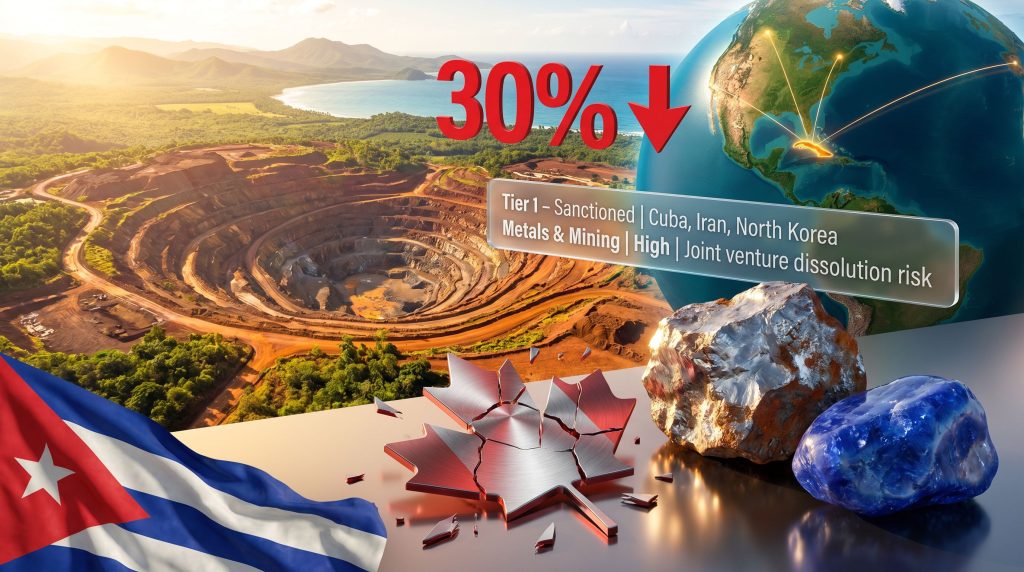
Sherritt's share price collapsed by approximately 30% following the sanctions announcement, a reaction that warrants careful interpretation. In one sense, the scale of the decline reflects the proportion of the company's operational base that was concentrated in Cuba. When a company's core producing assets become legally untenable overnight, a significant share price correction is the rational market response.
However, the 30% figure also reveals something more instructive about how markets have been pricing political risk in frontier and sanctioned jurisdictions more broadly. Prior to the executive order, investors in Sherritt were implicitly assigning a probability to a sustained sanctions escalation scenario. The magnitude of the share price reaction suggests that probability was materially underweighted.
The speed and severity of sanctioned-market asset repricing rarely matches the pace at which geopolitical risk actually accumulates. By the time a regulatory trigger forces a corporate exit, the underlying risk has often been building for years, visible in governance signals and compliance pressures that equity markets discount until they cannot.
This pattern has implications for investors with exposure to other companies operating in Tier 1 and Tier 2 risk jurisdictions. The political risk premium embedded in share prices of frontier-market mining operators may be systematically underpriced when the tail risk involves US secondary sanctions rather than host-country instability.
Cuba's Economic Exposure: The Downstream Consequences
The dissolution of the Sherritt Cuba mining venture carries consequences that extend well beyond the company's balance sheet. Cuba's nickel and cobalt sector has historically been one of the island's primary sources of hard-currency earnings, with mineral exports providing the foreign exchange necessary to fund essential imports. The Moa operation's contribution to this revenue stream is not easily replaced.
The Energas withdrawal compounds the impact. Cuba has faced persistent and severe electricity generation shortfalls in recent years, with rolling blackouts affecting both urban and rural populations. The removal of an independent power generation operator in this environment removes a source of generation capacity that the Cuban state grid cannot readily substitute from domestic resources.
The chilling effect on remaining foreign investors may prove more economically significant than the direct asset withdrawal itself. Secondary sanctions create a deterrence mechanism that operates prospectively as well as on existing investments. Any company currently assessing whether to enter the Cuban market must now factor in not just host-country risk but the possibility of being targeted by US enforcement action regardless of its nationality or the structure of its investment.
The next major ASX story will hit our subscribers first
The Cobalt and Nickel Supply Chain Dimension
How Does This Affect Global Cobalt Supply?
The Moa operation occupies a specific and not insignificant position within the global cobalt supply landscape. Cobalt is a co-product of nickel laterite processing at Moa, meaning its production is intrinsically linked to the scale of nickel operations rather than being independently adjustable. This co-product relationship means that any reduction in Moa's operational throughput reduces cobalt availability regardless of prevailing cobalt prices.
Consequently, global cobalt supply is already structurally concentrated, with the Democratic Republic of Congo accounting for the dominant share of primary mine production. The pressures on global cobalt supply are intensifying precisely as battery manufacturers seek greater geographic diversity. Western Hemisphere sources, including Moa, have historically been valued as geographic diversifiers within battery supply chains, reducing dependence on a single geopolitical corridor.
The potential removal of Moa from the supply picture, even if Cuban state entities attempt to sustain operations without Sherritt's participation, introduces supply-side uncertainty in a market navigating rising critical minerals demand from electric vehicle battery manufacturing.
What Does This Mean for Nickel Diversity?
The nickel dimension is equally significant from a supply diversity perspective. Indonesian nickel dominance has reshaped global nickel supply in recent years through the rapid expansion of nickel pig iron and mixed hydroxide precipitate capacity, but this concentration in a single jurisdiction carries its own geopolitical risk profile. Western Hemisphere laterite producers have been positioned as an alternative supply source within battery supply chain diversification strategies.
The Strategic Contradiction at the Heart of US Sanctions Policy
There is a paradox embedded in the Cuba sanctions trajectory that deserves direct examination. The forced exit of a Western mining operator from a cobalt-producing joint venture occurs at precisely the moment when the United States is investing significant political and financial capital in securing diversified battery metal supply chains outside of Chinese influence.
Pentagon initiatives targeting Chinese dominance in critical mineral supply chains, including rare earths and battery metals, reflect a recognition at the highest levels of US policy that supply concentration creates strategic vulnerability. Furthermore, China's strategic minerals push demonstrates how effectively Beijing exploits these vacuums. Simultaneously, the extraterritorial application of Cuba sanctions dislodges a Canadian operator from a cobalt-producing asset in the Western Hemisphere and creates conditions under which Cuban mineral resources are more likely to attract Chinese or Russian replacement capital.
The likely outcome of this dynamic is not Cuban mineral isolation but Cuban mineral reorientation. Chinese mining investment has demonstrated consistent willingness to operate in sanctioned and politically isolated jurisdictions across Africa and Latin America. The vacuum created by Sherritt's departure may accelerate exactly the kind of Chinese integration into Western Hemisphere critical mineral supply that US industrial policy nominally seeks to prevent.
What This Means for the Future of Mining in Sanctioned Jurisdictions
The Sherritt Cuba mining venture sanctions case is already functioning as a recalibration signal for the international mining investment community. Canadian mining companies, which have historically been among the most active investors in geopolitically complex jurisdictions, face disproportionate exposure to US secondary sanctions given the deep financial integration between Canadian and American capital markets.
A Canadian company with US-dollar-denominated debt, US institutional shareholders, or operations that touch the US financial system in any way cannot easily maintain the legal separation that primary sanctions frameworks historically permitted.
The emerging investment risk framework for sanctioned-adjacent jurisdictions requires a more granular analysis than the traditional political risk models applied to frontier markets. Key considerations now include:
- The degree to which a company's financial structure intersects with US dollar clearing systems
- Whether operational assets in the target jurisdiction qualify as confiscated property under the Helms-Burton framework
- The nationality and jurisdictional exposure of joint venture partners and their own compliance obligations
- The probability of sanctions escalation from primary to secondary frameworks given current US foreign policy trajectories
- The availability of political risk insurance products that actually cover secondary sanctions triggers
The Sherritt exit does not mark the end of foreign mining investment in geopolitically complex jurisdictions. It does, however, mark the end of a period in which secondary sanctions risk could be treated as a remote tail risk rather than a central scenario in investment underwriting. For the next generation of mining executives, legal teams, and investment committees operating across contested geographies, this reckoning has arrived earlier than most models predicted.
This article contains forward-looking analysis and assessments of geopolitical risk. Readers should note that sanctions policies, commodity markets, and company-specific circumstances can change rapidly. Nothing in this article constitutes financial or investment advice. Independent verification of all investment decisions is recommended.
Want to Stay Ahead of the Next Major ASX Mineral Discovery?
While geopolitical risks reshape global mining investment, Discovery Alert's proprietary Discovery IQ model scans ASX announcements in real time, instantly identifying significant mineral discoveries across 30+ commodities — from nickel and cobalt to rare earths — and delivering actionable alerts directly to subscribers. Explore historic discoveries and their remarkable returns, then begin your 14-day free trial at Discovery Alert to position yourself ahead of the market.