
June 6, 2026
When Debt Becomes Destiny: How Pemex's Financial Crisis Is Reshaping Mexico's Energy Leadership Model
The history of national oil companies is, in many ways, a history of political ambition colliding with financial reality. From Venezuela's PDVSA crisis to Brazil's Petrobras, state-owned energy giants have repeatedly found themselves at the centre of broader national economic crises, their fortunes inseparable from sovereign creditworthiness and government fiscal policy. Mexico's Petróleos Mexicanos, universally known as Pemex, now occupies this same precarious position, and the decision by President Claudia Sheinbaum to appoint Pemex CFO Juan Carlos Carpio as the company's new chief executive is far more than a routine personnel change. It is a policy statement directed squarely at credit rating agencies, bond markets, and international investors.
When big ASX news breaks, our subscribers know first
Why Sheinbaum Appoints Pemex CFO to Lead the World's Most Indebted Oil Producer
The phrase "world's most indebted oil producer" is not rhetorical flourish. It describes a measurable, consequential financial condition that transforms every executive appointment at Pemex into a market-sensitive event with implications stretching well beyond the energy sector.
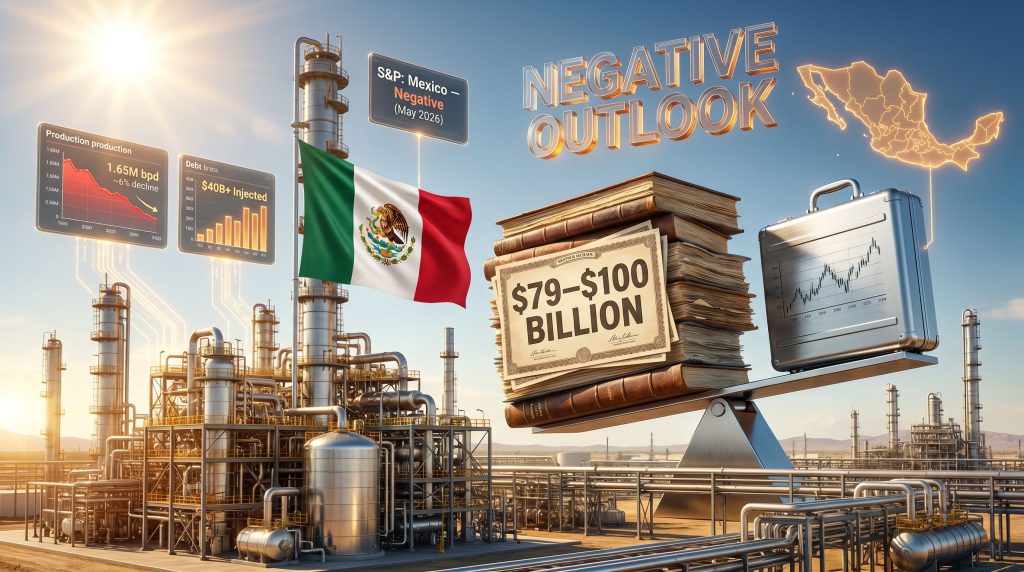
As of March 31, 2026, Pemex carried approximately $79 billion in total debt, recorded its third consecutive quarterly loss, and was producing crude oil at a rate of roughly 1.65 million barrels per day, following a production decline of approximately 6% during the tenure of outgoing CEO Víctor Rodríguez Padilla. Over that same period, the Sheinbaum administration directed more than $40 billion in government financial support toward the company to address debt obligations, refinery challenges, and payroll costs.
| Metric | Current Status (Q1 2026) |
|---|---|
| Total Debt | ~$79 billion |
| Daily Production Rate | ~1.65 million barrels per day |
| Production Decline (Prior Tenure) | ~6% |
| Consecutive Quarterly Losses | 3 |
| Government Financial Injections | Over $40 billion |
| Mexico Sovereign Credit Outlook | Revised to Negative by S&P Global Ratings (May 2026) |
The scale of these numbers matters because it changes the nature of the CEO role itself. At this level of indebtedness, operational decisions at Pemex do not merely affect energy output. They affect Mexico's sovereign borrowing costs, its currency stability, and its attractiveness to foreign direct investment. Furthermore, the broader context of oil market pressures globally only intensifies the scrutiny placed on leadership decisions of this kind.
Eurasia Group's lead analyst for Mexico, Matias Gomez Leautaud, characterised the Carpio appointment as part of a deliberate effort by President Sheinbaum to demonstrate fiscal discipline and reassure financial markets, framing it as a policy instrument rather than simply an operational management decision. (Source: Bloomberg, May 15, 2026)
What a CFO Appointment Actually Signals to Bond Markets
In the architecture of corporate leadership, appointing an internal chief financial officer as chief executive carries a specific message: the balance sheet has become more important than the field. At a privately owned energy company, this might signal a temporary phase of financial consolidation before returning to growth. At a state-owned enterprise of Pemex's scale, it signals something more structural.
When Sheinbaum appoints Pemex CFO to this role, the emphasis falls squarely on Carpio's deep familiarity with the company's debt reduction programmes and its ongoing consolidation across refinery operations, petrochemicals, fertilisers, and logistics. The president described him as the individual who understands the consolidation process most thoroughly within the organisation, reinforcing the message that institutional continuity, rather than external transformation, is the priority.
This framing carries several strategic layers:
- Continuity signalling to creditors: Carpio's involvement in existing debt restructuring negotiations means no renegotiation reset, reducing refinancing risk uncertainty
- Internal knowledge advantage: A CFO who already understands the financial architecture across all Pemex business segments can identify operational inefficiencies faster than an external recruit
- Avoidance of market disruption: Promoting from within, framed as a planned transition requiring board approval, protects institutional credibility in ways that an abrupt external appointment would not
- Debt management prioritisation: The choice explicitly communicates that financial stabilisation outweighs upstream production growth as the organisation's immediate mandate
Bradesco strategist Rodolfo Ramos assessed the appointment as a signal of management continuity rather than fundamental restructuring, noting that the change does not imply a dramatic shift in how the company operates day-to-day. (Source: Bloomberg, May 15, 2026)
The bond market's immediate verdict was instructive. Pemex bonds maturing in 2035 declined nearly one cent following the leadership announcement. While this may appear modest in isolation, sovereign and quasi-sovereign bond movements of this magnitude on leadership announcements are significant because they reflect investor recalibration of credit risk. Bond investors were revising their probability assessments of whether the new leadership configuration would successfully reduce Pemex's debt burden relative to its revenue-generating capacity.
The Sovereign Fiscal Feedback Loop Driving Mexico's Credit Pressures
Understanding why Sheinbaum appoints Pemex CFO to this role requires understanding how deeply Pemex's financial trajectory is embedded in Mexico's national fiscal accounts. This relationship operates through a self-reinforcing cycle that constrains government policy choices well beyond the energy sector. Consequently, crude oil price volatility in global markets only amplifies these domestic pressures.
The mechanism works as follows:
- Production declines reduce Pemex revenue and operating cash flow
- Revenue shortfalls increase the company's reliance on government capital injections to service existing debt
- Government injections increase Mexico's fiscal deficit and national debt burden
- Rising national debt attracts downward pressure from sovereign credit rating agencies
- Rating downgrades or negative outlooks increase Mexico's borrowing costs across all instruments
- Higher borrowing costs reduce government capacity to fund other national priorities
- Resource constraints create political pressure to maintain Pemex subsidies rather than invest in productivity-enhancing reform
- Cycle continues as production does not recover without upstream investment capital
This is precisely the context behind S&P Global Ratings revising Mexico's sovereign credit outlook from stable to negative in May 2026, citing deteriorating fiscal performance, rising debt levels, and the expectation that government financial support for Pemex would continue. The rating agency's action was not about any single event. It reflected the structural entrenchment of Pemex's financial dependency within Mexico's fiscal framework.
The S&P revision to a negative outlook signals that if current fiscal trajectories persist, a formal sovereign credit rating downgrade becomes a realistic probability within the medium term. This would raise borrowing costs not just for the Mexican government, but for Mexican corporations and financial institutions that access international capital markets under the sovereign ceiling.
Upstream Production Decline: The Capital Trap at the Heart of Pemex's Crisis
Why Reversing the Decline Is So Difficult
The operational challenge Carpio inherits is not simply a financial management problem. It is a capital allocation paradox that has few easy solutions given the existing debt structure.
Reversing a 6% production decline and stabilising output at current levels or above requires sustained upstream capital investment, typically in the range of several billion dollars annually for a producer of Pemex's scale. This covers well maintenance, enhanced recovery programmes at ageing fields, and new drilling activity at promising but underdeveloped prospects.
The problem is structural: with approximately $79 billion in total debt and three consecutive quarters of reported losses, Pemex's access to external capital markets is constrained and expensive. The company cannot easily issue new bonds at commercially attractive rates when existing bondholders are already pricing in elevated credit risk. This creates a double bind:
- Without investment, production continues declining, revenue falls further, and debt servicing becomes increasingly difficult relative to earnings
- With investment, the government must either inject more capital (worsening sovereign fiscal metrics) or Pemex must borrow more (further inflating an already unsustainable debt load)
The downstream footprint compounds this challenge. Pemex operates not just as an upstream oil producer but as an integrated energy company spanning:
- Refinery operations across multiple large-scale facilities
- Petrochemical production serving domestic industrial demand
- Fertiliser manufacturing critical for Mexican agricultural supply chains
- Logistics networks supporting domestic energy distribution
Each of these segments requires capital maintenance investment. Simultaneously managing operational transformation across this breadth while servicing a debt load of $79 billion is the defining challenge of the incoming CEO's mandate.
The Petrobras Dimension and the Private Investment Equation
Are There Viable Pressure Valves?
Two potential pressure valves exist within the current policy framework, though neither is straightforward to execute.
The first involves discussions around potential collaboration with Brazil's Petrobras. Analysts flagged these conversations as a possible avenue for capital co-investment and upstream technical capability transfer. A formal partnership between two of Latin America's largest state-owned energy companies would represent significant strategic alignment, potentially bringing Petrobras' deepwater and pre-salt technical expertise into ageing Mexican fields. However, any formal partnership would require navigating complex geopolitical, regulatory, and contractual frameworks. No formal agreement had been announced as of the time of this writing.
The second pressure valve is private investment in upstream oil and gas assets. The Sheinbaum administration has signalled support for attracting private capital into ageing fields as a mechanism for stabilising domestic production without requiring equivalent increases in direct government funding. In theory, private investment reduces the government's direct financial burden while maintaining production volumes. These approaches broadly reflect the kind of energy leadership models seen in other resource-rich nations navigating similar fiscal constraints.
In practice, Mexico's energy investment environment carries specific structural barriers:
- Historical nationalisation precedents create investor uncertainty around contract security over long-horizon oil field development cycles
- Regulatory framework complexity governs the terms under which private companies can participate in upstream Mexican energy
- Contract certainty requirements demand that private investors have confidence in fiscal terms remaining stable across government administrations
- Infrastructure access to existing pipelines, processing facilities, and export terminals affects the commercial viability of private upstream projects
Whether the administration can attract sufficient private capital at the scale required to materially reduce Pemex's fiscal dependency remains an open and consequential question. Furthermore, the broader dynamics of OPEC's market influence on global pricing add another layer of uncertainty for any long-term investment calculus at Pemex.
The next major ASX story will hit our subscribers first
Is This Leadership Change Enough to Change Pemex's Trajectory?
The honest analytical answer is that leadership changes at institutions facing structural debt and operational challenges of this magnitude are necessary but not sufficient conditions for recovery. Carpio's appointment sends the right signal to financial markets about fiscal discipline. It places a debt-literate executive at the helm during a period when debt management capability is the most critical organisational competency.
However, signals alone do not reverse production declines, retire billions in bond obligations, or unlock private capital at the scale required to stabilise an organisation of Pemex's complexity. The structural conditions driving the fiscal feedback loop, including declining output, high debt service costs, and continued government injection dependency, require systemic policy interventions that extend well beyond the executive suite.
What credit rating agencies, bond investors, and international partners will be watching alongside the leadership appointment includes:
- Whether Mexico's fiscal deficit trajectory narrows in the next two budget cycles
- Whether Pemex achieves measurable production stabilisation within the next four to six quarters
- Whether private investment commitments in upstream assets translate into actual capital deployment
- Whether the Petrobras partnership discussions produce a formal, capital-backed agreement
- Whether Carpio's debt reduction targets, once announced, are met against the company's actual financial performance
The Sheinbaum administration has demonstrated through this appointment that it understands financial markets well enough to use executive personnel decisions as policy communication tools. The harder task, stabilising Mexico's most systemically important state enterprise while preserving sovereign fiscal credibility, begins now.
Frequently Asked Questions: Pemex Leadership and Mexico's Energy Policy
What is Pemex's current total debt?
Pemex carried approximately $79 billion in total debt as of March 31, 2026, making it the most indebted state-owned oil producer in the world.
Why did Mexico's president appoint the CFO rather than an external energy expert?
The appointment prioritises financial management expertise and institutional knowledge of Pemex's debt reduction and consolidation programmes, reflecting a policy emphasis on fiscal stabilisation over upstream technical expansion.
How has Pemex's oil production changed recently?
Production declined approximately 6% during the prior leadership period, reaching roughly 1.65 million barrels per day by the end of March 2026.
What did S&P Global Ratings say about Mexico's credit outlook?
In May 2026, S&P revised Mexico's sovereign credit outlook from stable to negative, citing deteriorating fiscal performance, rising debt levels, and the expectation of continued government financial support for Pemex.
How much has the Mexican government injected into Pemex?
The Sheinbaum administration directed more than $40 billion toward Pemex during the prior CEO's tenure to address debt obligations, refinery challenges, and operational costs.
What does the Petrobras discussion mean for Pemex?
Analysts have noted potential partnership discussions between Pemex and Brazil's Petrobras as a possible avenue for capital co-investment and technical collaboration, though no formal agreement has been announced, as confirmed in reporting from May 2026.
This article is based on publicly available reporting and analysis as of May 2026. Forward-looking statements, credit rating assessments, and production forecasts involve inherent uncertainty and should not be construed as investment advice. Sovereign credit outlook revisions and bond price movements referenced herein reflect conditions at the time of reporting and are subject to change.
Want to Stay Ahead of High-Impact Resource Discoveries on the ASX?
While Pemex's debt crisis illustrates the systemic risks embedded in state-owned energy giants, nimble investors focused on ASX-listed mineral explorers operate in an entirely different landscape — one where early discovery intelligence can be decisive. Discovery Alert's proprietary Discovery IQ model delivers real-time alerts the moment significant ASX mineral discoveries are announced, transforming complex geological and commodity data into clear, actionable insights for both short-term traders and long-term investors. Explore historic discovery returns on Discovery Alert's dedicated discoveries page and begin a 14-day free trial to position yourself ahead of the broader market.