
June 6, 2026
The Hidden Economics of Coal Mine Life Extension in Southern Africa
Underground coal mining operates on a deceptively simple principle: once you lose safe access to a reserve, that coal is economically dead regardless of how much remains in the ground. This technical reality, rather than commodity price cycles or policy shifts, is what drives the most consequential investment decisions in South Africa's mature coal sector. When shaft infrastructure deteriorates to the point where safety pillars can no longer be guaranteed, operators face a binary choice: write off the reserve permanently, or engineer an entirely new access pathway at significant capital cost.
The decision Exxaro Resources made at its Matla Coal Mine represents one of the most instructive examples of this second path in recent Southern African mining history. Understanding why this matters requires looking beyond the headline figures. The Exxaro New Mine 1 at Matla Coal Mine is not simply a production milestone. It is a case study in how mine life extension economics function at scale, what they demand of project teams, and why the coal-to-power supply chain in Mpumalanga remains structurally irreplaceable within South Africa's energy architecture.
When big ASX news breaks, our subscribers know first
Why Underground Access Redevelopment Is the Dominant Strategy in South Africa's Mature Coal Belt
In greenfield mining, developers start with a blank geological canvas: the reserve is mapped, infrastructure is designed from scratch, environmental approvals are sought, and communities are engaged for the first time. In mature coal provinces like Mpumalanga, however, the calculus is entirely different. The reserves are known with high confidence. The communities exist. The infrastructure corridors are established. The challenge is not finding coal but re-engineering access to coal that was previously relinquished due to structural or safety constraints.
This distinction has profound implications for capital efficiency. A greenfield underground coal development in South Africa typically requires multi-year environmental impact assessment processes, new mining right applications, and the construction of entirely new surface infrastructure from portal to power line. An access redevelopment project, by contrast, operates within an existing mining right footprint, benefits from decades of geological data, and integrates into established surface handling systems.
The trade-off is capital concentration rather than capital spread. Access redevelopment projects tend to front-load large engineering costs — such as box cut excavations, new shaft sinking or decline development, and conveyor installation — before a single tonne of production coal is moved. This creates a J-curve investment profile that demands strong institutional balance sheets and, critically, long-term offtake certainty to justify the upfront commitment.
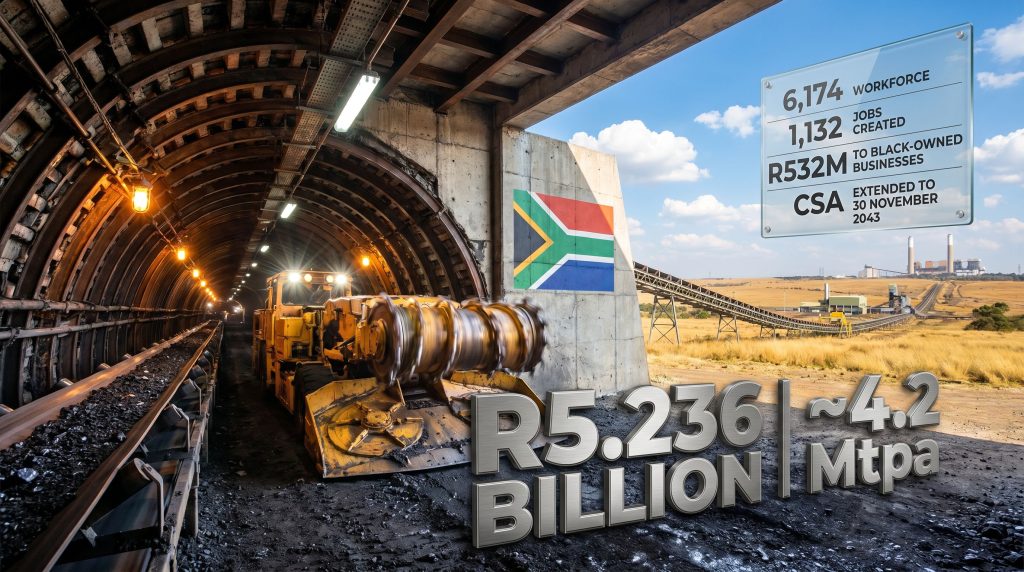
At Matla, furthermore, both conditions were present. Exxaro had the balance sheet capacity to underwrite a R5.236 billion programme, and the extended Coal Supply Agreement with Eskom provided the revenue visibility required to justify deployment of that capital over a development horizon stretching from August 2020 to commissioning in 2026.
The Structural Vulnerability That Created the Need for New Mine 1
The original Mine 1 at Matla was taken out of production in 2016 following the identification of deteriorating safety pillar conditions near the shaft infrastructure. This is a recognised underground coal mining failure mode, and one that carries significant regulatory weight in South Africa under the Mine Health and Safety Act. Broader coal supply challenges across the region have made such decisions even more consequential for the national grid.
Safety pillars are precisely dimensioned columns of unmined coal left in place to support the roof strata above underground workings and protect shaft infrastructure from subsidence. Their design is governed by geomechanical calculations that account for seam thickness, overburden depth, the compressive strength of the coal seam, and the dimensions of the surrounding excavations. When pillar deterioration is identified near shaft infrastructure, the risk profile changes fundamentally.
Unlike pillars in open stope areas, shaft protection pillars cannot be robbed or resized without creating catastrophic subsidence risk. The only operationally safe response is to cease production in the affected section, which is precisely what occurred at Mine 1 in 2016.
The engineering insight that unlocked the New Mine 1 concept was the recognition that the shaft infrastructure was compromised, not the reserve. The coal remained in place, geologically intact, simply inaccessible via the original entry point. By designing a new surface access point — the box cut — at a sufficient distance from the compromised shaft zone, engineers could re-establish safe entry to the Mine 1 working area without disturbing the existing pillar geometry around the old infrastructure.
This represents a geotechnical principle rarely explained in mining communications: the failure of access infrastructure does not equate to reserve impairment. The coal is still there. The question is always whether a safe and economically viable new pathway to that coal can be designed.
What the R5.236 Billion Programme Actually Built
Box Cut Construction and New Surface Entry
The box cut is the foundational element of the entire programme. It is a surface excavation — typically a trapezoidal or rectangular open cut driven down from the surface to intersect the target coal seam at a safe horizontal distance from the compromised original shaft. In the Matla context, the box cut establishes the new portal entry through which all subsequent underground access, equipment movement, ventilation, and coal egress flows.
Box cut construction in Mpumalanga's geology requires careful management of the overburden sequence, which typically includes Karoo Supergroup sediments comprising mudstone, siltstone, and sandstone interbedded above the Witbank and Highveld coalfields' productive seam groups. Exxaro's official project documentation confirms that stability of the cut faces during and after excavation is critical, requiring rock mass assessment, slope angle design, and often the installation of ground support measures before underground development can commence.
Underground Conveyor Infrastructure and Silo Feed System
Once underground access is established, coal transport from the working face to the surface requires an integrated conveyor network. The tunnel development silo feed conveyor system installed at New Mine 1 functions as the primary coal movement pathway, transferring mined product from the continuous miner working areas through a series of transfer points to a storage silo, from which it is metered onto the main conveyor for surface delivery.
Silo feed systems provide a buffer capacity that decouples the production rate of the mining equipment from the throughput requirements of the surface handling plant. This buffering function is operationally significant: it allows continuous mining sections to operate at their own optimal cycle time without being constrained by downstream conveyor availability.
Surface Handling, Crushing, and Eskom Network Integration
The overland conveyor and crushing plant represent the interface between mine production and Eskom's existing conveyor infrastructure. Coal arriving at the surface passes through crushing to achieve the particle size specification required by Matla Power Station's pulverised fuel boilers, before being transferred onto Eskom's conveyor network for direct delivery to the power station stockpile.
This direct conveyor connection, rather than truck haulage, is a defining characteristic of the captive-supply model. It eliminates road transport costs, removes weather and logistics variability from the supply chain, and allows precise metering of coal delivery to match power station consumption requirements in near real time.
Equipment Transition: From Shortwall to Continuous Mining
Perhaps the least widely understood aspect of the New Mine 1 programme is the transition from legacy shortwall mining technology to new-generation continuous mining equipment. Shortwall mining is well suited to seam geometries with consistent thickness and limited structural disruption. As reserves in a section are progressively worked out, however, the remaining panels tend to be geometrically more complex, reducing shortwall productivity.
Continuous mining, using a drum-type machine that cuts and loads coal simultaneously in a room-and-pillar or hybrid configuration, offers greater flexibility in adapting to irregular geology. The equipment can be redeployed between headings more rapidly than shortwall face equipment, and its operational cycle is less sensitive to minor geological disruptions. The decision to deploy new-generation continuous miners reflects a deliberate choice to optimise extraction methodology to the actual geological conditions.
Key Project Parameters at a Glance
| Parameter | Detail |
|---|---|
| Project designation | Mega-project under MLOMP framework |
| Total capital commitment | R5.236 billion |
| Programme commencement | August 2020 |
| Official commissioning | 2026 |
| Annual coal output target | ~4.2 million tonnes |
| CSA effective date | 1 April 2026 |
| CSA expiration date | 30 November 2043 |
| Total mine workforce | 6,174 employees and contractors |
| Local employment created (MLOMP) | ~1,132 positions |
| Investment in black-owned businesses | R532 million |
The Cost-Plus Model: Who Bears the Risk at Matla?
The Coal Supply Agreement governing Matla's output operates on a cost-plus basis — a funding structure common in captive-supply power generation arrangements but considerably less prevalent in commercial coal markets. Under this model, Eskom bears contractual responsibility for funding the mine's operational costs in exchange for guaranteed coal supply at the lowest achievable fuel cost per unit of energy delivered.
From Exxaro's perspective, the cost-plus structure transfers commodity price risk and operational cost exposure to Eskom, while Exxaro retains operational management responsibility. Eskom's rationale for accepting this structure is equally coherent: as the sole customer of Matla's output, it exercises direct control over operational cost efficiency and ensures that no margin extraction occurs between the mine gate and the power station.
This aligns precisely with Eskom's Cost Optimisation and Revenue Enhancement programme, which targets systemic reductions in primary energy expenditure across its coal-fired generation fleet. Eskom Group Chief Executive Dan Marokane noted that the extended contract was negotiated within the CORE programme framework, and that New Mine 1's commissioning coincided with Eskom recording 365 consecutive days without load-shedding. (African Mining Market, May 15, 2026)
The next major ASX story will hit our subscribers first
The 17-Year Supply Horizon and What It Signals About South Africa's Energy Transition
The CSA extension running to 30 November 2043 is not an indefinite commitment to coal. It is a precisely bounded supply agreement that aligns with Eskom's modelled requirements for coal-fired baseload generation during the period in which South Africa's transmission infrastructure is being upgraded to accommodate large-scale renewable energy penetration. This context is inseparable from the broader South Africa mining decline narrative that has intensified scrutiny on every long-term coal investment.
A 17-year supply horizon implies that Eskom's planners have modelled the point at which Matla Power Station's contribution to baseload supply can be structurally reduced or retired, and have worked backward from that point to establish the coal volume requirements underpinning the CSA's annual offtake obligations. The 2025 Memorandum of Understanding between Exxaro and Eskom on emissions reduction, carbon capture research, and just energy transition initiatives adds a further dimension to this relationship.
South Africa's energy transition is structurally different from those of Western European economies. The country lacks the grid interconnection capacity, the gas peaking infrastructure, and the demand-side flexibility that allowed rapid coal phase-down in the UK or Germany. Baseload coal, under a managed retirement timeline, is not a policy failure but a pragmatic sequencing decision.
The broader mining energy transition across southern Africa will, consequently, unfold over decades rather than years, making agreements of this nature an essential bridge mechanism.
Socio-Economic Impact: Beyond the Production Numbers
The Matla Life of Mine Project's socio-economic footprint in Mpumalanga extends well beyond its headline production contribution. Since inception, the programme has generated approximately 1,132 local employment opportunities, directed R532 million in procurement to black-owned enterprises, and embedded skills development and SMME support initiatives within its supply chain architecture.
Socio-Economic Outcomes Summary
| Metric | Outcome |
|---|---|
| Local employment opportunities created | ~1,132 positions |
| Investment in black-owned businesses | R532 million |
| Total mine workforce (employees and contractors) | 6,174 |
| Geographic focus | Mpumalanga province |
| B-BBEE alignment | Broad-Based Black Economic Empowerment framework |
The R532 million directed to black-owned businesses represents a deliberate procurement architecture, not incidental spend. In South Africa's mining sector, Broad-Based Black Economic Empowerment compliance functions as both a regulatory requirement and a social licence condition. For operations in Mpumalanga, where mining has historically generated significant employment but inconsistent community economic participation, the localisation of procurement spend creates multiplier effects that extend well beyond the mine boundary.
Minister of Minerals and Petroleum Resources Gwede Mantashe attended the New Mine 1 opening and went underground with workers, noting that his personal connection to Matla spans back to a six-year period he spent at the mine as a worker and labour organiser. He expressed that coal mining is a sector defined by continuous evolution rather than decline, pointing to ongoing advances in safety practice and technical innovation. (African Mining Market, May 15, 2026)
Project Execution as Investor Signal: Delivering on Time, to Budget, at Scale
For investors assessing Exxaro's operational capability, the completion of the MLOMP on schedule and within the R5.236 billion programme budget carries specific analytical weight. Complex underground infrastructure projects in South Africa's coal sector have historically been subject to significant cost overruns and schedule extensions, driven by geological surprises, labour relations challenges, equipment procurement delays, and regulatory friction.
The Exxaro leadership transition under CEO Ben Magara brought a sharper focus on disciplined execution, and that philosophy is evident in the MLOMP's delivery record. Magara framed this directly at the commissioning event, emphasising that the milestone reflects the organisation's capacity for disciplined execution of complex programmes in challenging operating conditions. (African Mining Market, May 15, 2026)
In addition, the programme's success reinforces a broader point about the mining industry evolution underway across southern Africa: that technical innovation, disciplined capital allocation, and long-term supply partnerships are increasingly the differentiating factors between operations that survive and those that do not.
How Mine Life Extension Compares to Greenfield Development
| Dimension | Greenfield Development | Life Extension (Matla Model) |
|---|---|---|
| Capital risk | High, with significant uncertainty | Moderate, known geological baseline |
| Permitting timeline | Multi-year, new rights required | Shorter, existing mining right footprint |
| Reserve certainty | Lower, reliant on exploration data | Higher, decades of production history |
| Infrastructure requirement | Full build from first principles | Partial build, integrating existing systems |
| Community relations | New establishment required | Existing relationships and social licence |
| Offtake security | Market-dependent or to be negotiated | Contracted under existing CSA framework |
Frequently Asked Questions: Exxaro New Mine 1 at Matla Coal Mine
What is the Exxaro New Mine 1 at Matla Coal Mine?
The Exxaro New Mine 1 at Matla Coal Mine is the redeveloped underground access point to the Mine 1 section of Matla Coal Mine in Mpumalanga, South Africa. It was developed after the original Mine 1 section was closed in 2016 following the identification of deteriorating safety pillar conditions near the shaft infrastructure. The project forms part of the broader R5.236 billion Matla Life of Mine Project and was officially commissioned in 2026.
Why was the original Mine 1 closed in 2016?
The original Mine 1 infrastructure was taken out of production because safety pillars near the shaft had deteriorated to a point where continued operation could not be conducted safely. Rather than permanently abandoning the remaining coal reserves, Exxaro developed a new access pathway — the box cut — at a safe distance from the compromised infrastructure, allowing production to be re-established without disturbing the existing pillar geometry.
How much coal will New Mine 1 produce each year?
New Mine 1 is expected to contribute approximately 4.2 million tonnes of coal annually to Matla Power Station under the terms of the extended Coal Supply Agreement with Eskom. Eskom's joint media statement confirms that this output underpins the long-term energy security rationale for the agreement.
How does the cost-plus supply model work?
Under the cost-plus Coal Supply Agreement, Eskom funds all operational costs at Matla in exchange for guaranteed coal supply at the lowest achievable fuel cost. This structure transfers cost risk from Exxaro to Eskom and aligns with Eskom's broader Cost Optimisation and Revenue Enhancement programme targeting efficiency improvements across primary energy procurement.
How long does the new supply agreement last?
The extended Coal Supply Agreement became effective on 1 April 2026 and runs through to 30 November 2043, providing a 17-year supply horizon that underpins the capital justification for the R5.236 billion MLOMP investment.
What socio-economic outcomes has the MLOMP delivered?
Since inception, the Matla Life of Mine Project has created approximately 1,132 local employment opportunities, directed R532 million in procurement to black-owned businesses, and supported skills development and SMME programmes in Mpumalanga.
What does the Exxaro-Eskom MOU cover?
In 2025, Exxaro and Eskom signed a Memorandum of Understanding committing both organisations to collaborate on emissions reduction initiatives, carbon capture research, and broader just energy transition programmes. This MOU signals that the Matla relationship is evolving from a pure fuel supply arrangement into a partnership with an explicit decarbonisation dimension.
Key Takeaways
- The Exxaro New Mine 1 at Matla Coal Mine demonstrates that access redevelopment, rather than greenfield development, is the defining capital strategy in South Africa's mature underground coal sector
- The geotechnical distinction between compromised access infrastructure and impaired reserves is central to understanding why New Mine 1 was economically viable despite the 2016 Mine 1 closure
- The cost-plus CSA structure fundamentally repositions Exxaro as a contracted service operator rather than a market-exposed coal producer at Matla, with materially different risk characteristics than conventional mining investments
- The 17-year supply horizon to 2043 reflects a deliberate managed transition philosophy, maintaining baseload coal security while South Africa's transmission grid is upgraded to accommodate renewable energy penetration
- Delivering the R5.236 billion MLOMP on schedule and to budget in a complex underground operating environment is a meaningful indicator of Exxaro's project execution capability
- Socio-economic outcomes, including R532 million to black-owned businesses and 1,132 employment positions, reflect the dual commercial and developmental mandate that characterises responsible resource development in Mpumalanga
This article is based on publicly available information sourced from African Mining Market (May 15, 2026) and Exxaro's official project documentation. Forward-looking statements regarding production volumes, CSA terms, and transition timelines reflect publicly stated company and counterparty positions and should not be construed as investment advice. Readers should conduct independent due diligence before making any investment decisions.
Want To Catch the Next Major ASX Mineral Discovery Before the Market Does?
Discovery Alert's proprietary Discovery IQ model delivers real-time alerts on significant ASX mineral discoveries, transforming complex geological and commodity data into actionable investment insights for both short-term traders and long-term investors. Explore how historic discoveries have generated extraordinary returns on Discovery Alert's dedicated discoveries page, and begin your 14-day free trial today to secure your market-leading advantage.