
May 16, 2026
The Architecture of Strategic Voting: Why Colombia's 2026 Race Is Being Decided Before Polling Day
Across Latin America, two-round presidential systems have a well-documented tendency to compress voter behaviour in unexpected ways. When the rules require an absolute majority to win outright, every ballot cast in a first round carries a second-order calculation: not simply who a voter prefers, but who has the capacity to survive elimination and win a final contest. In Colombia's 2026 presidential race, that logic has been amplified to a degree that political risk analysts describe as structurally unprecedented for this cycle. The central question driving Colombia presidential election tactical voting is no longer which candidate voters genuinely want in office. It is which candidate gives their bloc the highest probability of prevailing in a runoff against a frontrunner they are determined to stop.
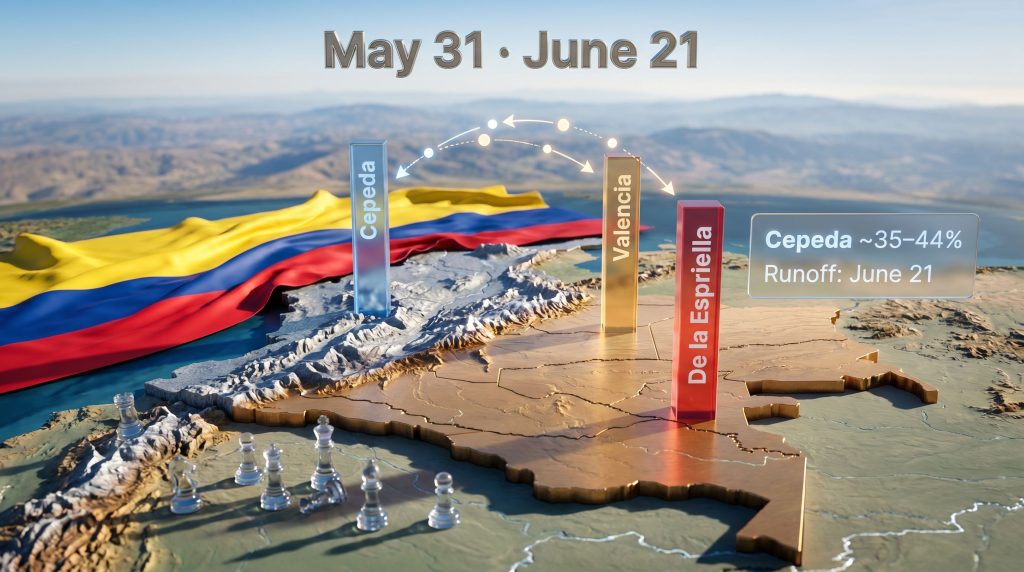
With the first-round vote scheduled for May 31 and a potential runoff on June 21, the window for strategic recalibration is closing rapidly. Understanding why this election has become a probability exercise as much as a democratic preference exercise requires examining both the mechanics of Colombia's electoral architecture and the specific competitive dynamics shaping the 2026 field.
When big ASX news breaks, our subscribers know first
Colombia's "Three-Round" Framework: How Earlier Contests Locked in the Competitive Field
Most analysts describe Colombia's presidential system as a standard two-round majority contest. What makes 2026 structurally different is the argument, advanced by Sergio Guzmán, director of Colombia Risk Analysis, that voters have effectively already participated in a first functional round before the May 31 ballot opens. Congressional elections and inter-party primaries conducted earlier in the electoral cycle served as a candidate-sorting mechanism, consolidating the competitive field and establishing approximate polling hierarchies before the formal presidential campaign began. (BNamericas, May 15, 2026)
Guzmán's position is that these prior contests were not procedural preliminaries. They were substantive political events that shaped donor expectations, candidate positioning, and, crucially, the tactical calculus of swing voters. By the time the presidential campaign reached its final weeks, the field had already been pre-sorted into tiers.
The structural consequence of this compression is significant. In a standard two-round model, voters can freely express a first preference in round one and then recalibrate for the runoff. When earlier contests have already functionally established viability hierarchies, that sequential freedom collapses. First-round votes become simultaneously expressive and strategic, requiring voters to assess runoff probability at the same moment they cast their initial ballot.
A core threshold anchors this analysis: no candidate polling consistently below 44% can realistically reach the 50% threshold required for a first-round outright win. With multiple candidates splitting the field, a June 21 runoff is the mathematically near-certain outcome of May 31 voting.
The Three Candidates Shaping Colombia's 2026 Dynamics
Iván Cepeda: The Frontrunner Whose Lead Generates Opposition
Leftist candidate Iván Cepeda enters the final stretch of the campaign as the consistent polling leader, with support ranges estimated between approximately 35% and 44% across available surveys. His platform centres on continuing the social reform agenda developed during President Gustavo Petro's administration, with particular emphasis on maintaining the "paz total" (total peace) security framework that pursues negotiated arrangements with armed groups rather than enforcement-led confrontation.
Paradoxically, Cepeda's frontrunner status has functioned less as a consolidating force for his coalition and more as an organising principle for his opponents. The conversation in Bogotá, according to Guzmán, has shifted entirely away from whether anti-Cepeda voters want him to lose, and toward the more sophisticated question of who can most reliably defeat him in a runoff. (BNamericas, May 15, 2026)
The most consequential element of Cepeda's policy platform from an investor and institutional perspective is his support for a constituent assembly, a mechanism that critics argue would place Colombia's entire constitutional and institutional framework under comprehensive review. This is not simply a left-wing governance position. It represents a qualitative escalation in institutional risk.
Political risk analysts note that investors tolerated Petro's presidency partly because they trusted the robustness of Colombia's institutional checks and balances. The concern with Cepeda's constituent assembly proposal is that a successor administration, building on two terms of leftist governance, would face significantly fewer structural constraints than Petro did. Former presidents Santos and Uribe both demonstrated that two-term presidents exert substantially greater influence over independent institutions, including oversight bodies, prosecutors, and congressional dynamics, than single-term predecessors. A constituent assembly layered on top of that accumulated executive influence would, in analysts' assessments, put the entire institutional architecture back into play. (BNamericas, May 15, 2026)
Paloma Valencia: The Consolidation Candidate and the Running Mate Signal
Conservative senator Paloma Valencia, running under the Centro Democrático banner associated with former president Álvaro Uribe, is positioned by most analysts as the strongest consolidation candidate for anti-Cepeda voters. Her challenge is structural: Centro Democrático carries an established and loyal voter base, but also a political ceiling. The Uribista identity that energises the party's core has historically constrained its appeal to moderate urban voters who are ideologically centrist but uncomfortable with the party's harder-right positioning on security and social issues.
Valencia's strategic response to that ceiling is visible in her running mate selection. By choosing Juan Daniel Oviedo, a former national statistics director who is openly gay and widely regarded as a technocratic moderate, Valencia sent a deliberate signal to constituencies that would not typically consider a Centro Democrático ticket. The selection combines credibility on economic governance with social accessibility, representing an identity group traditionally alienated from Uribista politics. (BNamericas, May 15, 2026)
Theodore Kahn, director at Control Risks' global risk analysis team in Bogotá, assessed Valencia as offering substantially better runoff prospects than her conservative rival. Furthermore, he noted that swing voters who six months prior would not have contemplated voting for Centro Democrático are now viewing a Valencia candidacy as a route toward a more moderate outcome. (BNamericas, May 15, 2026)
Abelardo de la Espriella: The Vote-Splitting Variable
Far-right outsider Abelardo de la Espriella occupies a third-place polling position with an anti-establishment campaign that appeals to a distinct voter segment within the broader conservative bloc. His approach is characterised by a harder security line than Valencia's and a rejection of political convention that resonates with voters alienated from mainstream party structures.
The analytical concern around de la Espriella is not his individual candidacy, but what his presence does to the arithmetic of the right. When two candidates compete for overlapping voter pools, their combined vote share may exceed what either could win alone, but the fragmentation means neither reaches the runoff threshold with maximum strength. If conservative votes are divided between Valencia and de la Espriella, Cepeda enters a two-candidate runoff in a structurally stronger position than if he faced a unified conservative challenger.
This is the classic coordination failure of multicandidate races in majority-runoff systems: the aggregate preferences of one bloc can be rendered ineffective by internal fragmentation even when that bloc represents a clear majority of the electorate.
The Mechanics of Tactical Voting in a Majority-Runoff System
Tactical voting is not unique to Colombia. What makes it analytically interesting in this context is how the majority-runoff architecture creates distinct incentive structures compared to plurality systems.
In a first-past-the-post model, voting for a losing candidate is often described as "wasting" a vote because it contributes nothing to the outcome. In a two-round majority system, the calculus is more nuanced: a first-round vote for an eliminated candidate is not wasted in the same terminal sense, because the voter participates again in the runoff. However, the choice of whom to support in the first round still shapes which candidates reach the runoff. If a voter's preferred outcome is to maximise the probability that candidate X defeats candidate Y in the second round, they must ensure that X reaches the second round with the strongest possible position, which may require concentrating anti-Y votes behind X even at the cost of supporting a different first-preference candidate.
Regional Precedents Informing Colombian Voter Behaviour
Colombia's voters are not making these calculations in isolation. Recent Latin American electoral history provides a set of instructive precedents:
-
Chile 2021: José Antonio Kast finished second in the first round with approximately 27.9% of the vote, behind Gabriel Boric's 25.8%. The first-round ordering did not determine the runoff outcome, as Boric won the December runoff with 55.9%. The lesson absorbed by analysts is that first-round positioning matters less than the capacity to build runoff coalitions from eliminated candidates' voter bases. (Reuters, December 2021)
-
Brazil 2022: Lula's first-round lead of approximately 48.4% against Bolsonaro's 43.2% translated into a narrow runoff victory of 50.9% to 49.1%. Tactical concentration of centrist votes behind Lula in the second round proved decisive despite Bolsonaro's stronger-than-expected first-round performance. (Brazilian Electoral Court TSE, October 2022)
-
Peru 2021: Pedro Castillo advanced from the first round with roughly 19% of the vote in a fragmented field, reaching the runoff against Keiko Fujimori. Neither candidate reflected the genuine preferences of Peru's centrist majority. The cautionary lesson for Colombia is that fragmented first rounds in polarised environments can produce runoffs that no significant voter constituency actually wanted.
| Country | Election Year | First-Round Leader | Runoff Outcome | Key Tactical Lesson |
|---|---|---|---|---|
| Chile | 2021 | Kast (27.9%) | Boric won (55.9%) | First-round lead does not determine runoff winner |
| Brazil | 2022 | Lula (48.4%) | Lula won (50.9%) | Runoff coalition-building is decisive |
| Peru | 2021 | Castillo (19%) | Polarised runoff neither majority preferred | Fragmentation creates unwanted runoffs |
| Colombia | 2026 | Cepeda (~35-44%) | Runoff virtually certain | Conservative fragmentation risks benefiting frontrunner |
The Disinformation Complication
A factor that rarely receives sufficient analytical weight in tactical voting discussions is the vulnerability of strategic voters to deliberately distorted viability signals. When voters are making probabilistic assessments about which candidate can win a runoff, false polling data that artificially inflates or deflates candidate standing can cause systematic misallocation of tactical votes.
Political risk analysts monitoring the 2026 campaign have flagged coordinated social media activity spreading misleading survey data across conservative voter communities, potentially causing tactical voters to concentrate support behind a suboptimal anti-Cepeda candidate. Election authorities have issued warnings, but correcting false viability narratives within a compressed campaign timeline is demonstrably difficult.
Security Environment as a Structural Constraint on Tactical Calculations
Any analysis of Colombia presidential election tactical voting that does not account for the security environment is analytically incomplete. Colombia's 2026 race is taking place against a backdrop of death threats against hundreds of candidates across multiple regions, with illegal armed groups maintaining territorial control that translates directly into voter suppression in specific geographic zones.
The mechanisms are concrete and measurable:
-
Armed group checkpoints and curfews in rural areas deter voter mobilisation on election day
-
Candidate intimidation in conflict-affected departments limits campaign activity and information access
-
Geographic voter suppression disproportionately affects rural constituencies, which tend to hold distinct political profiles from urban centres
The consequence for tactical voting calculations is significant. If sophisticated tactical voting is concentrated in urban areas where information access is high and security conditions allow free participation, while rural voter participation is suppressed by security conditions, the effective electorate in 2026 may be systematically skewed toward demographics that tactical voting models built on national polling data do not accurately represent.
The "paz total" policy divide compounds this dynamic. Cepeda's continuation of armed group negotiations and the conservative candidates' enforcement-based alternatives have functionally transformed the security question into a binary ideological referendum. Voters in conflict-affected areas face the most direct personal stake in this policy choice, yet are also the voters whose participation is most structurally constrained.
Economic and Investment Stakes: Asymmetric Market Responses to Each Scenario
For investors and companies operating in Colombia's energy, mining, and infrastructure sectors, the 2026 presidential outcome carries material consequences that extend well beyond standard election-cycle uncertainty. Furthermore, these consequences intersect with broader geopolitical mining risks that are reshaping investment decisions across the region.
If Cepeda Wins
Political risk analysts assess that a Cepeda victory would generate immediate downward pressure on Colombian peso valuations and measurable capital outflows in the weeks following the result. Kahn assessed that some capital flight and exchange rate movement are probable outcomes, while also noting that Colombia's institutional architecture and central bank capacity should prevent the level of disruption that would require major monetary intervention. (BNamericas, May 15, 2026)
The constituent assembly dimension is the factor that separates Cepeda's risk profile from a standard leftist governance scenario. A new constitutional process would introduce comprehensive institutional uncertainty, affecting property rights frameworks, contract enforceability, and regulatory predictability across all sectors simultaneously. For long-duration infrastructure and extractive investments that depend on stable 10-to-30-year regulatory environments, this represents a qualitatively different risk than standard policy volatility. The market reaction to policy shifts of this magnitude can be swift and severe, as recent global precedents demonstrate.
If a Conservative Candidate Wins
A Valencia or de la Espriella victory would likely generate an initial rally in investor sentiment, with oil and gas exploration, mining permit reforms, and potential fracking policy all positioned as primary beneficiaries. Both conservative candidates have signalled openness to new exploration licensing rounds and a broadly pro-investment regulatory posture.
However, Guzmán articulated a critical caution that investors would benefit from internalising before pricing in a full-scale policy reversal. Even with strong political will, a new conservative administration would face the same environmental licensing requirements, prior consultation obligations with indigenous and Afro-Colombian communities, and judicial review processes that constrained Petro's administration. (BNamericas, May 15, 2026)
Analysts caution that optimism about a conservative electoral victory may fade quickly once investors realise that the new government's ability to immediately deliver on oil and gas licensing or mining environmental permits is more limited than campaign rhetoric suggests. Regulatory, environmental, and consultation processes represent structural constraints that do not dissolve with a change in presidential ideology.
Kahn similarly noted that while new exploration rounds and openness to fracking are probable under conservative governance, aggressively circumventing environmental licensing and prior consultation frameworks would generate a volatile social risk environment with its own investment implications. (BNamericas, May 15, 2026) In addition, government intervention in mining remains a persistent structural consideration regardless of which administration takes power.
The broader picture for extractives investment is also shaped by global critical minerals demand, which continues to intensify pressure on Colombia's regulatory environment irrespective of domestic electoral outcomes.
| Policy Area | Cepeda (Left) | Valencia (Centre-Right) | De la Espriella (Far-Right) |
|---|---|---|---|
| Oil and Gas Licensing | Restrictive; Petro-era continuity | New exploration rounds; pro-investment | Deregulatory; pro-industry |
| Mining Permitting | Cautious; environmental emphasis | Reform-oriented; investor-friendly | Deregulatory |
| Fracking Policy | Opposed | Open to debate | Supportive |
| Armed Groups / Security | "Paz total" continuation | Tougher enforcement | Hardline; militarised |
| Constituent Assembly | Supporter | Opponent | Opponent |
| Foreign Investment Climate | Cautious | Broadly favourable | Broadly favourable |
The next major ASX story will hit our subscribers first
Swing Voters, Urban Moderates, and the Centrist Calculation
The voter segment that both conservative camps are competing to attract is not the Uribista base. That constituency is already allocated. The decisive demographic in a potential runoff is urban moderate voters, characterised by priority for institutional stability and economic predictability over ideological alignment, and previous reluctance to support Centro Democrático due to its harder-right positioning.
Valencia's running mate selection directly targets this group. Oviedo's technocratic credentials and personal identity signal a departure from the socially conservative, security-focused brand that has historically defined Centro Democrático's public face. For a moderate Bogotá voter who prioritised economic competence and social inclusion over security hardlining, this signal may be sufficient to make Valencia an acceptable choice when the alternative is Cepeda and the institutional uncertainty his constituent assembly proposal introduces.
The centrist candidates remaining in the field, including lower-polling figures such as Fajardo and López, serve a different function in the tactical calculus. Their presence prevents any candidate from reaching the 50% first-round threshold, but their voter bases represent a critical runoff coalition resource. Whichever candidate successfully absorbs the majority of votes from eliminated centrist candidates in the runoff will hold a decisive structural advantage.
Key Takeaways for Investors, Analysts, and Observers
Colombia presidential election tactical voting ultimately distils into a small number of analytically tractable conclusions:
-
The runoff is virtually certain. No candidate carries consistent polling support above the 50% threshold needed for a first-round majority, making June 21 the election that actually matters.
-
Conservative coordination is the swing variable. Whether Valencia or de la Espriella consolidates the anti-Cepeda vote in the first round will largely determine whether the runoff is competitive.
-
Market responses will be asymmetric and sequenced. A Cepeda victory triggers immediate confidence pressure; a conservative victory generates optimism that may erode as implementation realities constrain delivery.
-
The constituent assembly is the qualitative risk multiplier. It is what separates Cepeda's risk profile from a standard continuation-of-Petro scenario.
-
Energy and mining sector outcomes are contingent on both the election result and regulatory realities that exist independently of presidential ideology.
-
Security conditions and disinformation introduce structural uncertainty into tactical voting models that sophisticated analysts must explicitly account for, not treat as background noise.
This article is intended for informational and analytical purposes only and does not constitute investment advice. Forecasts and risk assessments reflect analyst opinions available at the time of publication and are subject to change. Readers should conduct independent due diligence before making investment or business decisions based on political risk analysis.
Want to Stay Ahead of Major Mineral Discoveries Shaping Investment Decisions in Volatile Markets?
While political risk cycles like Colombia's 2026 election reshape commodity and extractives investment outlooks, Discovery Alert's proprietary Discovery IQ model delivers real-time alerts on significant ASX mineral discoveries — turning complex data across 30+ commodities into clear, actionable insights for both traders and long-term investors. Explore how historic discoveries have generated substantial returns by visiting Discovery Alert's dedicated discoveries page, and begin your 14-day free trial today to position yourself ahead of the market.