June 13, 2026
The Anode Material Bottleneck That Western Battery Chains Cannot Ignore
Every lithium-ion battery cell contains a cathode and an anode. While cathode chemistry receives the majority of investor and policy attention, the anode side of the equation presents an equally serious supply challenge. Natural graphite, the dominant anode material in commercial battery cells, is overwhelmingly sourced from a single country. China accounts for roughly 60 to 70 percent of global natural graphite mine production and controls an even larger share of the downstream processing capacity required to transform raw flake into battery-grade spherical purified graphite (SPG). The global graphite shortage this creates for North American manufacturers building out electric vehicle and grid storage supply chains represents a structural vulnerability with no quick fix.
The challenge is not simply one of geography. Battery-grade SPG must meet exacting specifications for particle size distribution, carbon purity, and surface chemistry. Flake graphite that does not originate from a jurisdiction with processing infrastructure capable of meeting these standards cannot simply be redirected through an alternative route. Building that processing capability outside China requires project-scale capital commitments, long permitting timelines, and patient institutional capital — conditions that have historically been difficult to assemble simultaneously for a commodity that lacks the mainstream investor recognition of lithium or nickel.
That is precisely what makes the Nouveau Monde Graphite Matawinie mine construction financing story worth examining in detail — not as a single corporate announcement, but as a case study in how battery supply chain infrastructure actually gets built from the ground up in Western jurisdictions.
When big ASX news breaks, our subscribers know first
How Graphite's Unique Chemistry Creates a Supply Chain Problem Unlike Any Other Battery Material
Why Graphite Cannot Simply Be Substituted
Natural graphite's role in battery anodes is not incidental. The layered crystalline structure of graphite — specifically its ability to intercalate lithium ions between graphene layers during charge and discharge cycles — makes it the most commercially scalable anode material currently available. Synthetic graphite can serve as an alternative but requires significantly more energy-intensive production, typically derived from petroleum coke precursors in high-temperature furnaces, making it both more expensive and more carbon-intensive than natural flake graphite that is properly processed.
The shift toward natural graphite in battery manufacturing is therefore not purely a cost decision. It also reflects the carbon intensity considerations increasingly embedded in battery manufacturer sustainability reporting and the lifecycle emissions calculations that automotive OEMs must now disclose. A tonne of battery-grade SPG produced from Quebec natural flake graphite, powered by the province's abundant hydroelectric grid, carries a carbon footprint that is difficult to replicate in production environments reliant on fossil fuel-powered electricity.
The Processing Bottleneck: From Flake to Spherical Purified Graphite
Most discussions of graphite supply focus on mining tonnage. The more consequential bottleneck, however, sits in downstream processing. Natural flake graphite extracted from the ground is not directly usable in battery anodes. It must first be milled, shaped into spherical particles, coated, and purified to carbon purity levels typically exceeding 99.95 percent. This multi-stage transformation into SPG is where China's processing dominance is most pronounced and where it is most difficult to replicate quickly in other jurisdictions.
Projects that position themselves as vertically integrated — combining mining with SPG processing capability — therefore command a strategic premium over pure-play mining operations. The ability to deliver battery-ready material directly to cell manufacturers reduces the supply chain steps that need to be de-risked by automotive procurement teams. Furthermore, the evolving battery raw materials market continues to reward projects with this integrated approach.
The Financing Architecture That Is Taking Shape Around Matawinie
Senior Secured Debt: The Foundation of the Capital Stack
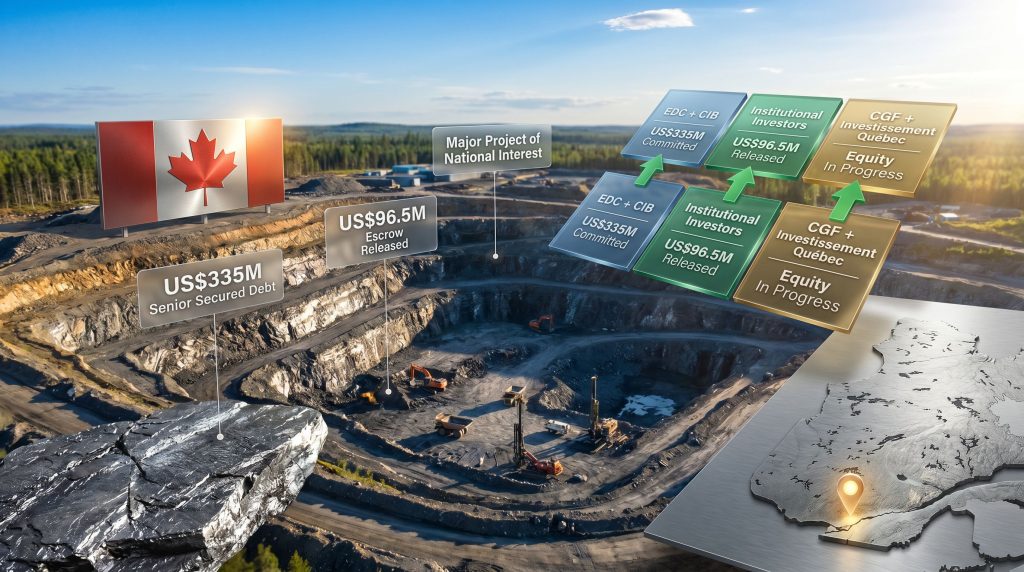
The most structurally significant element of the Nouveau Monde Graphite Matawinie mine construction financing is the US$335 million senior secured project debt package anchored by Export Development Canada (EDC) and the Canada Infrastructure Bank (CIB). Understanding what this debt commitment actually means requires unpacking the terminology.
Senior secured project debt sits at the top of the repayment priority hierarchy. In the event of project distress, senior debt holders have the first claim on project assets, cash flows, and any enforcement remedies. For a mine construction project, this security is typically structured around the physical assets of the project itself, the mineral rights, the processing infrastructure, and the revenue streams from offtake agreements. The "project finance" structure is distinct from corporate lending in that repayment depends primarily on the project's own cash generation rather than on the broader balance sheet of the sponsoring company.
This distinction matters enormously for investor interpretation. When EDC and CIB commit to senior secured project debt, they are not simply expressing confidence in NMG as a corporate entity. They are conducting rigorous independent analysis of the project's standalone economics, technical feasibility, market assumptions, and risk-adjusted return profile. That analytical process functions as a form of third-party technical and commercial due diligence that private equity and strategic investors cannot easily replicate at the same depth.
Escrow Release: What the US$96.5 Million Unlock Actually Represents
The release of US$96.5 million from escrow and its deployment into the Matawinie project is more nuanced than a simple capital injection. Escrow structures in staged project financings are designed to hold institutional capital in trust until pre-defined milestones or conditions are satisfied. The release of those funds signals that those conditions have been met to the satisfaction of the escrow trustee and the subscribing investors.
Critically, this release triggered the automatic conversion of subscription receipts into ordinary NMG shares. Subscription receipts are a financing instrument commonly used in Canadian capital markets that allows investors to commit capital ahead of a defined milestone, with the actual share issuance contingent on that milestone being achieved. The conversion increases NMG's total share count and therefore dilutes the percentage ownership of existing shareholders, but it also transforms contingent capital into permanent equity, strengthening the company's balance sheet for the construction phase ahead.
| Financing Component | Provider(s) | Quantum | Current Status |
|---|---|---|---|
| Senior Secured Project Debt | EDC + CIB | US$335 million | Committed |
| Released Escrow Capital | Institutional Investors | US$96.5 million | Deployed |
| Government Equity Stakes | Canada Growth Fund + Investissement Quebec | TBC | Stakes Increased |
| Remaining Equity Gap | Strategic Investors | TBC | Under Negotiation |
The Equity Layer: Why This Is the Most Complex Piece to Close
Debt and escrow capital represent the lower-risk tiers of a project finance capital stack precisely because they carry defined repayment obligations and security structures. Equity sits at the bottom of that stack, absorbing losses first and receiving returns only after debt obligations are satisfied. For a project of Matawinie's scale, closing the equity layer is structurally more difficult than securing debt because it requires investors willing to accept a higher risk profile without the protective covenants available to lenders.
The Canada Growth Fund (CGF) and Investissement Quebec (IQ) have both increased their ownership stakes as part of the current financing round. CGF was established as a federal policy instrument to catalyse private investment in low-carbon and clean economy sectors, while IQ operates as Quebec's economic development investment arm. Their combined participation serves an important signalling function: it reduces the perceived risk premium that fully commercial equity investors must price in, potentially attracting strategic partners from the battery manufacturing and automotive supply chain who require a degree of institutional confidence before committing capital at this project stage.
The most consequential near-term execution risk for the Matawinie project is not technical readiness or regulatory approval, it is closing the remaining equity financing gap on terms that satisfy both the debt providers' conditions precedent and NMG's dilution thresholds simultaneously.
What Phase 2 of the Matawinie Mine Actually Involves
Location, Scope, and What Makes Quebec an Exceptional Jurisdiction
The Matawinie Mine sits approximately 120 kilometres north of Montreal in Quebec's Lanaudière region. This location is not incidental to the project's strategic logic. Quebec's electricity grid is powered overwhelmingly by hydroelectric generation, giving the province some of the lowest-carbon and lowest-cost industrial electricity in North America. For an operation like Matawinie, where the downstream processing of graphite into SPG is energy-intensive, access to clean, affordable hydroelectric power is a material competitive advantage that directly affects both operating cost economics and lifecycle carbon intensity calculations.
Phase 2 encompasses the full development of the open-pit graphite mining operation alongside concentration and downstream processing infrastructure designed to produce battery-grade anode material. This integrated design is central to the project's commercial rationale. A mine that sells flake concentrate is exposed directly to commodity price volatility. However, a mine with SPG processing capability sells into a value-added product market where specifications, qualification requirements, and long-term offtake relationships provide a degree of pricing insulation.
Construction Readiness Indicators Already in Place
The appointment of Pomerleau as construction manager represents a meaningful signal of construction phase maturity. Pomerleau is among Canada's largest and most experienced construction firms, and its engagement on a project of this technical complexity indicates that the engineering and procurement work has advanced to a stage where a tier-one contractor is willing to commit its brand and resources.
Equally significant is the fact that major contract awards representing more than 50 percent of total project capital expenditure have already been completed. In project finance, this level of procurement maturity substantially reduces the execution risk that lenders and equity investors must price into their return requirements. A project where the majority of key contracts remain unsigned carries significantly higher cost overrun and schedule risk than one where suppliers and contractors are already engaged under binding terms.
Key construction readiness indicators currently in place include:
- Appointment of a tier-one Canadian construction manager in Pomerleau
- Binding contract awards covering more than half of total project CAPEX
- Advanced engineering and procurement documentation
- Institutional debt commitment from federal government-backed lenders
- Conversion of escrow capital into deployable equity
The Investor Profile: Understanding Who Is Backing Matawinie and Why
Canada Growth Fund: Policy Capital With Commercial Discipline
The Canada Growth Fund was created to mobilise private capital into clean economy and critical mineral sectors by co-investing alongside private partners and thereby reducing the risk premium that purely commercial investors must absorb. Crucially, CGF is not a grant-making body. It operates on commercial return principles, which means its increased stake in NMG reflects an affirmative view of the project's economics, not merely a policy mandate to support domestic graphite production.
This distinction carries meaningful weight in investor analysis. When a commercially disciplined government fund with full access to project-level data increases its ownership position, it communicates something substantively different from a political endorsement. It indicates that the project's internal rate of return, market demand assumptions, and risk profile have been assessed as viable under rigorous financial scrutiny. In addition, this kind of institutional validation is increasingly central to the broader critical minerals demand narrative shaping energy transition investment globally.
Investissement Quebec: Provincial Conviction and Its Implications
IQ's role as Quebec's economic development investment arm means its participation carries a provincial governance dimension alongside its financial rationale. IQ has historically been involved in resource sector development across Quebec, and its track record in supporting major industrial projects gives it credibility as a project anchor that private co-investors treat as a meaningful validation signal.
The combination of CGF and IQ as co-equity anchors creates a governance dynamic worth noting. Both institutions will hold board representation or oversight rights commensurate with their ownership positions, which introduces a degree of public interest accountability into the project's governance framework. For ESG-mandated institutional investors evaluating Matawinie as a potential portfolio inclusion, this governance structure may be viewed as a net positive rather than a constraint.
Strategic Investors: The Final Piece of the Equity Puzzle
The remaining equity gap is most likely to be filled by strategic investors rather than purely financial ones. In critical mineral project financing, strategic equity and offtake agreements are frequently structured together, with a battery cell manufacturer or automotive OEM taking an ownership position in exchange for long-term supply commitments at preferential terms. This structure aligns the financial incentives of the mine developer with the supply security interests of the downstream buyer in a way that pure financial equity cannot replicate.
Potential strategic investor categories for a project of Matawinie's profile include:
- Battery cell manufacturers with active North American gigafactory buildouts
- Automotive OEMs committed to North American battery material sourcing
- Energy trading houses with commodity offtake expertise
- Sovereign wealth funds with mandated allocations to critical mineral supply chains
- Specialty chemicals companies with downstream graphite processing interests
Execution Risks Between Now and Full Financial Close
Graphite Market Dynamics and Their Effect on Project Economics
The graphite market has faced sustained price pressure in recent years, driven in part by Chinese production capacity expansion that has created supply surpluses in flake concentrate. Understanding how this affects a project like Matawinie requires distinguishing between the commodity price for raw flake graphite and the value-added price for battery-grade SPG, which commands a substantial premium and is subject to somewhat different demand drivers.
NMG's downstream processing capability partially insulates the project from flake concentrate price weakness, but the relationship between commodity pricing and project internal rates of return remains a variable that institutional investors will stress-test carefully. EV adoption curves, gigafactory commissioning timelines, and battery chemistry evolution all affect the demand-side projections underpinning Matawinie's financial model. Consequently, a compelling recycled graphite product ecosystem developing in parallel may also influence long-term supply assumptions.
ESG Governance as a Financing Prerequisite
The appointment of Josée Gagnon as Chief Legal Officer and Martine Paradis as Chief of Sustainability and Culture reflects a deliberate effort to build institutional-grade governance ahead of final investment decision. This is not incidental. ESG performance metrics and sustainability governance requirements are increasingly embedded directly into the covenant structures of institutional project debt, particularly for government-backed lenders like EDC and CIB whose mandates include environmental and social risk management.
A dedicated Chief Legal Officer signals that NMG is preparing for the documentation complexity of a multi-party project finance structure, where credit agreements, offtake contracts, engineering procurement and construction agreements, and government funding instruments must be carefully coordinated. A Chief of Sustainability and Culture signals that the company is building the reporting and stakeholder engagement capability that institutional lenders will require throughout the construction and operations phases.
ESG leadership is no longer a reputational add-on for projects seeking government-backed institutional financing. It is increasingly a prerequisite embedded in the financing documentation itself.
The next major ASX story will hit our subscribers first
What Matawinie's Progress Means for Canada's Broader Battery Material Ecosystem
The Template Value of the EDC and CIB Co-Lending Model
The co-lending structure involving both EDC and CIB on a single project is notable for its relative rarity in Canadian critical mineral financing. EDC traditionally focuses on export-oriented business risk, while CIB targets infrastructure with public benefit characteristics. Their joint participation on Matawinie suggests that the project has been assessed as meeting multiple policy mandates simultaneously: export competitiveness, domestic infrastructure development, and clean economy transition.
If Matawinie successfully reaches financial close and construction proceeds, the financing structure it establishes will serve as a reference model for other Canadian critical mineral developers attempting to assemble similar capital stacks. The demonstrated viability of EDC-CIB co-lending alongside CGF equity participation would reduce the uncertainty premium that subsequent projects must overcome. Furthermore, the implications extend well beyond Canada, informing how policymakers approach critical minerals supply chains across allied jurisdictions seeking to reduce strategic dependencies.
Quebec's Emerging Position as a Battery Material Processing Hub
A fully operational Matawinie mine with integrated SPG processing capability would represent a meaningful contribution to North American battery-grade graphite supply — a market currently almost entirely served by Chinese producers. The project's proximity to planned and operational battery manufacturing facilities in Ontario and the northeastern United States amplifies its strategic relevance for automotive supply chain planners working to qualify domestic material sources ahead of content requirements embedded in North American trade frameworks.
Quebec's combination of clean hydroelectric power, established mining regulatory frameworks, proximity to major manufacturing markets, and now demonstrated access to government-backed project financing creates a compelling jurisdictional case that is increasingly attracting attention from battery material developers across multiple commodity categories.
The Nouveau Monde Graphite Matawinie mine construction financing milestones achieved in May 2026 do not yet represent a completed deal. The equity layer remains open, and the formal Final Investment Decision targeted for the first half of 2026 is contingent on closing that gap. However, the architecture assembled to date — senior secured debt committed, escrow capital deployed, and institutional equity anchors increasing their positions — represents the most substantive financing progress a Canadian graphite project has achieved in the battery material era.
Readers seeking further context on Canadian critical minerals financing structures and battery supply chain development may find additional value in reviewing coverage from the Canadian Mining Journal, The Northern Miner, and Mining.com, which have tracked the evolution of the Matawinie project across multiple development stages. This article contains forward-looking statements and financial projections that reflect current expectations and assumptions. Actual outcomes may differ materially from those described. Nothing in this article constitutes investment advice.
Want to Identify the Next Major Critical Mineral Discovery Before the Broader Market?
Discovery Alert's proprietary Discovery IQ model delivers real-time alerts on significant ASX mineral discoveries — including battery materials such as graphite — instantly transforming complex geological and market data into actionable investment insights for both short-term traders and long-term investors. Explore how historic mineral discoveries have generated extraordinary returns and begin your 14-day free trial today to secure a market-leading advantage as the battery material supply chain continues to reshape global investment opportunities.