August 5, 2026
Why Summer Energy Markets Are More Complex Than They Appear
Most market participants treat energy seasonality as a single, unified phenomenon. The assumption is straightforward: summer arrives, people drive more, energy demand rises, and prices follow. But this framing collapses important distinctions that separate informed traders from reactive ones. The reality is that different energy commodities respond to summer through entirely different mechanisms, and confusing those mechanisms leads to poorly constructed positions and mispriced risk.
Understanding how natural gas prices and summer driving season interact, and where they diverge, is one of the most practically useful frameworks available to commodity market participants heading into the warmer months.
When big ASX news breaks, our subscribers know first
The Summer Driving Season: What It Actually Does to Fuel Prices
How the Seasonal Demand Surge Builds
The summer driving season is generally defined as the period stretching from Memorial Day weekend in late May through Labor Day in early September. During this window, U.S. vehicle miles traveled climb meaningfully, creating downstream pressure on refined fuel inventories and ultimately on pump prices.
However, the demand surge itself is only part of the price story. What amplifies it is the supply-side constraint that arrives at the same time.
The Summer-Blend Switchover: A Recurring Structural Price Catalyst
Every year, refiners face a fixed compliance deadline of May 1 to transition terminal operations to summer-blend gasoline formulations. These blends are chemically distinct from winter-grade fuels, requiring stricter Reid Vapor Pressure (RVP) standards to reduce evaporative emissions during warmer temperatures.
The practical consequence is that summer-blend fuel is more expensive to produce. The switchover period creates a temporary supply disruption as refineries shift operations, reducing available inventory precisely when demand is beginning its seasonal climb. This structural mismatch between supply availability and rising demand is why gasoline pump prices historically show a peak pattern in late April through June, often before peak driving activity itself has been reached.
Key seasonal indicators for the gasoline market include:
| Indicator | Seasonal Pattern | Peak Period |
|---|---|---|
| U.S. vehicle miles traveled | Rises February through August | August |
| Gasoline retail demand | Builds from spring | Memorial Day to Labor Day |
| Refinery utilization rates | Tightens pre-summer | April to May |
| Summer-blend compliance deadline | Fixed annual trigger | May 1 |
The takeaway is that gasoline is a direct beneficiary of summer driving season dynamics. The demand driver is clear, measurable, and arrives on a broadly predictable schedule each year.
Natural Gas Prices in Summer: A Fundamentally Different Story
Cooling Load, Not Road Travel, Is the Real Price Driver
Here is where many market participants make a critical analytical error. Natural gas prices and summer driving season are often referenced together as though they share the same catalyst. They do not.
Natural gas demand in summer rises primarily because of residential and commercial air conditioning load. When temperatures climb across major population centres, electricity consumption surges. Gas-fired power plants, which function as the marginal generation source across most U.S. electricity markets, are the assets that get dispatched to meet that incremental demand. Higher electricity consumption in summer therefore translates directly into higher gas-fired power burn.
Furthermore, current natural gas price trends show just how sensitive pricing can be to these demand shifts, particularly as summer approaches and cooling requirements intensify.
"The summer driving season is a direct bullish catalyst for gasoline but functions only as an indirect influence on natural gas. The primary lever for gas prices in summer is air conditioning load, not vehicle fuel consumption."
This distinction matters enormously for risk assessment. A summer that delivers high vehicle miles traveled but moderate temperatures will be bullish for gasoline and neutral-to-bearish for natural gas. A summer with extreme heat events but low travel activity will produce the opposite outcome. Treating both as a single seasonal trade is a structural analytical mistake.
The Injection Season Dynamic
Summer also coincides with the natural gas injection season, which runs from approximately April through October. During this window, the market works to rebuild storage inventories depleted by winter heating demand.
The rate at which injections accumulate relative to the five-year historical average functions as a real-time price signal:
- Below-average injection builds suggest tightening supply and generate upward price pressure
- Above-average injection builds indicate comfortable inventory buffers and tend to suppress prices
- Near-average builds provide a moderate baseline that leaves prices sensitive to weather surprises
U.S. inventories projected to end the withdrawal season near the five-year average represent a neutral starting point for summer. From that baseline, weather becomes the decisive variable.
What Rising Production Means for the Price Ceiling
The US natural gas forecast from the U.S. EIA projects that domestic production will continue increasing through 2026 and 2027. This structural supply growth acts as a natural ceiling on price rallies, particularly when storage builds are proceeding at near-average rates. For traders, this means that while weather-driven spikes remain possible, the structural backdrop limits how far and how long sustained price surges can run absent a major supply disruption or extended extreme heat event.
The Asymmetric Risk-Reward Setup in Natural Gas
Why Multi-Year Lows Create Unusual Positioning Opportunities
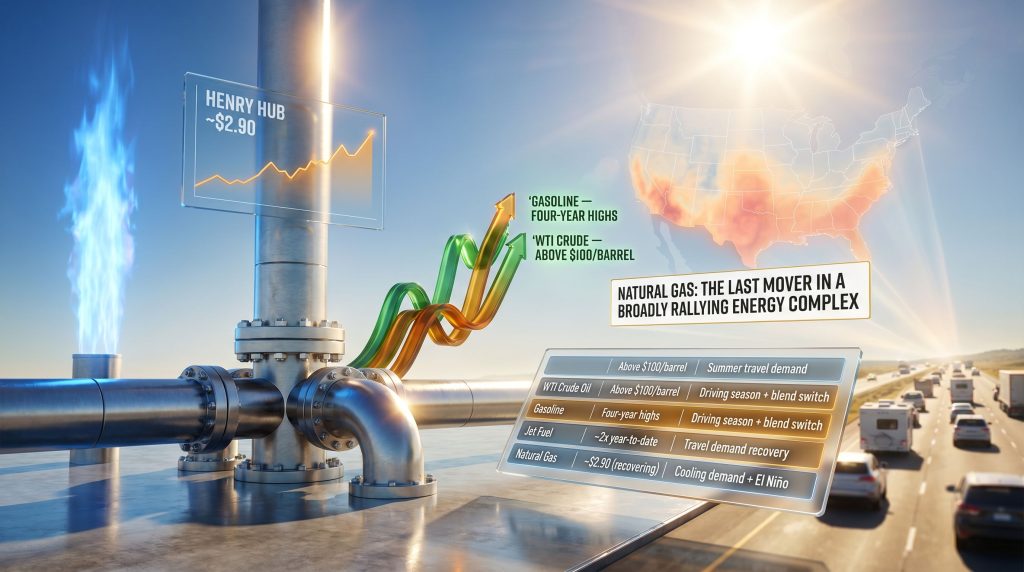
Within the broader energy complex, natural gas has been the clear relative underperformer through recent months. While WTI crude oil has reclaimed levels above $100 per barrel, gasoline has broken out to four-year highs, and jet fuel prices have roughly doubled since the start of the year, natural gas has remained compressed near multi-year lows.
This divergence within a broadly rising energy complex creates what technical and macro analysts refer to as a catch-up opportunity thesis: when the rest of a sector has already repriced, the laggard with strong fundamental catalysts ahead often presents the most favourable risk-reward profile.
The support zone in the $2.50 to $2.60 range has demonstrated significant buying interest and held firm as a technical floor. A recovery back above the $2.90 level, representing a gain of more than 6% on a weekly basis, signals renewed directional momentum and suggests the market is beginning to reprice summer demand expectations.
"When a commodity trades near multi-year lows while approaching a seasonally supportive demand window, the downside becomes structurally bounded while the upside potential remains open. This asymmetry forms the basis for high-conviction seasonal positioning frameworks."
El Niño as a Weather Amplifier
El Niño weather patterns are associated with above-average summer temperatures across broad portions of the United States. For natural gas, hotter temperatures translate directly into increased electricity demand for cooling, which increases gas-fired power plant utilisation. This makes active El Niño conditions a bullish seasonal amplifier that can meaningfully shift demand projections above baseline.
The combination of technical support holding at multi-year lows, an approaching seasonal demand catalyst, and El Niño amplification potential creates a layered case for positioning. As the market transitions through June, July, and into the peak summer cooling months, these factors are expected to increasingly influence price direction.
How the Broader Energy Complex Shapes Natural Gas Sentiment
Capital Rotation Into the Energy Complex
Energy markets do not operate in isolation. Commodity traders and institutional managers allocate across the entire complex, and rotation patterns matter. As precious metals including gold and platinum begin showing signs of pressure in mid-May, with gold pulling back below key moving averages including the 50-day, capital that had been positioned in metals typically seeks new opportunities elsewhere.
The energy complex frequently absorbs a portion of this rotational flow, particularly when energy fundamentals are constructive. With crude oil above $100, gasoline at multi-year highs, and jet fuel reflecting strong demand recovery, the macro backdrop for energy has been clearly supportive. Natural gas, as the laggard within this setup, becomes the highest relative value target for capital rotating from metals.
Current Commodity Complex Snapshot
| Energy Asset | Recent Price Context | Primary Seasonal Catalyst |
|---|---|---|
| WTI Crude Oil | Above $100 per barrel | Summer travel and industrial demand |
| Gasoline | Four-year highs | Driving season plus blend transition |
| Jet Fuel | Approximately doubled year-to-date | Travel demand recovery |
| Natural Gas | Near $2.90, recovering | Cooling demand plus El Niño conditions |
| Gold | Consolidating near $4,700 per ounce | Rotation pressure as May progresses |
Macro Risks to Monitor: The Late May and June Volatility Window
Systematic Pressure Points in the Late Spring Calendar
Not every macro force in late May and June is supportive of commodity prices. Several structural calendar events create predictable volatility and potential headwinds that traders need to account for explicitly.
The end-of-quarter portfolio rebalancing cycle drives systematic selling across risk assets as institutional managers adjust allocations before June 30. This is a mechanical process that can generate selling pressure even in fundamentally strong markets. Layered on top of this is quad witching options expiry, when stock index futures, stock index options, individual stock options, and single stock futures all expire simultaneously, amplifying volatility and forcing repositioning across derivatives markets.
Additionally, the U.S. dollar tends to build momentum during this window. A strengthening dollar creates headwinds for dollar-denominated commodities broadly, including both energy and metals. For natural gas, this creates a scenario where short-term price weakness in late May through June may not reflect deteriorating fundamentals but rather macro-driven technical selling. In addition, the trade war oil impact on broader commodity sentiment during this period can compound these existing pressures.
Seasonal Risk Calendar for Commodity Traders
| Time Window | Key Risk Event | Likely Market Impact |
|---|---|---|
| Late May | Quad witching options expiry | Elevated volatility, potential pullbacks |
| End of May to Early June | Quarter-end portfolio rebalancing | Systematic selling in risk assets |
| May to June | U.S. dollar seasonal strength | Broad commodity headwind |
| June to August | Summer cooling demand peak | Bullish for natural gas fundamentals |
The strategic implication is clear: short-term price weakness during this window should be evaluated against the medium-term fundamental backdrop rather than treated as a trend reversal signal.
The next major ASX story will hit our subscribers first
A Framework for Monitoring Natural Gas Through Summer
Three Layers of Intelligence for Informed Analysis
Effective seasonal positioning in natural gas requires tracking signals across three distinct layers simultaneously.
Layer 1: Storage and Supply Fundamentals
- Weekly EIA Natural Gas Storage Reports released each Thursday provide injection volume data versus the five-year seasonal average
- U.S. production growth trajectory, which continues trending higher through 2026 and 2027, functions as a structural price moderator
- The LNG supply outlook for export volumes influences domestic supply balances and can tighten the market meaningfully during periods of high international demand
Layer 2: Weather and Demand Signals
- NOAA seasonal temperature outlooks represent the single most important near-term directional catalyst for summer gas prices
- Cooling Degree Days (CDDs) versus historical norms provide the primary quantitative metric for summer gas demand
- El Niño or La Niña cycle status determines whether the weather baseline leans toward above-normal or below-normal summer heat
Layer 3: Market Structure and Positioning
- The shape of the Henry Hub futures curve, specifically whether it is in backwardation (near-term prices above forward prices) or contango (forward prices above spot), signals whether the market perceives near-term tightness or surplus
- CFTC Commitments of Traders reports reveal net speculative positioning, which can identify potential short-squeeze setups when bearish crowding is extreme
- Technical price levels including support zones, moving average alignment, and breakout confirmation points provide entry and risk management anchors
Natural Gas vs. Gasoline: A Side-by-Side Seasonal Comparison
| Factor | Gasoline | Natural Gas |
|---|---|---|
| Primary summer demand driver | Road travel and vehicle miles | Air conditioning and power generation |
| Seasonal demand peak | August | July to August, heat dependent |
| Key price catalyst window | April to June, blend transition | June to August, cooling load |
| Storage dynamic | Refinery throughput and stocks | Injection season build rate |
| Weather sensitivity | Moderate | High, temperature-driven power burn |
| 2025 seasonal performance | Strong, multi-year highs | Underperformed relative to complex |
Despite their different mechanisms, these two fuels are connected at the macro level. Strong gasoline consumption during the driving season reflects robust consumer economic activity. Elevated crude prices driven partly by driving season demand tighten the overall energy budget, which can shift incremental power generation demand toward natural gas. The connection is indirect but real, and understanding it allows for more sophisticated multi-asset energy positioning rather than single-commodity analysis in isolation.
Frequently Asked Questions: Natural Gas Prices and the Summer Driving Season
Does the summer driving season directly push natural gas prices higher?
No. The summer driving season primarily affects gasoline and refined fuel prices through increased road travel demand and the annual summer-blend fuel requirement. Natural gas prices and summer driving season dynamics operate through distinct mechanisms, with gas responding mainly to cooling demand — specifically the electricity required to power widespread air conditioning. The two markets share the broader seasonal energy demand backdrop but diverge significantly in their fundamental drivers.
What is the injection season and why does it matter?
The injection season runs from approximately April through October. During this period, natural gas is pumped into underground storage to replenish reserves drawn down over the winter heating season. Injection rates relative to the five-year historical average are closely watched as a real-time supply-demand signal. Below-average builds suggest tightening and support prices; above-average builds indicate ample supply and tend to cap price upside.
How does El Niño influence natural gas prices?
El Niño conditions are associated with above-average summer temperatures across significant portions of the United States. Hotter summers increase electricity demand for cooling, driving higher utilisation of gas-fired power plants. This makes El Niño a bullish amplifier for summer natural gas prices, particularly during the peak cooling months of June through August.
Why has natural gas lagged the broader energy market?
Natural gas has underperformed relative to crude oil, gasoline, and jet fuel due to a combination of rising U.S. domestic production, near-average storage inventory levels, and softer-than-expected summer cooling demand. Furthermore, strategies around commodity volatility hedging have become increasingly relevant as traders navigate this laggard dynamic and position ahead of the peak cooling season.
What signals would indicate a meaningful natural gas price breakout ahead?
Key indicators to watch include: weekly EIA storage reports showing below-average injection rates, NOAA temperature outlooks projecting above-normal summer heat, Henry Hub futures shifting into backwardation, and net speculative positioning in COT data turning increasingly long. When these signals converge, the setup for a sustained upside move historically becomes more compelling.
Strategic Takeaways for the Summer Energy Cycle
The Bull Case, The Risk Factors, and The Broader Framework
The structural case for natural gas as a seasonal opportunity heading into summer rests on several converging factors: proximity to multi-year technical lows within a broadly rising energy complex, an approaching seasonal demand catalyst in the form of cooling load, and El Niño weather conditions that could amplify heat-driven power burn beyond baseline expectations. Rising domestic production acts as a defined ceiling on the upside, which paradoxically makes the risk-reward framework clearer rather than less attractive.
Risk factors that could limit or reverse upside include cooler-than-normal summer temperatures reducing cooling demand below seasonal norms, faster-than-expected production growth outpacing incremental demand, a broad risk-off episode driven by dollar strength during the late May and June volatility window, and above-average storage builds removing supply urgency from market pricing.
"Summer energy markets function as an interconnected system rather than a collection of isolated commodities. Gasoline demand drives crude consumption, elevated crude prices signal broad energy tightness, and that tightness eventually flows through to natural gas as weather amplifies cooling demand. Recognising these linkages is what separates multi-asset energy analysis from single-commodity guesswork."
Readers seeking additional independent context on energy market seasonality can explore the U.S. EIA's Natural Gas outlook and CME Group's educational resources on natural gas seasonality for further background on the dynamics discussed throughout this article. Nothing in this article constitutes financial advice. Commodity markets carry significant risk, and all price projections and seasonal patterns represent historical tendencies rather than guaranteed future outcomes.
Want To Stay Ahead Of The Next Major Mineral Discovery On The ASX?
Discovery Alert's proprietary Discovery IQ model delivers real-time alerts on significant ASX mineral discoveries, turning complex commodity data into actionable insights for both short-term traders and long-term investors — explore historic examples of exceptional discovery outcomes to understand the scale of opportunity, and begin your 14-day free trial at Discovery Alert to position yourself ahead of the broader market.