August 6, 2026
The Invisible Architecture Behind the AI Revolution
Every technological revolution runs on something most people never think about. The semiconductor era needed silicon. The mobile era needed lithium. The AI era, it turns out, needs fluorine, and fluorine comes from fluorspar for AI data centers and battery storage in quantities that the world is only beginning to reckon with.
Fluorspar, or calcium fluoride (CaF₂), is not a new discovery. It has been mined for centuries and touches more than 170 documented industrial processes, from steel manufacturing to pharmaceutical production. Yet despite this breadth of application, it has remained largely invisible to the investment community. That invisibility is now colliding with one of the most capital-intensive infrastructure buildouts in modern history.
When big ASX news breaks, our subscribers know first
Why Fluorspar Is Different From Every Other Critical Mineral
To understand why fluorspar occupies a unique position in the critical minerals demand landscape, it helps to first understand what makes it chemically irreplaceable.
Fluorspar is the primary commercial source of fluorine, the most electronegative element on the periodic table. This electronegativity makes fluorine an extraordinarily reactive bonding agent, capable of forming stable compounds with elements that resist almost every other chemical process. Unlike lithium or cobalt, where substitution research is active and alternative chemistries exist on the horizon, fluorine's physical properties cannot be replicated by another element at scale.
What Are the Three Commercial Grades?
There are three commercial grades of fluorspar:
- Acid spar (97%+ CaF₂ purity): used in hydrofluoric acid (HF) production, the precursor to virtually all fluorochemicals
- Metallurgical spar (60–85% CaF₂): used as a flux agent in steel and aluminium production
- Ceramic spar (85–96% CaF₂): used in glass, enamel, and speciality ceramic manufacturing
The acid spar grade is the most strategically important, feeding into battery electrolytes, semiconductor etching chemicals, refrigerants, and nuclear fuel processing. It is also the grade most exposed to the demand surge now underway.
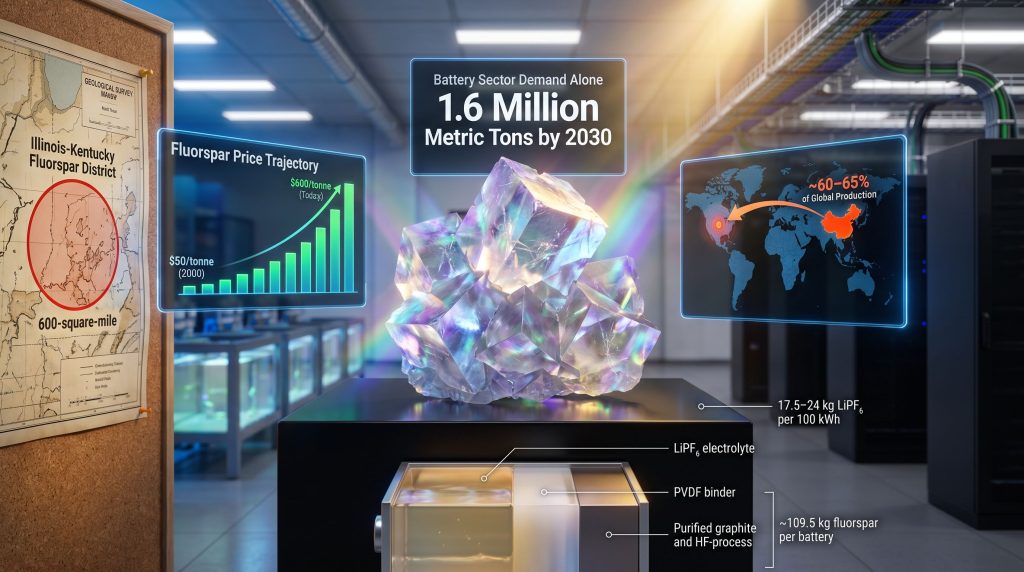
What separates fluorspar from other critical minerals is a property economists call price inelasticity. When an input is non-substitutable and essential to downstream production, buyers pay whatever is required to secure supply. Fluorspar has already demonstrated this dynamic: prices have risen from approximately $50 per tonne in 2000 to around $600 per tonne delivered in the United States today, a 12-fold increase driven not by speculation but by structural demand shifts.
Three Demand Vectors Converging Simultaneously
What makes the current fluorspar situation unlike any previous commodity cycle is the simultaneous emergence of three independent demand drivers, each large enough to strain global supply on its own.
AI Data Centers and the Fluorine Cooling Crisis
The thermal challenge inside a modern AI data center is not well understood outside engineering circles. Next-generation graphics processing units (GPUs) and tensor processing units (TPUs) used for large language model training generate heat densities that conventional air cooling systems cannot handle. The industry response has been immersion cooling, where server hardware is submerged in a thermally conductive, electrically non-conductive fluid.
The fluids best suited to this application are fluorinated compounds. Their chemical stability, non-conductivity, and thermodynamic properties make them the preferred solution for high-density computing environments. Furthermore, two-phase immersion cooling systems, which exploit the boiling and condensation cycle of fluorinated fluids, are increasingly deployed in hyperscale facilities precisely because the boiling point characteristics of fluorine-based compounds can be tuned to match chip operating temperatures.
Beyond cooling fluids, fluoropolymers appear throughout data center infrastructure:
- Protective coatings on semiconductors and printed circuit boards
- Insulation for high-frequency cabling in server rack environments
- Fire suppression systems using fluorinated gas agents
- Sealing compounds for high-pressure cooling infrastructure
According to research on the critical mineral demands of AI data centres, the scale of the infrastructure being built amplifies this demand sharply. Data centers are no longer measured in computing flops or processor counts — they are sized in gigawatts of power consumption. Amazon has been reported to be developing a 9 GW AI facility in Utah, a figure that requires context to fully appreciate.
For comparison, the Bruce Power nuclear generating station in Ontario, Canada, one of the largest nuclear generating facilities in the world, has a total installed capacity of approximately 6.4 GW across all its operating reactors. Consequently, a single AI campus is being designed to consume more power than that entire nuclear complex.
Major hyperscalers are collectively planning an estimated 130 GW of new data center capacity, a figure equivalent to adding a substantial fraction of the world's current electricity generation capacity dedicated to a single sector.
The Battery Storage Compounding Loop
Nuclear power cannot close the energy gap on the timelines these facilities require. Building a single 1 GW nuclear plant takes approximately a decade and costs several billion dollars. With no meaningful nuclear capacity coming online within the planning horizon of current data center buildouts, the only viable path to powering 24/7 AI operations through renewable energy is large-scale battery storage paired with solar generation.
This is where fluorspar demand becomes self-reinforcing. Every gigawatt of battery raw materials deployed to enable solar-powered AI facilities creates a direct, quantifiable fluorspar demand event. Battery storage is not a peripheral consideration; it is the enabling infrastructure that makes the AI buildout possible.
The fluorine content embedded in a lithium-ion battery is substantially higher than most analysts appreciate. A single 100 kWh battery system requires approximately 109.5 kg of raw fluorspar across multiple components, translating to roughly 1.1 kg of fluorspar per kWh of battery capacity.
| Battery Component | Fluorspar-Derived Input | Requirement per 100 kWh | Function |
|---|---|---|---|
| Electrolyte Salt (LiPF₆) | Hydrofluoric acid (HF) | 17.5–24 kg LiPF₆ | Ionic conductivity |
| Binder Material (PVDF) | Polyvinylidene fluoride | 6–8 kg | Electrode adhesion |
| Graphite Purification | Hydrofluoric acid (HF) | 7.5–15 kg HF | Battery-grade anode production |
| Separator Coating | Fluoropolymer compounds | Variable | Thermal stability |
For comparison, lithium content in a 100 kWh battery is estimated at approximately 11 kg, meaning a lithium-ion battery contains more fluorine by mass than it does lithium. This fact is almost entirely absent from mainstream critical minerals discourse, representing one of the most significant analytical gaps in the sector.
Battery demand alone is forecast to drive fluorspar consumption to more than 1.6 million metric tons annually by 2030, according to industry forecasts tracking lithium-ion deployment across EVs and stationary storage applications. When data center storage requirements are layered on top of this baseline, the figures become considerably more demanding.
Nuclear Enrichment and Semiconductor Fabrication
Uranium enrichment requires uranium hexafluoride (UF₆) as the gaseous feedstock for isotope separation, extracting fissile U-235 from the far more abundant U-238. Fluorspar is the source material for the fluorine used in this conversion process, with approximately six tonnes of fluorspar consumed per tonne of enriched uranium produced. As small modular reactor (SMR) development programs advance, enrichment demand is set to grow beyond its current stable baseline.
Semiconductor manufacturing adds a third, rapidly growing demand stream. Hydrofluoric acid is the critical etchant used in silicon wafer processing, applied across three distinct stages: metal deposition, silicon wafer etching, and post-process wafer cleaning. Currently representing approximately 5% of global fluorspar consumption, this share is growing disproportionately as fabrication plant construction accelerates globally.
In addition, a less commonly understood dynamic is the geochemical relationship between fluorspar deposits and exotic critical minerals. Deposits in historically productive fluorspar districts frequently contain associated mineralisation of germanium, gallium, and rare earth elements, all of which are independently critical to semiconductor and defence manufacturing supply chains.
The Supply Chain Problem: Why China's Pivot Changes Everything
Global fluorspar production is highly concentrated, creating structural vulnerabilities that become more acute as demand accelerates.
| Region | Share of Global Production | Key Risk Factor |
|---|---|---|
| China | ~60–65% | Transitioning from net exporter to net importer |
| Mongolia | Significant | Majority of output directed toward China |
| Mexico | ~10% | Primary non-Chinese supplier to North America |
| Vietnam and Africa | Below 20% combined | Limited scale and infrastructure constraints |
| United States | Near zero active production | 100% import dependent |
China's transition from the world's dominant fluorspar exporter to a net importer is the single most important structural shift in the global fluorspar market. As China's domestic AI industry, battery manufacturing sector, and fluorochemical industry scale simultaneously, the country's estimated 6 million tonnes per year of internal consumption is absorbing supply that previously flowed to international buyers.
The secondary effect has been the elimination of the Mexican discount. Mexican acid spar historically sold at a 30 to 40% discount to U.S. buyers, partly because China supply dependence constrained prices. That pricing dynamic has evaporated, with Chinese buyers now competing directly with American buyers for Mexican supply.
The United States, which currently imports 100% of its fluorspar requirements against annual consumption of approximately 400,000 tonnes, faces a supply gap that cannot be addressed through existing import channels alone. The arithmetic is stark: U.S. consumption may need to scale to between 1.5 and 2 million tonnes annually to support planned AI and battery infrastructure, against a supply base that is already constrained.
The Illinois-Kentucky Fluorspar District: America's Strategic Opportunity
The solution to the U.S. fluorspar supply deficit may lie in a region that was once the backbone of American fluorine production. The Illinois-Kentucky Fluorspar District (IKFD), a geological province spanning approximately 600 square miles, historically accounted for 95% of all U.S. domestic fluorspar production.
Production in the district did not cease because the resource was exhausted. It ceased because Chinese producers began flooding global markets with low-cost fluorspar beginning in the late 1970s, making domestic production uneconomical. The competitive dynamics that shut American mines down have now fully reversed.
Several characteristics make the IKFD strategically distinctive:
- Proven metallurgy: more than a century of production records demonstrate predictable processing characteristics
- Private land tenure: operations on private land avoid the Bureau of Land Management (BLM) and federal EPA permitting processes that can extend timelines to a decade or more
- State permitting environment: Kentucky state mining and processing permits follow substantially streamlined pathways compared to federal processes
- Geochemical optionality: fluorspar mineralisation in the district is associated with germanium, gallium, and rare earth element showings, adding strategic value beyond fluorspar alone
- Historical infrastructure: proximity to existing transport corridors and industrial facilities reduces greenfield development costs
An important valuation insight emerges when fluorspar ore grades are considered in economic terms. Acid spar at 97% CaF₂ purity currently trades at approximately $600 per tonne. Raw mineralisation grading between 30% and 60% CaF₂ carries an in-situ value of approximately $180 to $360 per tonne of ore. For context, gold mining operations that generate $100 per tonne of ore value are generally regarded as economically robust projects.
Internationally, the valuation gap between U.S. fluorspar projects and peers in other jurisdictions highlights the scale of the opportunity being overlooked. Mongolian fluorspar projects are trading at approximately 10 times the valuation multiples of comparable U.S. projects. In Australia, one advanced-stage fluorspar developer reached a $700 million market capitalisation after Japanese trading house Sumitomo acquired a 30% stake for $150 million, demonstrating the appetite among industrial end-users to secure supply through equity investment.
Government Strategic Frameworks and Critical Mineral Designation
Fluorspar has been formally designated as a U.S. critical mineral by executive order, reflecting its indispensable role across defence, energy, and technology supply chains. U.S. government agencies have issued a $250 million fluorspar strategic stockpile procurement programme, and broader critical mineral funding estimated at $30 billion is available across the Department of Defense, U.S. Export-Import Bank, and Department of Commerce for qualifying projects.
The precedent set by government investment in strategically critical mineral processing is instructive. U.S. government agencies committed approximately $3 billion to support Korean Zinc's germanium processing expansion in Tennessee. This demonstrates a policy posture in which strategic supply security takes precedence over standard financial metrics for critical mineral infrastructure.
However, it is important to note that these funding frameworks represent available programmes and policy postures. Individual project eligibility requires demonstration of production pathway credibility and does not represent automatic or guaranteed support for any specific company or deposit.
The critical mineral production powers framework being adopted by the U.S. government signals a fundamental shift in how strategically important minerals are treated at the policy level, with fluorspar sitting firmly within that framework.
The next major ASX story will hit our subscribers first
Navigating PFAS Regulation: Risk and Resilience
No analysis of the fluorochemical supply chain is complete without addressing the regulatory environment surrounding per- and polyfluoroalkyl substances (PFAS). This broad class of fluorine-based compounds has attracted significant regulatory attention due to concerns about environmental persistence and health impacts.
The key distinction for data center and battery applications is system configuration. Immersion cooling systems in data centers operate in closed-loop configurations, fundamentally limiting direct environmental release during normal operation. The primary PFAS contamination risks are concentrated in manufacturing and processing facilities, not end-use applications.
Legislative activity in 2025 included the proposed PFAS Research and Development Reauthorization Act of 2025 (H.R.6667) and the Clean Water Standards for PFAS Act of 2025 (H.R.6668), alongside an EPA fast-track chemical review programme announced for data center applications in September 2025. The regulatory direction reflects tension between environmental protection objectives and strategic supply security imperatives. Furthermore, the processing challenges that exist across the broader critical minerals sector apply equally to fluorochemical production.
The regulatory landscape around fluorochemicals is evolving, and investors should monitor PFAS legislation closely. Restrictions on specific compound classes could affect processing economics for certain fluorochemical applications, though the strategic designation of fluorspar as a critical mineral signals that supply security considerations carry significant weight in the policy calculus.
Scenario Analysis: Fluorspar Price Pathways to 2030
| Scenario | Key Assumption | Price Outlook | Supply Response |
|---|---|---|---|
| Base Case | AI buildout continues at current pace; Mexico supply stable | $700–$900/tonne by 2028 | Incremental new projects in Africa and Australia |
| Accelerated Demand | U.S. data center capacity approaches 130 GW; battery storage scales significantly | $1,200–$1,500/tonne | IKFD domestic production restarts; government offtake agreements |
| Supply Disruption | Chinese export restrictions or Mongolia supply interruption | $2,000+/tonne | Strategic stockpile drawdowns; accelerated permitting pathways |
The speculative dimensions of these scenarios should be acknowledged directly. Price forecasting for commodities with concentrated supply and accelerating demand is inherently uncertain. The base case assumptions could be disrupted by technological substitution research, regulatory interventions affecting fluorochemical applications, or macroeconomic conditions affecting the pace of AI infrastructure buildout. For instance, according to Benchmark Minerals' fluorspar analysis, supply-side constraints remain a persistent structural feature of the market regardless of demand trajectory.
Key Milestones That Will Define the Fluorspar Market
Several near-term developments will materially influence how the fluorspar for AI data centers and battery storage supply-demand equation resolves:
- U.S. strategic stockpile procurement outcomes (2025–2026): the procurement process will establish price benchmarks and signal government commitment to domestic supply
- IKFD permitting progress: first new U.S. fluorspar mine permits are anticipated in the 2026–2027 window, with processing plant commissioning potentially achievable by 2028
- CHIPS Act semiconductor fab buildout (2025–2027): facilities coming online will increase HF consumption and tighten the acid spar market further
- Utility-scale battery storage deployment: large storage projects tied to solar-powered AI facilities in Utah, Louisiana, and the Carolinas represent defined fluorspar demand events
- Chinese export policy signals: any restriction on fluorspar exports from China would immediately trigger a global supply crisis of a magnitude that existing non-Chinese production cannot offset
Frequently Asked Questions
What is fluorspar used for in AI data centres?
Fluorine-derived compounds serve multiple functions in modern AI data center infrastructure. Fluorinated dielectric fluids enable immersion cooling of high-heat-load AI chips, fluoropolymer coatings protect semiconductor components and high-density cabling, and fluorinated gas agents provide fire suppression in hyperscale facilities. As chip thermal loads increase with successive GPU generations, fluorine-based cooling solutions are becoming the engineering standard rather than the exception.
How much fluorspar is needed to produce a battery?
A single 100 kWh lithium-ion battery system requires approximately 109.5 kg of raw fluorspar across electrolyte salt production (LiPF₆), electrode binder material (PVDF), and anode graphite purification using hydrofluoric acid. This equates to roughly 1.1 kg of fluorspar per kWh of battery capacity, a figure that exceeds the lithium content of the same battery.
Why is fluorspar designated a critical mineral in the United States?
Fluorspar's critical mineral status reflects its irreplaceable role across AI infrastructure, battery technology, uranium enrichment, and semiconductor manufacturing, combined with the fact that the United States currently produces no fluorspar domestically and imports 100% of its annual requirements.
Where is fluorspar primarily produced globally?
China accounts for approximately 60 to 65% of global fluorspar production, with Mongolia and Mexico as secondary producers. China's transition from net exporter to net importer is the most consequential current shift in global fluorspar supply dynamics.
What is the Illinois-Kentucky Fluorspar District?
The IKFD is a 600-square-mile geological province that historically produced 95% of all U.S. fluorspar output. Production ceased due to Chinese price competition beginning in the late 1970s and continuing through the 2000s, not because the resource was depleted. Rising fluorspar prices and strategic mineral policy are now making the district economically compelling again.
Disclaimer: This article is intended for informational and educational purposes only. Nothing contained herein constitutes financial, investment, or legal advice. Commodity prices, demand forecasts, and project timelines referenced are subject to change and involve significant uncertainty. Readers should conduct independent due diligence and consult qualified professional advisors before making any investment decisions. Forward-looking statements and scenario projections are speculative in nature and should not be relied upon as predictions of future outcomes.
Want To Be First When the Next Major Mineral Discovery Hits the ASX?
Discovery Alert's proprietary Discovery IQ model delivers real-time alerts on significant ASX mineral discoveries — including critical minerals like fluorspar and the broader battery and technology metals driving the AI infrastructure buildout — turning complex announcement data into actionable insights for investors at every level. Explore why major mineral discoveries can generate extraordinary returns and begin your 14-day free trial at Discovery Alert to position yourself ahead of the market.