May 15, 2026
When Industrial Policy Meets Market Reality: Decoding the Honda Ontario EV Battery Plant Suspension
Every few years, a single corporate decision cuts through the noise of policy announcements and investment pledges to reveal something fundamental about the structural health of an industrial strategy. The Honda Ontario EV battery plant suspension is one of those moments. It does not simply represent a corporate pivot or a temporary setback for one automaker. It functions as a diagnostic signal, exposing the fault lines between ambitious government supply chain architecture and the volatile commercial realities that ultimately determine whether those ambitions translate into operational capacity.
Understanding what this suspension truly means requires stepping back from the headline figures and examining the layered forces that converged to make a CAD $15 billion commitment economically untenable, at least for now.
When big ASX news breaks, our subscribers know first
The Scale of What Has Been Paused
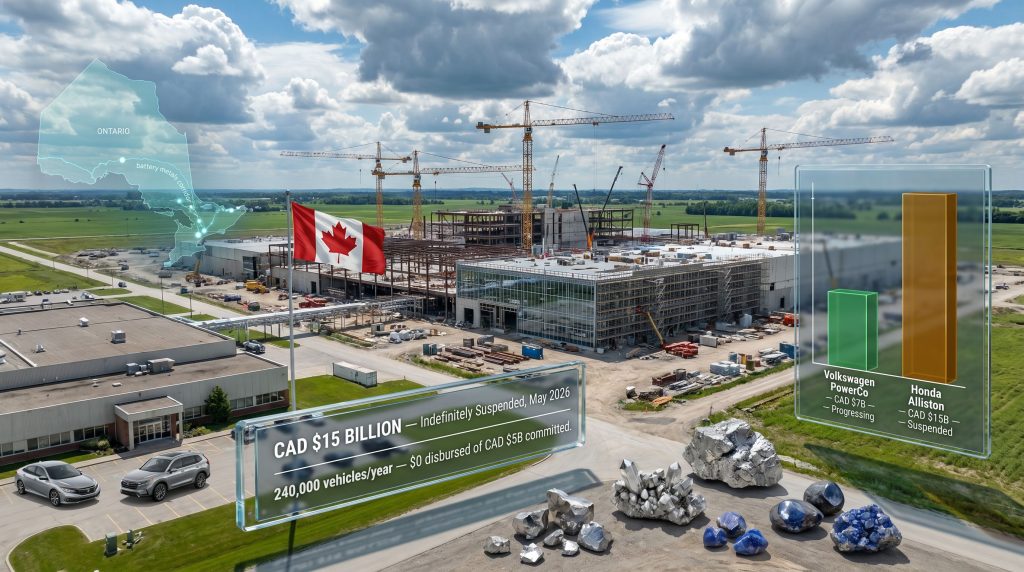
The scope of the Honda Ontario EV battery plant suspension is difficult to overstate. The project, valued at approximately CAD $15 billion (USD $11 billion), was structured to transform Honda's existing Alliston, Ontario manufacturing footprint into one of North America's most integrated EV production ecosystems. The design encompassed four distinct facilities: an upgraded vehicle assembly plant, a standalone battery production facility, and two supporting component plants. At full operational capacity, the complex was projected to produce as many as 240,000 vehicles per year.
Beyond the production metrics, the human dimension of the project was equally significant. The existing Alliston plant employs approximately 4,200 workers, producing the Honda Civic and CR-V. The planned expansion was intended to add roughly 1,000 additional positions, bringing the total workforce to around 5,200. Critically, Honda confirmed that the indefinite suspension applies exclusively to the expansion component. The existing facility and its current workforce continue to operate without disruption.
Perhaps the most structurally revealing detail in the entire announcement is this: despite a combined federal and Ontario government funding commitment of approximately CAD $5 billion, not a single dollar had been transferred to Honda at the time the suspension was declared. That disbursement gap matters enormously for how this situation is interpreted, both fiscally and politically.
The fact that no public funds changed hands before the suspension is a double-edged reality. It protects taxpayers from an immediate loss, but it also raises pointed questions about whether funding commitment structures in large-scale industrial partnerships are sequenced in ways that actually influence corporate decision-making before projects reach crisis points.
A Three-Stage Collapse: From Announcement to Indefinite Suspension
The Honda Ontario EV battery plant suspension did not materialise without warning. Its progression followed a recognisable pattern that investors and policy analysts should study carefully. According to reports from CBC News, the trajectory unfolded across approximately two years.
| Milestone | Timeframe | Key Detail |
|---|---|---|
| Original project announcement | 2024 | CAD $15B commitment; 2028 production target |
| First public delay | May 2025 | Two-year postponement to 2030; EV market slowdown cited |
| Indefinite suspension declared | May 14-15, 2026 | Full project halt; zero government funds disbursed |
This trajectory from announcement to delay to full suspension illustrates a deteriorating alignment between Honda's evolving strategic priorities and the policy environment Canada constructed to attract and retain the investment. Each stage represented a recalibration of risk tolerance as external conditions worsened rather than improved.
Four Converging Pressures That Broke the Investment Case
Honda's Historic Financial Loss and the Capital Allocation Cascade
The financial backdrop to the Honda Ontario EV battery plant suspension cannot be separated from Honda's corporate-level distress. For the fiscal year ending March 31, 2026, Honda reported a net loss of ¥423.9 billion, equivalent to approximately CAD $3.6 billion. According to Canadian Mining Journal, this represented Honda's first full-year net loss of this magnitude in the company's history.
When a corporation of Honda's scale absorbs a loss of this size, capital allocation decisions across the entire enterprise come under intense scrutiny. Long-horizon greenfield manufacturing investments exceeding CAD $15 billion become structurally vulnerable during loss cycles because they compete for capital against immediate operational stabilisation needs. The Alliston expansion, with a production horizon extending to the end of the decade, was precisely the type of commitment that becomes expendable when balance sheet repair takes priority.
EV Demand Deceleration and the Forecast Gap
The global EV market has experienced a pronounced divergence between the growth trajectories modelled by automakers and governments in 2022–2024 and the actual adoption rates that materialised. Honda explicitly cited shifting customer demand as a primary driver of the suspension, acknowledging that the commercial logic underpinning the original investment had been eroded by softer sales growth than originally forecast.
This is not a Honda-specific phenomenon. Across the automotive industry, spending plans have been moderated in response to a combination of high production costs, uneven policy signals from major markets, and consumer hesitancy driven by charging infrastructure gaps and vehicle pricing. Furthermore, the broader battery metals investment landscape has grown considerably more cautious as forecast EV demand timelines stretch outward.
The CUSMA Uncertainty Premium and U.S. Tariff Exposure
Honda's principal automotive market is the United States, which means the economics of manufacturing in Canada are fundamentally tied to cross-border trade conditions. Two developments have severely compressed those economics. The US-China trade war impacts have also introduced additional complexity into global automotive supply chains, further clouding the investment outlook.
First, the Canada-United States-Mexico Agreement (CUSMA) is currently under joint review by all three signatory nations. The automotive provisions of CUSMA, which govern tariff exemptions on vehicles and components crossing North American borders, are directly relevant to whether a Canadian manufacturing facility serving U.S. consumers remains cost-competitive. Any modification to those exemptions introduces a structural risk premium that makes long-term capital commitments harder to justify.
Second, the Trump administration's April 6, 2026 tariff adjustments expanded the scope of duties applied to core industrial metals, placing 50% tariffs on steel, aluminum, and copper, with 25% tariffs applied to most derivatives. The broader effect of tariffs on supply chains has been to compress margins on vehicles produced for U.S. export, undermining the financial modelling that underpinned the investment case.
Internal Capital Competition: Legacy Vehicles vs. EV Transition
Honda's own quarterly disclosures revealed a third dimension of pressure that is less visible but equally important. The company acknowledged reduced competitiveness in its Asian vehicle lineup as a direct consequence of redirecting engineering and financial resources toward EV platform development. This internal capital competition between maintaining profitability in existing gasoline and hybrid vehicle lines and funding the EV transition created a structural tension that large-scale greenfield projects are particularly ill-equipped to survive.
When core business units suffer from underinvestment because capital is being directed toward future-state manufacturing infrastructure, the result is a feedback loop: declining core profitability reduces the financial capacity to fund the very transformation projects intended to secure long-term competitiveness.
Ontario's EV Manufacturing Scorecard: A Pattern Worth Examining
The Honda Ontario EV battery plant suspension does not stand alone. It is the latest entry in a troubling record for Ontario's EV manufacturing ambitions. Canada's energy transition challenges have compounded these difficulties, making it harder to attract and retain anchor manufacturing commitments.
| Project | Investor | Announced Value | Status as of 2026 |
|---|---|---|---|
| Honda Alliston EV Complex | Honda | CAD $15B | Indefinitely suspended |
| NextStar Energy Battery Plant, Windsor | LG Energy Solution / Stellantis | CAD $5B | Restructured after 2023 halt |
| PowerCo SE Battery Plant, St. Thomas | Volkswagen | CAD $7B | Progressing; operational target 2027 |
| Oakville Assembly Plant | Ford | N/A | Pivoted to pickup truck production |
| BrightDrop Electric Van Production | General Motors | N/A | Production ceased in Ontario |
Of five major EV-related manufacturing commitments tracked across Ontario, only the Volkswagen PowerCo facility in St. Thomas is advancing toward an operational state, though even that project is progressing more slowly than originally planned. The PowerCo plant's relative resilience is instructive. It is a purpose-built battery manufacturing entity rather than a legacy automaker attempting to manage a structural transition while simultaneously protecting existing product lines.
That distinction reduces the internal capital competition dynamic that has proved so damaging for automakers like Honda, Ford, and General Motors. The PowerCo facility broke ground in October 2025 with a 2027 operational target, representing a far more compressed execution timeline than the multi-year horizon of the Honda project.
What the Suspension Means for Canada's Critical Minerals Supply Chain
One of the less-discussed consequences of the suspension involves its ripple effects through the upstream critical minerals sector. Ontario had been actively championing a battery metals corridor concept, designed to link domestic nickel, lithium, and cobalt production to downstream EV battery manufacturing. The role of critical minerals and energy security in this broader strategy cannot be overstated, as upstream assets form the foundation of any viable domestic battery supply chain.
Despite the Honda setback, the provincial government continues to advance upstream projects intended to feed that manufacturing ecosystem. Canada Nickel's Crawford project (TSXV: CNC; US-OTC: CNIKF) and Frontier Lithium's PAK project (TSXV: FL; US-OTC: LITOF) remain on Ontario's priority development list, alongside several cobalt processing infrastructure investments.
Accelerating upstream critical mineral development while anchor downstream manufacturing investments stall creates a potential supply-demand mismatch within Canada's domestic battery materials ecosystem. Upstream projects that can serve both domestic and export markets carry materially lower risk than those dependent on a single domestic anchor customer.
This distinction matters for investors evaluating Canadian critical minerals exposure. Canada competes globally with Australia, Chile, and Indonesia for critical mineral supply chain positioning, and repeated disruptions to domestic EV manufacturing weaken the integrated value proposition that makes Canadian mineral assets strategically attractive to international battery manufacturers.
The next major ASX story will hit our subscribers first
The Government's Position and the Redeployable Capital Question
Prime Minister Mark Carney characterised the Honda decision as disappointing, situating it within Honda's broader financial pressures and the elevated cost environment the company is navigating. Ontario, for its part, has already begun shifting a portion of its industrial policy focus toward defence metals and critical minerals targeting non-automotive applications — a strategic pivot that reflects the accumulated frustration of repeated EV manufacturing disappointments.
The approximately CAD $5 billion in uncommitted government funding, originally pledged as part of the Honda incentive package, now represents a significant and fully redeployable policy instrument. CP24 reported that three strategic options exist for that capital:
-
Reinforce the Volkswagen PowerCo investment by accelerating its timeline or expanding planned capacity, strengthening the one advancing anchor EV project in Ontario.
-
Deploy capital upstream into Crawford, PAK, and cobalt processing infrastructure, consolidating Canada's position as an export-oriented supplier of battery materials to international manufacturers.
-
Hold the envelope as a future incentive and use it to attract an alternative anchor investor, potentially a South Korean, Japanese, or American battery manufacturer with a more contained capital structure than a legacy automaker managing a full-fleet EV transition.
What Would It Take to Reactivate the Project?
| Scenario | Required Conditions | Assessment |
|---|---|---|
| Full reactivation by 2029 | EV demand recovery; CUSMA auto exemptions preserved; Honda returns to profitability | Low-to-moderate probability |
| Scaled-down restart with battery partner | Honda reduces capital exposure through partnership; funding restructured on milestones | Moderate probability |
| Alternative anchor investor at Alliston | Ontario repackages site and funding to attract different OEM or battery manufacturer | Moderate-to-high over 3-5 years |
| Permanent cancellation | Prolonged trade friction; sustained EV weakness; Honda restructures away from North American manufacturing | Low-to-moderate probability |
The optionality embedded in the word "indefinite" matters here. Honda has not formally cancelled the project. If EV adoption rates recover toward more aggressive trajectories by the late 2020s and trade conditions stabilise, the Alliston infrastructure and the government funding envelope could theoretically be recombined around a revised business case. However, the window for capturing first-mover advantage in Canadian EV manufacturing narrows with each year of delay.
The Investor Framework: Disbursed vs. Committed Capital
For investors evaluating government-backed EV manufacturing commitments, the Honda Ontario EV battery plant suspension reinforces a critical analytical discipline: headline funding announcements and actual disbursed capital are not the same metric, and conflating them distorts the real financial exposure of industrial policy programmes.
The CAD $5 billion pledged to Honda represents a policy commitment that was never converted into a financial transfer. This structure protected public finances in this instance, but it also raises a broader question about whether funding disbursement mechanics are designed to create genuine alignment between government and corporate stakeholders, or whether they function primarily as announcement-stage incentives with limited binding force on corporate decision-making.
Canada's competitive advantages in the global battery supply chain race remain structurally intact. Political stability, world-class critical mineral endowments, clean energy infrastructure, and proximity to the largest automotive market on earth are durable assets. The execution gap, however, is real. Translating those advantages into operational manufacturing capacity requires project structures with shorter timelines, more adaptive funding mechanisms, and corporate partners whose transition strategies are not in direct competition with their own legacy profitability.
Frequently Asked Questions
What exactly did Honda suspend in Ontario?
Honda indefinitely suspended its planned CAD $15 billion (USD $11 billion) EV and battery manufacturing complex at its Alliston, Ontario site. The project included an upgraded vehicle assembly plant, a standalone battery production facility, and two supporting component plants targeting up to 240,000 vehicles per year.
Are existing Alliston plant operations affected?
No. Honda explicitly confirmed the suspension applies only to the planned expansion. The existing facility, which manufactures the Honda Civic and CR-V and employs approximately 4,200 workers, continues to operate normally.
Has the Canadian government lost money?
No government funds were transferred to Honda before the suspension was declared. The combined CAD $5 billion federal and Ontario commitment remains fully undeployed and available for reallocation.
What were Honda's stated reasons for the suspension?
Honda cited revised strategic objectives, evolving external resource strategies, and shifting customer demand patterns, particularly the deceleration of EV market growth relative to earlier forecasts.
How do U.S. tariffs factor into this decision?
The Trump administration's April 2026 tariff adjustments placed 50% duties on steel, aluminum, and copper, with 25% applied to most derivatives. Given that Honda's primary market is the United States, elevated input costs combined with CUSMA renegotiation uncertainty directly undermined the financial case for Canadian manufacturing investment.
Is Canada's broader EV supply chain strategy still viable?
Canada's upstream critical mineral assets remain globally significant. However, the repeated disruption of anchor downstream manufacturing investments raises legitimate questions about execution frameworks. The Volkswagen PowerCo plant in St. Thomas currently represents the most credible near-term proof point for the strategy's viability.
This article is intended for informational purposes only and does not constitute financial or investment advice. Forward-looking statements involve inherent uncertainty. Readers should conduct independent due diligence before making any investment decisions related to companies or sectors discussed herein.
Want to Track the Next Major Mineral Discovery Before the Market Does?
Discovery Alert's proprietary Discovery IQ model delivers real-time alerts on significant ASX mineral discoveries across battery metals and critical minerals — translating complex data into actionable insights for investors at every level. Explore Discovery Alert's dedicated discoveries page to understand why major mineral discoveries can generate substantial returns, and begin your 14-day free trial to position yourself ahead of the market.