May 15, 2026
The Race to Build Non-Chinese Critical Mineral Supply Chains Has a New Frontrunner
When geopolitical pressure collides with industrial necessity, capital moves fast. The global scramble to secure traceable, non-Chinese sources of tungsten, tin, and tantalum has been building for years, driven by concentrated supply risks that Western manufacturers, defence contractors, and electronics producers can no longer afford to ignore. With China controlling roughly 85% of global tungsten supply and periodically restricting exports, the search for credible alternative producers has become one of the defining investment themes in critical minerals markets.
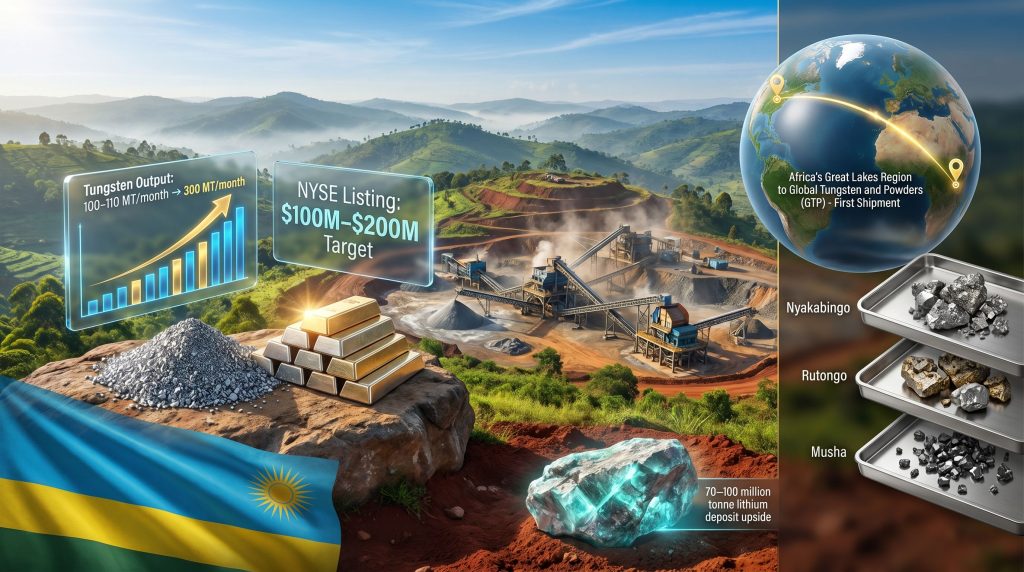
Rwanda's Trinity Metals has emerged as one of the most strategically compelling answers to that question. Having consolidated three undercapitalised Rwandan mining assets in 2022 and since quadrupled total output, the company is now targeting a New York Stock Exchange listing to raise between $100 million and $200 million, with the capital earmarked for an aggressive production expansion across its Trinity Metals US listing tin tungsten output portfolio.
This article breaks down the investment thesis, production fundamentals, geopolitical positioning, and speculative upside that define Trinity Metals' story in 2026 and beyond.
When big ASX news breaks, our subscribers know first
Understanding the 3T Minerals: Why Tin, Tungsten, and Tantalum Matter
The term 3T minerals refers collectively to tin, tungsten, and tantalum, three metals that sit at the operational heart of modern industrial civilisation. Each plays a distinct and irreplaceable role across multiple high-value sectors:
-
Tungsten is one of the hardest naturally occurring metals, with the highest melting point of any element. It is essential for cutting tools, armour-piercing munitions, aerospace components, and specialised electronics. There is no cost-effective substitute for tungsten in many of these applications.
-
Tin is a critical soldering material in electronics manufacturing, used extensively in printed circuit boards, semiconductors, and consumer devices. The global shift toward electrification and connected devices has reinforced tin demand structurally.
-
Tantalum is used in capacitors found in virtually every smartphone, laptop, and advanced electronic system. Its high melting point and corrosion resistance make it uniquely suited to miniaturised, high-performance electronic components.
The combination of concentrated Chinese supply, rising Western demand, and the growing policy emphasis on conflict-free, traceable sourcing has elevated 3T minerals into the same strategic conversation as lithium, cobalt, and rare earth elements. Furthermore, the critical minerals demand surge currently reshaping global supply chains makes this conversation more urgent than ever.
How Trinity Metals Built Rwanda's Largest Industrial Mining Platform
Trinity Metals was established through the deliberate consolidation of three mining assets in Rwanda during 2022, each of which had been operating well below its potential due to limited capital investment and reliance on artisanal extraction methods. The three assets that form the foundation of the platform are:
- Nyakabingo Mine – a tungsten operation now recognised as Africa's largest tungsten-producing facility
- Rutongo Mines – a tin mining operation in Rwanda's northern mining belt
- Musha Mines – a tin-tantalum licence with production across both commodities
The transformation thesis was straightforward in concept but demanding in execution: inject capital, replace artisanal methods with mechanised infrastructure, and develop the underground access needed to scale volumes to industrial levels. Since consolidation, total output across the platform has quadrupled, a rate of operational improvement that reflects both the resource quality of the underlying assets and the scale of the efficiency gap that existed at baseline.
The fourfold increase in output achieved since 2022 is not primarily a geological story. It is an operational and capital deployment story, demonstrating the leverage available when industrial-scale practices are applied to structurally underinvested mineral assets.
This distinction matters for investors evaluating Trinity's expansion targets. The production growth to date has been driven by mechanisation and infrastructure rather than new resource discovery, which suggests the tripling of output targeted over the next three to five years follows a similar, lower-risk pathway.
The Institutional Backing Structure
Trinity's capital structure reflects a deliberate effort to align the company with Western strategic interests at the institutional level. The company is backed by TechMet, a Dublin-headquartered critical minerals investment firm with an explicit mandate to develop non-Chinese supply chains across battery and industrial metals. The US Development Finance Corporation (DFC) also provides institutional backing, reflecting direct US government interest in securing alternative mineral supply routes outside of Chinese-controlled networks.
This combination of private institutional capital and US government development finance creates a tripartite structure alongside the Rwandan sovereign partnership that materially reduces the financing and operational risk profile for prospective investors.
Current Production Metrics and the Path to 300 Tonnes Per Month
Trinity's three-asset platform currently produces across tungsten, tin, and tantalum, with Nyakabingo anchoring the portfolio as the highest-value and highest-volume operation.
| Asset | Primary Commodity | Approx. Monthly Output | Approx. Annual Run Rate |
|---|---|---|---|
| Nyakabingo Mine | Tungsten | 100–110 metric tonnes | ~1,200 tonnes/year |
| Rutongo Mines | Tin | 40–70 metric tonnes | ~525 tonnes/year |
| Musha Mines | Tin | 30–40 metric tonnes | ~168 tonnes/year |
| Musha Mines | Tantalum | Small quantities | Not disclosed |
The company's expansion target is ambitious but structurally grounded: triple both tin and tungsten output to approximately 300 metric tonnes per month each within three to five years. The operational levers driving this trajectory are mechanisation programs and new underground development at all three sites, with the $50 million processing plant at Nyakabingo, targeted for commissioning by end-2027, expected to be the most significant single contributor to expanded tungsten recovery.
Achieving 300 tonnes per month of tungsten output from Nyakabingo alone would represent a roughly threefold increase from current baseline production, transforming the mine from Africa's largest tungsten operation into one of the most significant non-Chinese tungsten producers globally by volume.
Why Grade and Processing Matter as Much as Volume
A critical but often overlooked dimension of mineral production expansion is the relationship between extraction volume and processing efficiency. In tungsten mining, recovery rate refers to the percentage of in-situ tungsten content that is successfully captured in the final concentrate product. Artisanal and semi-mechanised operations frequently achieve substantially lower recovery rates than industrial-scale processing facilities, meaning that the same ore body can produce significantly more finished concentrate when processed through modern infrastructure.
The planned $50 million processing plant at Nyakabingo is specifically designed to improve tungsten recovery rates, implying that a portion of Trinity's projected output growth will come not from mining more rock, but from extracting more tungsten from the rock already being mined. This is an important nuance for investors modelling production trajectories, as processing improvements tend to carry lower capital intensity per incremental tonne than purely volume-driven expansion.
The First Tungsten Shipment to the US: A Supply Chain Milestone
In September 2025, Trinity Metals completed what Reuters confirmed as the first-ever tungsten shipment from Africa's Great Lakes region to the United States. The concentrate was delivered to Global Tungsten and Powders (GTP) in Pennsylvania, a major processor and supplier of tungsten products to industrial and defence end users.
The commercial structure underpinning this shipment is notable for its durability. Offtake partner Traxys, a leading global commodities trader, facilitated the arrangement, with Trinity committed to supplying 4 to 7 containers of tungsten concentrate per quarter over an initial two-year term. This contract structure provides Trinity with revenue visibility while establishing a verifiable track record as a reliable Western-facing supplier.
This shipment did more than move product across an ocean. It established Rwanda as a verified, auditable node in the US tungsten supply chain for the first time, a precedent with lasting implications for how Western buyers approach African mineral sourcing.
The significance extends beyond the commercial terms. For Western buyers operating under conflict-mineral due diligence obligations and supply chain security mandates, having a certified, traceable African supplier with demonstrable delivery capability changes the calculus around sourcing diversification. Trinity's industrial operating model and institutional backing make it meaningfully different from artisanal or informally structured African mineral exporters in the eyes of compliance-sensitive procurement teams.
The Trinity Metals US Listing: NYSE Strategy and Capital Deployment
CEO Peter Geleta confirmed at the Africa CEO Summit in Kigali that the company has selected the New York Stock Exchange as its preferred listing venue, citing superior liquidity and a deeper institutional investor base with appetite for critical minerals assets compared to alternative exchanges in London or Toronto. The timeline for the Trinity Metals US listing tin tungsten output expansion is within 12 to 18 months from mid-2026, placing the anticipated IPO window in late 2027.
The targeted capital raise of $100 million to $200 million is sized to fund a clearly defined capital expenditure programme across the three-mine platform.
| Capital Allocation | Target Asset | Estimated Cost | Target Timeline |
|---|---|---|---|
| Processing plant (tungsten) | Nyakabingo Mine | $50–60 million | End-2027 |
| Total portfolio capital expenditure | All three assets | ~$150 million | 3-year horizon |
| US IPO capital raise target | NYSE | $100–200 million | Within 12–18 months |
The deployment plan is designed to bridge the gap between Trinity's current artisanal-to-industrial conversion phase and full mechanised production at scale. The $150 million in planned capital expenditure over three years is the infrastructure investment required to underpin the tripling of tin and tungsten output targets.
Why the NYSE Over Other Exchanges?
The choice of New York over London's AIM market or Toronto's TSX-V reflects a deliberate alignment between Trinity's strategic positioning and its investor targeting. US institutional capital markets have demonstrated substantially greater appetite for critical minerals investment theses in 2024 to 2026 than their European or Canadian counterparts, driven by domestic policy emphasis on supply chain resilience and growing defence sector demand for traceable tungsten and tin sources.
There is also a practical commercial logic: Trinity's primary offtake partners and end customers are concentrated in the United States and Europe, and US-listed equity provides greater visibility and liquidity for the institutional buyers that also happen to be Trinity's commercial customers. This alignment between capital market participants and commercial counterparties is a structural advantage that is difficult to replicate on alternative exchanges. In addition, energy transition pressures are accelerating demand for precisely the kind of traceable supply chains Trinity has built.
The next major ASX story will hit our subscribers first
Rwanda's Geopolitical Stability as a Commercial Asset
The conflict in eastern Democratic Republic of Congo has created significant disruption across the broader Great Lakes region, generating legitimate concerns about mineral smuggling, supply chain integrity, and operational continuity for businesses operating near the DRC border. Geleta confirmed that Trinity's Rwandan operations have not been materially affected by the DRC conflict, a position supported by Rwanda's fundamentally different governance and regulatory environment compared to its neighbour.
This distinction is commercially important in ways that extend beyond operational continuity. Western buyers and defence procurement agencies are increasingly required to document chain-of-custody for 3T minerals, given longstanding concerns about conflict-mineral contamination in DRC-adjacent supply chains. Rwanda's stable regulatory environment and Trinity's industrial operating model, combined with its institutional backing, position the company as a certified, auditable supplier, a status that is increasingly a prerequisite rather than a differentiator for accessing institutional Western offtake markets.
The competitive implications are significant. While artisanal miners in the region may achieve lower unit costs in the short term, they face structural exclusion from Western supply chains that require documented provenance. Trinity's industrial model, built specifically to satisfy those requirements, commands a structural pricing premium. Consequently, concerns around antimony shortage risks and other critical supply chain vulnerabilities have only reinforced the importance of provenance-verified producers like Trinity.
Trinity's Competitive Position in the Global Tungsten Landscape
Outside of China, the universe of industrial-scale tungsten producers capable of supplying Western markets at volume is remarkably small. The table below contextualises Trinity's competitive position within non-Chinese tungsten supply:
| Producer Region | Key Operations | Approx. Annual Capacity | Western Market Access |
|---|---|---|---|
| Rwanda (Trinity Metals) | Nyakabingo Mine | ~1,200 t/yr (targeting ~3,600 t/yr) | US, Europe, Thailand – direct contracts |
| Portugal | Panasqueira Mine | ~1,000 t/yr | Europe-focused |
| Vietnam | Various operations | Moderate, variable | Mixed market access |
| China | Multiple large operations | ~85% of global supply | Restricted for Western buyers |
The scarcity of credible, industrial-scale non-Chinese tungsten producers is a structural market reality that underpins Trinity's pricing power and its ability to secure long-term Western offtake contracts at commercially attractive terms. As China's export restrictions persist or intensify, Trinity's Nyakabingo operation occupies a position in the Western supply chain that cannot quickly be replicated by new entrants given the capital requirements and timeline to develop comparable underground tungsten operations.
The Lithium Discovery: Asymmetric Upside on an Already Compelling Platform
Beyond the 3T production story, Trinity is advancing exploration of a lithium deposit estimated at 70 to 100 million tonnes at grades exceeding 1%, located within its existing Rwandan licence areas. Geleta indicated that further drilling confirmation could position this deposit among the world's top 10 lithium resources by size, according to Reuters reporting.
For context, a 70 to 100 million tonne resource at over 1% lithium oxide grade would be a material discovery in any global context. Top-tier lithium deposits globally are typically measured in the hundreds of millions of tonnes for brine operations or tens of millions of tonnes for hard rock spodumene deposits. The grade threshold of greater than 1% is meaningful for hard rock lithium and, if confirmed across a sizeable ore body through systematic drilling, would represent a significant re-rating catalyst.
Several speculative but analytically grounded points are worth considering:
- A confirmed top-10 global lithium resource would fundamentally transform Trinity's valuation profile ahead of its NYSE listing, potentially shifting the company from a 3T producer story to a multi-commodity critical minerals platform narrative
- Lithium exploration results released ahead of the IPO could serve as a material re-rating catalyst, potentially compressing the timeline to Geleta's stated ambition of a billion-dollar valuation within five years
- The geological context of Rwanda's Albertine Rift, which hosts significant rare earth and base metal endowment in addition to 3T minerals, provides scientific plausibility for lithium occurrence within the same licence areas, though this remains subject to drilling confirmation
Disclaimer: Statements regarding potential lithium resource rankings and valuation outcomes are speculative and subject to drilling results, independent resource estimation, and prevailing market conditions. Forward-looking projections should not be relied upon as investment advice.
What the Trinity Metals US Listing Means for Rwanda's Broader Mining Sector
A successful NYSE listing for the Trinity Metals US listing tin tungsten output platform would represent more than a corporate milestone. It would validate Rwanda as a viable, investable jurisdiction for Western capital markets participants seeking exposure to African critical minerals, potentially catalysing capital flows into the broader Rwandan mining sector.
The DFC's involvement in Trinity's capital structure signals a degree of US institutional confidence in the Rwandan investment environment that carries weight for other prospective investors evaluating African critical minerals opportunities. Rwanda's track record of stable governance, investor-friendly regulatory frameworks, and consistent policy alignment with Western economic interests distinguishes it from many other sub-Saharan African jurisdictions competing for the same capital.
Trinity's trajectory from artisanal-dominated operations in 2022 to a prospective NYSE-listed, multi-commodity critical minerals producer by 2027 offers a template for how African mineral assets can be systematically transformed through institutional capital, operational discipline, and strategic alignment with Western supply chain priorities. Furthermore, Rwanda's role in US defence supply chains is set to deepen considerably as these expansion targets are realised.
The convergence of rising 3T commodity prices driven by Chinese export restrictions, Western supply chain policy mandates, Trinity's multi-asset Rwandan platform, and a potentially significant lithium discovery creates a growth narrative with near-term production catalysts and long-term resource optionality that is rare in the current critical minerals investment landscape. However, as with all emerging market investment theses, the risks of tungsten supply to US markets remain important considerations for investors conducting thorough due diligence.
This article is for informational purposes only and does not constitute financial or investment advice. Critical minerals markets are subject to significant price volatility, geopolitical risk, and operational uncertainty. Readers should conduct independent due diligence before making any investment decisions.
Want to Capitalise on the Next Major Critical Minerals Discovery Before the Market Does?
Discovery Alert's proprietary Discovery IQ model delivers real-time alerts on significant ASX mineral discoveries across tungsten, tin, tantalum, lithium, and over 30 other commodities — instantly translating complex data into actionable investment insights for both short-term traders and long-term investors. Explore historic examples of exceptional discovery returns or begin your 14-day free trial today to position yourself ahead of the broader market.