
May 15, 2026
The Hidden Cost of Holding Gold Without a Yield
For most of modern investing history, gold has functioned as a form of financial insurance. Investors bought it, stored it, paid fees on it, and waited. The metal protected purchasing power across decades of monetary expansion, but it never sent a check. That structural limitation kept gold permanently outside the income-generating category of assets, even as central banks inflated currency supplies and bond markets struggled to deliver meaningful real returns.
That logic is now being challenged by a growing class of instruments known as gold fixed income products, which aim to combine the inflation-hedging properties of physical gold with a genuine yield component. Understanding how these products work, who they suit, and what risks they carry requires stepping back from conventional gold investing frameworks entirely.
When big ASX news breaks, our subscribers know first
Why Gold Has Always Sat Outside the Income Category
The investment case for gold has historically rested on a single foundation: scarcity-backed purchasing power preservation. Unlike equities, which represent fractional ownership of earnings-generating businesses, or bonds, which represent contractual claims on future cash flows, gold generates nothing internally. It sits in a vault, its value fluctuating with currency dynamics, geopolitical stress, and inflation expectations.
Mainstream financial theory has generally classified gold as a non-yielding commodity asset, tolerating its presence in portfolios as a hedge rather than a contributor to total return. Gold and bond markets have long operated with this distinction firmly in place. Gold exchange-traded funds (ETFs) replicate spot price exposure. Physical bullion provides storage of value but attracts storage and insurance costs of typically 0.5% to 1.0% annually, creating a built-in negative carry for long-term holders.
Gold futures offer leverage and speculation but no income. Mining equities pay dividends in fiat currency, but their performance is tied to operational variables far removed from the gold price itself.
This structural reality meant that every percentage point earned by a Treasury bond, a high-yield savings account, or a corporate bond represented an opportunity cost charged against holding gold. During periods of elevated nominal interest rates, that cost was punishing enough to keep gold on the periphery of many institutional and retail portfolios.
The Opportunity Cost Equation Has Reversed
The macroeconomic environment of 2025 and 2026 has fundamentally altered the calculus. As of April 2026, the U.S. headline Consumer Price Index reached 3.8% year-over-year, accelerating from 3.3% in March and representing the highest reading since May 2023. The Producer Price Index recorded its largest single-month jump since March 2022, at 1.4% month-on-month. Core PCE, the Federal Reserve's preferred inflation gauge, sits at approximately 3.2% year-over-year, well above the 2% target the Fed has failed to consistently achieve for several years.
The Federal Reserve has held the Federal Funds Rate at 3.50% to 3.75% through May 2026, with Goldman Sachs projecting no rate cuts until December 2026 at the earliest. That creates a straightforward arithmetic problem for traditional fixed income investors. A Treasury instrument yielding 3.75% in a 3.8% inflation environment produces a negative real return of approximately -0.05% annually. Holding dollars in a high-yield savings account yields a similar outcome: nominal gain, real loss.
This inversion is precisely what makes the current environment significant for gold fixed income products. When gold-denominated yield of even 4% represents a positive real return while Treasury bonds deliver negative real returns, the historical argument against gold as an income asset dissolves structurally rather than temporarily. Furthermore, understanding the broader gold bonds dynamics helps contextualise why these shifts matter across economic cycles.
The existence of Treasury Inflation-Protected Securities (TIPS) is itself an institutional acknowledgment that standard bond instruments struggle against persistent inflation. A government agency creating an inflation-adjusted bond variant implicitly concedes that the standard product is inadequate during inflationary regimes.
The logic, as articulated by practitioners in the gold yield space, is direct: the opportunity cost of holding gold over dollars has reversed. Previously, investors sacrificed yield to hold gold. Now, in specialised structures, they can hold gold and generate yield, while those holding dollars sacrifice purchasing power simply by standing still.
How Gold Fixed Income Products Actually Work
The mechanics behind gold fixed income products differ fundamentally from conventional fixed income. Standard bonds involve a borrower receiving currency and paying periodic interest in currency. Gold fixed income operates on a different foundation: the yield generated is denominated in gold, not in fiat currency.
Is the Gold Interest Rate Independent From Central Bank Policy?
One of the least understood aspects of gold yield products is that the gold interest rate operates independently of central bank policy rates. The Federal Funds Rate reflects the cost of overnight dollar lending between banks. The gold interest rate reflects the supply and demand dynamics within gold lending markets, the creditworthiness of gold borrowers, and the opportunity cost for gold owners relative to storage alternatives.
This independence has a practical implication: when the Fed holds rates at 3.5% to 3.75%, that decision does not directly set what gold lenders can earn. A gold owner willing to lend their metal can earn whatever the gold lending market supports based on genuine commercial demand. Industrial users of gold, including electronics manufacturers, dental suppliers, and jewellery producers, have ongoing requirements for physical gold and are willing to pay lease rates to access it without purchasing outright.
Key Structures in the Gold Fixed Income Space
Gold fixed income products currently take several structural forms, primarily within private credit and structured finance frameworks. The main instrument types are outlined below.
| Structure | How It Works | Income Type | Investor Access |
|---|---|---|---|
| Gold Bond | Private debt security; investor lends capital backed by gold assets | Gold-denominated interest | Accredited investors only |
| Gold Lease | Physical gold lent to industrial/commercial users | Physical gold units | Accredited investors only |
| Compound Gold Bond | Secured lending tied to gold-linked collateral | APY up to 10.95% gold-linked | Capital-preservation oriented |
| Gold Mining Dividend | Equity dividend from listed gold producers | Fiat currency | Retail and institutional |
| Gold ETF | Spot price tracking; no income component | None | Retail and institutional |
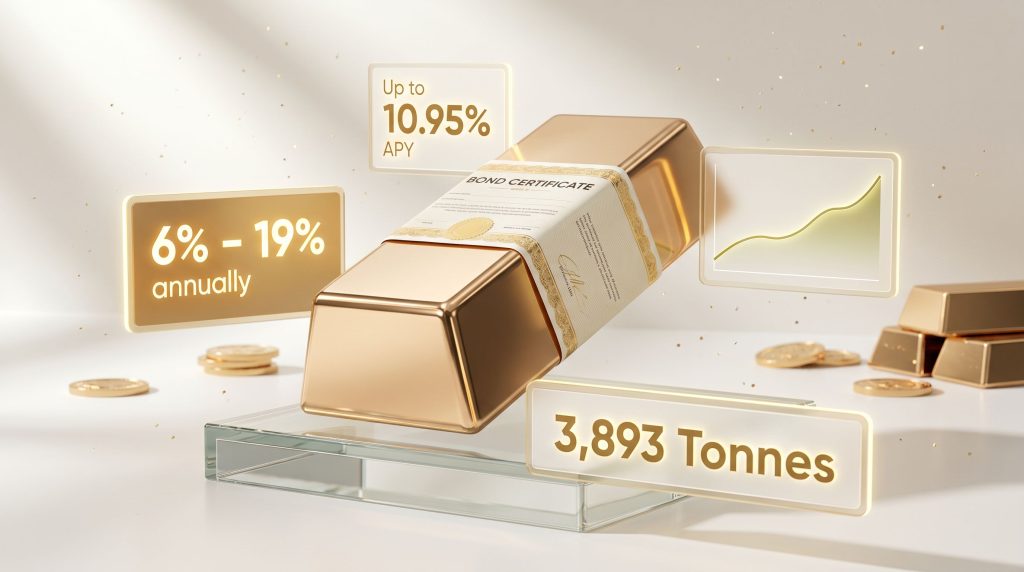
Yields reported in private gold bond markets range from approximately 6% to 19% annually, depending on term, collateral quality, and borrower creditworthiness. Compound gold bond structures in some current offerings report APY of up to 10.95%. These figures require verification against specific product prospectuses, as they vary substantially by issuer and structure.
The yield differential over Treasury rates (which sit at 3.5%-3.75%) represents a risk premium composed of illiquidity, counterparty exposure, and the absence of regulatory guarantee frameworks. Considering physical gold vs ETFs is an important step when evaluating which structure best suits an investor's objectives.
The Insurance Analogy and the Dual-Function Asset
A framework that practitioners in the gold yield space have articulated helps clarify why these products represent a structural innovation rather than merely a financial novelty. Traditional hedges, whether insurance policies, gold bullion, or put options, perform one function: they protect against a defined downside. They do not generate return in isolation. The investor pays a cost (the premium, the storage fee, the option price) in exchange for protection.
The structural innovation embedded in gold fixed income products is the creation of a dual-function instrument: a hedge that also produces utility. The investor holds physical gold, retaining its inflation-hedging and currency-debasement-protection properties, while simultaneously receiving income denominated in that same gold. The return is not in dollars that might depreciate. It is in additional ounces of gold, compounding the underlying hedge.
This mirrors, conceptually, the logic behind overfunded high cash value life insurance structures used by some sophisticated investors. In that model, the investor overfunds the policy, minimising the death benefit relative to the premium, allowing the excess capital to grow tax-free within a private contract at returns comparable to inflation. The insurance function and the capital-staging function coexist. Gold fixed income products operate on analogous logic: the gold ownership function and the yield-generation function coexist within a single instrument.
When a hedge also pays you to hold it, the fundamental investment calculus changes. You are no longer weighing protection against return. You are selecting between different forms of return with different inflation-adjustment characteristics.
The Private Credit Framework and Accessibility Constraints
Gold fixed income products currently exist almost entirely within private credit and structured finance frameworks rather than on regulated exchanges. This creates a bifurcated market:
- Mainstream gold investing (ETFs, bullion, mining equities) remains liquid, publicly traded, and accessible to retail investors but generates no gold-denominated income
- Specialised gold income structures (bonds, leases, compound structures) generate genuine gold-denominated yield but are restricted to accredited investors under current securities regulations and involve significantly lower liquidity
The accredited investor threshold (typically defined as individuals with net worth exceeding $1 million excluding primary residence, or income above $200,000 annually in the U.S.) means that most retail investors cannot access these instruments directly. The higher yield on offer reflects, in part, an illiquidity premium: investors forgo the ability to exit quickly in exchange for above-market returns. For those exploring broader options, gold as a strategic investment provides additional context on how gold fits within a wider inflation-defence framework.
The next major ASX story will hit our subscribers first
Comparing Gold Investment Products Across Key Dimensions
| Feature | Gold ETF | Physical Bullion | Gold Bond or Lease | Mining Equity |
|---|---|---|---|---|
| Income Generation | None | None | Yes, gold-denominated | Dividends in fiat |
| Inflation Protection | Strong | Strong | Strong | Partial |
| Liquidity | High | Moderate | Low (private) | High |
| Currency Risk Hedge | Yes | Yes | Yes | Limited |
| Retail Accessibility | Yes | Yes | Accredited only | Yes |
| Regulatory Oversight | High | Moderate | Limited (private) | High |
| Storage or Custody Cost | Embedded in fee | 0.5%-1.0% annually | Varies by structure | Not applicable |
Integrating Gold Fixed Income Into a Portfolio Framework
The Barbell Strategy and Gold's Role Within It
Portfolio construction frameworks that incorporate gold fixed income most naturally tend to use a barbell approach: high-risk growth assets on one end (equities, real estate with leverage, venture positions) and capital-preservation instruments on the other (cash, bonds, physical commodities). Gold fixed income products occupy an interesting position within this structure.
They are not primary growth vehicles. Their function is to preserve purchasing power, generate real income denominated in a non-fiat asset, and reduce exposure to dollar debasement risk while activating capital that would otherwise sit idle in physical storage. Within the barbell, they enhance the defensive end by adding a yield component to what would traditionally be a zero-return hedge position.
Practitioners who use this framework describe holding physical gold as a structural hedge against dollar risk, then layering gold income structures on top to ensure that hedge capital is doing measurable work rather than sitting in storage collecting fees. Exploring the gold safe-haven investment case further reinforces why the defensive role of gold remains foundational even as yield-generating structures evolve.
Comparing Gold Fixed Income to Other Alternative Income Strategies
| Strategy | Income Type | Inflation Protection | Liquidity | Complexity |
|---|---|---|---|---|
| Gold Fixed Income Products | Gold-denominated yield | High | Low | High |
| Real Estate Equity | Rental income in fiat | Moderate to High | Low | High |
| High-Yield Savings | Dollar interest | Low | High | Low |
| TIPS Bonds | Inflation-adjusted fiat | Moderate | High | Low |
| Private Credit Funds | Fiat interest | Low | Low | High |
The table illustrates a gap in the landscape. Most high-inflation-protection instruments offer low income or low liquidity. Most liquid income instruments offer low inflation protection. Gold fixed income products occupy the high-inflation-protection, income-generating quadrant, but at the cost of liquidity and with elevated structural complexity.
Risks That Require Careful Evaluation
Liquidity Risk
Gold bonds and lease structures are not exchange-traded. There is no secondary market where an investor can sell their position on short notice. Lock-up periods and redemption mechanics vary by product and issuer. Investors should treat capital allocated to these instruments as illiquid for the full term of the investment. The yield premium on offer is partly compensation for this illiquidity.
Counterparty and Credit Risk
Unlike physical gold bullion, which carries no counterparty risk (the metal exists independently of any borrower's creditworthiness), gold fixed income products introduce a borrower or issuer between the investor and the underlying gold. If that borrower defaults, recovery depends on collateral structures, legal enforceability, and the specific terms of the instrument. Evaluating the creditworthiness of lessees and bond issuers requires the same due diligence applied to any private credit investment.
Tax Treatment Complexity
Gold income products carry materially different tax treatment from standard bond income in most jurisdictions. In the United States, gold is frequently classified as a collectible under the tax code, which can attract capital gains tax rates of up to 28% on long-term gains rather than the standard 15%-20% rate applied to conventional securities. Gold interest income and yield payments may also be treated differently from bond coupon income depending on how the instrument is legally structured.
For investors based in Australia, providers such as BetaShares gold ETFs offer regulated, exchange-traded gold exposure, which can serve as a useful benchmark when evaluating the relative complexity and cost of private gold income structures.
Tax treatment of gold income products varies significantly by jurisdiction and investor classification. The nominal yield on any gold fixed income product must be adjusted for after-tax impact before meaningful comparison to other income instruments can occur. Always seek qualified tax advice before allocating capital.
Regulatory Risk
Private securities offerings lack the regulatory protections available to listed securities. Accredited investor frameworks provide a partial screen against the most unsophisticated buyers, but they do not constitute a guarantee of product quality, transparency, or issuer integrity. Independent legal and financial due diligence remains essential before committing capital to any private gold credit structure. Canstar's guide to investing in gold provides a useful overview of the regulatory landscape for Australian investors navigating these choices.
Frequently Asked Questions
What exactly is a gold fixed income product?
A gold fixed income product is a financial instrument that generates yield or interest payments denominated in gold or gold-linked value, rather than in fiat currency. Structures include gold bonds, gold leases, and secured lending tied to gold assets. Unlike gold ETFs or physical bullion, these products are designed to produce ongoing income from gold holdings rather than relying solely on price appreciation.
Are these products accessible to retail investors?
Most gold fixed income products, particularly gold bonds and leases offered through private platforms, are currently restricted to accredited investors due to their private securities classification. Retail investors can access indirect gold income through mining equities or gold-linked structured products, though these carry different risk and currency-denomination profiles.
How is the yield on gold fixed income products determined?
Gold yield rates reflect the supply and demand dynamics within gold lending markets, the creditworthiness of borrowers, and the risk premium associated with the specific instrument. They operate independently of central bank policy rates. Reported yields in current private market offerings range from approximately 6% to 19% annually for gold bonds, with compound structures reporting up to 10.95% APY in some cases. These figures require verification against specific product documentation.
What is the difference between a gold bond and a gold ETF?
A gold ETF tracks the spot price of gold and provides price exposure without generating income. A gold bond is a private debt security where the investor lends capital or gold and receives interest payments, typically denominated in gold, over a fixed term. Gold ETFs are liquid and retail-accessible. Gold bonds are illiquid, restricted to accredited investors, and carry counterparty risk not present in ETF structures.
Is gold fixed income a mainstream investment category?
Not yet. As of 2026, gold fixed income products remain a niche within alternative and private credit markets. Mainstream gold investing continues to be dominated by ETFs, bullion, and mining equities. None of these mainstream vehicles generate gold-denominated fixed income. The category is growing alongside broader interest in alternative fixed income, but it remains structurally distinct from traditional bond markets.
Key Takeaways for Investors Considering Gold Fixed Income
- Gold fixed income products represent a structural innovation pairing gold's inflation-hedging properties with genuine yield generation, both denominated in the underlying asset
- The current macroeconomic environment, with headline CPI at 3.8% and the Fed holding rates at 3.50%-3.75%, has reversed the traditional opportunity cost disadvantage of holding gold over dollar-denominated instruments
- Yields in private gold bond markets range from 6% to 19% annually, with some compound structures reporting up to 10.95% APY, though all figures require verification from specific product documentation and prospectuses
- These instruments are best suited for capital-preservation-oriented accredited investors who already hold gold as an inflation hedge and want to activate that capital for yield rather than pay ongoing storage costs on an idle position
- Illiquidity, counterparty credit risk, and jurisdiction-specific tax treatment are the three primary risk factors requiring thorough evaluation before any capital commitment
- After-tax returns must be calculated carefully, as gold's collectible classification in the U.S. can substantially reduce the effective net yield relative to the nominal rate
This article is for educational and informational purposes only and does not constitute financial, tax, or investment advice. Gold fixed income products involve material risks including illiquidity, counterparty default, and potential loss of capital. All yield figures cited require verification from specific product documentation. Investors should consult qualified financial and tax advisors before making any investment decisions.
Want to Catch the Next Major ASX Gold Discovery Before the Market Does?
While gold fixed income products offer a compelling way to generate yield from existing holdings, the most transformative returns in the gold sector have historically come from being positioned early in significant new discoveries — and Discovery Alert's proprietary Discovery IQ model delivers real-time ASX mineral discovery alerts straight to subscribers, turning complex geological announcements into actionable opportunities. Explore historic discovery returns to see what early positioning can mean, then begin your 14-day free trial at Discovery Alert to ensure you never miss the next major find.