May 16, 2026
The Geography of Risk: Why Where Oil Comes From Now Matters as Much as How Much It Costs
For most of the past half-century, global energy procurement operated on a relatively simple logic: source the cheapest available barrel, hedge price risk through futures markets, and trust that supply chains would function. That model is breaking down in real time. As current crude oil prices show Brent crude trading above $109/barrel and WTI pushing past $104/barrel in May 2026, the driver is not a demand shock or an OPEC production cut. It is geography.
Specifically, it is the growing recognition that approximately one-fifth of global oil trade squeezes through a maritime corridor less than 33 kilometres wide at its narrowest point, and that corridor is under sustained geopolitical pressure.
The Strait of Hormuz has always been theoretically vulnerable. What has changed is that energy importers across Europe, South Asia, and Asia-Pacific are no longer treating that vulnerability as a tail-risk scenario to be modelled annually. They are treating it as an active operational variable requiring immediate portfolio responses.
The question dominating upstream boardrooms right now is not whether Hormuz risk is real. It is which basins can provide structurally insulated supply at scale, at speed, and at competitive economics. One formation keeps appearing at the top of that analysis: Vaca Muerta as alternative to Middle East oil supply risk represents Argentina's vast shale play in Neuquén province, and the largest commercially accessible unconventional petroleum system open to international operators outside of North America.
When big ASX news breaks, our subscribers know first
Vaca Muerta as an Alternative to Middle East Oil Supply Risk: The Strategic Case
Understanding the Non-Middle East Supply Hierarchy
Not all alternatives to Gulf supply are equivalent. When energy analysts map the global landscape of non-OPEC production capacity, a clear hierarchy emerges across three tiers:
-
Tier 1: Established producers with mature infrastructure and significant existing output, including U.S. shale, Canadian oil sands, and the North Sea. These systems provide supply today but face maturation constraints, with key plays like the Bakken plateauing and North Sea fields in structural decline.
-
Tier 2: Large-scale plays with proven geology and accelerating development but constrained export infrastructure, including Vaca Muerta and Guyana's deepwater Stabroek Block. These systems represent the most credible medium-term supply growth engines outside OPEC.
-
Tier 3: Frontier exploration provinces with long lead times, unproven commercial viability, or elevated political risk. These are irrelevant to any supply scenario within a five-year horizon.
The critical analytical question for importers is not which basin produces the most oil today. It is which basin can reliably scale production within a 36 to 60-month window to absorb a meaningful share of disrupted Gulf supply. On that measure, Vaca Muerta's position within Tier 2 is unambiguous, and its trajectory toward Tier 1 status is accelerating faster than most market participants appreciate.
Why Vaca Muerta's Geology Sets It Apart
Vaca Muerta's competitive position rests on a foundation of subsurface quality that is increasingly difficult to dispute. According to Rystad Energy's analysis published in May 2026, the formation is already outperforming benchmark U.S. plays including the Permian Basin, Bakken, and Eagle Ford on normalised well productivity measures. This is a technically precise claim that requires context to appreciate fully.
Normalised productivity comparison adjusts for lateral length variations, completion intensity differences (volumes of proppant and fluid pumped per foot of lateral), and well spacing density. When these variables are standardised, Vaca Muerta's per-foot initial production rates are proving competitive with or superior to North American benchmarks. The geological reasons for this are related to the formation's thickness, thermal maturity profile, and natural fracture networks that enhance hydraulic stimulation effectiveness.
The formation already supplies more than half of Argentina's total domestic oil and natural gas output, a production concentration that reflects both the scale of the resource and the maturity of operator understanding of the subsurface. Rystad Energy projects that crude production from the basin is on track to exceed 1 million barrels per day before the end of the decade, a trajectory that would make Vaca Muerta one of the most significant production growth stories in global energy markets.
Comparative Economics: Where Vaca Muerta Sits Against Global Shale
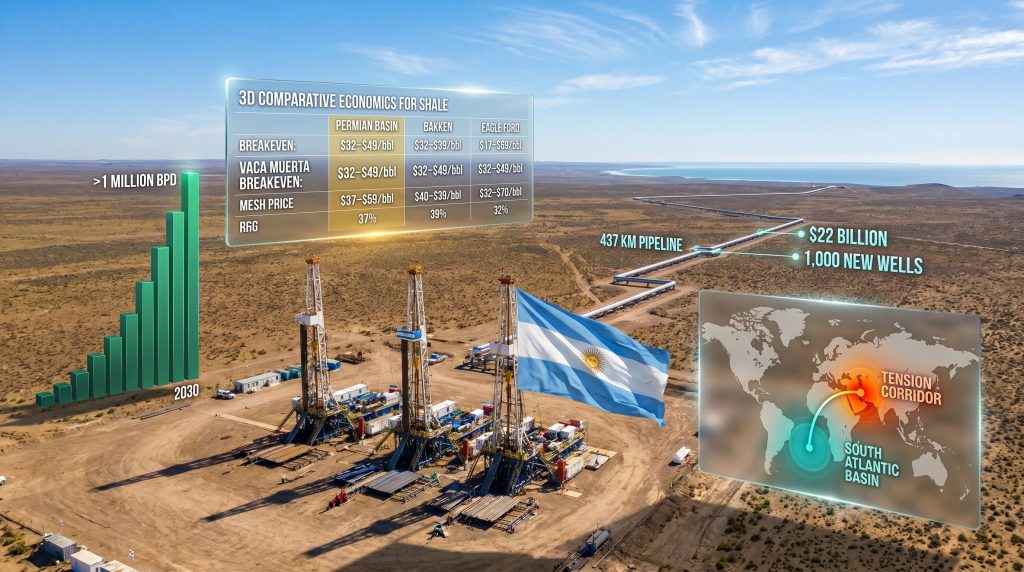
| Metric | Vaca Muerta | Permian Basin | Bakken | Eagle Ford |
|---|---|---|---|---|
| Breakeven (approx.) | $32–$49/bbl | $35–$55/bbl | $40–$60/bbl | $38–$55/bbl |
| International Operator Access | Open | Primarily domestic | Primarily domestic | Primarily domestic |
| Production Growth Trajectory | Accelerating rapidly | Maturing | Plateauing | Stable to declining |
| Infrastructure Maturity | Developing at pace | Fully developed | Developed | Developed |
| Hormuz Exposure | Zero | Zero | Zero | Zero |
| Atlantic Basin Export Position | Yes | No | No | No |
Sources: Rystad Energy, Wood Mackenzie
At current Brent prices above $109/barrel, the implied operating margin across Vaca Muerta's most prospective acreage ranges from $60 to $77 per barrel, a profit spread that comfortably clears typical internal rate of return hurdle thresholds for international energy operators. This economic environment is creating urgency among operators who missed earlier entry windows, with acquisition and farm-in activity increasingly displacing organic acreage access.
Argentina's 2026 Acreage Auction: Architecture and Opportunity
The Largest Block Offering in a Decade
Argentina's provincial energy company Gas y Petróleo del Neuquén (GyP) has launched the country's most significant Vaca Muerta acreage tender since 2016, placing 15 exploration blocks on offer across the formation's distinct geological zones. This round is more than double the six blocks offered in the previous provincial auction, a scale increase that reflects deliberate policy intent to accelerate international capital deployment at a moment of elevated global supply anxiety.
The geographical distribution of the 15 blocks is strategically designed to offer operators a genuine portfolio choice across differentiated risk-reward profiles:
-
Northwest acreage: Condensate-rich zones commanding premium liquid pricing with higher hydrocarbon yield per well
-
Northeast acreage: Oil-dominant geology generating higher crude volumes supporting near-term production economics
-
Southern fringe acreage: Frontier territory requiring greater technical de-risking but offering potential upside for operators with appetite for geological uncertainty
How the Bid Structure Works
Competitive submissions must address four distinct parameters simultaneously, creating a multi-dimensional evaluation framework that rewards operators capable of integrating fiscal commitments with operational credibility:
- Working interest carry allocated to GyP as provincial owner
- Royalty commitments above the 15% statutory minimum
- Defined work program obligations specifying capital deployment timelines
- Access bonus payments with a minimum floor of $500,000 per block
This architecture explicitly favours operators with demonstrated North American unconventional expertise. The evaluation process weights technical execution capability alongside fiscal terms, reflecting GyP's understanding that subsurface quality alone does not translate into commercial barrels without the operational knowledge to exploit it efficiently.
Rystad Energy's Jai Singh, Head of US Oil and Gas Research, has characterised the current round as the best organic entry opportunity into Vaca Muerta available to international operators in approximately ten years, noting that the basin is maturing rapidly, infrastructure construction is advancing at pace, and the bid terms are calibrated specifically to attract operators with North American shale competencies.
The Inorganic Transaction Context
A less-discussed but analytically important dimension of this auction is what it represents relative to recent transaction patterns. The majority of Vaca Muerta deal activity since the previous provincial round has been inorganic in nature, consisting primarily of acquisitions and farm-in arrangements rather than fresh acreage entry. This means the secondary market has progressively absorbed available positions, creating scarcity for operators seeking direct block access rather than paying acquisition premiums for established positions.
The recent entry by Continental Resources, a U.S. shale pioneer with deep Permian and Bakken operational experience, acquiring a 90% working interest in the Los Toldos II Oeste block and subsequently establishing a farm-in arrangement with Pan American Energy assets, provides the most tangible signal of tier-1 operator conviction in the play's commercial viability. Continental's willingness to commit capital at this scale validates both the geology and the economic framework in a way that analytical commentary alone cannot.
The Real Constraints: What Vaca Muerta Cannot Do
Infrastructure Gaps and the $22 Billion Question
Intellectual honesty about Vaca Muerta's strategic role requires confronting its genuine limitations alongside its strengths. The most material constraint is not geological. It is the capital requirement and timeline associated with building export-scale infrastructure capable of converting subsurface productivity into global supply.
Independent analysis from Wood Mackenzie estimates that reaching meaningful export capacity requires approximately $22 billion in capital investment and the drilling of approximately 1,000 additional wells. The infrastructure programme includes a 437-kilometre pipeline connecting to Punta Colorada on the Atlantic coast, expanded capacity on routes to Chile, and enhanced terminal facilities at Bahía Blanca.
Projects of this complexity and scale typically require five to eight years from final investment decision to full operational capacity, regardless of capital availability or operator urgency. Furthermore, the oil logistics risks associated with such ambitious construction programmes cannot be understated, particularly in remote operating environments.
Phoenix Global Resources has announced a $6 billion Vaca Muerta expansion plan, signalling large-scale operator conviction, but even this commitment represents a fraction of the total infrastructure requirement, illustrating that basin-wide export scaling is fundamentally a collective industry problem rather than one any single operator can resolve.
Subsurface Complexity in Structurally Challenging Zones
New entrants to Vaca Muerta must also navigate genuine geological complexity that is not uniformly distributed across the formation. Areas closer to the deformation front and structurally complex zones present materially different challenges compared to the core development areas where operator experience is deep and well productivity is most predictable. These zones require sophisticated understanding of:
- Local faulting patterns and their interaction with hydraulic fracture propagation
- Stress regime variability affecting completion design optimisation
- Landing zone selection within vertically heterogeneous intervals
- Natural fracture orientation and its influence on drainage geometry
Operators without established Neuquén organisational presence, regional supply chain relationships, and local technical personnel face a meaningful disadvantage relative to incumbents when working in these areas. The lesson from North American unconventional development is that basin-specific organisational capability accumulates over years of operational iteration and cannot be replicated quickly through capital deployment alone.
The Scale Reality: Vaca Muerta vs. Middle East Production
| Supply Source | Current/Near-Term Output | Approximate Global Share | Hormuz Exposure |
|---|---|---|---|
| Gulf States (combined) | 25–30 million bpd | ~25–30% | High |
| U.S. Shale (total) | ~13 million bpd | ~13% | None |
| Vaca Muerta (2026 estimate) | 500,000–700,000 bpd | Less than 1% | None |
| Vaca Muerta (2030 projection) | 1+ million bpd | ~1% | None |
Sources: Rystad Energy, Wood Mackenzie, IEA
Even at projected 2030 production levels, Vaca Muerta would represent roughly 1% of global petroleum supply. The strategic value of the formation lies not in its capacity for standalone substitution of Gulf volumes, but in its contribution to a diversified portfolio of geopolitically insulated supply sources that collectively reduce systemic concentration risk.
Scenario Analysis: How Vaca Muerta Performs Under Stress
Prolonged Hormuz Disruption
Under a scenario involving extended Hormuz access constraints lasting six to eighteen months, Vaca Muerta's immediate contribution would be meaningful but limited by existing export infrastructure bottlenecks. Atlantic Basin importers, particularly European refiners already seeking to manage oil market disruptions by finding alternatives to both Russian and Gulf supply simultaneously, would be primary beneficiaries of any incremental Argentine barrels reaching global markets.
However, the speed at which additional production could be mobilised and exported would be constrained by the infrastructure gaps described above, limiting the formation's near-term crisis response capacity. Elevated oil prices sustained above $80/barrel materially improve the economic case for accelerating infrastructure investment, potentially compressing development timelines as projects that were marginal at lower prices become commercially urgent.
Structural Multi-Year Gulf Supply Reduction
A sustained multi-year reduction in Gulf output would fundamentally alter Vaca Muerta's development trajectory by improving project economics across the entire $22 billion infrastructure investment programme. At sustained Brent prices above $100/barrel, the capital case for pipeline and export terminal construction becomes compelling for both private operators and Argentina's federal and provincial governments.
Under this scenario, a realistic contribution by 2030 of 1 to 1.5 million barrels per day would represent a partial but material offset to Gulf supply reduction, particularly relevant for Atlantic Basin importers.
The Current Baseline: Moderate Tension, Strategic Repositioning
The most probable near-term trajectory positions Vaca Muerta primarily as a risk-mitigation instrument within international operator portfolios rather than an emergency supply source. At current oil prices, development economics are compelling, infrastructure construction is advancing, and international operator interest is demonstrably increasing.
Argentina simultaneously benefits from strengthening its position as a net hydrocarbon exporter, with positive implications for its balance of payments position and sovereign creditworthiness over the medium term. In this context, exploring alternative energy suppliers from stable Atlantic Basin producers has become a strategic priority for many importing nations.
Who Gains Most From Vaca Muerta's Expansion?
Mapping the Beneficiary Landscape
The geographic and economic logic of who benefits from increased Vaca Muerta output varies significantly by buyer category:
-
European refiners represent the most natural and immediate beneficiary group. They face the unusual challenge of simultaneously reducing dependence on Russian pipeline supply and Middle East crude imports, and Vaca Muerta's Atlantic export position is geographically optimal for this requirement.
-
South American regional markets provide a natural near-term demand base for incremental production before export infrastructure reaches sufficient scale to compete globally. Domestic Argentine demand and neighbouring country requirements can absorb early-phase production growth efficiently.
-
U.S. refiners with light-sweet crude processing capacity may find Argentine crude grades complementary to existing import strategies, particularly as domestic U.S. shale production growth faces incremental supply constraints in maturing plays.
-
Asian importers face a less favourable logistics equation given longer shipping routes from Patagonia, but geopolitical trade tensions and diversification mandates at the sovereign level may override pure economics for key importers like Japan, South Korea, and India, all of which have elevated strategic interest in reducing Gulf supply concentration.
The Geopolitical Safety Premium
An underappreciated dimension of the current environment is the emergence of what might be termed a geopolitical safety premium for non-Gulf barrels. Long-term offtake agreements are increasingly incorporating supply geography as a pricing variable, with buyers accepting modest cost premiums for barrels that arrive with lower probability of disruption.
This represents a structural shift in procurement logic that benefits all Atlantic Basin producers, but Vaca Muerta's combination of scale, growth trajectory, and established operator presence positions it to capture this premium more effectively than most alternatives. The current Hormuz crisis is functioning, in practical terms, as a marketing event for non-Middle East producers, and as Reuters reports, the urgency it creates in importing country energy ministries is translating directly into elevated interest in assets like Vaca Muerta.
The next major ASX story will hit our subscribers first
Key Investment Risks That Demand Attention
The investment case for Vaca Muerta operators is compelling at current oil prices, but responsible analysis requires clear-eyed assessment of material risks:
-
Regulatory and fiscal stability: Argentina's history of policy volatility, including periodic changes to export tax regimes, currency controls, and energy pricing frameworks, remains a material consideration for operators making decade-scale capital commitments. Improved frameworks in recent years have reduced this risk but not eliminated it.
-
Currency and repatriation risk: Peso dynamics and foreign exchange controls have historically complicated operator economics by creating mismatches between peso-denominated costs and dollar-denominated revenues. Structural improvements in Argentina's macroeconomic management are ongoing but the risk profile remains elevated relative to North American jurisdictions.
-
Infrastructure execution risk: The $22 billion buildout requirement depends on sustained capital availability across multiple operators, regulatory approvals spanning provincial and federal jurisdictions, and construction execution capability in a remote operating environment.
-
Operational scaling risk: Moving from current production levels to 1 million barrels per day requires a substantial expansion of Neuquén's local supply chains, workforce, and technical service capacity, all of which accumulate over years rather than months.
This article is intended for informational purposes only and does not constitute financial or investment advice. Projections and forecasts cited reflect third-party analytical estimates and are subject to material uncertainty. Past performance of any energy investment or commodity price is not indicative of future results.
Frequently Asked Questions: Vaca Muerta and Global Supply Diversification
What Makes Vaca Muerta Strategically Important Right Now?
The combination of proven well productivity rivalling top U.S. shale plays, breakeven economics between $32 and $49 per barrel, Atlantic Basin export positioning, and active acreage availability through Argentina's 2026 auction creates a convergence of factors that elevates Vaca Muerta as alternative to Middle East oil supply risk precisely when disruption risk is at its most acute.
Can Vaca Muerta Replace Middle East Supply?
Not within any realistic timeframe. Even at projected 2030 production levels exceeding 1 million barrels per day, the formation would represent approximately 1% of global petroleum supply. Its strategic value lies in contributing to a portfolio of diversified non-Gulf supply sources, not in standalone substitution.
What Is the Infrastructure Investment Requirement?
Wood Mackenzie estimates that reaching meaningful export scale requires approximately $22 billion in capital investment and the drilling of approximately 1,000 new wells, alongside pipeline and terminal construction including a 437-kilometre export pipeline to Punta Colorada on the Atlantic coast.
What Are the Main Geological Challenges for New Entrants?
Areas near the deformation front and structurally complex zones require sophisticated understanding of local faulting patterns, stress regime variability, and landing zone selection within heterogeneous vertical intervals. These challenges are manageable but demand organisational investment in local technical expertise and supply chain presence that cannot be compressed into short timeframes.
Which Buyers Benefit Most From Vaca Muerta's Growth?
European importers seeking simultaneous diversification away from Russian and Gulf supply represent the most natural beneficiary group given the formation's Atlantic export position. South American regional markets provide near-term demand absorption capacity, while Asian importers represent a longer-term opportunity subject to competitive logistics economics.
The Correct Strategic Frame: Portfolio Instrument, Not Gulf Replacement
The analytical error that distorts most commentary on Vaca Muerta is evaluating it against an impossible standard: whether it can substitute for Gulf supply. Applied to that question, any assessment will conclude that it falls short, because no single basin outside the Middle East can replicate volumes representing 25 to 30 percent of global trade. That framing misses the point entirely.
The correct question is whether Vaca Muerta can serve as a meaningful component within a diversified non-OPEC supply architecture that collectively reduces global dependence on Hormuz-exposed barrels. Evaluated on that basis, the answer is unambiguously affirmative. The formation offers a rare combination of characteristics that very few basins globally can match:
- Internationally accessible acreage
- Proven and improving well productivity
- Competitive breakeven economics
- Zero Hormuz exposure
- Atlantic export positioning
- A development trajectory pointing toward 1+ million barrels per day before the end of the decade
Rystad Energy's assessment that Vaca Muerta has spent recent years quietly building the pipeline and export terminal infrastructure needed to translate geological quality into global supply reflects an analytical consensus that the window for early-stage entry is narrowing as basin maturity increases and organic acreage availability diminishes. Furthermore, as IEEFA's financial analysis highlights, understanding the financial risks associated with this development remains essential for operators making long-term commitments.
For energy importers, upstream operators, and investors working through how to position portfolios in a world where supply geography has become a strategic variable rather than a procurement footnote, Vaca Muerta deserves serious and sustained attention. Not as the answer to the Middle East supply problem, but as one of the most credible, scalable, and geopolitically insulated answers to the broader question of where reliable non-Gulf barrels will come from across the next decade.
Want to Stay Ahead of the Next Major Mineral Discovery Before the Market Moves?
While Vaca Muerta repositions global energy supply chains, savvy investors are equally focused on identifying the next transformative resource discovery closer to home — Discovery Alert's proprietary Discovery IQ model delivers real-time ASX mineral discovery alerts, turning complex geological and commodity data into actionable investment opportunities the moment they are announced. Explore how historic discoveries have generated substantial returns on Discovery Alert's dedicated discoveries page, and begin your 14-day free trial today to position yourself ahead of the broader market.