May 16, 2026
The Long Runway: Why South Africa's Grid Cannot Afford to Let Coal Go Yet
Energy transitions are rarely as clean as policy documents suggest. History shows that the gap between declared decarbonisation ambitions and the operational realities of electricity grids can stretch across decades, shaped by infrastructure inertia, capital constraints, and the irreplaceable physics of dispatchable baseload generation. Nowhere is this tension more visible in 2026 than in South Africa, where a coal mine that began its expansion programme twenty years ago is now the subject of a landmark 17.5-year supply agreement with the national utility. The Exxaro Matla coal mine expansion is not simply a mining story. It is a diagnostic window into how emerging economies navigate the collision between energy pragmatism and decarbonisation ambition.
When big ASX news breaks, our subscribers know first
South Africa's Electricity Grid and the Structural Weight of Coal
South Africa's power sector sits in a position that few developed-economy observers fully appreciate. Coal accounts for approximately 80% of the country's electricity generation, a dependency ratio that places it in a category shared by very few major economies of comparable size and complexity. This is not a recent development born of policy failure but rather the legacy of decades of deliberate industrial planning around abundant, accessible domestic coal reserves in the Mpumalanga province.
Eskom, the state-owned utility, operates a fleet of coal-fired power stations that collectively underpin national baseload supply. Several of these stations have had their operational lives extended beyond original retirement dates to manage demand shortfalls, a pattern that reflects the consequences of generation capacity deficits experienced during years of severe load-shedding. Renewable energy additions, including wind and solar capacity, are accelerating across the country, however the fundamental challenge remains: intermittent renewable sources cannot replicate the dispatchable baseload characteristics of a large coal-fired station without substantial grid-scale energy storage infrastructure, which South Africa currently lacks at the required scale.
Within this context, the Matla Power Station in Mpumalanga occupies a position of considerable strategic weight. Commissioned fully in 1983 and carrying a nameplate generation capacity of 3,600 megawatts, Matla is one of the foundational assets in Eskom's baseload fleet. Its continued operation is directly contingent on a reliable, proximate coal supply, and it is the anchor demand source for the Exxaro Matla coal mine expansion that is now reshaping the region's energy supply outlook through 2043.
What the Exxaro Matla Coal Mine Expansion Actually Involves
The term "expansion" can suggest a straightforward scaling of existing operations, but the reality at Matla is considerably more complex. The Matla Mine 1 Relocation Mega Project has been underway since 2006, making it one of the longest-running mine life-extension programs in South Africa's coal sector. The two-decade development timeline reflects not indecision but the sheer engineering complexity of constructing new underground access infrastructure at a mature, operating mine while simultaneously maintaining production continuity.
The core engineering challenge is best understood through a single statistic: approximately 85% of Matla's remaining coal reserves are situated within areas that the existing mine workings cannot access. Without completing the expansion infrastructure, the overwhelming majority of the mine's economic resource base remains stranded below ground.
The infrastructure programme required to unlock these reserves is multi-component and capital-intensive:
| Infrastructure Component | Function | Current Status |
|---|---|---|
| Mine 1 Decline Shaft | Primary underground access to remaining reserves | Under development |
| Box Cut and Surface Infrastructure | Surface-to-underground entry point | In progress |
| Underground Tunnel Networks | Reserve access and haulage routes | Ongoing |
| North-West Access (Mines 2 and 3) | Reserve unlocking development headings | Active |
| Mine 3 Ventilation Shaft | Ventilation capacity for expanded workings | In progress |
| Conveyor and Processing Systems | Surface coal handling and preparation upgrades | Planned |
| Geological Drilling Programme | Reserve delineation and coal quality characterisation | Active |
A decline shaft, for those unfamiliar with underground mining terminology, is an inclined tunnel driven from the surface downward at a controlled gradient, allowing personnel, equipment, and materials to move between surface and underground working levels. Unlike vertical shaft systems, decline shafts accommodate conveyor belts and trackless mining equipment, making them the preferred access method for bulk coal operations. The construction of a new decline shaft at Matla is the critical-path item that determines when the mine can begin recovering reserves in delayed expansion areas.
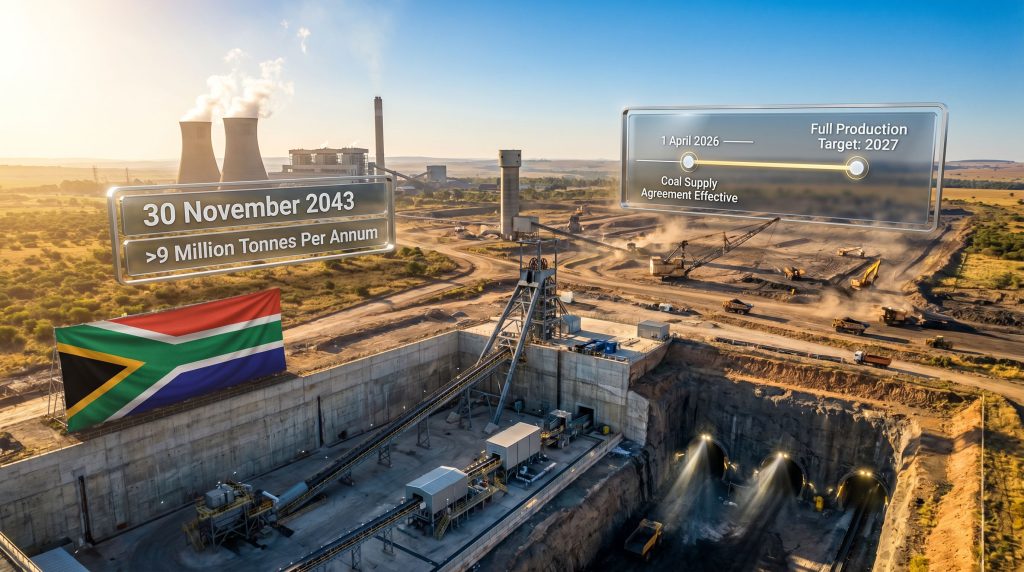
Full production from the expanded mine areas is targeted for 2027, contingent on completing the decline shaft and the North-West Access development headings at Mines 2 and 3.
The Exxaro–Eskom Coal Supply Agreement: Structure and Commercial Logic
The commercial foundation of the Exxaro Matla coal mine expansion is a long-term Coal Supply Agreement between Exxaro and Eskom that became effective on 1 April 2026 and extends through to 30 November 2043. Under its terms, Exxaro is contracted to deliver in excess of 9 million tonnes of coal annually to the Matla Power Station, representing a total contracted supply volume of more than 157 million tonnes across the life of the agreement.
The contract structure creates a mutually reinforcing commercial incentive: Exxaro receives revenue certainty that justifies the sustained capital expenditure required for the mine expansion, while Eskom secures a captive, proximate coal supply that eliminates the logistics costs and supply chain vulnerabilities associated with sourcing coal from more distant operations. Furthermore, the broader coal supply challenges facing South Africa's energy sector make this kind of long-term arrangement increasingly valuable to both parties.
Long-term offtake agreements of this duration are increasingly unusual in the global coal sector, where financial institutions and infrastructure insurers are progressively reducing their exposure to fossil fuel projects. A 17.5-year supply commitment signals that both parties are operating under a framework of energy pragmatism, one that prioritises grid stability over alignment with ideological decarbonisation timelines.
Key terms of the agreement at a glance:
| Parameter | Detail |
|---|---|
| Agreement effective date | 1 April 2026 |
| Agreement expiry date | 30 November 2043 |
| Contract duration | Approximately 17.5 years |
| Annual contracted supply | More than 9 million tonnes |
| Estimated total contracted volume | More than 157 million tonnes |
| Matla Power Station capacity | 3,600 megawatts |
The Department of Mineral and Petroleum Resources confirmed in a public statement in May 2026 that the Matla Mine 1 expansion project involves constructing a new decline shaft to access remaining coal reserves, with the objective of extending mine life and ensuring continued coal supply to Eskom's Matla Power Station. This public acknowledgment from the regulator reflects institutional awareness of the project, though it does not constitute an official designation or acceleration of permitting processes.
Exxaro's Dual-Track Investment Strategy
One of the more nuanced dimensions of the Exxaro Matla coal mine expansion story is how Exxaro's leadership frames coal production within a broader corporate strategy that simultaneously encompasses renewable energy development. In addition, the Exxaro transition strategy under new leadership has brought renewed focus to how these parallel priorities are communicated to investors.
Caroline Shirindza, Exxaro's Executive Head of Coal, articulated the company's position clearly during a site visit to the Matla operation in May 2026. Shirindza emphasised that coal production and renewable energy development are pursued as parallel, complementary strategies rather than competing priorities, with coal revenues providing the cash generation capacity that funds the company's transition-aligned investments.
This dual-track approach is reflected in the company's reported capital allocation across its two primary strategic pillars:
| Strategic Pillar | Reported Investment | Purpose |
|---|---|---|
| Coal life extension (Matla expansion) | Approximately R5.2 billion | Secure long-term baseload cash generation |
| Renewable energy development | Approximately R4.7 billion | Build transition-aligned revenue streams |
The logic of this model is straightforward from a corporate finance perspective. Rather than divesting coal assets prematurely at compressed valuations, Exxaro maximises the remaining economic value of its coal portfolio, using those cash flows to fund investments in renewable energy infrastructure that will generate returns beyond the coal era. The Exxaro renewable energy plans illustrate how the company intends to deploy this capital effectively across wind and solar projects.
This approach mirrors a pattern increasingly observed among large diversified miners globally: life-of-mine extensions on existing permitted operations are preferred over greenfield coal development because they offer materially lower capital intensity, faster reserve access timelines, and reduced regulatory risk exposure.
The critical distinction here is between extending the productive life of an already-operating, already-permitted mine versus initiating a new coal development from scratch. The latter faces near-insurmountable ESG and financing headwinds in the current market. The former, particularly when tied to an existing long-term offtake agreement, occupies a more defensible position with both capital allocators and regulators.
The Technical and Geological Realities Behind the Reserve Situation
The statistic that 85% of Matla's remaining coal reserves lie within delayed expansion areas is arguably the most operationally significant figure in the entire expansion narrative. It reveals a technical reality about mature underground coal mines that is not widely appreciated outside the sector.
As underground coal mines age, the most accessible and lowest-cost reserves are progressively depleted. What remains tends to require more complex and capital-intensive access infrastructure. At Matla, the original mine workings have been producing coal since the early 1980s, meaning that four decades of production have systematically exhausted the most readily accessible portions of the reserve base.
The geological drilling programme underway as part of the expansion project serves a dual purpose: it delineates the boundaries and tonnage of remaining reserves with greater precision, and it characterises coal quality parameters including calorific value, ash content, and moisture content, which are critical to Eskom's boiler specifications at the Matla Power Station. Eskom's power stations are designed to operate within specific coal quality ranges, and supply agreements typically include quality specifications that the miner must meet to avoid penalty provisions or supply curtailment.
This interplay between geological characterisation and supply contract compliance is a lesser-discussed but practically important dimension of mine-to-power-station supply relationships in South Africa's coal sector.
The next major ASX story will hit our subscribers first
South Africa's Just Transition: Matla's Role in the Socioeconomic Equation
The Mpumalanga province, where the Matla operations are located, is one of South Africa's most mining-intensive regions and one where economic activity is deeply intertwined with the coal sector. Exxaro describes the Matla operation as an economic anchor for the region, supporting direct employment, local enterprise development contracts, and community infrastructure investment.
South Africa's Just Transition framework aims to manage the shift away from coal in a manner that protects affected workers and communities from the economic disruption of rapid decarbonisation. The practical implication of this framework is that premature curtailment of coal operations like Matla would carry socioeconomic consequences that extend far beyond the mine gate, affecting communities that currently have limited alternative economic activity.
The 2043 supply contract horizon provides a defined planning window within which government, Eskom, Exxaro, and community stakeholders can develop alternative economic pathways for Mpumalanga. Consequently, this is the often-overlooked function of long-duration coal supply agreements in a just transition context: they do not simply perpetuate fossil fuel dependency but establish a known endpoint from which transition planning can be structured.
Global Framing: Life-of-Mine Extensions in the Decarbonisation Era
The mining and energy transition dynamic globally helps contextualise why the Exxaro Matla coal mine expansion exists within a recognisable pattern. As institutional capital increasingly avoids greenfield coal development in response to ESG mandates and declining project finance availability, mining companies are channelling capital toward life-of-mine extension projects at existing operations. These projects offer a risk profile that is structurally more attractive than new development, particularly given rising energy transition demand for stable baseload generation during the build-out of renewables infrastructure.
| Project Type | Capital Intensity | Regulatory Risk | Financing Availability |
|---|---|---|---|
| Greenfield coal mine | High | Very high | Severely constrained |
| Life-of-mine extension | Medium | Moderate | Limited but available |
| Processing or logistics optimisation | Low | Low | More accessible |
For investors and analysts tracking South Africa's energy sector, the Matla expansion serves as a bellwether case study in how energy-dependent emerging economies balance decarbonisation objectives against the immediate operational demands of grid stability. The 2043 supply horizon aligns with the timeframe within which South Africa's renewable energy and grid-scale storage capacity could plausibly reach the scale necessary to absorb Matla Power Station's eventual decommissioning.
The Matla expansion is not a repudiation of South Africa's energy transition. It is a recognition that structural transitions of this scale require a longer operational runway than policy documents typically acknowledge, and that the infrastructure required to close that gap must be built while existing systems remain functional.
Key Milestones and Monitoring Framework
For those tracking the progression of the Exxaro Matla coal mine expansion, the following milestone framework provides a structured monitoring reference:
| Milestone | Timeline |
|---|---|
| Mine 1 Relocation Mega Project initiated | 2006 |
| Exxaro-Eskom Coal Supply Agreement effective | 1 April 2026 |
| Full production from expanded areas targeted | 2027 |
| Mining right renewal (extension anticipated) | Post-2025 period |
| Coal Supply Agreement expiry | 30 November 2043 |
The most consequential developments to monitor over the next 24 months include:
- Completion and commissioning of the Mine 1 decline shaft, the critical-path infrastructure item for reserve access
- Confirmation of the mining right renewal from the Department of Mineral and Petroleum Resources, which underpins the long-term capital programme
- Progress on North-West Access development headings at Mines 2 and 3, which determines whether the 2027 full production target is achievable on schedule
- Exxaro's capital allocation disclosures in upcoming investor communications, particularly the balance between Matla expansion spending and renewable energy investment commitments
- Eskom's operational life decisions regarding Matla Power Station itself, as any revision to the station's retirement timeline would directly affect the supply agreement framework
Frequently Asked Questions
What is the Exxaro Matla coal mine expansion?
The Matla Mine 1 Relocation Mega Project is a long-running life-of-mine extension programme at Exxaro's Matla coal operations in Mpumalanga, South Africa. It involves constructing new underground access infrastructure, including a decline shaft, box cut, tunnel networks, and upgraded ventilation systems, to unlock coal reserves that are inaccessible through existing mine workings. The project has been underway since 2006 and targets full production from expanded areas by 2027.
How much coal will Exxaro deliver to Eskom under the new contract?
Under the Coal Supply Agreement effective from 1 April 2026, Exxaro is contracted to deliver more than 9 million tonnes of coal annually to the Matla Power Station through to 30 November 2043, representing a total supply commitment of more than 157 million tonnes over the contract life.
Why is a coal mine being expanded when South Africa is pursuing renewable energy?
Exxaro's position is that coal and renewable energy development operate as parallel, complementary strategies. Coal revenues from Matla fund investment in wind and solar projects. At the grid level, South Africa currently generates approximately 80% of its electricity from coal, and Matla Power Station's 3,600 megawatts of dispatchable baseload capacity cannot be replaced by intermittent renewable sources at the required scale within the near term.
What percentage of Matla's reserves are in delayed expansion areas?
Approximately 85% of Matla's remaining coal reserves are located within areas dependent on the completion of delayed expansion project infrastructure. This makes the Mine 1 decline shaft and associated underground development the operational and commercial centrepiece of the entire programme.
What is the status of Matla's mining right?
The Matla mining right was noted as due for renewal post-2025, with an extension anticipated from the Department of Mineral and Petroleum Resources. Regulatory continuity is a key risk variable for the project's long-term capital programme and should be monitored by investors and analysts tracking the expansion.
Disclaimer: This article contains forward-looking statements, projections, and analytical interpretations based on publicly available information as of the date of publication. It does not constitute financial advice. Production timelines, capital estimates, regulatory outcomes, and contract performance are subject to material risk and uncertainty. Readers should conduct independent due diligence before making any investment decisions related to the companies or projects discussed.
Want to Track the Next Major ASX Mineral Discovery Before the Market Moves?
Discovery Alert's proprietary Discovery IQ model scans ASX announcements in real time, instantly alerting subscribers to significant mineral discoveries across more than 30 commodities — visit the Discovery Alert discoveries page to see how historic finds have generated extraordinary returns, and begin your 14-day free trial to position yourself ahead of the broader market.