
August 21, 2026
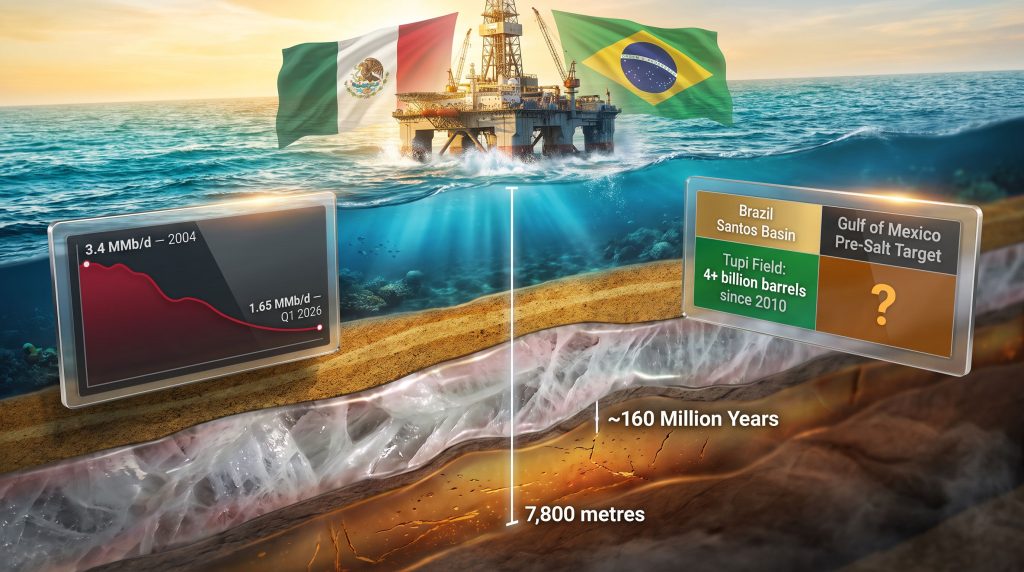
The Geological Frontier That Could Redefine Gulf of Mexico Energy
Deepwater exploration has always separated the technically capable from the merely ambitious. In the Gulf of Mexico, where operators like Shell and Chevron spent decades refining subsaline drilling techniques before achieving commercial scale, the next geological frontier sits even deeper, older, and more technically demanding than anything previously attempted in the basin. The pre-salt layer beneath the Gulf's existing productive formations represents a hydrocarbon target that has resisted commercial development not because it lacks geological promise, but because the engineering and capital requirements have historically exceeded what any single operator could confidently deploy.
That calculus is now shifting, driven by a state-to-state alliance between two of Latin America's most strategically significant national oil companies. The framework connecting PEMEX and Petrobras around PEMEX Petrobras ultra-deep pre-salt exploration reflects something more nuanced than a bilateral handshake; it represents a calculated response to intersecting pressures including production decline, fiscal constraints, upstream sovereignty policy, and the growing geopolitical value of Western Hemisphere hydrocarbon diversification. Furthermore, current crude oil prices are adding additional urgency to the search for new reserve additions at scale.
When big ASX news breaks, our subscribers know first
Understanding Pre-Salt Geology: Why Depth Changes Everything
Formation Age and Structural Character
Pre-salt geology refers to hydrocarbon-bearing source rocks deposited beneath thick, high-pressure salt sequences. In the Gulf of Mexico context, the target formations were laid down approximately 160 million years ago, making them geologically older than the pre-salt systems that Petrobras has successfully commercialised in Brazil's Santos Basin, where formation ages are typically estimated between 120 and 130 million years.
This age difference is not merely academic. Older formations have experienced greater burial depths, longer thermal maturation cycles, and more complex structural deformation histories. The resulting reservoir characteristics, including porosity, permeability, and fluid composition, may differ substantially from the Santos Basin analogue that Petrobras operators know intimately.
A critical distinction frequently overlooked in mainstream coverage is the difference between subsaline and pre-salt targets. Operators including Shell and Chevron have produced crude from subsaline reservoirs in the Gulf of Mexico for decades. These are formations that sit beneath salt overburden but above the pre-salt source rock horizon. The PEMEX-Petrobras collaboration targets the genuinely pre-salt layer, which sits significantly deeper and operates under far more extreme temperature and pressure conditions.
The Seismic Imaging Problem
One of the least-discussed technical barriers to pre-salt exploration is the distortion that thick salt bodies introduce into seismic wave propagation. Salt layers are acoustically anomalous, causing seismic energy to refract, reflect, and scatter in ways that make subsurface imaging unreliable. This means geological models constructed from seismic data alone carry substantially higher uncertainty below salt than they do in conventional deepwater settings.
The practical implication is that a company can invest heavily in seismic acquisition and processing, develop a detailed geological model, and still encounter a fundamentally different subsurface reality once the drill bit penetrates beneath the salt canopy. This is precisely what occurred in PEMEX's 2018 drilling campaign, when the company bored past 7,800 metres below the seabed without achieving commercial discovery, despite working from seismic data that identified the geological cluster as prospective.
| Geological Parameter | Brazil Santos Basin Pre-Salt | Gulf of Mexico Pre-Salt Target |
|---|---|---|
| Formation Age | ~120-130 million years | ~160 million years |
| Water Depth Range | 1,500m to 3,000m | Comparable ultra-deep range |
| Commercial Production Start | 2009 (Tupi Field) | Not yet commercially proven |
| Cumulative Tupi Output | 4+ billion barrels since 2010 | Undetermined |
| Primary Technical Risks | Salt mobility, pressure | Salt mobility, extreme depth, seismic imaging uncertainty |
| Well Control Data Available | Extensive | Very limited |
PEMEX's Production Decline: The Structural Problem Driving the Alliance
From 3.4 Million Barrels to 1.65 Million Barrels
PEMEX's production trajectory tells a story of prolonged structural decline that conventional remedies have failed to reverse. At its 2004 peak, the company produced approximately 3.4 million barrels per day (MMb/d) of liquids, a figure that positioned it among the world's most significant producers. By Q1 2026, that output had stabilised at approximately 1.65 MMb/d, representing a decline of more than 50% over two decades.
The primary driver of this decline is natural reservoir depletion at the Cantarell complex in the Sonda de Campeche. Cantarell was once considered the world's second-largest producing oilfield, but its natural pressure declined sharply after the early 2000s despite nitrogen injection programmes designed to maintain reservoir drive. Advanced seismic reprocessing and improved reservoir management in mature Campeche basins offer incremental near-term gains, but they cannot substitute for new resource additions of meaningful scale.
Why the State-to-State Model Was the Only Viable Path
The Mexican government's upstream development policy establishes a preference for state-controlled exploration and production, which effectively eliminates the conventional route of attracting international oil companies through competitive concession rounds. This is not a temporary political position but a structural feature of how the Sheinbaum administration approaches upstream sovereignty.
Within those constraints, PEMEX faces a genuine capability gap. Ultra-deepwater pre-salt drilling requires proprietary engineering systems, specialised drilling vessels rated for extreme pressures, purpose-built subsea production infrastructure, and a reservoir characterisation methodology developed through years of operational experience in analogous geological settings. PEMEX currently possesses none of these in commercially deployable form.
Petrobras provides precisely this package. Crucially, as a fellow state-owned enterprise, it does so without triggering upstream liberalisation concerns. The PEMEX-Petrobras framework is therefore not simply a technical partnership; it is a politically sustainable mechanism for accessing world-class deepwater capabilities within a state-controlled model.
The state-to-state structure allows PEMEX to access Petrobras' decade-and-a-half of pre-salt operational experience without ceding upstream control to private international concessionaires, preserving the Mexican government's fundamental policy position on national resource sovereignty.
What the MoU Actually Commits Both Parties To
A Framework, Not a Drilling Programme
The non-binding, two-year Memorandum of Understanding formalised in Rio de Janeiro by PEMEX Director General Juan Carlos Carpio and Petrobras Executive President Magda Chambriard is best understood as a structured evaluation framework rather than an operational commitment. It does not create a joint venture, establish binding investment obligations, or set a drilling schedule.
This distinction matters enormously for anyone seeking to interpret the near-term implications of the agreement. No capital has been formally committed. No specific well locations have been designated for drilling. Any projects that emerge from the joint geological evaluation would require entirely separate contractual structures and regulatory approvals before becoming operational realities.
The MoU formalises technical dialogue that had been advancing through diplomatic channels over several months, underpinned by the bilateral relationship between Mexican President Claudia Sheinbaum and Brazilian President Luiz Inácio Lula da Silva. By embedding the technical cooperation within a broader diplomatic relationship, the agreement gains political durability that a purely commercial arrangement might lack.
Cooperation Domains Under the Agreement
The scope outlined by Petrobras Exploration and Production Director Sylvia Anjos extends well beyond pre-salt drilling evaluation and covers a diverse operational landscape:
- Ultra-deep pre-salt exploration: Joint geological and seismic evaluation of the Campeche target cluster, including reanalysis of data from the 2018 PEMEX well
- Turbidite system assessment: Evaluation of deep-water sedimentary fans formed by underwater avalanche deposits of mud and sand, which can host significant hydrocarbon accumulations in their own right
- Shallower structural targets: Review of salt-related structural traps at more accessible depths as lower-risk, potentially nearer-term opportunities
- Mature basin optimisation: Advanced seismic reprocessing in the Sonda de Campeche and Cantarell complex area
- Refining collaboration: Joint evaluation of downstream processing efficiency improvements
- Fuel marketing: Commercial cooperation in distribution and marketing initiatives
- Lower-carbon technologies: Shared development of emissions-reduction capabilities applicable across both companies' operations
Petrobras' Technical Credentials: What 15 Years of Pre-Salt Operation Looks Like
The Santos Basin Track Record
Petrobras produced its first pre-salt oil in 2009 from Brazil's Santos Basin, establishing what has since become a defining chapter in offshore energy history. The Tupi field, Petrobras' flagship pre-salt asset, has yielded more than 4 billion barrels of crude oil since 2010, a production record that validated the commercial viability of ultra-deepwater pre-salt extraction at scale. In addition, industry trends and innovation in subsea engineering have continued to reduce costs and improve reliability across comparable deepwater environments.
The technical capabilities Petrobras developed across this operational journey include salt-tolerant drilling systems capable of maintaining wellbore integrity through mobile salt formations, high-pressure wellbore engineering designed for reservoir conditions that would overwhelm standard deepwater equipment, and subsea production infrastructure engineered to function reliably at water depths between 1,500 and 3,000 metres.
Critically, Petrobras also developed a reservoir characterisation methodology that integrates seismic imaging, well data, and production performance in ways specifically calibrated for pre-salt geological complexity. This institutional knowledge, accumulated over 15 years of operational refinement, is arguably more valuable than any single piece of hardware.
The Uncharted Territory Caveat
Despite this impressive track record, geologists with direct Petrobras experience have been clear that the Gulf of Mexico pre-salt represents genuinely new geological ground. Pedro Zalan, a former Petrobras geologist who spent 34 years with the company, has emphasised that while the regional geology on the Mexican side of the Gulf presents structurally favourable conditions for hydrocarbon accumulation, Petrobras is operating beyond the boundaries of its established Santos Basin experience base.
This is a critically important nuance. The Santos Basin analogue provides a useful conceptual framework and a toolkit of applicable technologies, but it does not provide direct geological precedent for what lies beneath the Campeche pre-salt horizon. The 160 million year old source rocks, the greater burial depths, and the limited well control data in the target area all introduce uncertainties that no amount of Brazilian operational experience can fully resolve in advance of drilling.
Risk Architecture: What Could Go Wrong at 7,800 Metres
Technical Failure Modes
Ultra-deep pre-salt drilling carries a distinctive risk profile that differs qualitatively, not just quantitatively, from conventional deepwater operations. The primary technical failure modes include:
- Salt mobility and wellbore deformation: At extreme depths, salt behaves as a viscous fluid under overburden pressure, causing wellbore walls to creep and close around drilling equipment. Specialised casing programmes and real-time monitoring are required to manage this risk, but complete mitigation is impossible
- Extreme pressure and temperature conditions: Pre-salt reservoirs can operate at pressures and temperatures that exceed the design limits of standard subsea equipment, requiring purpose-engineered systems that add both cost and lead time
- Seismic imaging degradation: Thick salt canopies distort the acoustic signals used to construct subsurface geological models, meaning pre-drill geological interpretations carry higher uncertainty than in salt-free deepwater settings
- Well cost exposure: Individual ultra-deepwater pre-salt wells can require capital commitments running into the hundreds of millions of dollars, with no assurance of commercial discovery even when the geological model appears favourable
Three Scenario Pathways for the Programme
| Scenario | Trigger Conditions | Implications for PEMEX | Implications for Regional Supply |
|---|---|---|---|
| Commercial Pre-Salt Discovery | Seismic reprocessing confirms viable accumulation; subsequent drilling achieves commercial flow rates | Potential to materially reverse production decline; transformative for PEMEX's fiscal position | Significant new Gulf of Mexico supply addition; Western Hemisphere diversification benefit |
| Technical Collaboration Without Discovery | Joint studies proceed; geological data does not support commercial drilling programme | Incremental knowledge transfer and technology exposure; no near-term production impact | Minimal effect on regional supply; MoU framework may be extended or redirected toward other targets |
| Programme Stalled by Capital or Policy Constraints | Fiscal pressure on PEMEX intensifies; political priorities shift; capital cannot be secured for drilling phase | Status quo production decline continues; no structural solution to output trajectory | No change to regional supply dynamics; deepwater frontier remains unexplored |
The next major ASX story will hit our subscribers first
The Broader Strategic Picture: NOC Collaboration as a Model
Why State-to-State Technology Transfer Is Accelerating
The PEMEX-Petrobras framework reflects a broader pattern emerging across national oil company (NOC) relationships globally. Technically complex frontier plays increasingly require specialised capabilities that individual state operators cannot develop independently, either because of capital constraints, insufficient operational history, or the sheer novelty of the geological target.
Rather than ceding access to private international oil companies, resource-rich governments are increasingly exploring cooperative arrangements with technically capable NOC counterparts. This model preserves upstream sovereignty while creating pathways for capability transfer that purely commercial arrangements cannot replicate.
The PEMEX-Petrobras arrangement is particularly well-structured for this purpose because both operators share comparable institutional cultures as state enterprises, both have a direct interest in the long-term success of the programme, and the diplomatic relationship between the two governments provides a stabilising framework that extends beyond the technical collaboration itself. Consequently, understanding OPEC market influence on global pricing also matters here, as non-OPEC supply additions from the Western Hemisphere carry increasing strategic weight.
Geopolitical Timing and Western Hemisphere Energy
The timing of the PEMEX Petrobras ultra-deep pre-salt exploration initiative is not incidental. Elevated Middle Eastern geopolitical instability has reinforced the strategic value that energy policymakers place on Western Hemisphere hydrocarbon diversification. A commercially successful Gulf of Mexico pre-salt play, if eventually achieved, would represent a meaningful addition to non-OPEC supply from a geographically secure production base.
For Brazil, the partnership extends Petrobras' influence as a regional deepwater technology provider, positioning the company beyond its domestic Santos Basin operations and establishing a precedent for future cross-border NOC collaborations in the region. Furthermore, crude oil price trends in 2025 have underscored why frontier reserve additions carry such long-term strategic importance for both governments.
Investment Implications and Investor Caution
Who Stands to Benefit if the Programme Advances
Even in its current pre-drilling, evaluation-focused phase, the PEMEX-Petrobras framework creates observable investment implications across several categories:
- Subsea oilfield service companies with Gulf of Mexico operational capability and ultra-deepwater engineering expertise stand to benefit if the MoU progresses toward active drilling programmes
- Seismic data processors and geoscience technology providers capable of handling sub-salt imaging challenges in the Gulf are likely to find demand for their services as the joint geological evaluation advances
- Ultra-deepwater drilling contractors with rigs rated for extreme-depth operations represent another category of potential beneficiary, though any drilling contract awards remain a considerable distance from the current evaluation stage
Investor Caution: The non-binding character of the MoU means no capital has been committed and no drilling timeline established. In ultra-deepwater pre-salt environments, the pathway from initial geological evaluation to commercial production typically spans a decade or more under even the most favourable conditions. Investors should calibrate expectations to that timeline, not to the agreement's signing date.
Comparative Context: How the Campeche Pre-Salt Stacks Up
The Campeche pre-salt target is geologically older and technically more complex than most commercially producing pre-salt systems operating anywhere in the world today. Unlike Brazil's Santos Basin, where Petrobras benefited from progressively refined well control data accumulated across multiple exploration campaigns, the Gulf of Mexico pre-salt has extremely limited well penetration history.
The 2018 PEMEX drilling attempt, which reached beyond 7,800 metres without commercial success, represents essentially the entire well control database for this geological system. This data scarcity is both a risk factor and, paradoxically, a reason why the geological evaluation phase now underway is genuinely meaningful. Reprocessing the 2018 well data through Petrobras' analytical framework could produce insights that were not available to PEMEX engineers working alone in the pre-MoU environment. According to the International Energy Agency, frontier deepwater basins are expected to account for a growing share of global reserve additions through 2040, reinforcing the long-term logic of this collaboration.
However, as the U.S. Energy Information Administration notes, the commercial viability of any ultra-deepwater play is also highly sensitive to the broader trajectory of oil prices and oil prices and trade war dynamics, both of which remain subject to substantial near-term uncertainty.
Key Takeaways for Understanding This Alliance
The PEMEX Petrobras ultra-deep pre-salt exploration collaboration is best understood through five structural realities:
- The geological target is genuinely frontier territory: At approximately 160 million years old and depths exceeding 7,800 metres, the Campeche pre-salt sits at the outer boundary of commercially attempted exploration globally
- Petrobras brings a verified track record: More than 4 billion barrels produced from the Tupi field since 2010 validates the pre-salt model, though the Santos Basin analogue does not eliminate geological uncertainty in Mexico
- The MoU is an evaluation framework, not a drilling commitment: Near-term outcomes will be defined by geological data analysis, not production timelines
- PEMEX's production decline creates genuine urgency: The fall from 3.4 MMb/d in 2004 to 1.65 MMb/d in Q1 2026 represents a structural problem that cannot be solved through mature basin management alone
- Commercial production, if ever achieved, would require at least a decade from any positive drilling result: Investors and analysts should apply long-horizon frameworks when assessing the programme's ultimate significance
This article contains forward-looking analysis based on publicly available information. It does not constitute financial advice. Pre-salt exploration outcomes are subject to significant geological, technical, financial, and regulatory uncertainty. Past production performance in analogous geological systems does not guarantee comparable outcomes in the Gulf of Mexico pre-salt.
Want to Track the Next Major Resource Discovery Before the Market Moves?
Discovery Alert's proprietary Discovery IQ model scans ASX announcements in real time, instantly identifying high-potential mineral discoveries across more than 30 commodities and converting complex geological data into clear, actionable investment insights — the same kind of frontier opportunity analysis that separates informed investors from the rest. Explore how historic discoveries have generated extraordinary returns and begin your 14-day free trial today to position yourself ahead of the market.