August 5, 2026
Understanding Peralkaline Rare Earth Systems in Arctic Environments
Arctic mineral development represents one of the most technically challenging frontiers in modern mining operations. Peralkaline-hosted rare earth systems, characterised by alkaline igneous rocks with distinct geochemical signatures, offer unique opportunities for strategic metal extraction in regions previously considered economically inaccessible. These geological formations concentrate rare earth elements through complex magmatic processes, creating deposits with favourable mineralogy for extraction and processing compared to traditional granitic-hosted systems.
The technical complexity of Arctic operations extends beyond conventional mining challenges. Permafrost conditions, extreme temperature variations, and limited seasonal access windows require specialised equipment deployment and operational protocols. However, recent technological advances in mobile analytical laboratories, cold-weather drilling techniques, and renewable energy integration have transformed the viability of large-scale Arctic mineral development projects.
When big ASX news breaks, our subscribers know first
Advanced Drilling Operations in Greenland's Tanbreez System
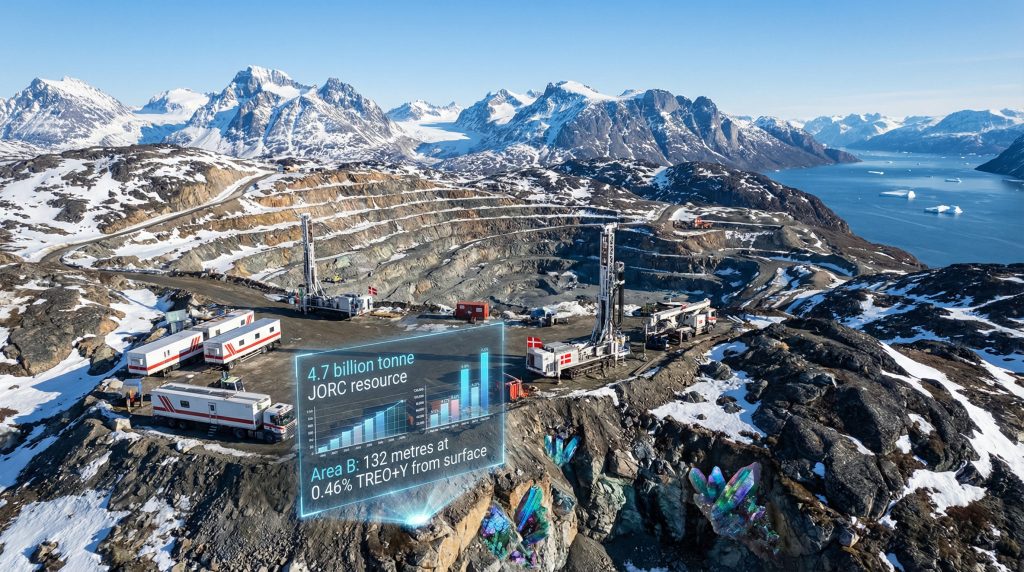
The Tanbreez rare earth drilling project in Greenland demonstrates how systematic exploration programmes can unlock world-class mineral resources through technical excellence and environmental stewardship. Located within southern Greenland's Gardar Province, this operation encompasses a 4.7 billion tonne JORC-compliant resource base across multiple mineralised zones spanning a 5-kilometre by 2.5-kilometre footprint.
Recent drilling campaigns have revealed exceptional geological continuity across the deposit architecture. The 2025 exploration programme achieved remarkable consistency in rare earth intersections, with Area B drilling returning grades ranging from 0.35% to 0.61% total rare earth oxide plus yttrium (TREO+Y) across a 1.75-kilometre strike length. These results demonstrate systematic mineralisation rather than isolated high-grade pockets, supporting resource upgrade potential through continued exploration.
Mineralisation Architecture and Grade Distribution
The deposit comprises three primary zones: the established Fjord Deposit, the Hill Zone Deposit, and the emerging Area B zone. Each zone exhibits distinct geological characteristics while maintaining consistent rare earth concentrations suitable for large-scale mining operations. Furthermore, advanced 3D geological modeling techniques have been crucial in understanding the complex deposit architecture.
Key drilling highlights include:
• Area B Zone: 132 metres at 0.46% TREO+Y from surface (Hole 25-D10)
• Fjord Extension: 55.5 metres at 0.41% TREO+Y from 2 metres depth (Hole 25-D15)
• Multiple Stacked Intervals: 82 metres at 0.44% TREO+Y with higher-grade zones of 0.61% TREO+Y
• Consistent Heavy Rare Earth Content: 21-27% of total rare earth oxide content across all drilling locations
Mobile Laboratory Integration for Real-Time Analysis
The deployment of mobile geochemical analysis laboratories represents a significant technological advancement for Arctic mineral exploration. These facilities enable on-site assay processing, reducing sample transport logistics and accelerating drilling decision-making through rapid turnaround analytical data. Quality control protocols for Arctic operations address sample preservation in extreme environments, equipment calibration in high-corrosion conditions, and chain-of-custody procedures for field-deployed analytical equipment.
Real-time analytical capabilities allow exploration teams to optimise drilling targets dynamically, improving resource definition efficiency whilst minimising operational costs in challenging Arctic environments. Additionally, AI transforming drilling techniques have enhanced precision and safety in these remote operations. This technological integration demonstrates how modern mineral exploration adapts advanced analytical methods to overcome traditional logistical constraints.
Strategic Metal Portfolio Beyond Primary Rare Earth Elements
The Tanbreez rare earth drilling project in Greenland encompasses a diverse portfolio of strategic elements essential for defence applications, advanced manufacturing, and emerging technologies. Beyond the primary rare earth oxide content, confirmed associated elements include gallium, hafnium, yttrium, cerium, niobium, tantalum, and zirconium.
Heavy rare earth oxides (HREO) constitute greater than 25% of total rare earth content, representing exceptional value concentration for premium applications. Heavy rare earth elements including dysprosium, terbium, and europium command significant market premiums due to their critical applications in permanent magnets, specialised electronics, and defence technologies. These elements form part of a broader critical minerals strategy that Western nations are prioritising for supply chain security.
Critical Element Applications and Market Significance
Gallium applications span semiconductor manufacturing, with gallium arsenide (GaAs) remaining essential for defence electronics, aerospace communications systems, and high-frequency integrated circuits. Global gallium production approximates 500 tonnes annually, with supply concentration creating strategic value for Western production capacity.
Hafnium serves specialised nuclear and aerospace applications, particularly in reactor control rods and high-temperature alloy systems. Its neutron-absorption properties make hafnium irreplaceable for nuclear reactor applications, conferring strategic importance independent of commercial availability. Current global production remains limited to approximately 50-70 tonnes annually.
Niobium primarily supports steel alloy applications, accounting for approximately 65% of global consumption through automotive and pipeline steel enhancement. Secondary applications include aerospace alloys, superconducting materials, and specialised optical components.
Tantalum concentrates in electronic capacitor applications for consumer electronics, military equipment, and renewable energy systems. Its exceptional melting point (3,290°C) establishes critical importance for military and aerospace applications where material performance under extreme conditions is essential.
| Strategic Element | Primary Applications | Market Characteristics |
|---|---|---|
| Gallium | Semiconductors, Defence Electronics | Limited global supply, China-dominated |
| Hafnium | Nuclear Reactors, Aerospace Alloys | Extremely limited production, strategic importance |
| Niobium | Steel Alloys, Superconductors | Brazil supply concentration |
| Tantalum | Electronic Capacitors, Military Applications | Supply risk from political instability |
Environmental Excellence in Arctic Mining Operations
The Tanbreez rare earth drilling project in Greenland demonstrates how environmental stewardship can be integrated with large-scale mineral development. The deposit's unique characteristic of containing virtually no radioactive byproducts eliminates complex waste management challenges typically associated with rare earth processing operations.
Zero-Radioactive Byproduct Advantage
Traditional rare earth operations often contend with uranium and thorium contamination, requiring specialised waste management protocols and regulatory compliance frameworks. The Tanbreez system's absence of significant radioactive content streamlines processing pathways, reduces environmental permitting complexity, and minimises long-term waste storage requirements.
This geological advantage translates into operational benefits including simplified processing facility design, reduced regulatory oversight requirements, and enhanced public acceptance for mining operations in environmentally sensitive Arctic regions. According to Critical Metals Corp's latest updates, the environmental advantages position this project favourably for sustainable development.
Renewable Energy Integration Framework
Strategic planning for the Tanbreez rare earth drilling project in Greenland incorporates renewable energy supply agreements with Nukissiorfiit, Greenland's national power company. Hydropower integration supports carbon footprint minimisation objectives whilst ensuring reliable energy supply for year-round operations.
The project's deep-water fjord access, with 104-metre depth capability, enables year-round shipping logistics through the Port of Qaqortoq. This transportation infrastructure reduces operational carbon intensity compared to remote mining projects requiring extensive overland transport networks. Furthermore, the integration aligns with broader mining industry innovation trends towards sustainable operations.
Production Scaling Models for Large-Scale Development
Technical analysis indicates the Tanbreez rare earth drilling project in Greenland supports phased development strategies beginning with 85,000 tonnes rare earth oxide (REO) annually in initial production phases, scaling to 425,000 tonnes REO capacity at full development. This scaling approach enables systematic infrastructure development whilst managing capital deployment risks associated with large-scale Arctic operations.
Processing Technology Selection Criteria
The project's peralkaline-hosted mineralisation style influences processing methodology selection. Alkaline igneous host rocks typically concentrate rare earth elements in mineral phases that facilitate separation compared to traditional carbonatite or ion-adsorption clay deposits. This geological characteristic supports extraction efficiency optimisation and separation technology deployment for heavy rare earth element recovery.
Processing technology selection must address multiple strategic elements recovery, optimising byproduct revenue streams from gallium, hafnium, and other associated elements. Multi-element extraction pathways require sophisticated metallurgical protocols balancing primary rare earth recovery with strategic metal byproduct optimisation.
Infrastructure Development Milestones
Phase 1 Development Targets (2026-2028):
- Resource estimation enhancement through systematic infill drilling programmes
- Processing facility construction incorporating multi-element extraction capabilities
- Transportation infrastructure optimisation leveraging deep-water port access
- Renewable energy integration through hydropower supply agreements
Full-Scale Production Targets (2029-2032):
- Mining operations scaling to support 425,000 tonnes annual REO capacity
- Strategic customer relationship development for long-term offtake agreements
- Byproduct revenue stream optimisation from associated strategic elements
- Operational excellence protocols for sustainable Arctic mining practices
Geopolitical Implications of Western Rare Earth Development
The Tanbreez rare earth drilling project in Greenland represents a strategic asset for Western supply chain diversification initiatives. Current global rare earth production concentrates heavily in China, creating supply chain vulnerabilities for defence applications, renewable energy technologies, and advanced manufacturing sectors.
Strategic Resource Control and Security Enhancement
U.S. Export-Import Bank consideration of $120 million financing facilities demonstrates governmental recognition of the project's strategic importance for critical mineral security. Western-controlled rare earth production capacity reduces dependency on incumbent Chinese suppliers whilst enhancing NATO ally resource security frameworks. As highlighted by the BBC's analysis of Greenland's rare earth scramble, this geopolitical dimension adds significant value to the project.
The project's ownership structure, with Critical Metals Corp maintaining operational control and European Lithium holding a 37.5% strategic stake, positions the asset as accessible to Western supply chains seeking secure, long-term rare earth supply agreements.
Greenlandic Sovereignty and Resource Governance
The Exploitation Licence framework, granted in August 2020, establishes regulatory foundations for responsible mineral development under Greenlandic sovereignty. Local community engagement protocols and environmental stewardship requirements demonstrate how Arctic mineral development can proceed with indigenous community support and environmental protection integration.
Resource governance frameworks in Greenland emphasise sustainable development principles, ensuring that mineral extraction activities contribute to local economic development whilst maintaining environmental protection standards appropriate for Arctic ecosystems.
The next major ASX story will hit our subscribers first
Technical Innovation in Resource Expansion Programmes
Planned 2026 drilling programmes for the Tanbreez rare earth drilling project in Greenland focus on infill drilling for resource confidence improvement, step-out exploration in high-potential corridors, and pit optimisation through detailed geological modelling. These technical objectives support systematic resource expansion whilst advancing mining feasibility studies.
Advanced Geological Modelling and Mine Planning
Digital twin modelling applications enable comprehensive mine planning optimisation, integrating geological data with operational parameters to maximise resource recovery efficiency. Automated monitoring systems deployment supports predictive maintenance protocols, reducing operational downtime risks in challenging Arctic conditions.
The deposit's architecture, comprising multiple stacked mineralised intervals, requires sophisticated geological modelling to optimise selective mining strategies. Different mineralogical phases may concentrate different suites of strategic elements, enabling ore-sorting techniques to maximise recovery of highest-value elements.
Resource Estimation Enhancement Methodologies
JORC compliance upgrade pathways require systematic drilling density increases and geological continuity confirmation across all deposit zones. Current resource estimation enhancement focuses on:
• Geological continuity confirmation through systematic step-out drilling
• Grade distribution modelling for mining study advancement
• Metallurgical test work expansion for processing optimisation
• Environmental baseline studies for permitting advancement
Investment Analysis and Development Timeline Assessment
Independent valuation assessments for the Tanbreez rare earth drilling project in Greenland indicate project valuations up to $5.96 billion, reflecting the combination of scale, grade consistency, strategic element portfolio, and geopolitical positioning advantages. These valuations incorporate long-term rare earth price projections, byproduct revenue optimisation, and Western supply chain premium considerations.
Capital Deployment Strategy and Risk Management
Infrastructure development prioritisation focuses on essential operational components including processing facilities, renewable energy integration, and transportation logistics enhancement. Technology investment allocation emphasises mobile analytical capabilities, automated monitoring systems, and environmental protection technologies appropriate for Arctic operations.
Working capital requirements for scaled production must address Arctic operational complexities including seasonal logistics planning, inventory management for extended supply chains, and specialised equipment maintenance protocols for extreme weather conditions.
Partnership Structure Optimisation
Critical Metals Corp operational control provides technical expertise and regulatory experience for Arctic mining development. European Lithium's strategic exposure through its 37.5% stake offers diversified rare earth investment opportunities beyond traditional lithium-focused portfolios.
Joint venture potential exists for development acceleration through strategic partnerships with technology companies, defence contractors, or government agencies seeking secure rare earth supply arrangements. Such partnerships could accelerate capital deployment whilst reducing development risks through shared expertise and market access.
Investment Disclaimer: Rare earth development projects involve substantial technical, regulatory, and market risks. Arctic operations face additional challenges including environmental permitting, extreme weather conditions, and logistical complexity. Investment decisions should consider comprehensive due diligence including geological risk assessment, regulatory compliance evaluation, and market analysis for rare earth and strategic metal pricing projections.
Future Pathways for Arctic Mineral Development
The Tanbreez rare earth drilling project in Greenland establishes technical and operational precedents for responsible Arctic mineral development. Through systematic drilling expansion, environmental stewardship integration, and strategic partnership development, this operation demonstrates how challenging geographical locations can be transformed into globally significant supply chain assets.
Technological innovations including mobile analytical laboratories, renewable energy integration, and automated monitoring systems provide frameworks applicable to other Arctic mineral development projects. The combination of technical excellence, environmental responsibility, and strategic positioning offers pathways for Western-controlled critical mineral production capacity expansion.
The project's multi-element approach, recovering rare earth elements alongside strategic metals like gallium, hafnium, and tantalum, demonstrates revenue optimisation strategies essential for economic viability in high-cost Arctic operating environments. This integrated approach to critical mineral development provides models for future Arctic resource projects seeking to balance economic objectives with environmental stewardship and community engagement requirements.
Ready to Capitalise on the Next Arctic Mineral Discovery?
Discovery Alert's proprietary Discovery IQ model delivers real-time alerts on significant ASX mineral discoveries, instantly empowering subscribers to identify actionable opportunities ahead of the broader market. Understand why major mineral discoveries can lead to substantial market returns by exploring Discovery Alert's dedicated discoveries page, showcasing historic examples of exceptional outcomes, and begin your 14-day free trial today to position yourself ahead of the market.